Rigveda 1.66: To Agni
Introduction
Rigveda 1.66 is a hymn of 10 verses addressed to Agni. It stands in book (maṇḍala) 1, a collection of hymns by many families of poets. The Rigveda is the oldest collection of Sanskrit hymns, composed in the second half of the second millennium BCE and handed down orally for many centuries before it was written down.
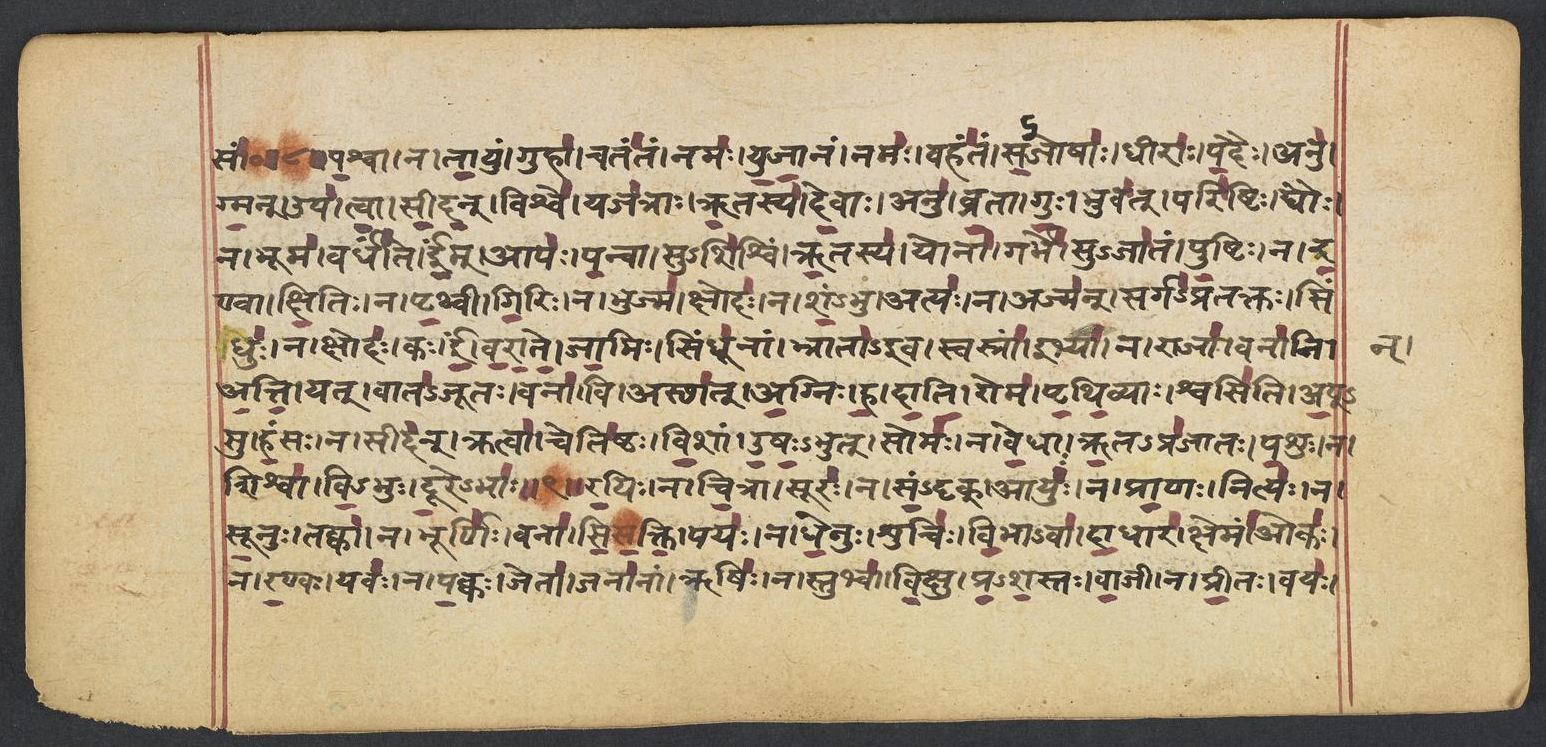
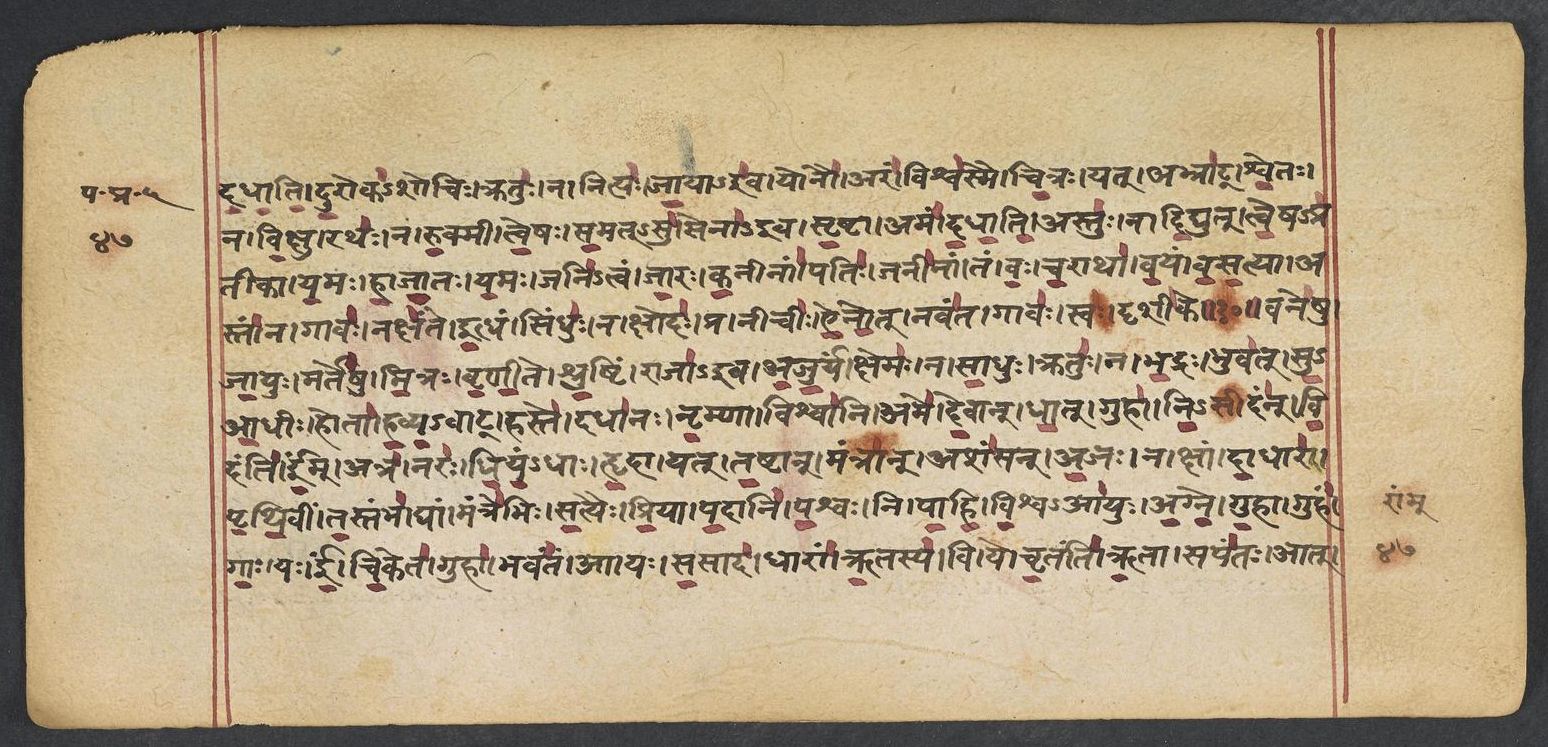
The manuscript shown is Penn Ms. Coll. 390 Item 41 (University of Pennsylvania), an undated paper manuscript of the padapāṭha (the word-by-word recitation text, in which every word is written separately and compounds are split) of the whole Ṛgveda in Devanāgarī, 884 leaves in fascicles, 7-9 lines to the page, accents in red; this hymn stands on fol. 47r-47v. Each section below gives the verses that end on one page; the page boundaries were read on the images (the opening words of every page), not counted out. Where the manuscript is a padapāṭha (the word-by-word recitation text), the section shows Aufrecht's continuous (saṃhitā) text first and, as the edition text, the padapāṭha of the same verses, which is the form written on the page.
How was this verified? (Provenance)
Where on the image
Penn Ms. Coll. 390 Item 41, fol. 47r (OPenn image 48, lower leaf). Checked on the image: the Rigveda text on this page begins in RV 1.64.15 ‹-jagamyāt›. The next page with Rigveda text, fol. 47v, begins in RV 1.66.4 ‹dadhāti›. Verses 1.66.1-3 end on this page.
1ra̱yir na ci̱trā sūro̱ na sa̱ṁdṛg āyu̱r na prā̱ṇo nityo̱ na sū̱nuḥ ||
2takvā̱ na bhūrṇi̱r vanā̍ siṣakti̱ payo̱ na dhe̱nuḥ śuci̍r vi̱bhāvā̍ ||
3dā̱dhāra̱ kṣema̱m oko̱ na ra̱ṇvo yavo̱ na pa̱kvo jetā̱ janā̍nām ||
Compare: Padapāṭha (word-by-word text written in the manuscript; Sansknet e-text via GRETIL)
1rayiḥ | na | citrā | sūraḥ | na | sam-dṛk | āyuḥ | na | prāṇaḥ | nityaḥ | na | sūnuḥ
2takvā | na | bhūrṇiḥ | vanā | saisakti | payaḥ | na | dhenuḥ | śuciḥ | vibhāvā
3dādhāra | kṣemam | okaḥ | na | raṇvaḥ | yavaḥ | na | pakvaḥ | jetā | janānām
1LIKE the Sun's glance, like wealth of varied sort, like breath which is the life, like one's own son,
2Like a swift bird, a cow who yields her milk, pure and refulgent to the wood he speeds.
3He offers safety like a pleasant home, like ripened corn, the Conqueror of men.
Where on the image
Penn Ms. Coll. 390 Item 41, fol. 47v (OPenn image 49, upper leaf). Checked on the image: the Rigveda text on this page begins in RV 1.66.4 ‹dadhāti›. The next page with Rigveda text, fol. 48r, begins in RV 1.67.8 ‹it vasūni pra vavāca›. Verses 1.66.4-10 end on this page; 1.66.4 begins on fol. 47r.
4ṛṣi̱r na stubhvā̍ vi̱kṣu pra̍śa̱sto vā̱jī na prī̱to vayo̍ dadhāti ||
5du̱roka̍śoci̱ḥ kratu̱r na nityo̍ jā̱yeva̱ yonā̱v ara̱ṁ viśva̍smai ||
6ci̱tro yad abhrā̍ṭ chve̱to na vi̱kṣu ratho̱ na ru̱kmī tve̱ṣaḥ sa̱matsu̍ ||
7sene̍va sṛ̱ṣṭāma̍ṁ dadhā̱ty astu̱r na di̱dyut tve̱ṣapra̍tīkā ||
8ya̱mo ha̍ jā̱to ya̱mo jani̍tvaṁ jā̱raḥ ka̱nīnā̱m pati̱r janī̍nām ||
9taṁ va̍ś ca̱rāthā̍ va̱yaṁ va̍sa̱tyāsta̱ṁ na gāvo̱ nakṣa̍nta i̱ddham ||
10sindhu̱r na kṣoda̱ḥ pra nīcī̍r aino̱n nava̍nta̱ gāva̱ḥ sva1̱̍r dṛśī̍ke ||
Compare: Padapāṭha (word-by-word text written in the manuscript; Sansknet e-text via GRETIL)
4ṛṣiḥ | na | stubhvā | vikṣu | pra-śastaḥ | vājī | na | prītaḥ | vayaḥ | dadhāti
5duroka-śociḥ | kratuḥ | na | nityaḥ | jāyāiva | yonau | aram | viśvasmai
6citraḥ | yat | abhrāṭ | śvetaḥ | na | vikṣu | rathaḥ | na | rukmī | tveṣaḥ | samat-su
7senāiva | sṛṣṭā | amam | dadhāti | astuḥ | na | didyut | tveṣa-pratīkā
8yamaḥ | ha | jātaḥ | yamaḥ | jani-tvam | jāraḥ | kanīnām | patiḥ | janīnām
9tam | vaḥ | carāthā | vayam | vasatyā astam | na | gāvaḥ | nakṣante | iddham
10sindhuḥ | na | kṣodaḥ | pra | nīcīḥ | ainot | navante | gāvaḥ | svaḥ | dṛśīke
4Like a Seer lauding, famed among the folk; like a steed friendly he vouchsafes us power.
5With flame insatiate, like eternal might; caring for each one like a dame at home;
6Bright when he shines forth, whitish mid the folk, like a car, gold-decked, thundering to the fight.
7He strikes with terror like a dart shot forth, e'en like an archer's arrow tipped with flame;
8Master of present and of future life, the maidens' lover and the matrons' Lord.
9To him lead all your ways: may we attain the kindled God as cows their home at eve.
10He drives the flames below as floods their swell: the rays rise up to the fair place of heaven.
Notes
- Sanskrit: Aufrecht's edition (1877) with the Vedic accents, as entered by van Nooten and Holland (GRETIL).
- English: Ralph T. H. Griffith, The Hymns of the Rigveda (1889-1892; 2nd ed. 1896-1897), from the VedaWeb digital text; OCR slips in that text were corrected against the printed 2nd edition (data/sources/rigveda/griffith_errata.json).
- Padapāṭha (edition text): Sansknet e-text via GRETIL (CC BY-NC-SA 4.0).
Cite
Sources
- Source: Penn Ms. Coll. 390 Item 41 (undated (catalogued with Penn's 18th-19th c. Vedic manuscripts)), OPenn, Public Domain Mark + Aufrecht's accented text (GRETIL) + Griffith's English (VedaWeb) (holding institution)
- Critical edition: Aufrecht (1877), accented e-text via GRETIL
← previous · → next · v cycle view · l back to library