Rigveda 1.67: To Agni
Introduction
Rigveda 1.67 is a hymn of 10 verses addressed to Agni. It stands in book (maṇḍala) 1, a collection of hymns by many families of poets. The Rigveda is the oldest collection of Sanskrit hymns, composed in the second half of the second millennium BCE and handed down orally for many centuries before it was written down.
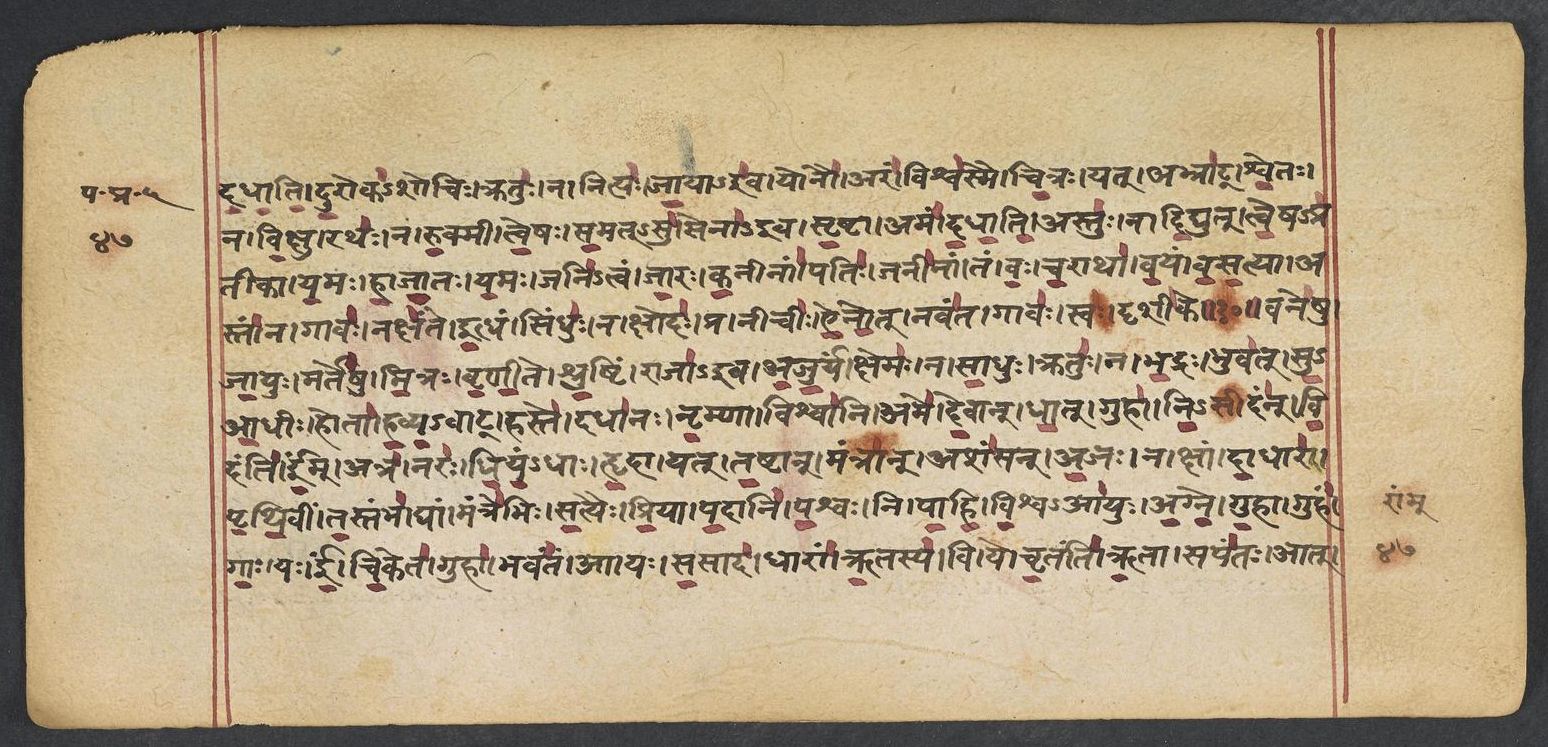
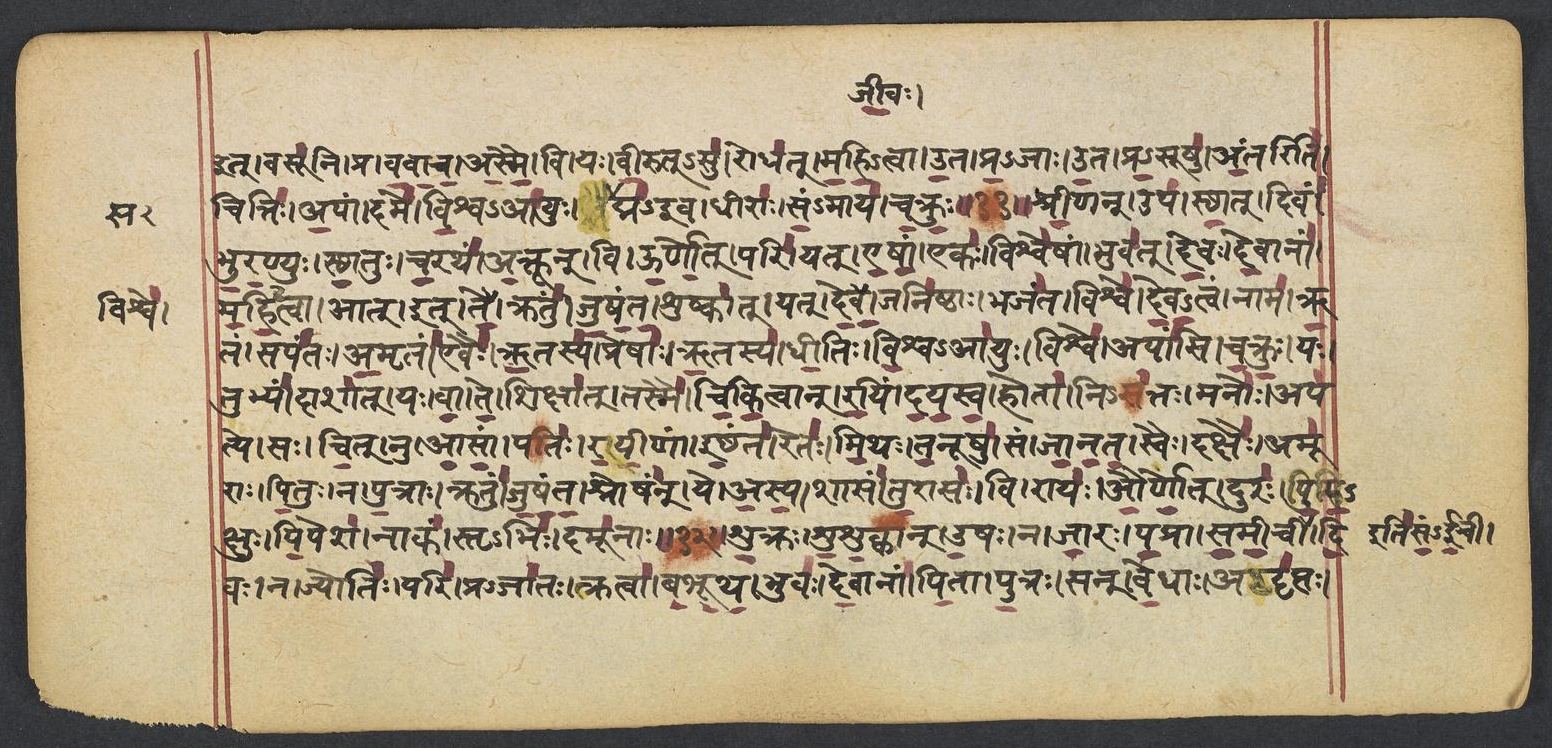
The manuscript shown is Penn Ms. Coll. 390 Item 41 (University of Pennsylvania), an undated paper manuscript of the padapāṭha (the word-by-word recitation text, in which every word is written separately and compounds are split) of the whole Ṛgveda in Devanāgarī, 884 leaves in fascicles, 7-9 lines to the page, accents in red; this hymn stands on fol. 47v-48r. Each section below gives the verses that end on one page; the page boundaries were read on the images (the opening words of every page), not counted out. Where the manuscript is a padapāṭha (the word-by-word recitation text), the section shows Aufrecht's continuous (saṃhitā) text first and, as the edition text, the padapāṭha of the same verses, which is the form written on the page.
How was this verified? (Provenance)
Where on the image
Penn Ms. Coll. 390 Item 41, fol. 47v (OPenn image 49, upper leaf). Checked on the image: the Rigveda text on this page begins in RV 1.66.4 ‹dadhāti›. The next page with Rigveda text, fol. 48r, begins in RV 1.67.8 ‹it vasūni pra vavāca›. Verses 1.67.1-7 end on this page.
1vane̍ṣu jā̱yur marte̍ṣu mi̱tro vṛ̍ṇī̱te śru̱ṣṭiṁ rāje̍vāju̱ryam ||
2kṣemo̱ na sā̱dhuḥ kratu̱r na bha̱dro bhuva̍t svā̱dhīr hotā̍ havya̱vāṭ ||
3haste̱ dadhā̍no nṛ̱mṇā viśvā̱ny ame̍ de̱vān dhā̱d guhā̍ ni̱ṣīda̍n ||
4vi̱dantī̱m atra̱ naro̍ dhiya̱ṁdhā hṛ̱dā yat ta̱ṣṭān mantrā̱m̐ aśa̍ṁsan ||
5a̱jo na kṣāṁ dā̱dhāra̍ pṛthi̱vīṁ ta̱stambha̱ dyām mantre̍bhiḥ sa̱tyaiḥ ||
6pri̱yā pa̱dāni̍ pa̱śvo ni pā̍hi vi̱śvāyu̍r agne gu̱hā guha̍ṁ gāḥ ||
7ya ī̍ṁ ci̱keta̱ guhā̱ bhava̍nta̱m ā yaḥ sa̱sāda̱ dhārā̍m ṛ̱tasya̍ ||
Compare: Padapāṭha (word-by-word text written in the manuscript; Sansknet e-text via GRETIL)
1vaneṣu | jāyuḥ | marteṣu | mitraḥ | vṛṇīte | śruṣtim | rājāiva | ajuryam
2kṣemaḥ | na | sādhuḥ | kratuḥ | na | bhadraḥ | bhuvat | su-ādhīḥ | hotā | havya-vāṭ
3haste | dadhānaḥ | nṛmṇā | viśvāni | ame | devān | dhāt | guhā | ni-sīdan
4vidanti | īm | atra | naraḥ | dhiyam-dhāḥ | hṛdā | yat | taṣṭān | mantrān | aśaṃsan
5ajaḥ | na | kṣām | dādhāra | pṛthivīm | tastambha | dyām | mantrebhiḥ | satyaiḥ
6priyā | padāni | paśvaḥ | ni | pāhi | viśva-āyuḥ | agne | guhā | guham | gāḥ
7yaḥ | īm | ciketa | guhā | bhavantam | ā | yaḥ | sasāda | dhārām | ṛtasya
1VICTORIOUS in the wood, Friend among men, ever he claims obedience as a King.
2Gracious like peace, blessing like mental power, Priest was he, offering-bearer, full of thought.
3He, bearing in his hand all manly might, crouched in the cavern, struck the Gods with fear.
4Men filled with understanding find him there, when they have sting prayers formed within their heart.
5He, like the Unborn, holds the broad earth up; and with effective utterance fixed the sky.
6O Agni, guard the spots which cattle love: thou, life of all, hast gone from lair to lair.
7Whoso hath known him dwelling in his lair, and hath approached the stream of holy Law,–
Where on the image
Penn Ms. Coll. 390 Item 41, fol. 48r (OPenn image 49, lower leaf). Checked on the image: the Rigveda text on this page begins in RV 1.67.8 ‹it vasūni pra vavāca›. The next page with Rigveda text, fol. 48v, begins in RV 1.69.3 ‹agniḥ vi-janan ūdhaḥ na›. Verses 1.67.8-10 end on this page; 1.67.8 begins on fol. 47v.
8vi ye cṛ̱tanty ṛ̱tā sapa̍nta̱ ād id vasū̍ni̱ pra va̍vācāsmai ||
9vi yo vī̱rutsu̱ rodha̍n mahi̱tvota pra̱jā u̱ta pra̱sūṣv a̱ntaḥ ||
10citti̍r a̱pāṁ dame̍ vi̱śvāyu̱ḥ sadme̍va̱ dhīrā̍ḥ sa̱mmāya̍ cakruḥ ||
Compare: Padapāṭha (word-by-word text written in the manuscript; Sansknet e-text via GRETIL)
8vi | ye | cṛtanti | ṛtā | sapantaḥ | āt | it | vasūni | pra | vavāca | asmai
9vi | yaḥ | vīrut-su | rodhat | mahi-tvā | uta | pra-jāḥ | uta | pra-sūṣu | antarit i
10cittiḥ | apām | dame | viśva-āyuḥ | sadma-iva | dhīrāḥ | sam-māya | cakruḥ
8They who release him, paying sacred rites, -truly to such doth he announce great wealth.
9He who grows mightily in herbs, within each fruitful mother and each babe she bears,
10Wise, life of all men, in the waters' home,– for him have sages built as 'twere a seat.
Notes
- Sanskrit: Aufrecht's edition (1877) with the Vedic accents, as entered by van Nooten and Holland (GRETIL).
- English: Ralph T. H. Griffith, The Hymns of the Rigveda (1889-1892; 2nd ed. 1896-1897), from the VedaWeb digital text; OCR slips in that text were corrected against the printed 2nd edition (data/sources/rigveda/griffith_errata.json).
- Padapāṭha (edition text): Sansknet e-text via GRETIL (CC BY-NC-SA 4.0).
Cite
Sources
- Source: Penn Ms. Coll. 390 Item 41 (undated (catalogued with Penn's 18th-19th c. Vedic manuscripts)), OPenn, Public Domain Mark + Aufrecht's accented text (GRETIL) + Griffith's English (VedaWeb) (holding institution)
- Critical edition: Aufrecht (1877), accented e-text via GRETIL
← previous · → next · v cycle view · l back to library