Rigveda 1.68: To Agni
Introduction
Rigveda 1.68 is a hymn of 10 verses addressed to Agni. It stands in book (maṇḍala) 1, a collection of hymns by many families of poets. The Rigveda is the oldest collection of Sanskrit hymns, composed in the second half of the second millennium BCE and handed down orally for many centuries before it was written down.
The manuscript shown is Penn Ms. Coll. 390 Item 41 (University of Pennsylvania), an undated paper manuscript of the padapāṭha (the word-by-word recitation text, in which every word is written separately and compounds are split) of the whole Ṛgveda in Devanāgarī, 884 leaves in fascicles, 7-9 lines to the page, accents in red; this hymn stands on fol. 48r. Each section below gives the verses that end on one page; the page boundaries were read on the images (the opening words of every page), not counted out. Where the manuscript is a padapāṭha (the word-by-word recitation text), the section shows Aufrecht's continuous (saṃhitā) text first and, as the edition text, the padapāṭha of the same verses, which is the form written on the page.
How was this verified? (Provenance)
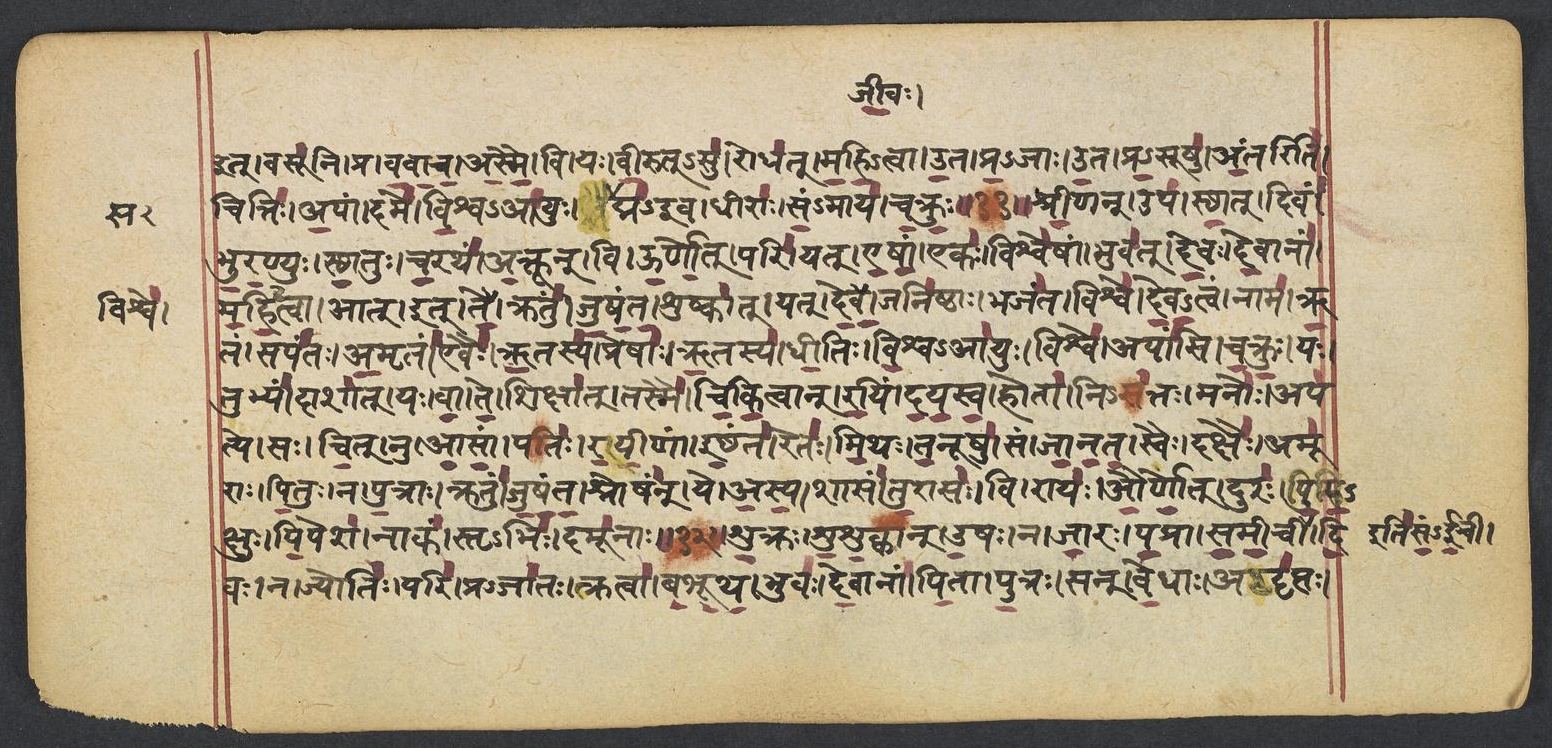
Where on the image
Penn Ms. Coll. 390 Item 41, fol. 48r (OPenn image 49, lower leaf). Checked on the image: the Rigveda text on this page begins in RV 1.67.8 ‹it vasūni pra vavāca›. The next page with Rigveda text, fol. 48v, begins in RV 1.69.3 ‹agniḥ vi-janan ūdhaḥ na›. Verses 1.68.1-10 end on this page.
1śrī̱ṇann upa̍ sthā̱d diva̍m bhura̱ṇyuḥ sthā̱tuś ca̱ratha̍m a̱ktūn vy ū̍rṇot ||
2pari̱ yad e̍ṣā̱m eko̱ viśve̍ṣā̱m bhuva̍d de̱vo de̱vānā̍m mahi̱tvā ||
3ād it te̱ viśve̱ kratu̍ṁ juṣanta̱ śuṣkā̱d yad de̍va jī̱vo jani̍ṣṭhāḥ ||
4bhaja̍nta̱ viśve̍ deva̱tvaṁ nāma̍ ṛ̱taṁ sapa̍nto a̱mṛta̱m evai̍ḥ ||
5ṛ̱tasya̱ preṣā̍ ṛ̱tasya̍ dhī̱tir vi̱śvāyu̱r viśve̱ apā̍ṁsi cakruḥ ||
6yas tubhya̱ṁ dāśā̱d yo vā̍ te̱ śikṣā̱t tasmai̍ ciki̱tvān ra̱yiṁ da̍yasva ||
7hotā̱ niṣa̍tto̱ mano̱r apa̍tye̱ sa ci̱n nv ā̍sā̱m patī̍ rayī̱ṇām ||
8i̱cchanta̱ reto̍ mi̱thas ta̱nūṣu̱ saṁ jā̍nata̱ svair dakṣai̱r amū̍rāḥ ||
9pi̱tur na pu̱trāḥ kratu̍ṁ juṣanta̱ śroṣa̱n ye a̍sya̱ śāsa̍ṁ tu̱rāsa̍ḥ ||
10vi rāya̍ aurṇo̱d dura̍ḥ puru̱kṣuḥ pi̱peśa̱ nāka̱ṁ stṛbhi̱r damū̍nāḥ ||
Compare: Padapāṭha (word-by-word text written in the manuscript; Sansknet e-text via GRETIL)
1śrīṇan | upa | sthāt | divam | bhuraṇyuḥ | sthātuḥ | caratham | aktūn | vi | ūrṇot
2pari | yat | eṣām | ekaḥ | viśveṣām | bhuvat | devaḥ | devānām | mahi-tvā
3āt | it | te | viśve | kratum | juṣanta | śuṣkāt | yat | deva | jīvaḥ | janiṣṭhāḥ
4bhajanta | viśve | deva-tvam | nāma | ṛtam | sapantaḥ | amṛtam | evaiḥ
5ṛtasya | preṣāḥ | ṛtasya | dhītiḥ | viśva-āyuḥ | viśve | apāṃsi | cakruḥ
6yaḥ | tubhyam | dāśāt | yaḥ | vā | te | śikṣāt | tasmai | cikitvān | rayim | dayasva
7hotā | ni-sattaḥ | manoḥ | apatye | saḥ | cit | nu | āsām | patiḥ | rayīṇām
8icchanta | retaḥ | mithaḥ | tanūṣu | sam | jānata | svaiḥ | dakṣaiḥ | amūrāḥ
9pituḥ | na | putrāḥ | kratum | juṣanta | śroṣan | ye | asya | śāsam | turāsaḥ
10vi | rāyaḥ | aurṇot | duraḥ | puru-kṣuḥ | pipeśa | nākam | stṛ-bhiḥ | damūnāḥ
1COMMINGLING, restless, he ascends the sky, unveiling nights and all that stands or moves,
2As he the sole God is preeminent in greatness among all these other Gods.
3All men are joyful in thy power, O God, that living from the dry wood thou art born.
4All truly share thy Godhead while they keep, in their accustomed ways, eternal Law.
5Strong is the thought of Law, the Law's behest; all works have they performed; he quickens all.
6Whoso will bring oblation, gifts to thee, to him, bethinking thee, vouchsafe thou wealth.
7Seated as Priest with Manu's progeny, of all these treasures he alone is Lord.
8Men yearn for children to prolong their line, and are not disappointed in their hope.
9Eagerly they who hear his word fulfil his wish as sons obey their sire's behest.
10He, rich in food, unbars his wealth like doors: he, the House-Friend, bath decked heaven's vault with stars.
Notes
- Sanskrit: Aufrecht's edition (1877) with the Vedic accents, as entered by van Nooten and Holland (GRETIL).
- English: Ralph T. H. Griffith, The Hymns of the Rigveda (1889-1892; 2nd ed. 1896-1897), from the VedaWeb digital text; OCR slips in that text were corrected against the printed 2nd edition (data/sources/rigveda/griffith_errata.json).
- Padapāṭha (edition text): Sansknet e-text via GRETIL (CC BY-NC-SA 4.0).
Cite
Sources
- Source: Penn Ms. Coll. 390 Item 41 (undated (catalogued with Penn's 18th-19th c. Vedic manuscripts)), OPenn, Public Domain Mark + Aufrecht's accented text (GRETIL) + Griffith's English (VedaWeb) (holding institution)
- Critical edition: Aufrecht (1877), accented e-text via GRETIL
← previous · → next · v cycle view · l back to library