Rigveda 10.13: To the two sacrificial carts
Introduction
Rigveda 10.13 is a hymn of 5 verses addressed to the two sacrificial carts. It stands in book (maṇḍala) 10, the last and latest book. The Rigveda is the oldest collection of Sanskrit hymns, composed in the second half of the second millennium BCE and handed down orally for many centuries before it was written down.
The manuscript shown is Penn Ms. Coll. 390 Item 41 (University of Pennsylvania), an undated paper manuscript of the padapāṭha (the word-by-word recitation text, in which every word is written separately and compounds are split) of the whole Ṛgveda in Devanāgarī, 884 leaves in fascicles, 7-9 lines to the page, accents in red; this hymn stands on fol. 751v-752r. Each section below gives the verses that end on one page; the page boundaries were read on the images (the opening words of every page), not counted out. Where the manuscript is a padapāṭha (the word-by-word recitation text), the section shows Aufrecht's continuous (saṃhitā) text first and, as the edition text, the padapāṭha of the same verses, which is the form written on the page.
How was this verified? (Provenance)
Where on the image
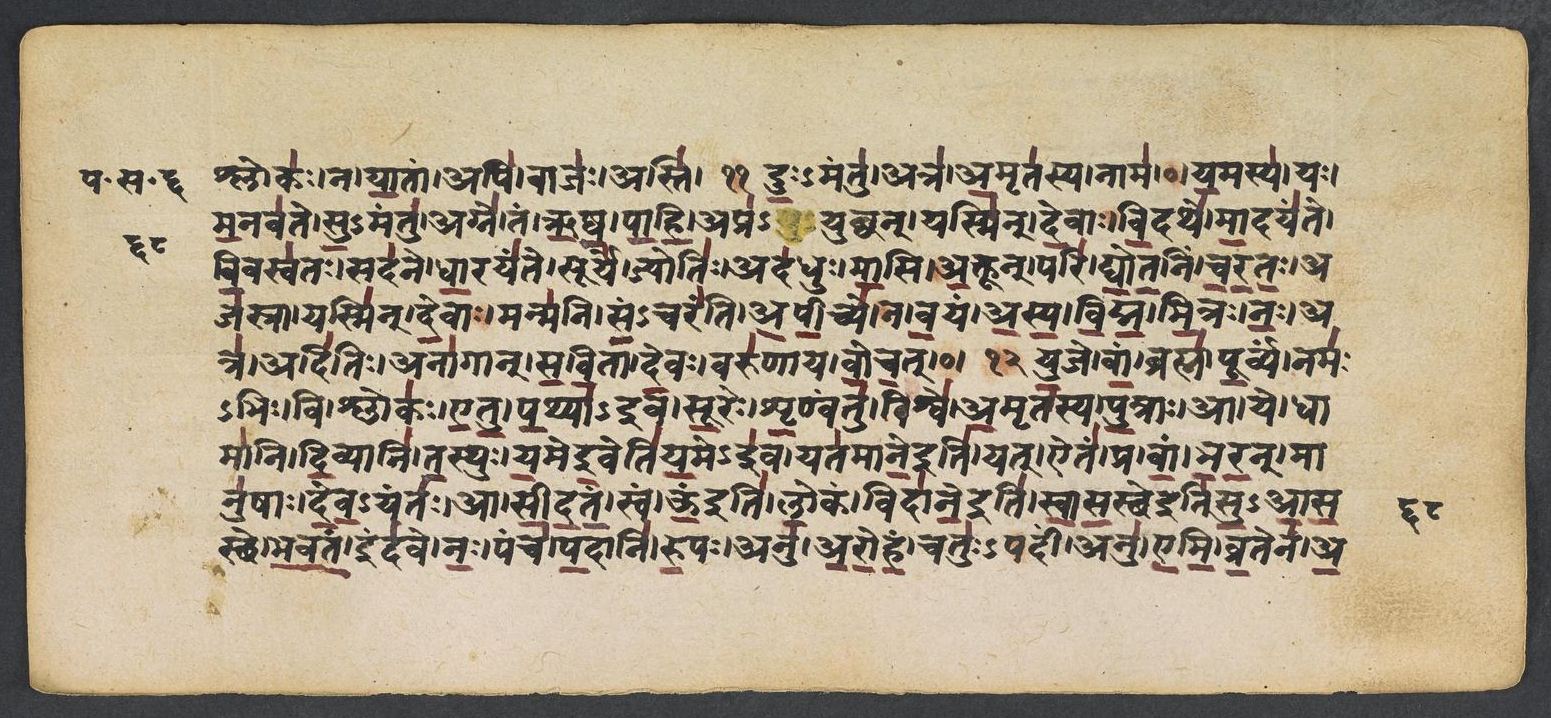
Penn Ms. Coll. 390 Item 41, fol. 751v (numbered 68v by the scribe) (OPenn image 752, upper leaf). Checked on the image: the Rigveda text on this page begins in RV 10.12.5 ‹ślokaḥ na yātām api›. The next page with Rigveda text, fol. 752r (numbered 69r by the scribe), begins in RV 10.13.3 ‹-akṣareṇa prati mime etām›. Verses 10.13.1-2 end on this page.
1yu̱je vā̱m brahma̍ pū̱rvyaṁ namo̍bhi̱r vi śloka̍ etu pa̱thye̍va sū̱reḥ | śṛ̱ṇvantu̱ viśve̍ a̱mṛta̍sya pu̱trā ā ye dhāmā̍ni di̱vyāni̍ ta̱sthuḥ ||
2ya̱me i̍va̱ yata̍māne̱ yad aita̱m pra vā̍m bhara̱n mānu̍ṣā deva̱yanta̍ḥ | ā sī̍data̱ṁ svam u̍ lo̱kaṁ vidā̍ne svāsa̱sthe bha̍vata̱m inda̍ve naḥ ||
Compare: Padapāṭha (word-by-word text written in the manuscript; Sansknet e-text via GRETIL)
1yuje | vām | brahma | pūrvyam | namaḥ-bhiḥ | vi | ślokaḥ | etu | pathyāiva | sūreḥ | śṛṇvantu | viśve | amṛtasya | putrāḥ | ā | ye | dhāmāni | divyāni | tasthuḥ
2yame ivetiyame--iva | yatamāneiti | yat | aitam | pra | vām | bharan | mānuṣāḥ | deva-yantaḥ | ā | sīdatam | svam | oṃ iti | lokam | vidāneiti | svāsasthe itisu-āsasthe | bhavatam | indave | naḥ
1I YOKE with prayer your ancient inspiration: may the laud rise as on the prince's pathway. All Sons of Immortality shall hear it, all the possessors of celestial natures.
2When speeding ye came nigh us like twin sisters, religious-hearted votaries brought you forward. Take your place, ye who know your proper station: be near, be very near unto our Soma.
Where on the image
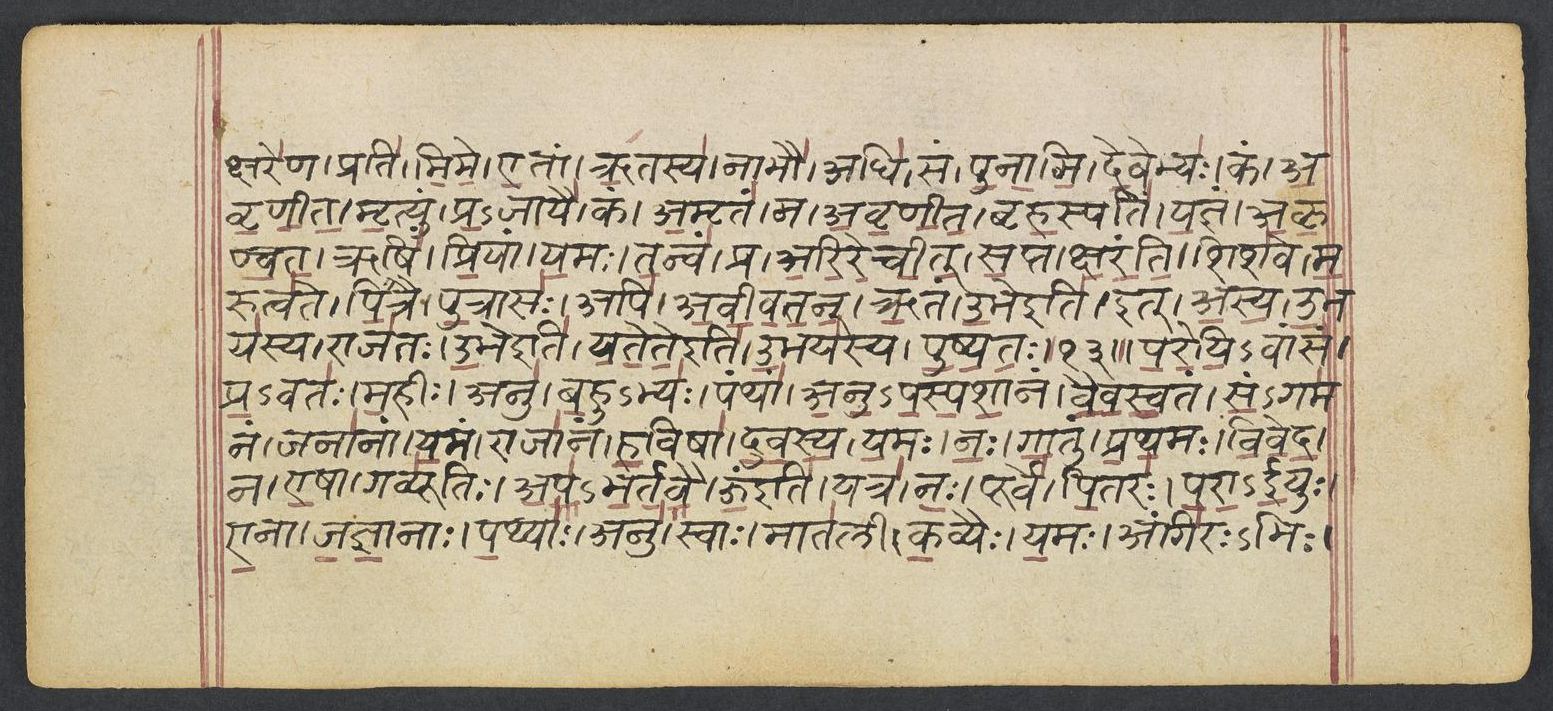
Penn Ms. Coll. 390 Item 41, fol. 752r (numbered 69r by the scribe) (OPenn image 752, lower leaf). Checked on the image: the Rigveda text on this page begins in RV 10.13.3 ‹-akṣareṇa prati mime etām›. The next page with Rigveda text, fol. 752v (numbered 69v by the scribe), begins in RV 10.14.3 ‹bṛhaspatiḥ ṛkva-bhiḥ vavṛdhānaḥ yān›. Verses 10.13.3-5 end on this page; 10.13.3 begins on fol. 751v (numbered 68v by the scribe).
3pañca̍ pa̱dāni̍ ru̱po anv a̍roha̱ṁ catu̍ṣpadī̱m anv e̍mi vra̱tena̍ | a̱kṣare̍ṇa̱ prati̍ mima e̱tām ṛ̱tasya̱ nābhā̱v adhi̱ sam pu̍nāmi ||
4de̱vebhya̱ḥ kam a̍vṛṇīta mṛ̱tyum pra̱jāyai̱ kam a̱mṛta̱ṁ nāvṛ̍ṇīta | bṛha̱spati̍ṁ ya̱jñam a̍kṛṇvata̱ ṛṣi̍m pri̱yāṁ ya̱mas ta̱nva1̱̍m prāri̍recīt ||
5sa̱pta kṣa̍ranti̱ śiśa̍ve ma̱rutva̍te pi̱tre pu̱trāso̱ apy a̍vīvatann ṛ̱tam | u̱bhe id a̍syo̱bhaya̍sya rājata u̱bhe ya̍tete u̱bhaya̍sya puṣyataḥ ||
Compare: Padapāṭha (word-by-word text written in the manuscript; Sansknet e-text via GRETIL)
3pañca | padāni | rupaḥ | anu | aroham | catuḥ-padīm | anu | emi | vratena | akṣareṇa | prati | mime | etām | ṛtasya | nābhau | adhi | sam | punāmi
4devebhyaḥ | kam | avṛṇīta | mṛtyum | pra-jāyai | kam | amṛtam | na | avṛṇīta | bṛhaspatim | yajñam | akṛṇvata | ṛṣim | priyām | yamaḥ | tanvam | pra | arirecīt
5sapta | kṣaranti | śiśave | marutvate | pitre | putrāsaḥ | api | avīvatan | ṛtam | ubhe iti | it | asya | ubhayasya | rājataḥ | ubhe iti | yateteiti | ubhayasya | puṣyataḥ
3Five paces have I risen from Earth. I follow her who hath four feet with devout observance. This by the Sacred Syllable have I measured: I purify in the central place of Order,
4He, for God's sake, chose death to be his portion. He chose not, for men's good, a life eternal They sacrificed Br̥ihaspati the R̥ishi. Yama delivered up his own dear body.
5The Seven flow to the Youth on whom the Maruts wait: the Sons unto the Father brought the sacrifice. Both these are his, as his they are the Lords of both: both toil; belonging unto both they prosper well.
Notes
- Sanskrit: Aufrecht's edition (1877) with the Vedic accents, as entered by van Nooten and Holland (GRETIL).
- English: Ralph T. H. Griffith, The Hymns of the Rigveda (1889-1892; 2nd ed. 1896-1897), from the VedaWeb digital text; OCR slips in that text were corrected against the printed 2nd edition (data/sources/rigveda/griffith_errata.json).
- Padapāṭha (edition text): Sansknet e-text via GRETIL (CC BY-NC-SA 4.0).
Cite
Sources
- Source: Penn Ms. Coll. 390 Item 41 (undated (catalogued with Penn's 18th-19th c. Vedic manuscripts)), OPenn, Public Domain Mark + Aufrecht's accented text (GRETIL) + Griffith's English (VedaWeb) (holding institution)
- Critical edition: Aufrecht (1877), accented e-text via GRETIL
← previous · → next · v cycle view · l back to library