Rigveda 10.130: Creation of the sacrifice
Introduction
Rigveda 10.130 is a hymn of 7 verses addressed to creation of the sacrifice. It stands in book (maṇḍala) 10, the last and latest book. The Rigveda is the oldest collection of Sanskrit hymns, composed in the second half of the second millennium BCE and handed down orally for many centuries before it was written down.
The manuscript shown is Penn Ms. Coll. 390 Item 48 (University of Pennsylvania), a paper manuscript of the eighth aṣṭaka (RV 10.46-10.191) of the Ṛgveda Saṃhitā in Devanāgarī, 158 leaves, 6 lines to the page, with the accents marked in red; the scribe's colophon on fol. 158 gives Saṃvat 1768 (1711 CE); this hymn stands on fol. 119v-120r. Each section below gives the verses that end on one page; the page boundaries were read on the images (the opening words of every page), not counted out. Like most Rigveda manuscripts, Penn Ms. Coll. 390 Item 48 writes a repeated refrain in short form after its first occurrence (for example kasmai° for kasmai devāya haviṣā vidhema); the Sanskrit shown is the full text of Aufrecht's edition.
How was this verified? (Provenance)
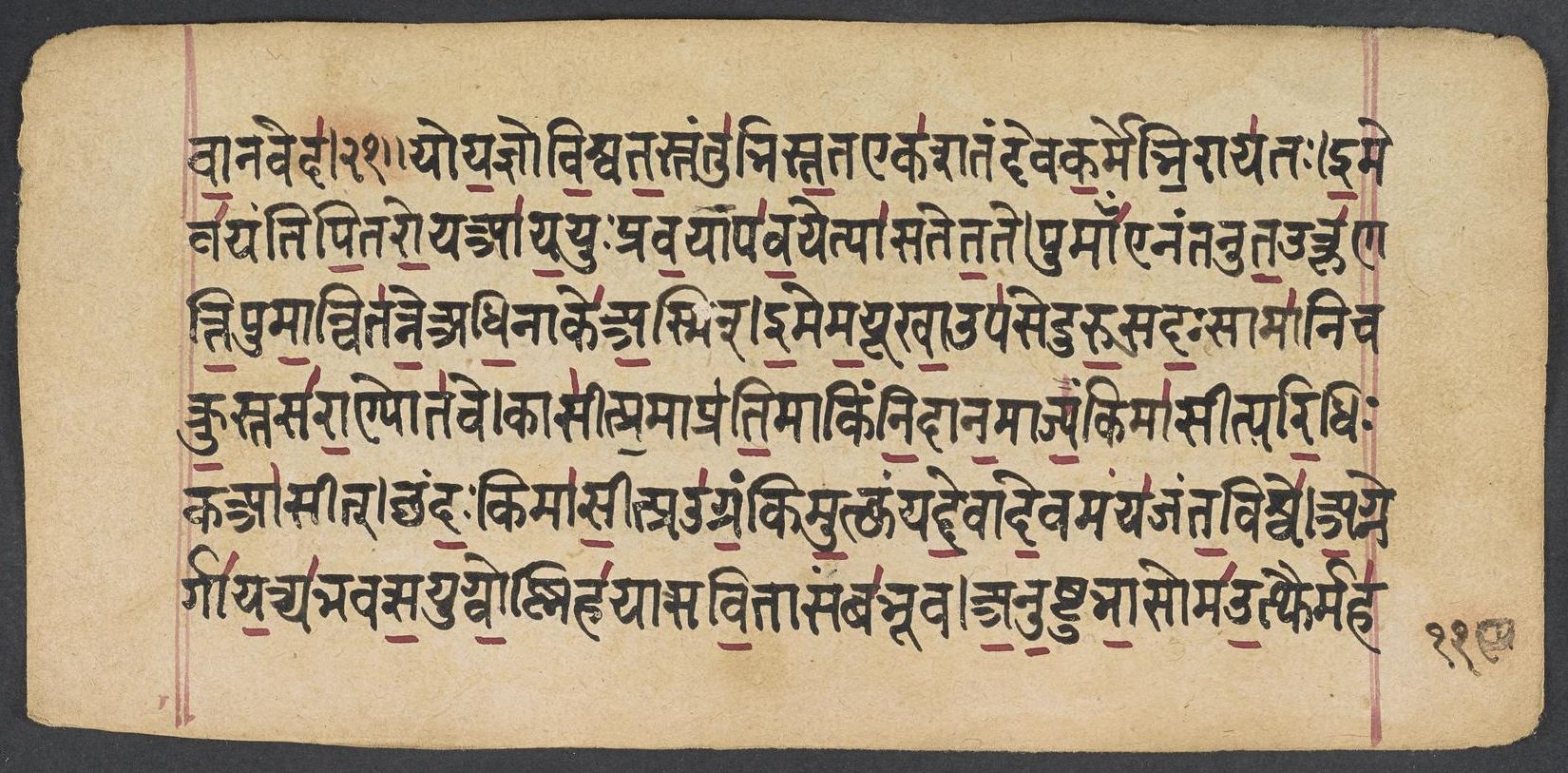
Where on the image
Penn Ms. Coll. 390 Item 48, fol. 119v (OPenn image 119, upper leaf). Checked on the image: the Rigveda text on this page begins in RV 10.129.7 ‹vā na veda›. The next page with Rigveda text, fol. 120r, begins in RV 10.130.4 ‹-mahasvān bṛhaspater bṛhatī vācam›. Verses 10.130.1-3 end on this page.
1yo ya̱jño vi̱śvata̱s tantu̍bhis ta̱ta eka̍śataṁ devaka̱rmebhi̱r āya̍taḥ | i̱me va̍yanti pi̱taro̱ ya ā̍ya̱yuḥ pra va̱yāpa̍ va̱yety ā̍sate ta̱te ||
2pumā̍m̐ enaṁ tanuta̱ ut kṛ̍ṇatti̱ pumā̱n vi ta̍tne̱ adhi̱ nāke̍ a̱smin | i̱me ma̱yūkhā̱ upa̍ sedur ū̱ sada̱ḥ sāmā̍ni cakru̱s tasa̍rā̱ṇy ota̍ve ||
3kāsī̍t pra̱mā pra̍ti̱mā kiṁ ni̱dāna̱m ājya̱ṁ kim ā̍sīt pari̱dhiḥ ka ā̍sīt | chanda̱ḥ kim ā̍sī̱t praü̍ga̱ṁ kim u̱kthaṁ yad de̱vā de̱vam aya̍janta̱ viśve̍ ||
1THE sacrifice drawn out with threads on every side, stretched by a hundred sacred ministers and one,– This do these Fathers weave who hitherward are come: they sit beside the warp and cry, Weave forth, weave back.
2The Man extends it and the Man unbinds it: even to this vault of heaven hath he outspun, it. These pegs are fastened to the seat of worship: they made the Sâma-hymns their weaving shuttles.
3What were the rule, the order and the model? What were the wooden fender and the butter? What were the hymn, the chant, the recitation, when to the God all Deities paid worship?
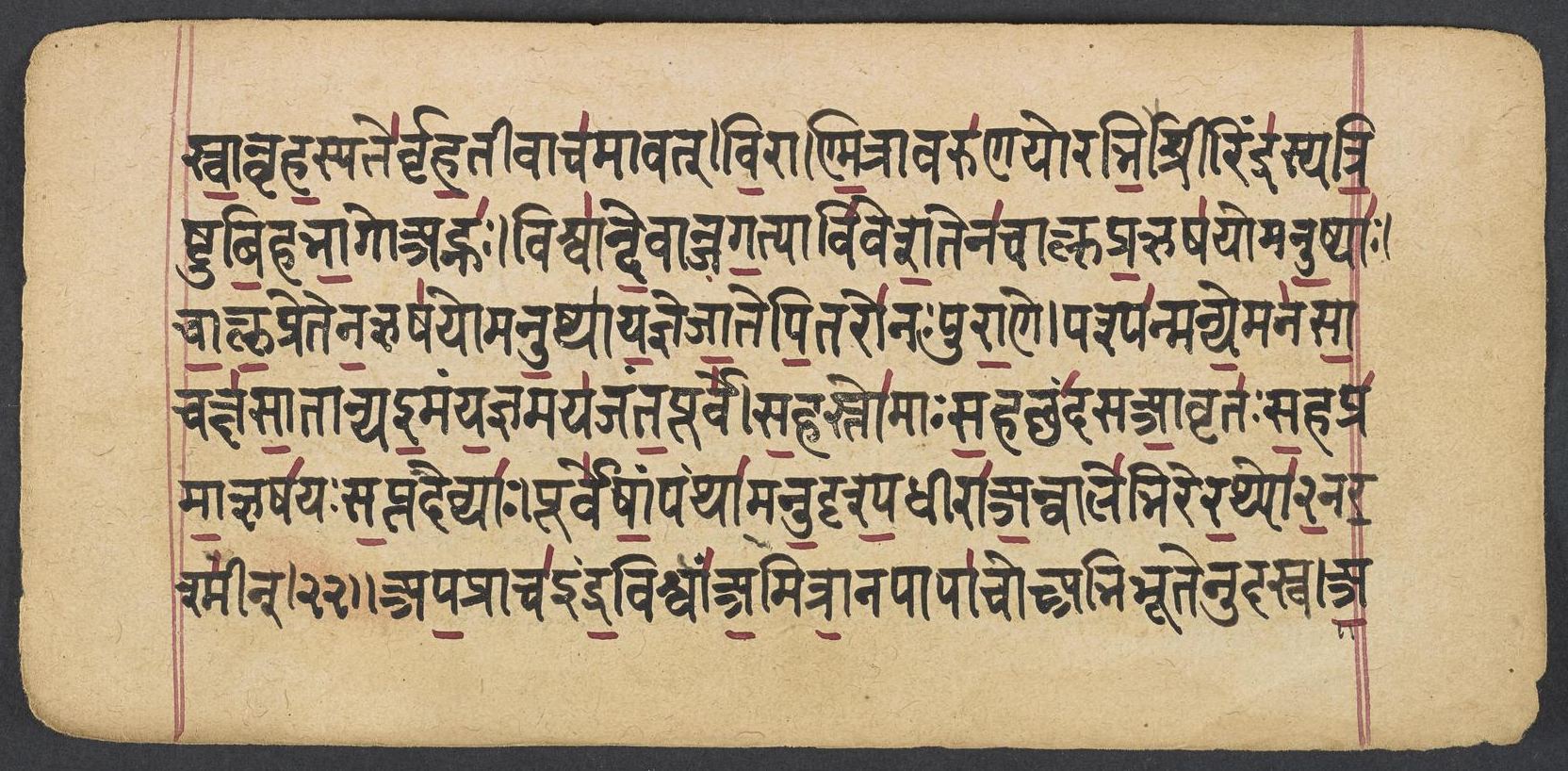
Where on the image
Penn Ms. Coll. 390 Item 48, fol. 120r (OPenn image 119, lower leaf). Checked on the image: the Rigveda text on this page begins in RV 10.130.4 ‹-mahasvān bṛhaspater bṛhatī vācam›. The next page with Rigveda text, fol. 120v, begins in RV 10.131.1 ‹-apodīco apa śūrādharāca urau›. Verses 10.130.4-7 end on this page; 10.130.4 begins on fol. 119v.
4a̱gner gā̍ya̱try a̍bhavat sa̱yugvo̱ṣṇiha̍yā savi̱tā sam ba̍bhūva | a̱nu̱ṣṭubhā̱ soma̍ u̱kthair maha̍svā̱n bṛha̱spate̍r bṛha̱tī vāca̍m āvat ||
5vi̱rāṇ mi̱trāvaru̍ṇayor abhi̱śrīr indra̍sya tri̱ṣṭub i̱ha bhā̱go ahna̍ḥ | viśvā̍n de̱vāñ jaga̱ty ā vi̍veśa̱ tena̍ cākḷpra̱ ṛṣa̍yo manu̱ṣyā̍ḥ ||
6cā̱kḷ̱pre tena̱ ṛṣa̍yo manu̱ṣyā̍ ya̱jñe jā̱te pi̱taro̍ naḥ purā̱ṇe | paśya̍n manye̱ mana̍sā̱ cakṣa̍sā̱ tān ya i̱maṁ ya̱jñam aya̍janta̱ pūrve̍ ||
7sa̱hasto̍māḥ sa̱hacha̍ndasa ā̱vṛta̍ḥ sa̱hapra̍mā̱ ṛṣa̍yaḥ sa̱pta daivyā̍ḥ | pūrve̍ṣā̱m panthā̍m anu̱dṛśya̱ dhīrā̍ a̱nvāle̍bhire ra̱thyo̱3̱̍ na ra̱śmīn ||
4Closely was Gâyatrî conjoined with Agni, and closely Savitar combined with Ushṇih. Brilliant with Ukthas, Soma joined Anushṭup: Br̥ihaspati's voice by Br̥ihatî was aided.
5Virâj adhered to Varuṇa and Mitra: here Trishṭup day by day was Indra's portion. Jagatî entered all the Gods together: so by this knowledge men were raised to R̥ishis.
6So by this knowledge men were raised to R̥ishis, when ancient sacrifice sprang up, our Fathers. With the mind's eye I think that I behold them who first performed this sacrificial worship.
7They who were versed in ritual and metre, in hymns and rules, were the Seven Godlike R̥ishis. Viewing the path of those of old, the sages have taken up the reins like chariot-drivers.
Notes
- Sanskrit: Aufrecht's edition (1877) with the Vedic accents, as entered by van Nooten and Holland (GRETIL).
- English: Ralph T. H. Griffith, The Hymns of the Rigveda (1889-1892; 2nd ed. 1896-1897), from the VedaWeb digital text; OCR slips in that text were corrected against the printed 2nd edition (data/sources/rigveda/griffith_errata.json).
Cite
Sources
- Source: Penn Ms. Coll. 390 Item 48 (1711 CE (colophon: Saṃvat 1768)), OPenn, Public Domain Mark + Aufrecht's accented text (GRETIL) + Griffith's English (VedaWeb) (holding institution)
- Critical edition: Aufrecht (1877), accented e-text via GRETIL
← previous · → next · v cycle view · l back to library