Rigveda 10.144: To Indra
Introduction
Rigveda 10.144 is a hymn of 6 verses addressed to Indra. It stands in book (maṇḍala) 10, the last and latest book. The Rigveda is the oldest collection of Sanskrit hymns, composed in the second half of the second millennium BCE and handed down orally for many centuries before it was written down.
The manuscript shown is Penn Ms. Coll. 390 Item 48 (University of Pennsylvania), a paper manuscript of the eighth aṣṭaka (RV 10.46-10.191) of the Ṛgveda Saṃhitā in Devanāgarī, 158 leaves, 6 lines to the page, with the accents marked in red; the scribe's colophon on fol. 158 gives Saṃvat 1768 (1711 CE); this hymn stands on fol. 130v-131r. Each section below gives the verses that end on one page; the page boundaries were read on the images (the opening words of every page), not counted out. Like most Rigveda manuscripts, Penn Ms. Coll. 390 Item 48 writes a repeated refrain in short form after its first occurrence (for example kasmai° for kasmai devāya haviṣā vidhema); the Sanskrit shown is the full text of Aufrecht's edition.
How was this verified? (Provenance)
Where on the image
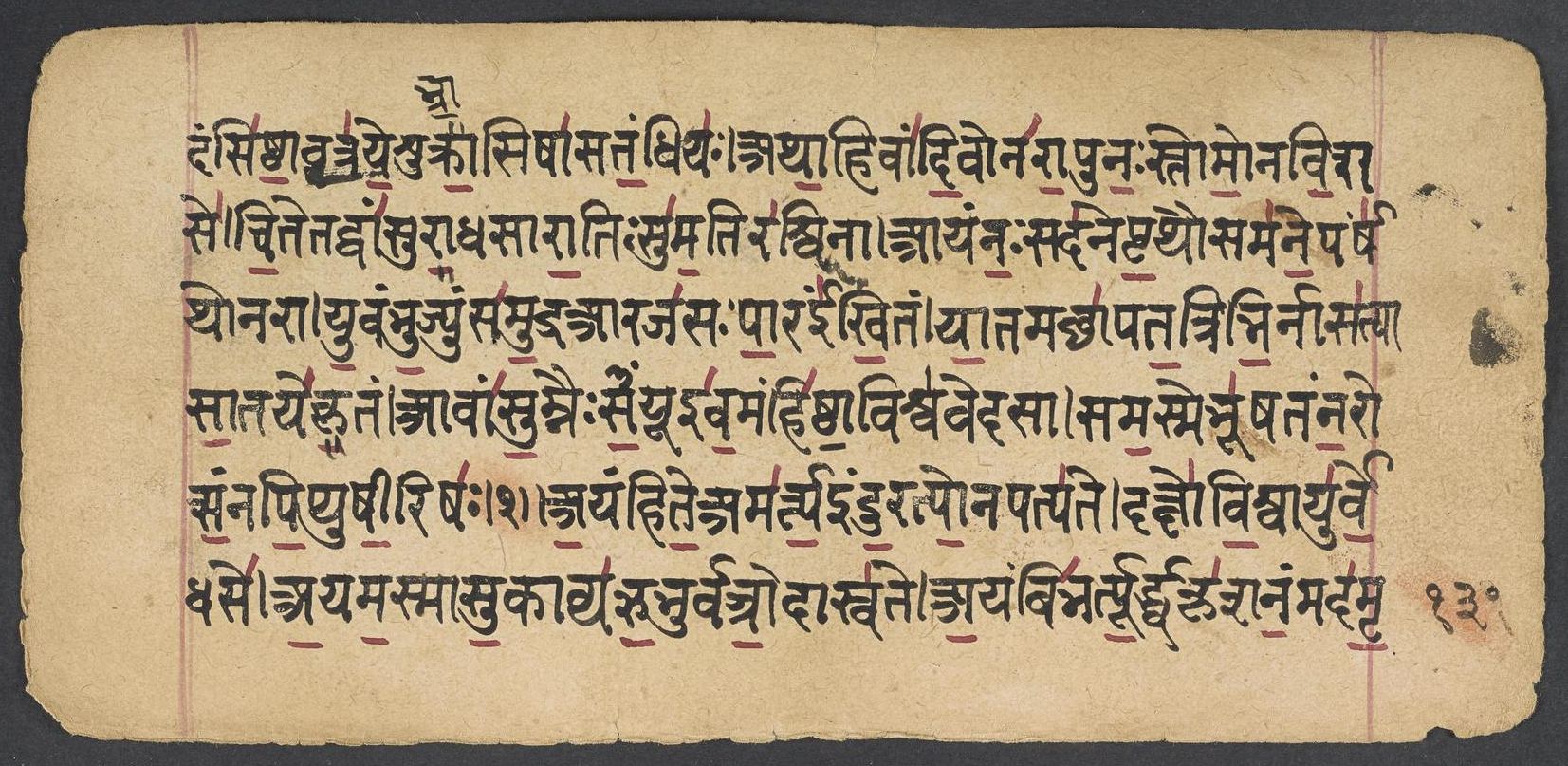
Penn Ms. Coll. 390 Item 48, fol. 130v (OPenn image 130, upper leaf). Checked on the image: the Rigveda text on this page begins in RV 10.143.3 ‹siṣāsataṁ dhiyaḥ›. The next page with Rigveda text, fol. 131r, begins in RV 10.144.2 ‹-ṛbhur na kṛtvyam madam›. Verse 10.144.1 ends on this page.
1a̱yaṁ hi te̱ ama̍rtya̱ indu̱r atyo̱ na patya̍te | dakṣo̍ vi̱śvāyu̍r ve̱dhase̍ ||
1THIS deathless Indu, like a steed, strong and of full vitality, Belongs to thee, the Orderer.
Where on the image
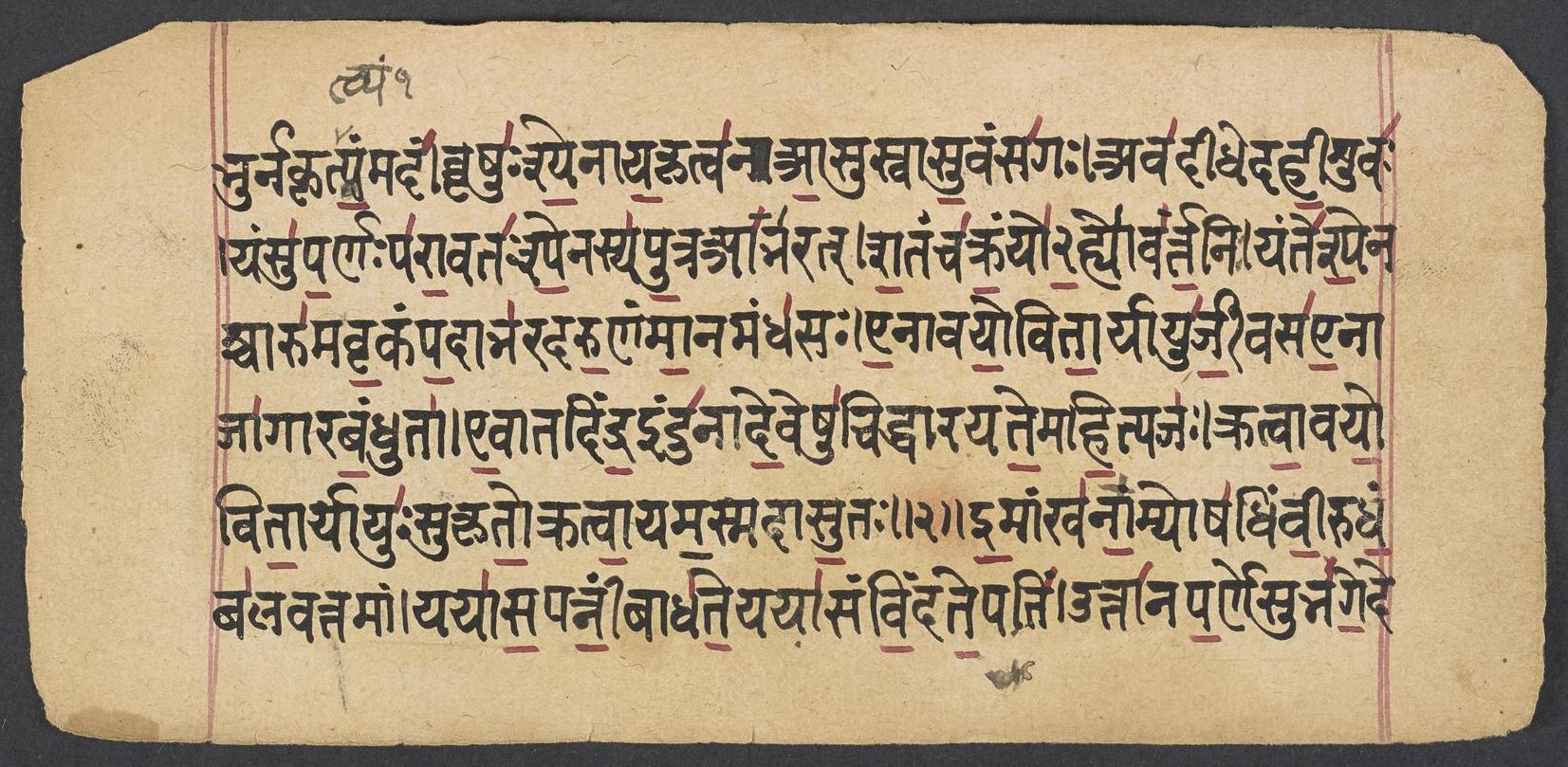
Penn Ms. Coll. 390 Item 48, fol. 131r (OPenn image 130, lower leaf). Checked on the image: the Rigveda text on this page begins in RV 10.144.2 ‹-ṛbhur na kṛtvyam madam›. The next page with Rigveda text, fol. 131v, begins in RV 10.145.2 ‹-devajūte sahasvati›. Verses 10.144.2-6 end on this page; 10.144.2 begins on fol. 130v.
2a̱yam a̱smāsu̱ kāvya̍ ṛ̱bhur vajro̱ dāsva̍te | a̱yam bi̍bharty ū̱rdhvakṛ̍śana̱m mada̍m ṛ̱bhur na kṛtvya̱m mada̍m ||
3ghṛṣu̍ḥ śye̱nāya̱ kṛtva̍na ā̱su svāsu̱ vaṁsa̍gaḥ | ava̍ dīdhed ahī̱śuva̍ḥ ||
4yaṁ su̍pa̱rṇaḥ pa̍rā̱vata̍ḥ śye̱nasya̍ pu̱tra ābha̍rat | śa̱taca̍kra̱ṁ yo̱3̱̍ 'hyo̍ varta̱niḥ ||
5yaṁ te̍ śye̱naś cāru̍m avṛ̱kam pa̱dābha̍rad aru̱ṇam mā̱nam andha̍saḥ | e̱nā vayo̱ vi tā̱ry āyu̍r jī̱vasa̍ e̱nā jā̍gāra ba̱ndhutā̍ ||
6e̱vā tad indra̱ indu̍nā de̱veṣu̍ cid dhārayāte̱ mahi̱ tyaja̍ḥ | kratvā̱ vayo̱ vi tā̱ry āyu̍ḥ sukrato̱ kratvā̱yam a̱smad ā su̱taḥ ||
2Here, by us, for the worshipper, is the wise bolt that works with skill. It brings the bubbling beverage as a dexterous man brings the effectual strong drink.
3Impetuous Ahîṣuva, a bull among cows of his, looked down upon the restless Hawk.
4That the strong-pinioned Bird hath brought, Child of the Falcon, from afar, What moves upon a hundred wheels along the female Dragon's path.
5Which, fair, unrobbed, the Falcon brought thee in his foot, the red-hued dwelling of the juice; Through this came vital power which lengthens out our days, and kinship through its help awoke.
6So Indra is by Indu's power; e'en among Gods will it repel great treachery. Wisdom, Most Sapient One, brings force that lengthens life. May wisdom bring the juice to us.
Notes
- Sanskrit: Aufrecht's edition (1877) with the Vedic accents, as entered by van Nooten and Holland (GRETIL).
- English: Ralph T. H. Griffith, The Hymns of the Rigveda (1889-1892; 2nd ed. 1896-1897), from the VedaWeb digital text; OCR slips in that text were corrected against the printed 2nd edition (data/sources/rigveda/griffith_errata.json).
Cite
Sources
- Source: Penn Ms. Coll. 390 Item 48 (1711 CE (colophon: Saṃvat 1768)), OPenn, Public Domain Mark + Aufrecht's accented text (GRETIL) + Griffith's English (VedaWeb) (holding institution)
- Critical edition: Aufrecht (1877), accented e-text via GRETIL
← previous · → next · v cycle view · l back to library