Rigveda 10.145: Against rivals in love
Introduction
Rigveda 10.145 is a hymn of 6 verses addressed to against rivals in love. It stands in book (maṇḍala) 10, the last and latest book. The Rigveda is the oldest collection of Sanskrit hymns, composed in the second half of the second millennium BCE and handed down orally for many centuries before it was written down.
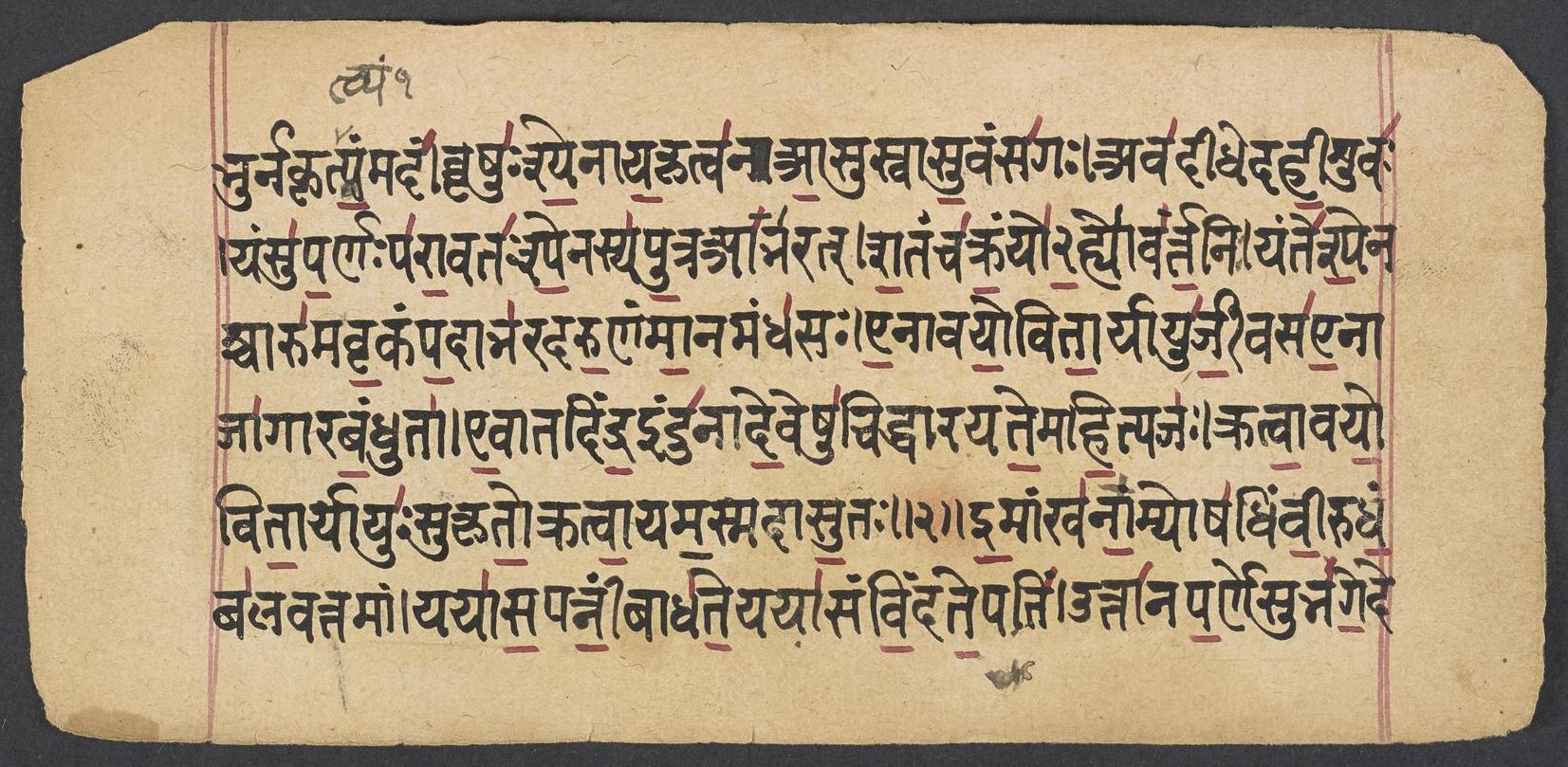
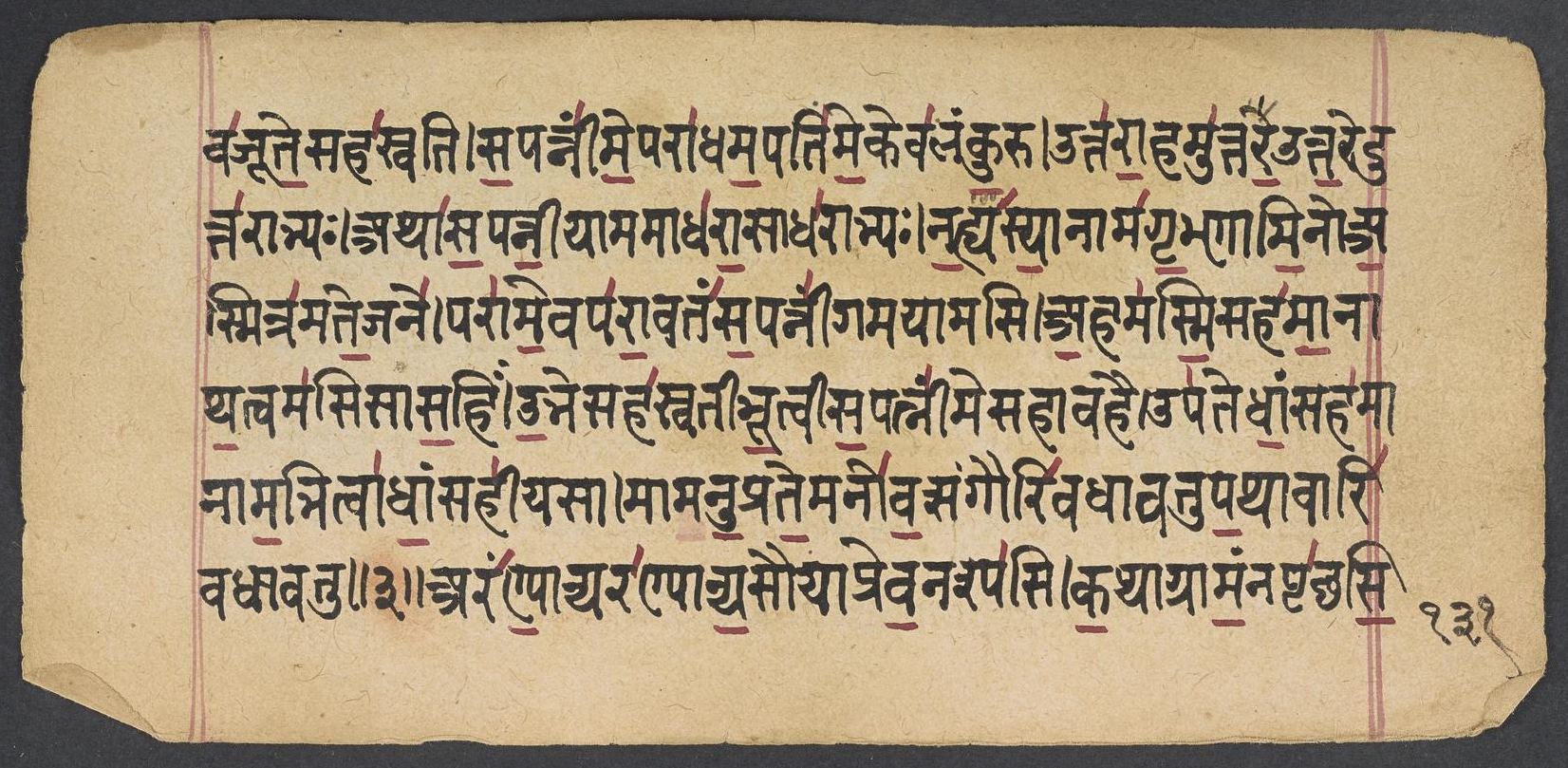
The manuscript shown is Penn Ms. Coll. 390 Item 48 (University of Pennsylvania), a paper manuscript of the eighth aṣṭaka (RV 10.46-10.191) of the Ṛgveda Saṃhitā in Devanāgarī, 158 leaves, 6 lines to the page, with the accents marked in red; the scribe's colophon on fol. 158 gives Saṃvat 1768 (1711 CE); this hymn stands on fol. 131r-131v. Each section below gives the verses that end on one page; the page boundaries were read on the images (the opening words of every page), not counted out. Like most Rigveda manuscripts, Penn Ms. Coll. 390 Item 48 writes a repeated refrain in short form after its first occurrence (for example kasmai° for kasmai devāya haviṣā vidhema); the Sanskrit shown is the full text of Aufrecht's edition.
How was this verified? (Provenance)
Where on the image
Penn Ms. Coll. 390 Item 48, fol. 131r (OPenn image 130, lower leaf). Checked on the image: the Rigveda text on this page begins in RV 10.144.2 ‹-ṛbhur na kṛtvyam madam›. The next page with Rigveda text, fol. 131v, begins in RV 10.145.2 ‹-devajūte sahasvati›. Verse 10.145.1 ends on this page.
1i̱māṁ kha̍nā̱my oṣa̍dhiṁ vī̱rudha̱m bala̍vattamām | yayā̍ sa̱patnī̱m bādha̍te̱ yayā̍ saṁvi̱ndate̱ pati̍m ||
1FROM out the earth I dig this plant, a herb of most effectual power, Wherewith one quells the rival wife and gains the husband for oneself.
Where on the image
Penn Ms. Coll. 390 Item 48, fol. 131v (OPenn image 131, upper leaf). Checked on the image: the Rigveda text on this page begins in RV 10.145.2 ‹-devajūte sahasvati›. The next page with Rigveda text, fol. 132r, begins in RV 10.146.1 ‹-na tvā bhīr iva›. Verses 10.145.2-6 end on this page; 10.145.2 begins on fol. 131r.
2uttā̍naparṇe̱ subha̍ge̱ deva̍jūte̱ saha̍svati | sa̱patnī̍m me̱ parā̍ dhama̱ pati̍m me̱ keva̍laṁ kuru ||
3utta̍rā̱ham u̍ttara̱ utta̱red utta̍rābhyaḥ | athā̍ sa̱patnī̱ yā mamādha̍rā̱ sādha̍rābhyaḥ ||
4na̱hy a̍syā̱ nāma̍ gṛ̱bhṇāmi̱ no a̱smin ra̍mate̱ jane̍ | parā̍m e̱va pa̍rā̱vata̍ṁ sa̱patnī̍ṁ gamayāmasi ||
5a̱ham a̍smi̱ saha̍mā̱nātha̱ tvam a̍si sāsa̱hiḥ | u̱bhe saha̍svatī bhū̱tvī sa̱patnī̍m me sahāvahai ||
6upa̍ te 'dhā̱ṁ saha̍mānām a̱bhi tvā̍dhā̱ṁ sahī̍yasā | mām anu̱ pra te̱ mano̍ va̱tsaṁ gaur i̍va dhāvatu pa̱thā vār i̍va dhāvatu ||
2Auspicious, with expanded leaves, sent by the Gods, victorious plant, Blow thou the rival wife away, and make my husband only mine.
3Stronger am I, O Stronger One, yea, mightier than the mightier; And she who is my rival wife is lower than the lowest dames.
4Her very name I utter not: she takes no pleasure in this man. Far into distance most remote drive we the rival wife away.
5I am the conqueror, and thou, thou also art victorious: As victory attends us both we will subdue my fellow-wife.
6I have gained thee for vanquisher, have grasped thee with a stronger spell. As a cow hastens to her calf, so let thy spirit speed te me, hasten like water on its way.
Notes
- Sanskrit: Aufrecht's edition (1877) with the Vedic accents, as entered by van Nooten and Holland (GRETIL).
- English: Ralph T. H. Griffith, The Hymns of the Rigveda (1889-1892; 2nd ed. 1896-1897), from the VedaWeb digital text; OCR slips in that text were corrected against the printed 2nd edition (data/sources/rigveda/griffith_errata.json).
Cite
Sources
- Source: Penn Ms. Coll. 390 Item 48 (1711 CE (colophon: Saṃvat 1768)), OPenn, Public Domain Mark + Aufrecht's accented text (GRETIL) + Griffith's English (VedaWeb) (holding institution)
- Critical edition: Aufrecht (1877), accented e-text via GRETIL
← previous · → next · v cycle view · l back to library