Rigveda 10.163: Against emaciation
Introduction
Rigveda 10.163 is a hymn of 6 verses addressed to against emaciation. It stands in book (maṇḍala) 10, the last and latest book. The Rigveda is the oldest collection of Sanskrit hymns, composed in the second half of the second millennium BCE and handed down orally for many centuries before it was written down.
The manuscript shown is Penn Ms. Coll. 390 Item 48 (University of Pennsylvania), a paper manuscript of the eighth aṣṭaka (RV 10.46-10.191) of the Ṛgveda Saṃhitā in Devanāgarī, 158 leaves, 6 lines to the page, with the accents marked in red; the scribe's colophon on fol. 158 gives Saṃvat 1768 (1711 CE); this hymn stands on fol. 141r-141v. Each section below gives the verses that end on one page; the page boundaries were read on the images (the opening words of every page), not counted out. Like most Rigveda manuscripts, Penn Ms. Coll. 390 Item 48 writes a repeated refrain in short form after its first occurrence (for example kasmai° for kasmai devāya haviṣā vidhema); the Sanskrit shown is the full text of Aufrecht's edition.
How was this verified? (Provenance)
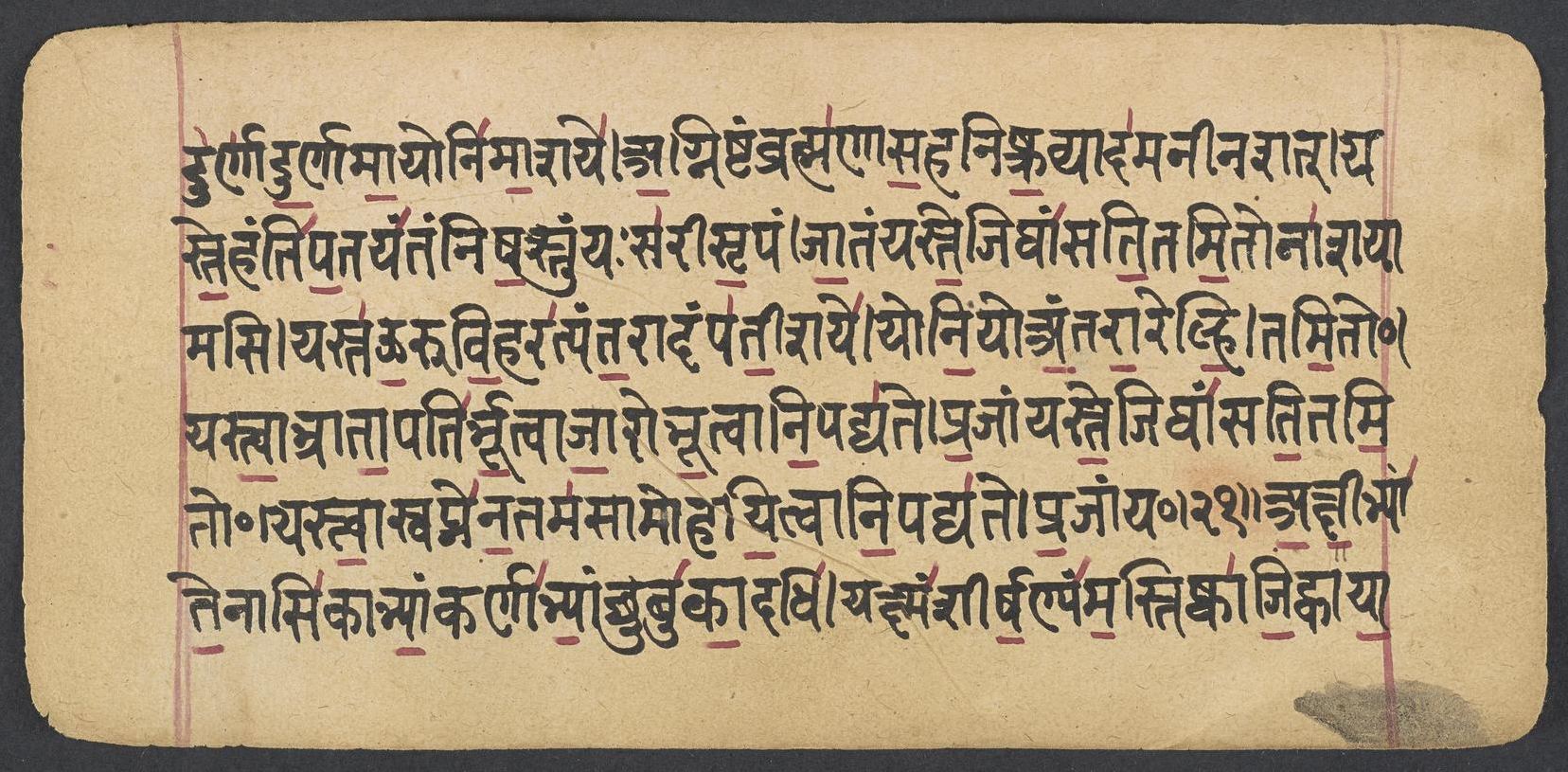
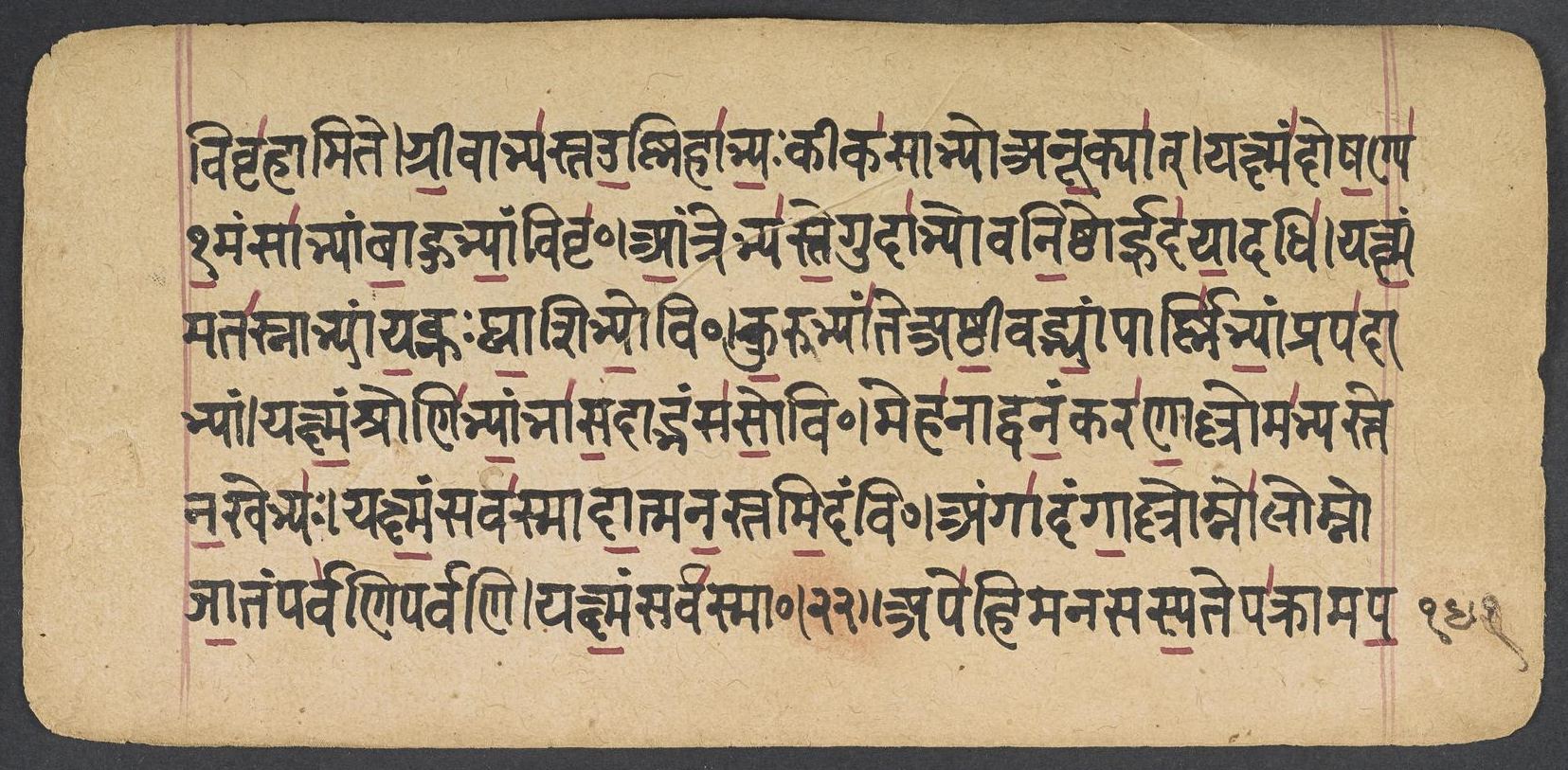
Where on the image
Penn Ms. Coll. 390 Item 48, fol. 141v (OPenn image 141, upper leaf). Checked on the image: the Rigveda text on this page begins in RV 10.163.1 ‹-jihvāyā vi vṛhāmi te›. The next page with Rigveda text, fol. 142r, begins in RV 10.164.1 ‹-paraś cara›. Verses 10.163.1-6 end on this page; 10.163.1 begins on fol. 141r.
1a̱kṣībhyā̍ṁ te̱ nāsi̍kābhyā̱ṁ karṇā̍bhyā̱ṁ chubu̍kā̱d adhi̍ | yakṣma̍ṁ śīrṣa̱ṇya̍m ma̱stiṣkā̍j ji̱hvāyā̱ vi vṛ̍hāmi te ||
2grī̱vābhya̍s ta u̱ṣṇihā̍bhya̱ḥ kīka̍sābhyo anū̱kyā̍t | yakṣma̍ṁ doṣa̱ṇya1̱̍m aṁsā̍bhyām bā̱hubhyā̱ṁ vi vṛ̍hāmi te ||
3ā̱ntrebhya̍s te̱ gudā̍bhyo vani̱ṣṭhor hṛda̍yā̱d adhi̍ | yakṣma̱m mata̍snābhyāṁ ya̱knaḥ plā̱śibhyo̱ vi vṛ̍hāmi te ||
4ū̱rubhyā̍ṁ te aṣṭhī̱vadbhyā̱m pārṣṇi̍bhyā̱m prapa̍dābhyām | yakṣma̱ṁ śroṇi̍bhyā̱m bhāsa̍dā̱d bhaṁsa̍so̱ vi vṛ̍hāmi te ||
5meha̍nād vana̱ṁkara̍ṇā̱l loma̍bhyas te na̱khebhya̍ḥ | yakṣma̱ṁ sarva̍smād ā̱tmana̱s tam i̱daṁ vi vṛ̍hāmi te ||
6aṅgā̍d-aṅgā̱l lomno̍-lomno jā̱tam parva̍ṇi-parvaṇi | yakṣma̱ṁ sarva̍smād ā̱tmana̱s tam i̱daṁ vi vṛ̍hāmi te ||
1FROM both thy nostrils, from thine eyes, from both thine ears and from thy chin, Forth from thy head and brain and tongue I drive thy malady away.
2From the neck-tendons and the neck, from the breast-bones and from the spine, From shoulders, upper, lower arms, I drive thy malady away.
3From viscera and all within, forth from the rectum, from the heart, From kidneys, liver, and from spleen, I drive thy malady away.
4From thighs, from knee-caps, and from heels, and from the forepart of the feet, From hips from stomach, and from groin I drive thy malady away.
5From what is voided from within, and from thy hair, and from they nails, From all thyself from top to toe, I drive thy malady away.
6From every member, every hair, disease that comes in every joint, From all thyself, from top to toe, I drive thy malady away.
Notes
- Sanskrit: Aufrecht's edition (1877) with the Vedic accents, as entered by van Nooten and Holland (GRETIL).
- English: Ralph T. H. Griffith, The Hymns of the Rigveda (1889-1892; 2nd ed. 1896-1897), from the VedaWeb digital text; OCR slips in that text were corrected against the printed 2nd edition (data/sources/rigveda/griffith_errata.json).
Cite
Sources
- Source: Penn Ms. Coll. 390 Item 48 (1711 CE (colophon: Saṃvat 1768)), OPenn, Public Domain Mark + Aufrecht's accented text (GRETIL) + Griffith's English (VedaWeb) (holding institution)
- Critical edition: Aufrecht (1877), accented e-text via GRETIL
← previous · → next · v cycle view · l back to library