Rigveda 10.21: To Agni
Introduction
Rigveda 10.21 is a hymn of 8 verses addressed to Agni. It stands in book (maṇḍala) 10, the last and latest book. The Rigveda is the oldest collection of Sanskrit hymns, composed in the second half of the second millennium BCE and handed down orally for many centuries before it was written down.
The manuscript shown is Penn Ms. Coll. 390 Item 41 (University of Pennsylvania), an undated paper manuscript of the padapāṭha (the word-by-word recitation text, in which every word is written separately and compounds are split) of the whole Ṛgveda in Devanāgarī, 884 leaves in fascicles, 7-9 lines to the page, accents in red; this hymn stands on fol. 760v-761r. Each section below gives the verses that end on one page; the page boundaries were read on the images (the opening words of every page), not counted out. Where the manuscript is a padapāṭha (the word-by-word recitation text), the section shows Aufrecht's continuous (saṃhitā) text first and, as the edition text, the padapāṭha of the same verses, which is the form written on the page.
How was this verified? (Provenance)
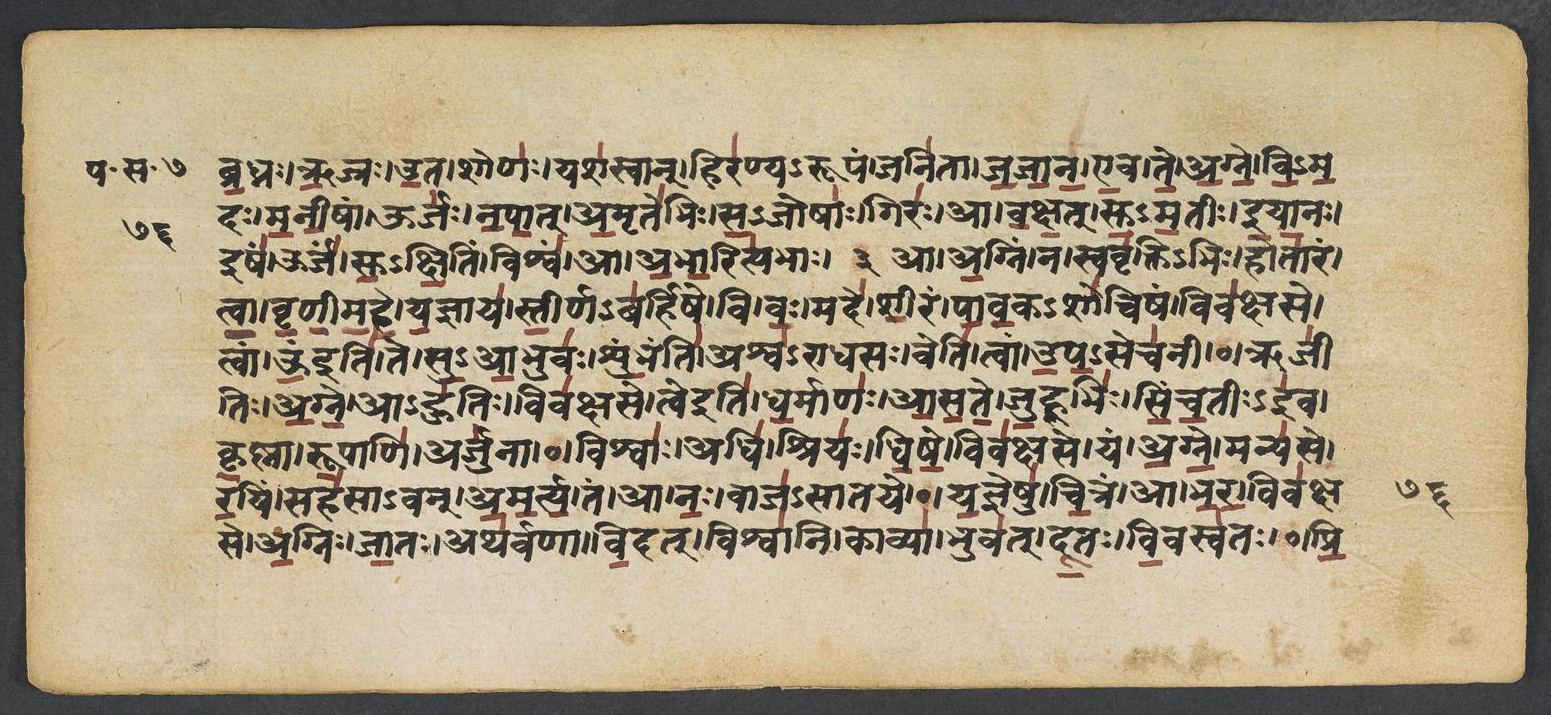
Where on the image
Penn Ms. Coll. 390 Item 41, fol. 760v (numbered 76v by the scribe) (OPenn image 761, upper leaf). Checked on the image: the Rigveda text on this page begins in RV 10.20.9 ‹bradhnaḥ ṛjraḥ uta śoṇaḥ›. The next page with Rigveda text, fol. 761r (numbered 77r by the scribe), begins in RV 10.21.5 ‹-priyaḥ yamasya kāmyaḥ vivakṣase›. Verses 10.21.1-4 end on this page.
1āgniṁ na svavṛ̍ktibhi̱r hotā̍raṁ tvā vṛṇīmahe | ya̱jñāya̍ stī̱rṇaba̍rhiṣe̱ vi vo̱ made̍ śī̱ram pā̍va̱kaśo̍ciṣa̱ṁ viva̍kṣase ||
2tvām u̱ te svā̱bhuva̍ḥ śu̱mbhanty aśva̍rādhasaḥ | veti̱ tvām u̍pa̱seca̍nī̱ vi vo̱ mada̱ ṛjī̍tir agna̱ āhu̍ti̱r viva̍kṣase ||
3tve dha̱rmāṇa̍ āsate ju̱hūbhi̍ḥ siñca̱tīr i̍va | kṛ̱ṣṇā rū̱pāṇy arju̍nā̱ vi vo̱ made̱ viśvā̱ adhi̱ śriyo̍ dhiṣe̱ viva̍kṣase ||
4yam a̍gne̱ manya̍se ra̱yiṁ saha̍sāvann amartya | tam ā no̱ vāja̍sātaye̱ vi vo̱ made̍ ya̱jñeṣu̍ ci̱tram ā bha̍rā̱ viva̍kṣase ||
Compare: Padapāṭha (word-by-word text written in the manuscript; Sansknet e-text via GRETIL)
1ā | agnim | na | svavṛkti-bhiḥ | hotāram | tvā | vṛṇīmahe | yajñāya | stīrṇa-barhi ṣe | vi | vaḥ | made | śīram | pāvaka-śociṣam | vivakṣase
2tvām | oṃ iti | te | su-ābhuvaḥ | śumbhanti | aśva-rādhasaḥ | veti | tvām | upa-secanī | vi | vaḥ | made | ṛjītiḥ | agne | āhutiḥ | vivakṣase
3tve iti | dharmāṇaḥ | āsate | juhūbhiḥ | siñcatīḥ-iva | kṛṣṇā | rūpāṇi | arjunā | vi | vaḥ | made | viśvāḥ | adhi | śriyaḥ | dhiṣe | vivakṣase
4yam | agne | manyase | rayim | sahasāvan | amartya | tam | ā | naḥ | vāja-sātaye | vi | vaḥ | made | yajñeṣu | citram | ā | bhara | vivakṣase
1WITH offerings of our own we choose thee, Agni, as Invoking Priest, For sacrifice with trimmed grass,– at your glad carouse-piercing and brightly shining. Thou art waxing great.
2The wealthy ones adorn thee, they who bring us horses as their gift: The sprinkling ladle, Agni,– at your glad carouse -and glowing offering taste thee. Thou art waxing great.
3The holy statutes rest by thee, as 'twere with ladles that o'erflow. Black and white-gleaming colours,– at your glad carouse-all glories thou assurnest. Thou art waxing great.
4O Agni, what thou deemest wealth, Victorious and Immortal One! Bring thou to give us vigour,– at your glad carouse -splendid at sacrifices. Thou art waxing great.
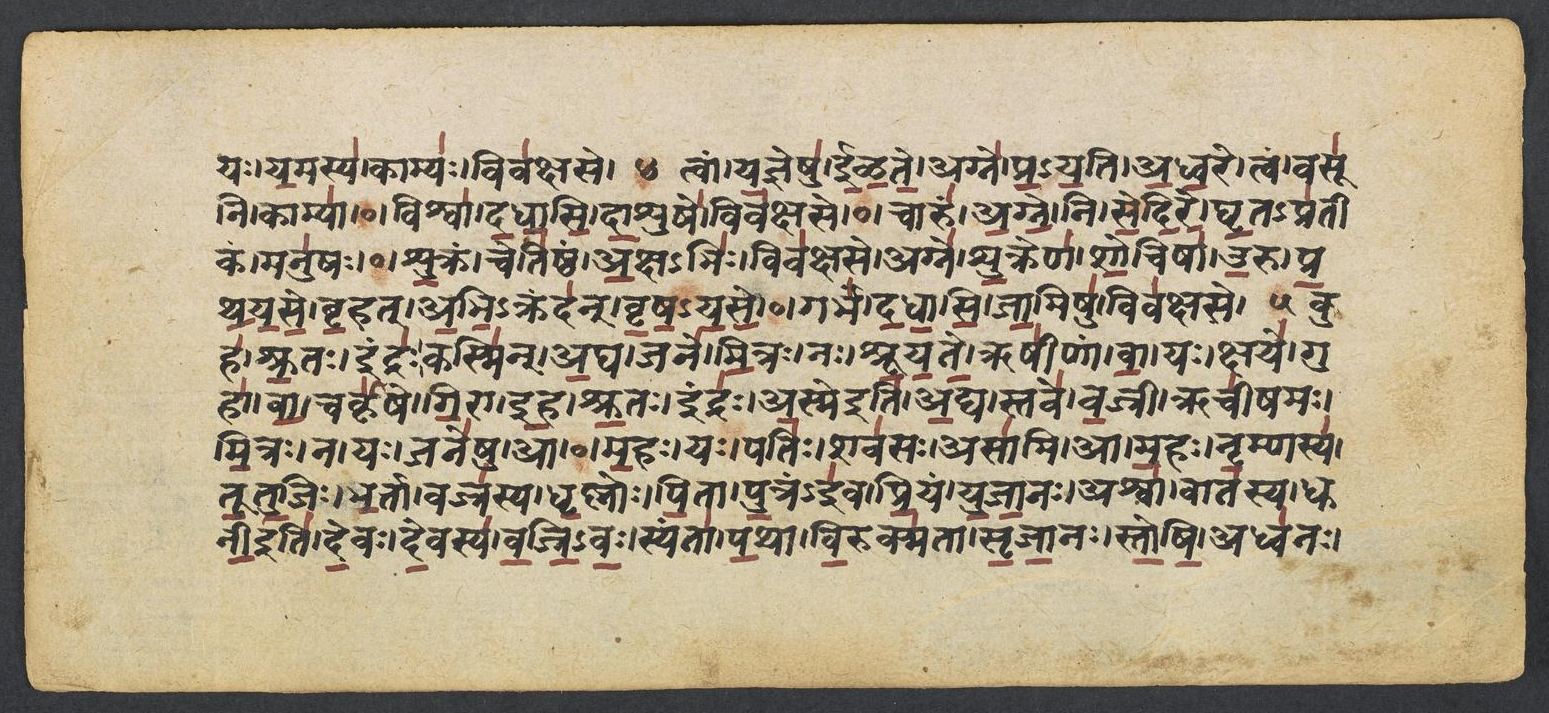
Where on the image
Penn Ms. Coll. 390 Item 41, fol. 761r (numbered 77r by the scribe) (OPenn image 761, lower leaf). Checked on the image: the Rigveda text on this page begins in RV 10.21.5 ‹-priyaḥ yamasya kāmyaḥ vivakṣase›. The next page with Rigveda text, fol. 761v (numbered 77v by the scribe), begins in RV 10.22.5 ‹tvam tyā cit vātasya›. Verses 10.21.5-8 end on this page; 10.21.5 begins on fol. 760v (numbered 76v by the scribe).
5a̱gnir jā̱to atha̍rvaṇā vi̱dad viśvā̍ni̱ kāvyā̍ | bhuva̍d dū̱to vi̱vasva̍to̱ vi vo̱ made̍ pri̱yo ya̱masya̱ kāmyo̱ viva̍kṣase ||
6tvāṁ ya̱jñeṣv ī̍ḻa̱te 'gne̍ praya̱ty a̍dhva̱re | tvaṁ vasū̍ni̱ kāmyā̱ vi vo̱ made̱ viśvā̍ dadhāsi dā̱śuṣe̱ viva̍kṣase ||
7tvāṁ ya̱jñeṣv ṛ̱tvija̱ṁ cāru̍m agne̱ ni ṣe̍dire | ghṛ̱tapra̍tīka̱m manu̍ṣo̱ vi vo̱ made̍ śu̱kraṁ ceti̍ṣṭham a̱kṣabhi̱r viva̍kṣase ||
8agne̍ śu̱kreṇa̍ śo̱ciṣo̱ru pra̍thayase bṛ̱hat | a̱bhi̱kranda̍n vṛṣāyase̱ vi vo̱ made̱ garbha̍ṁ dadhāsi jā̱miṣu̱ viva̍kṣase ||
Compare: Padapāṭha (word-by-word text written in the manuscript; Sansknet e-text via GRETIL)
5agniḥ | jātaḥ | atharvaṇā | vidat | viśvāni | kāvyā | bhuvat | dūtaḥ | vivasvataḥ | v i | vaḥ | made | priyaḥ | yamasya | kāmyaḥ | vivakṣase
6tvām | yajñeṣu | īḷate | agne | pra-yati | adhvare | tvam | vasūni | kāmyā | vi | vaḥ | made | viśvā | dadhāsi | dāśuṣe | vivakṣase
7tvām | yajñeṣu | ṛtvijam | cārum | agne | ni | sedire | ghṛta-pratīkam | manuṣaḥ | vi | vaḥ | made | śukam | cetiṣṭham | akṣa-bhiḥ | vivakṣase
8agne | śukreṇa | śociṣā | uru | prathayase | bṛhat | abhi-krandan | vṛṣa-yase | vi | vaḥ | made | garbham | dadhāsi | jāmiṣu | vivakṣase
5Skilled in all lore is Agni, he whom erst Atharvan brought to life. He was Vivasvan's envoy, at your glad carouse-the weIl-loved friend of Yama, Thou art waxing great.
6At sacrifices they adore thee, Agni, when the rite proceeds. All fair and lovely treasures-at your glad carouse-thou givest him who offers. Thou art waxing great.
7Men, Agni, have established thee as welcome Priest at holy rites, Thee whose face shines with butter,– at your glad carouse-bright, with eyes most observant. Thou art waxing great.
8Wide and aloft thou spreadest thee, O Agni, with thy brilliant flame. A Bull art thou when bellowing,– at your glad carouse-thou dost impregn the Sisters. Thou art waxing great.
Notes
- Sanskrit: Aufrecht's edition (1877) with the Vedic accents, as entered by van Nooten and Holland (GRETIL).
- English: Ralph T. H. Griffith, The Hymns of the Rigveda (1889-1892; 2nd ed. 1896-1897), from the VedaWeb digital text; OCR slips in that text were corrected against the printed 2nd edition (data/sources/rigveda/griffith_errata.json).
- Padapāṭha (edition text): Sansknet e-text via GRETIL (CC BY-NC-SA 4.0).
Cite
Sources
- Source: Penn Ms. Coll. 390 Item 41 (undated (catalogued with Penn's 18th-19th c. Vedic manuscripts)), OPenn, Public Domain Mark + Aufrecht's accented text (GRETIL) + Griffith's English (VedaWeb) (holding institution)
- Critical edition: Aufrecht (1877), accented e-text via GRETIL
← previous · → next · v cycle view · l back to library