Rigveda 10.24: To Indra and the Asvins
Introduction
Rigveda 10.24 is a hymn of 6 verses addressed to Indra and the Asvins. It stands in book (maṇḍala) 10, the last and latest book. The Rigveda is the oldest collection of Sanskrit hymns, composed in the second half of the second millennium BCE and handed down orally for many centuries before it was written down.
The manuscript shown is Penn Ms. Coll. 390 Item 41 (University of Pennsylvania), an undated paper manuscript of the padapāṭha (the word-by-word recitation text, in which every word is written separately and compounds are split) of the whole Ṛgveda in Devanāgarī, 884 leaves in fascicles, 7-9 lines to the page, accents in red; this hymn stands on fol. 762v-763r. Each section below gives the verses that end on one page; the page boundaries were read on the images (the opening words of every page), not counted out. Where the manuscript is a padapāṭha (the word-by-word recitation text), the section shows Aufrecht's continuous (saṃhitā) text first and, as the edition text, the padapāṭha of the same verses, which is the form written on the page.
How was this verified? (Provenance)
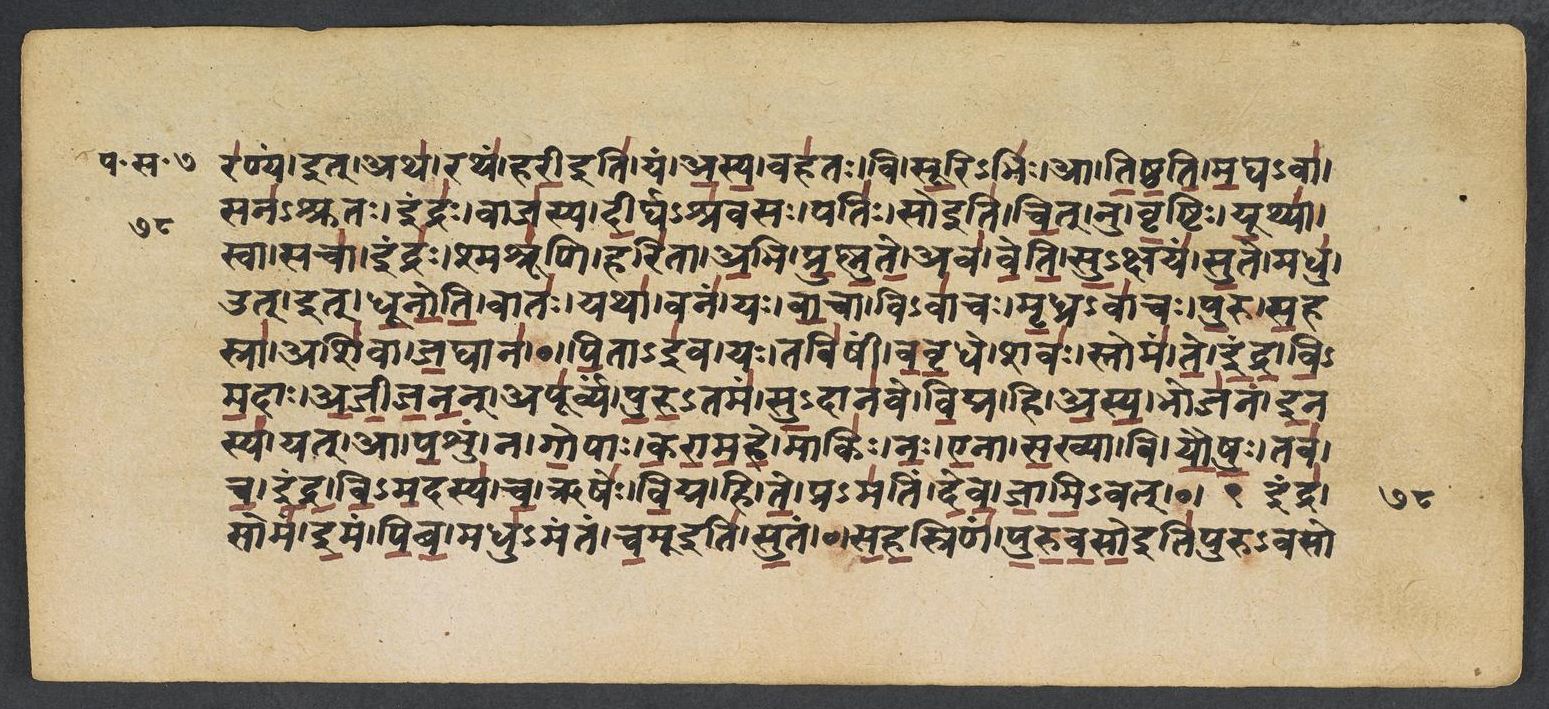
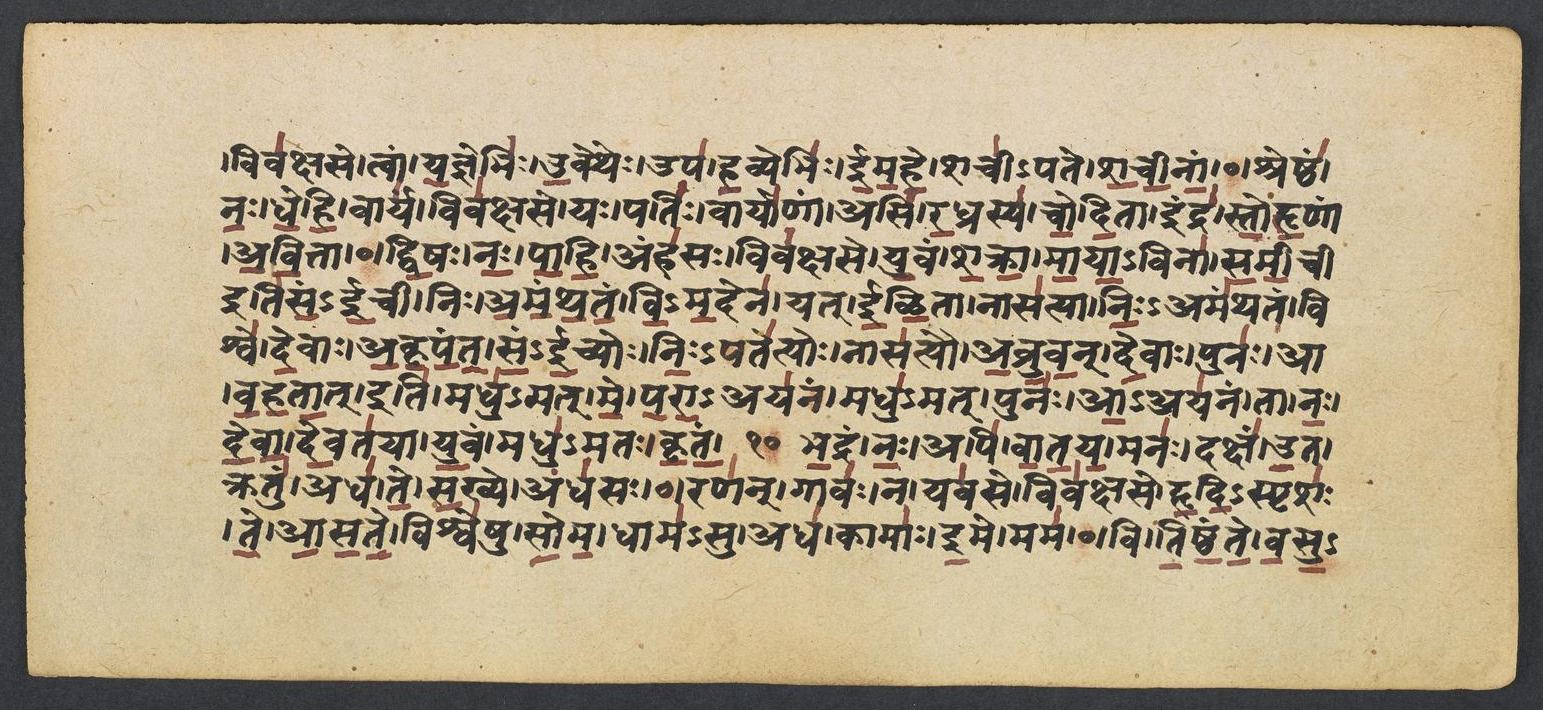
Where on the image
Penn Ms. Coll. 390 Item 41, fol. 763r (numbered 79r by the scribe) (OPenn image 763, lower leaf). Checked on the image: the Rigveda text on this page begins in RV 10.24.1 ‹vivakṣase›. The next page with Rigveda text, fol. 763v (numbered 79v by the scribe), begins in RV 10.25.2 ‹-vasu-yavaḥ vivakṣase›. Verses 10.24.1-6 end on this page; 10.24.1 begins on fol. 762v (numbered 78v by the scribe).
1indra̱ soma̍m i̱mam pi̍ba̱ madhu̍mantaṁ ca̱mū su̱tam | a̱sme ra̱yiṁ ni dhā̍raya̱ vi vo̱ made̍ saha̱sriṇa̍m purūvaso̱ viva̍kṣase ||
2tvāṁ ya̱jñebhi̍r u̱kthair upa̍ ha̱vyebhi̍r īmahe | śacī̍pate śacīnā̱ṁ vi vo̱ made̱ śreṣṭha̍ṁ no dhehi̱ vārya̱ṁ viva̍kṣase ||
3yas pati̱r vāryā̍ṇā̱m asi̍ ra̱dhrasya̍ codi̱tā | indra̍ stotṝ̱ṇām a̍vi̱tā vi vo̱ made̍ dvi̱ṣo na̍ḥ pā̱hy aṁha̍so̱ viva̍kṣase ||
4yu̱vaṁ śa̍krā māyā̱vinā̍ samī̱cī nir a̍manthatam | vi̱ma̱dena̱ yad ī̍ḻi̱tā nāsa̍tyā ni̱rama̍nthatam ||
5viśve̍ de̱vā a̍kṛpanta samī̱cyor ni̱ṣpata̍ntyoḥ | nāsa̍tyāv abruvan de̱vāḥ puna̱r ā va̍hatā̱d iti̍ ||
6madhu̍man me pa̱rāya̍ṇa̱m madhu̍ma̱t puna̱r āya̍nam | tā no̍ devā de̱vata̍yā yu̱vam madhu̍matas kṛtam ||
Compare: Padapāṭha (word-by-word text written in the manuscript; Sansknet e-text via GRETIL)
1indra | somam | imam | piba | madhu-mantam | camū iti | sutam | asme iti | rayim | ni | dhāraya | vi | vaḥ | made | sahasriṇam | puruvaso itipuru-vaso | vivakṣase
2tvām | yajñebhiḥ | ukthaiḥ | upa | havyebhiḥ | īmahe | śacī-pate | śacīnam | vi | vaḥ | made | śreṣṭham | naḥ | dhehi | vāryam | vivakṣase
3yaḥ | patim | vāryāṇām | asi | radhrasya | coditā | indra | stotṝṇām | avitā | vi | vaḥ | made | dviṣaḥ | naḥ | pāhi | aṃhasaḥ | vivakṣase
4yuvam | śakrā | māyāvinā | samīcī itisam-īcī | niḥ | amanthatam | vi-madena | yat | īḷitā | nāsatyā | nir- amanthatam
5viśve | devāḥ | akṛpanta | sam-īcyoḥ | niḥ-patantyoḥ | nāsatyau | abruvan | devāḥ | punaḥ | ā | vahatāt | iti
6madhu-mat | me | parāyaṇam | madhu-mat | punaḥ | āyanam | tā | naḥ | devā | devatayā | yuvam | madhu-mataḥ | kṛtam
1O INDRA, drink this Soma, pressed out in the mortar, full of sweets. Send down to us great riches,– at your glad carouse-in thousands, O Most Wealthy. Thou art waxing great.
2To thee with sacrifices, with oblations, and with lauds we come. Lord of all strength and power, grant-at your glad carouse-the best choiceworthy treasure. Thou art waxing great.
3Thou who art Lord of precious boons, inciter even of the churl. Guardian of singers, Indra,– at your glad carouse-save us from woe and hatred. Thou art waxing great.
4Strong, Lords of Magic power, ye Twain churned the united worlds apart, When ye, implored by Vimada, Nâsatyas, forced apart the pair.
5When the united pair were rent asunder all the Gods complained. The Gods to the Nâsatyas cried, Bring these together once again.
6Sweet be my going forth, and rich in sweets be my approach to home. So, through your Deity, both Gods, enrich us with all pleasantness.
Notes
- Sanskrit: Aufrecht's edition (1877) with the Vedic accents, as entered by van Nooten and Holland (GRETIL).
- English: Ralph T. H. Griffith, The Hymns of the Rigveda (1889-1892; 2nd ed. 1896-1897), from the VedaWeb digital text; OCR slips in that text were corrected against the printed 2nd edition (data/sources/rigveda/griffith_errata.json).
- Padapāṭha (edition text): Sansknet e-text via GRETIL (CC BY-NC-SA 4.0).
Cite
Sources
- Source: Penn Ms. Coll. 390 Item 41 (undated (catalogued with Penn's 18th-19th c. Vedic manuscripts)), OPenn, Public Domain Mark + Aufrecht's accented text (GRETIL) + Griffith's English (VedaWeb) (holding institution)
- Critical edition: Aufrecht (1877), accented e-text via GRETIL
← previous · → next · v cycle view · l back to library