Rigveda 10.38: To Indra
Introduction
Rigveda 10.38 is a hymn of 5 verses addressed to Indra. It stands in book (maṇḍala) 10, the last and latest book. The Rigveda is the oldest collection of Sanskrit hymns, composed in the second half of the second millennium BCE and handed down orally for many centuries before it was written down.
The manuscript shown is Penn Ms. Coll. 390 Item 41 (University of Pennsylvania), an undated paper manuscript of the padapāṭha (the word-by-word recitation text, in which every word is written separately and compounds are split) of the whole Ṛgveda in Devanāgarī, 884 leaves in fascicles, 7-9 lines to the page, accents in red; this hymn stands on fol. 777v-778r. Each section below gives the verses that end on one page; the page boundaries were read on the images (the opening words of every page), not counted out. Where the manuscript is a padapāṭha (the word-by-word recitation text), the section shows Aufrecht's continuous (saṃhitā) text first and, as the edition text, the padapāṭha of the same verses, which is the form written on the page.
How was this verified? (Provenance)
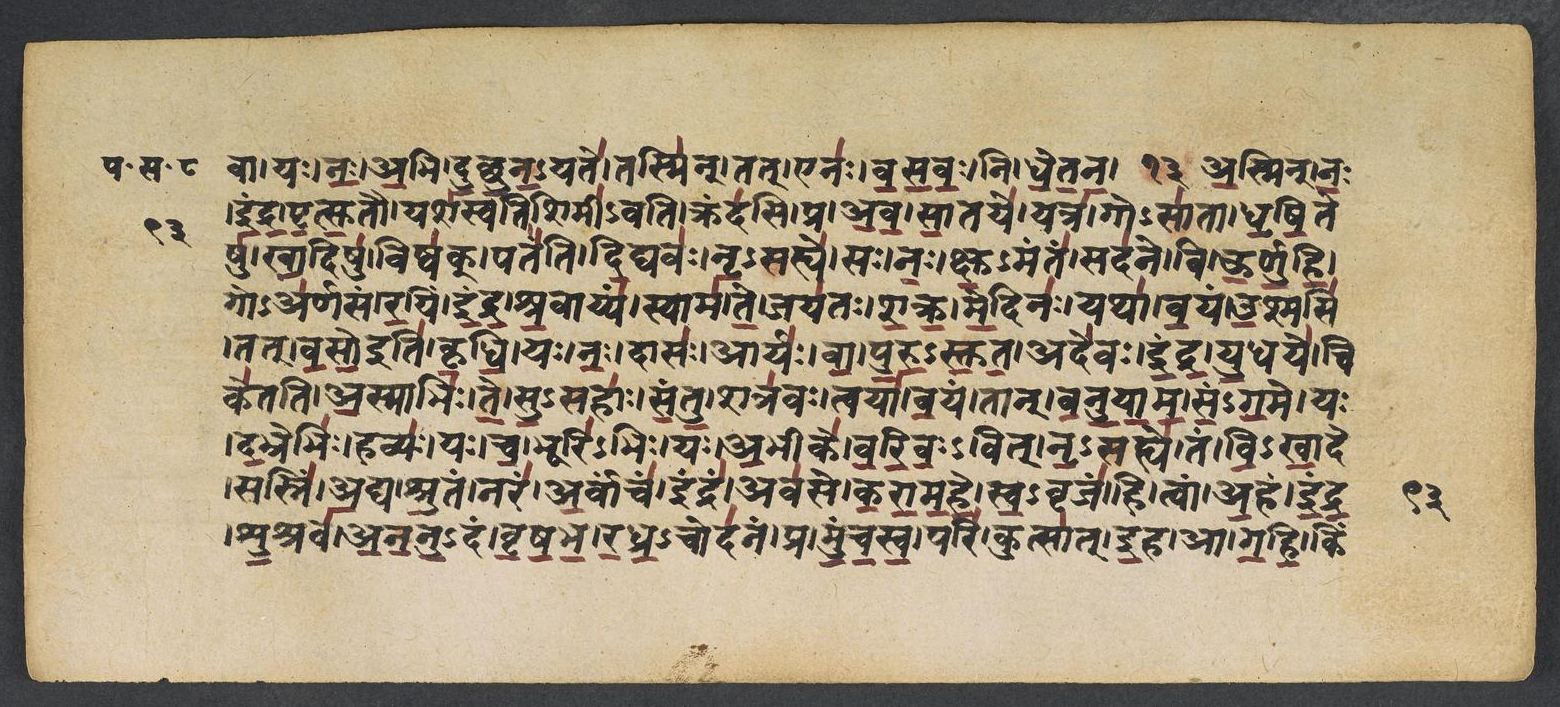
Where on the image
Penn Ms. Coll. 390 Item 41, fol. 777v (numbered 93v by the scribe) (OPenn image 778, upper leaf). Checked on the image: the Rigveda text on this page begins in RV 10.37.12 ‹-arāvā yaḥ naḥ abhi›. The next page with Rigveda text, fol. 778r (numbered 94r by the scribe), begins in RV 10.38.5 ‹oṃ iti tvāvān muṣkayoḥ›. Verses 10.38.1-4 end on this page.
1a̱smin na̍ indra pṛtsu̱tau yaśa̍svati̱ śimī̍vati̱ kranda̍si̱ prāva̍ sā̱taye̍ | yatra̱ goṣā̍tā dhṛṣi̱teṣu̍ khā̱diṣu̱ viṣva̱k pata̍nti di̱dyavo̍ nṛ̱ṣāhye̍ ||
2sa na̍ḥ kṣu̱manta̱ṁ sada̍ne̱ vy ū̍rṇuhi̱ goa̍rṇasaṁ ra̱yim i̍ndra śra̱vāyya̍m | syāma̍ te̱ jaya̍taḥ śakra me̱dino̱ yathā̍ va̱yam u̱śmasi̱ tad va̍so kṛdhi ||
3yo no̱ dāsa̱ āryo̍ vā puruṣṭu̱tāde̍va indra yu̱dhaye̱ cike̍tati | a̱smābhi̍ṣ ṭe su̱ṣahā̍ḥ santu̱ śatra̍va̱s tvayā̍ va̱yaṁ tān va̍nuyāma saṁga̱me ||
4yo da̱bhrebhi̱r havyo̱ yaś ca̱ bhūri̍bhi̱r yo a̱bhīke̍ varivo̱vin nṛ̱ṣāhye̍ | taṁ vi̍khā̱de sasni̍m a̱dya śru̱taṁ nara̍m a̱rvāñca̱m indra̱m ava̍se karāmahe ||
Compare: Padapāṭha (word-by-word text written in the manuscript; Sansknet e-text via GRETIL)
1asmin | naḥ | indra | pṛtsutau | yaśasvati | śimī-vati | krandasi | pra | ava | sātaye | yatra | go--sātā | dhṛṣiteṣu | khādiṣu | viṣvak | patanti | didyavaḥ | nṛ-sahye
2saḥ | naḥ | kṣu-mantam | sadane | vi | ūrṇuhi | go--arṇasam | rayim | indra | śravāyyam | syāma | te | jayataḥ | śakra | medinaḥ | yathā | vayam | uśmasi | tat | vaso iti | kṛdhi
3yaḥ | naḥ | dāsaḥ | āryaḥ | vā | puru-stuta | adevaḥ | indra | yudhaye | ciketati | asmābhiḥ | te | su-sahāḥ | santu | śatravaḥ | tvayā | vayam | tān | vanuyāma | sam-game
4yaḥ | dabhrebhiḥ | havyaḥ | yaḥ | ca | bhūri-bhiḥ | yaḥ | abhīke | varivaḥ-vit | nṛ-sahye | tam | vi-khāde | sasnim | adya | śrutam | naram | arvāñcam | indram | avase | karāmahe
1O INDRA, in this battle great and glorious, in this loud din of war help us to victory, Where in the strife for kine among bold ring-decked men arrows fly all around and heroes are subdued.
2At home disclose to us opulence rich in food, streaming with milk, O Indra, meet to be renowned. Ṣakra, may we be thine, the friendly Conqueror's: even as we desire, O Vasu, so do thou.
3The godless man, much-lauded Indra, whether he be Dâsa or be Ârya, who would war with us,– Easy to conquer he for thee, with us, these foes: with thee may we subdue them in the clash of fight.
4Him who must be invoked by many and by few, who standeth nigh with comfort in the war of men, Indra, famed Hero, winner in the deadly strife, let us bring hitherward to-day to favour us.
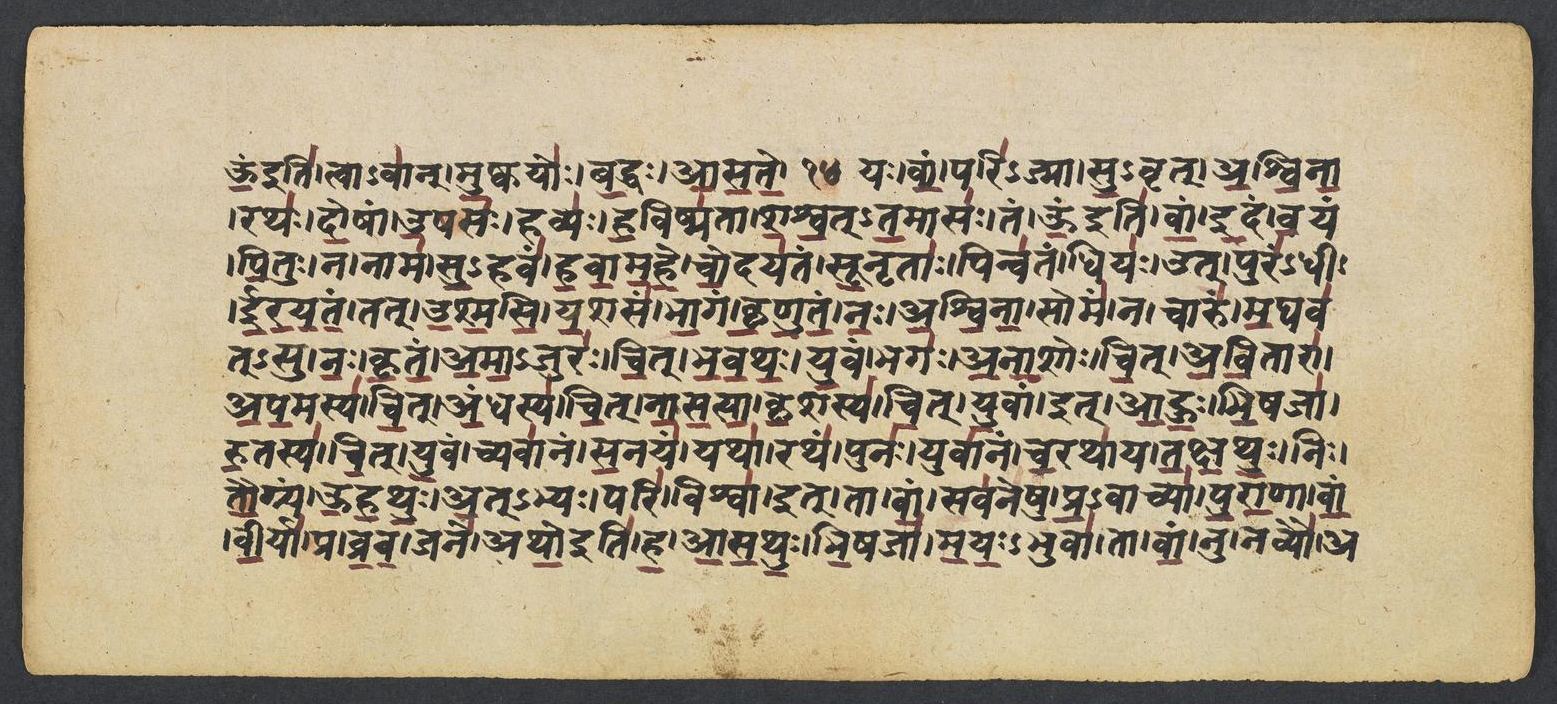
Where on the image
Penn Ms. Coll. 390 Item 41, fol. 778r (numbered 94r by the scribe) (OPenn image 778, lower leaf). Checked on the image: the Rigveda text on this page begins in RV 10.38.5 ‹oṃ iti tvāvān muṣkayoḥ›. The next page with Rigveda text, fol. 778v (numbered 94v by the scribe), begins in RV 10.39.5 ‹-avase karāmahe ayam nāsatyā›. Verse 10.38.5 ends on this page; 10.38.5 begins on fol. 777v (numbered 93v by the scribe).
5sva̱vṛja̱ṁ hi tvām a̱ham i̍ndra śu̱śravā̍nānu̱daṁ vṛ̍ṣabha radhra̱coda̍nam | pra mu̍ñcasva̱ pari̱ kutsā̍d i̱hā ga̍hi̱ kim u̱ tvāvā̍n mu̱ṣkayo̍r ba̱ddha ā̍sate ||
Compare: Padapāṭha (word-by-word text written in the manuscript; Sansknet e-text via GRETIL)
5sva-vṛjam | hi | tvām | aham | indra | śuśrava | ananu-dam | vṛṣabha | radhra-codanam | pra | muñcasva | pari | kutsāt | iha | ā | gahi | kim | oṃ iti | tvāvān | muṣkayoḥ | baddhaḥ | āsate
5For, Indra, I have heard thee called Self. capturer, One, Steer! who never yields, who urges even the churl. Release thyself from Kutsa and come hither. How shall one like thee sit still bound that he may not move?
Notes
- Sanskrit: Aufrecht's edition (1877) with the Vedic accents, as entered by van Nooten and Holland (GRETIL).
- English: Ralph T. H. Griffith, The Hymns of the Rigveda (1889-1892; 2nd ed. 1896-1897), from the VedaWeb digital text; OCR slips in that text were corrected against the printed 2nd edition (data/sources/rigveda/griffith_errata.json).
- Padapāṭha (edition text): Sansknet e-text via GRETIL (CC BY-NC-SA 4.0).
Cite
Sources
- Source: Penn Ms. Coll. 390 Item 41 (undated (catalogued with Penn's 18th-19th c. Vedic manuscripts)), OPenn, Public Domain Mark + Aufrecht's accented text (GRETIL) + Griffith's English (VedaWeb) (holding institution)
- Critical edition: Aufrecht (1877), accented e-text via GRETIL
← previous · → next · v cycle view · l back to library