Rigveda 10.7: To Agni
Introduction
Rigveda 10.7 is a hymn of 7 verses addressed to Agni. It stands in book (maṇḍala) 10, the last and latest book. The Rigveda is the oldest collection of Sanskrit hymns, composed in the second half of the second millennium BCE and handed down orally for many centuries before it was written down.
The manuscript shown is Penn Ms. Coll. 390 Item 41 (University of Pennsylvania), an undated paper manuscript of the padapāṭha (the word-by-word recitation text, in which every word is written separately and compounds are split) of the whole Ṛgveda in Devanāgarī, 884 leaves in fascicles, 7-9 lines to the page, accents in red; this hymn stands on fol. 747r-747v. Each section below gives the verses that end on one page; the page boundaries were read on the images (the opening words of every page), not counted out. Where the manuscript is a padapāṭha (the word-by-word recitation text), the section shows Aufrecht's continuous (saṃhitā) text first and, as the edition text, the padapāṭha of the same verses, which is the form written on the page.
How was this verified? (Provenance)
Where on the image
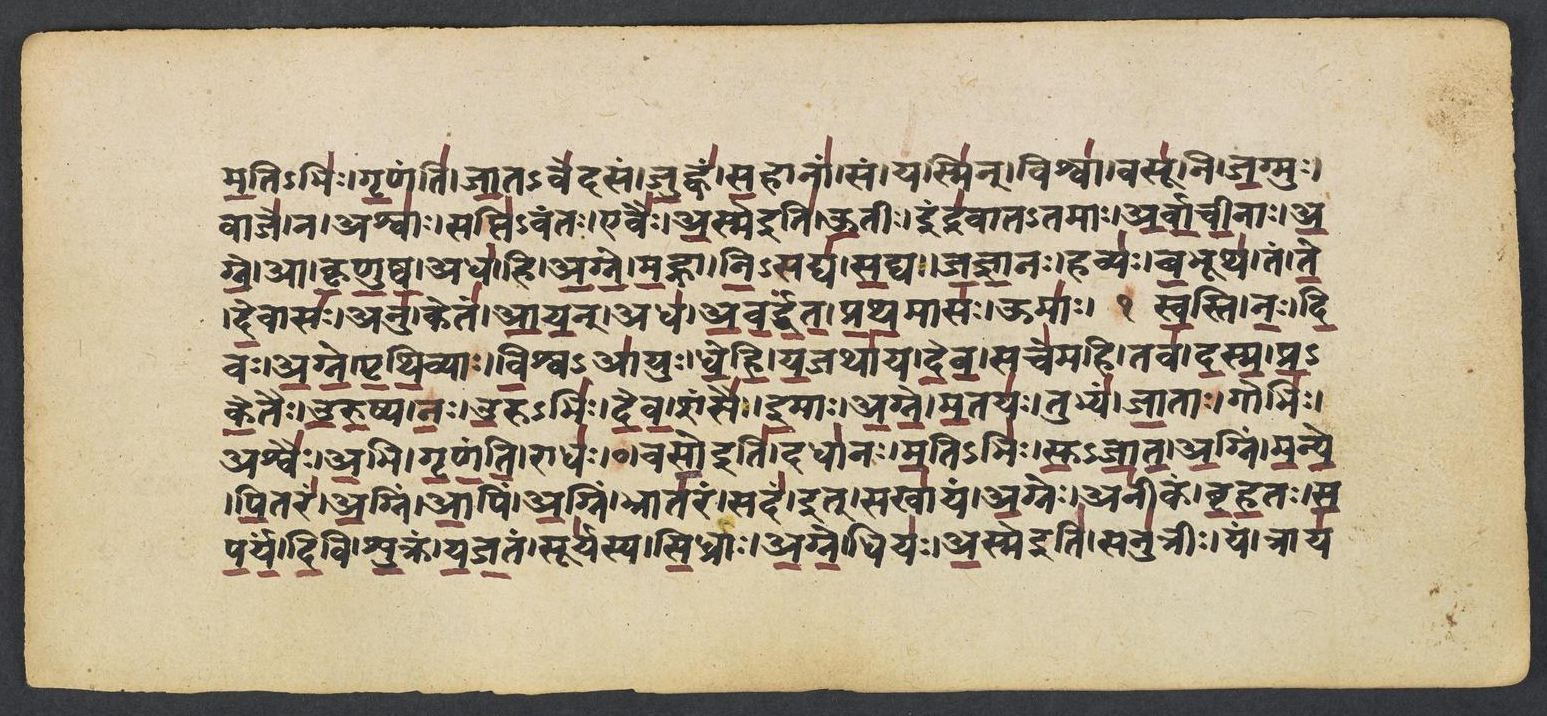
Penn Ms. Coll. 390 Item 41, fol. 747r (numbered 64r by the scribe) (OPenn image 747, lower leaf). Checked on the image: the Rigveda text on this page begins in RV 10.6.5 ‹mati-bhiḥ gṛṇanti jāta-vedasam juhvam›. The next page with Rigveda text, fol. 747v (numbered 64v by the scribe), begins in RV 10.7.4 ‹-trāyase dame ā nitya-hotā›. Verses 10.7.1-3 end on this page.
1sva̱sti no̍ di̱vo a̍gne pṛthi̱vyā vi̱śvāyu̍r dhehi ya̱jathā̍ya deva | sace̍mahi̱ tava̍ dasma prake̱tair u̍ru̱ṣyā ṇa̍ u̱rubhi̍r deva̱ śaṁsai̍ḥ ||
2i̱mā a̍gne ma̱taya̱s tubhya̍ṁ jā̱tā gobhi̱r aśvai̍r a̱bhi gṛ̍ṇanti̱ rādha̍ḥ | ya̱dā te̱ marto̱ anu̱ bhoga̱m āna̱ḍ vaso̱ dadhā̍no ma̱tibhi̍ḥ sujāta ||
3a̱gnim ma̍nye pi̱tara̍m a̱gnim ā̱pim a̱gnim bhrāta̍ra̱ṁ sada̱m it sakhā̍yam | a̱gner anī̍kam bṛha̱taḥ sa̍paryaṁ di̱vi śu̱kraṁ ya̍ja̱taṁ sūrya̍sya ||
Compare: Padapāṭha (word-by-word text written in the manuscript; Sansknet e-text via GRETIL)
1svasti | naḥ | divaḥ | agne | pṛthivyāḥ | viśva-āyuḥ | dhehi | yajathāya | deva | sacemahi | tava | dasma | pra-ketaiḥ | uruṣya | naḥ | uru-bhiḥ | deva | śaṃsaiḥ
2imāḥ | agne | matayaḥ | tubhyam | jātāḥ | gobhiḥ | aśvaiḥ | abhi | gṛṇanti | rādhaḥ | yadā | te | martaḥ | anu | bhogam | ānaṭ | vaso iti | dadhānaḥ | mati-bhiḥ | su-jāta
3agnim | manye | pitaram | agnim | āpim | agnim | bhrātaram | sadam | it | sakhāyam | agneḥ | anīkam | bṛhataḥ | saparyan | divi | śukram | yajatam | sūryasya
1O AGNI, shared by all men living bring us good luck for sacrifice from earth and heaven. With us be thine intelligence, WonderWorker! Protect us, God, with thy far-reaching blessings.
2These hymns brought forth for thee, O Agni, laud thee for bounteous gifts, with cattle and with horses. Good Lord, when man from thee hath gained enjoyment, by hymns, O noblyborn, hath he obtained it.
3Agni I deem my Kinsman and my Father, count him my Brother and my Friend for ever. I honour as the face of lofty Agni in heaven the bright and holy light of Sûrya.
Where on the image
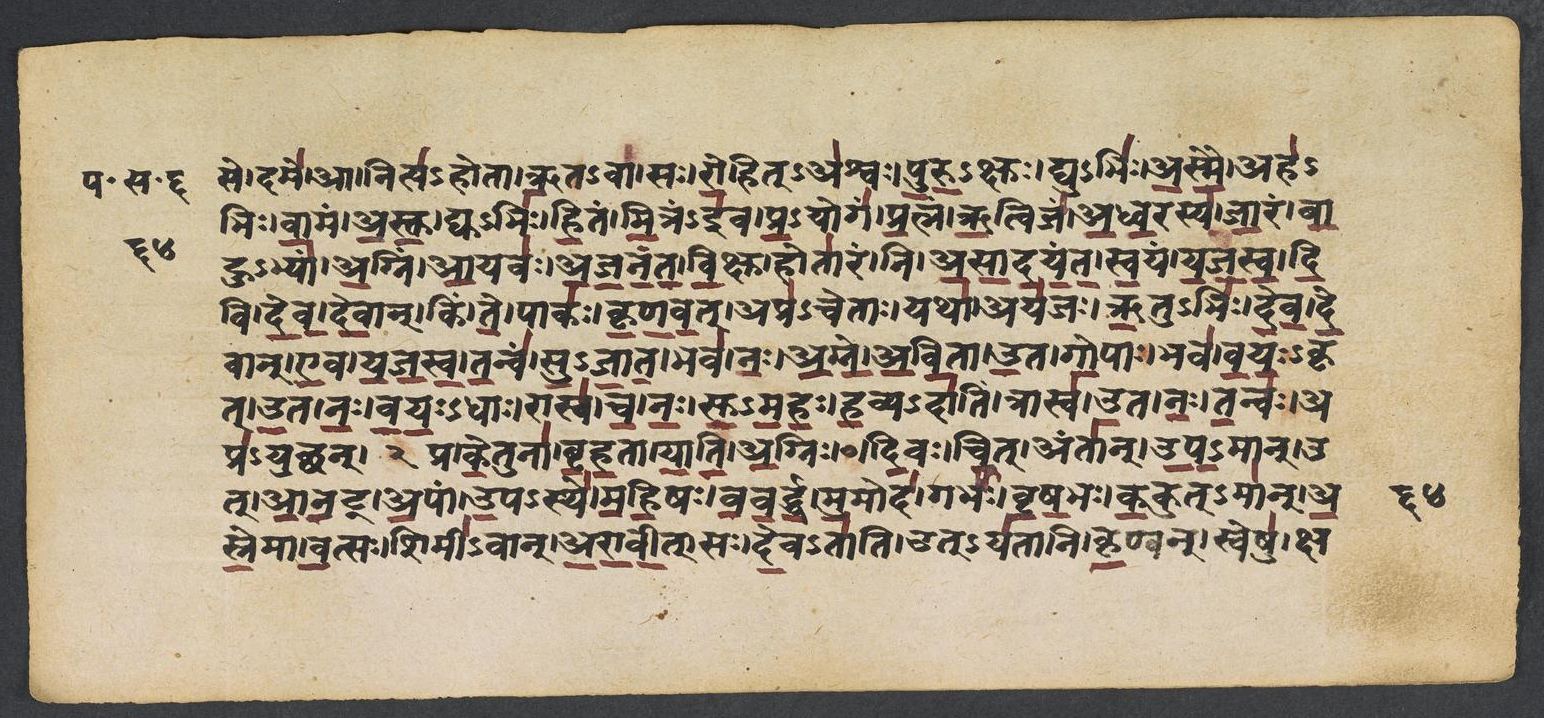
Penn Ms. Coll. 390 Item 41, fol. 747v (numbered 64v by the scribe) (OPenn image 748, upper leaf). Checked on the image: the Rigveda text on this page begins in RV 10.7.4 ‹-trāyase dame ā nitya-hotā›. The next page with Rigveda text, fol. 748r (numbered 65r by the scribe), begins in RV 10.8.2 ‹-kṣayeṣu prathamaḥ jigāti›. Verses 10.7.4-7 end on this page; 10.7.4 begins on fol. 747r (numbered 64r by the scribe).
4si̱dhrā a̍gne̱ dhiyo̍ a̱sme sanu̍trī̱r yaṁ trāya̍se̱ dama̱ ā nitya̍hotā | ṛ̱tāvā̱ sa ro̱hida̍śvaḥ puru̱kṣur dyubhi̍r asmā̱ aha̍bhir vā̱mam a̍stu ||
5dyubhi̍r hi̱tam mi̱tram i̍va pra̱yoga̍m pra̱tnam ṛ̱tvija̍m adhva̱rasya̍ jā̱ram | bā̱hubhyā̍m a̱gnim ā̱yavo̍ 'jananta vi̱kṣu hotā̍ra̱ṁ ny a̍sādayanta ||
6sva̱yaṁ ya̍jasva di̱vi de̍va de̱vān kiṁ te̱ pāka̍ḥ kṛṇava̱d apra̍cetāḥ | yathāya̍ja ṛ̱tubhi̍r deva de̱vān e̱vā ya̍jasva ta̱nva̍ṁ sujāta ||
7bhavā̍ no agne 'vi̱tota go̱pā bhavā̍ vaya̱skṛd u̱ta no̍ vayo̱dhāḥ | rāsvā̍ ca naḥ sumaho ha̱vyadā̍ti̱ṁ trāsvo̱ta na̍s ta̱nvo̱3̱̍ apra̍yucchan ||
Compare: Padapāṭha (word-by-word text written in the manuscript; Sansknet e-text via GRETIL)
4sidhrāḥ | agne | dhiyaḥ | asme iti | sanutrīḥ | yam | trāyase | dame | ā | nitya-hotā | ṛta-vā | saḥ | rohit-aśvaḥ | puru-kṣuḥ | dyu-bhiḥ | asmai | aha-bhiḥ | vāmam | astu
5dyu-bhiḥ | hitam | mitram-iva | pra-yogam | pratnam | ṛtvijam | adhvarasya | jāram | bāhu-bhyām | agnim | āyavaḥ | ajananta | vikṣu | hotāram | ni | asādayanta
6svayam | yajasva | divi | deva | devān | kim | te | pākaḥ | kṛṇavat | apra-cetāḥ | yathā | ayajaḥ | ṛtu-bhiḥ | deva | devān | eva | yajasva | tanvam | su-jāta
7bhava | naḥ | agne | avitā | uta | gopāḥ | bhava | vayaḥ-kṛt | uta | naḥ | vayaḥ-dhāḥ | rāsva | ca | naḥ | su-mahaḥ | havya-dātim | trāsva | uta | naḥ | tanvaḥ | apra-yucchan
4Effectual, Agni, are our prayers for profit. He whom, at home thou, Priest for ever, guardest Is rich in food, drawn by red steeds, and holy: by day and night to him shall all be pleasant.
5Men with their arms have generated Agni, helpful as some kind friend, adorned with splendours, And stablished as Invoker mid the people the ancient Priest the sacrifice's lover.
6Worship, thyself, O God, the Gods in heaven: what, void of knowledge, shall the fool avail thee? As thou, O God, hast worshipped Gods by seasons, so, nobly-born! to thine own self pay worship.
7Agni, be thou our Guardian and Protector bestow upon us life and vital vigour. Accept, O Mighty One, the gifts we offer, and with unceasing care protect our bodies.
Notes
- Sanskrit: Aufrecht's edition (1877) with the Vedic accents, as entered by van Nooten and Holland (GRETIL).
- English: Ralph T. H. Griffith, The Hymns of the Rigveda (1889-1892; 2nd ed. 1896-1897), from the VedaWeb digital text; OCR slips in that text were corrected against the printed 2nd edition (data/sources/rigveda/griffith_errata.json).
- Padapāṭha (edition text): Sansknet e-text via GRETIL (CC BY-NC-SA 4.0).
Cite
Sources
- Source: Penn Ms. Coll. 390 Item 41 (undated (catalogued with Penn's 18th-19th c. Vedic manuscripts)), OPenn, Public Domain Mark + Aufrecht's accented text (GRETIL) + Griffith's English (VedaWeb) (holding institution)
- Critical edition: Aufrecht (1877), accented e-text via GRETIL
← previous · → next · v cycle view · l back to library