Rigveda 10.9: To the waters
Introduction
Rigveda 10.9 is a hymn of 9 verses addressed to the waters. It stands in book (maṇḍala) 10, the last and latest book. The Rigveda is the oldest collection of Sanskrit hymns, composed in the second half of the second millennium BCE and handed down orally for many centuries before it was written down.
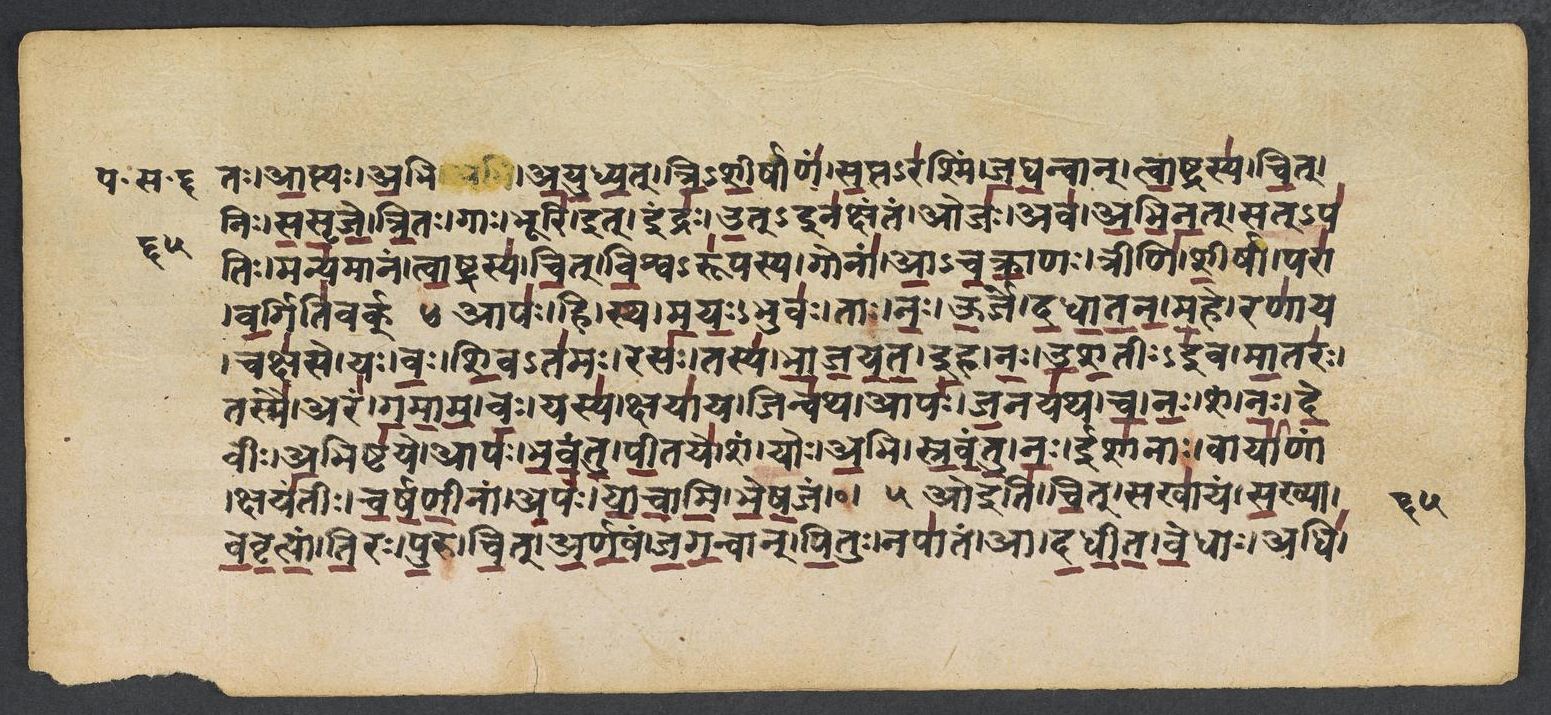
The manuscript shown is Penn Ms. Coll. 390 Item 41 (University of Pennsylvania), an undated paper manuscript of the padapāṭha (the word-by-word recitation text, in which every word is written separately and compounds are split) of the whole Ṛgveda in Devanāgarī, 884 leaves in fascicles, 7-9 lines to the page, accents in red; this hymn stands on fol. 748v. Each section below gives the verses that end on one page; the page boundaries were read on the images (the opening words of every page), not counted out. Where the manuscript is a padapāṭha (the word-by-word recitation text), the section shows Aufrecht's continuous (saṃhitā) text first and, as the edition text, the padapāṭha of the same verses, which is the form written on the page.
How was this verified? (Provenance)
Where on the image
Penn Ms. Coll. 390 Item 41, fol. 748v (numbered 65v by the scribe) (OPenn image 749, upper leaf). Checked on the image: the Rigveda text on this page begins in RV 10.8.8 ‹-indra-iṣitaḥ āptyaḥ abhi ayudhyat›. The next page with Rigveda text, fol. 749r (numbered 66r by the scribe), begins in RV 10.10.1 ‹kṣami pra-taram dīdhyānaḥ›. Verses 10.9.1-9 end on this page.
1āpo̱ hi ṣṭhā ma̍yo̱bhuva̱s tā na̍ ū̱rje da̍dhātana | ma̱he raṇā̍ya̱ cakṣa̍se ||
2yo va̍ḥ śi̱vata̍mo̱ rasa̱s tasya̍ bhājayate̱ha na̍ḥ | u̱śa̱tīr i̍va mā̱tara̍ḥ ||
3tasmā̱ ara̍ṁ gamāma vo̱ yasya̱ kṣayā̍ya̱ jinva̍tha | āpo̍ ja̱naya̍thā ca naḥ ||
4śaṁ no̍ de̱vīr a̱bhiṣṭa̍ya̱ āpo̍ bhavantu pī̱taye̍ | śaṁ yor a̱bhi sra̍vantu naḥ ||
5īśā̍nā̱ vāryā̍ṇā̱ṁ kṣaya̍ntīś carṣaṇī̱nām | a̱po yā̍cāmi bheṣa̱jam ||
6a̱psu me̱ somo̍ abravīd a̱ntar viśvā̍ni bheṣa̱jā | a̱gniṁ ca̍ vi̱śvaśa̍mbhuvam ||
7āpa̍ḥ pṛṇī̱ta bhe̍ṣa̱jaṁ varū̍thaṁ ta̱nve̱3̱̍ mama̍ | jyok ca̱ sūrya̍ṁ dṛ̱śe ||
8i̱dam ā̍pa̱ḥ pra va̍hata̱ yat kiṁ ca̍ duri̱tam mayi̍ | yad vā̱ham a̍bhidu̱droha̱ yad vā̍ śe̱pa u̱tānṛ̍tam ||
9āpo̍ a̱dyānv a̍cāriṣa̱ṁ rase̍na̱ sam a̍gasmahi | paya̍svān agna̱ ā ga̍hi̱ tam mā̱ saṁ sṛ̍ja̱ varca̍sā ||
Compare: Padapāṭha (word-by-word text written in the manuscript; Sansknet e-text via GRETIL)
1āpaḥ | hi | stha | mayaḥ-bhuvaḥ | tāḥ | naḥ | ūrje | dadhātana | mahe | raṇāya | cakṣase
2yaḥ | vaḥ | śiva-tamaḥ | rasaḥ | tasya | bhājayata | iha | naḥ | uśatīḥ-iva | mātaraḥ
3tasmai | aram | gamāma | vaḥ | yasya | kṣayāya | jinvatha | āpaḥ | janayatha | ca | naḥ
4śam | naḥ | devīḥ | abhiṣṭaye | āpaḥ | bhavantu | pītaye | śam | yoḥ | abhi | sravantu | naḥ
5īśānāḥ | vāryāṇām | kṣayantīḥ | carṣaṇīnām | apaḥ | yācāmi | bheṣajam
6ap-su | me | somaḥ | abravīt | antaḥ | viśvāni | bheṣajā | agnim | ca | viśva-śambhuvam
7āpaḥ | pṛṇīta | bheṣajam | varūtham | tanve | mama | jyok | ca | sūryam | dṛśe
8idam | āpaḥ | pra | vahata | yat | kim | ca | duḥ-itam | mayi | yat | vā | aham | abhi--dudroha | yat | vā | śepe | uta | anṛtam
9āpaḥ | adya | anu | acāriṣam | rasena | sam | agasmahi | payasvān | agne | ā | gahi | tam | mā | sam | sṛja | varcasā
1YE, Waters, are beneficent: so help ye us to energy That we may look on great delight.
2Give us a portion of the sap, the most auspicious that ye have, Like mothers in their longing love.
3To you we gladly come for him to whose abode ye send us on; And, Waters, give us procreant strength.
4The Waters. be to us for drink, Goddesses for our aid and bliss: Let them stream to us health and strength.
5I beg the Floods to give us balm, these Queens who rule o'er precious things, And have supreme control of men.
6Within the Waters-Soma thus hath told me-dwell all balms that heal, And Agni, he who blesseth all.
7O Waters, teem with medicine to keep my body safe from harm, So that I long may see the Sun.
8Whatever sin is found in me, whatever evil I have wrought, If I have lied or falsely sworn, Waters, remove it far from me.
9The Waters I this day have sought, and to their moisture have we come: O Agni, rich in milk, come thou, and with thy splendour cover me.
Notes
- Sanskrit: Aufrecht's edition (1877) with the Vedic accents, as entered by van Nooten and Holland (GRETIL).
- English: Ralph T. H. Griffith, The Hymns of the Rigveda (1889-1892; 2nd ed. 1896-1897), from the VedaWeb digital text; OCR slips in that text were corrected against the printed 2nd edition (data/sources/rigveda/griffith_errata.json).
- Padapāṭha (edition text): Sansknet e-text via GRETIL (CC BY-NC-SA 4.0).
Cite
Sources
- Source: Penn Ms. Coll. 390 Item 41 (undated (catalogued with Penn's 18th-19th c. Vedic manuscripts)), OPenn, Public Domain Mark + Aufrecht's accented text (GRETIL) + Griffith's English (VedaWeb) (holding institution)
- Critical edition: Aufrecht (1877), accented e-text via GRETIL
← previous · → next · v cycle view · l back to library