Rigveda 2.22: To Indra
Introduction
Rigveda 2.22 is a hymn of 4 verses addressed to Indra. It stands in book (maṇḍala) 2, the family book of Gṛtsamada. The Rigveda is the oldest collection of Sanskrit hymns, composed in the second half of the second millennium BCE and handed down orally for many centuries before it was written down.
The manuscript shown is Penn Ms. Coll. 390 Item 41 (University of Pennsylvania), an undated paper manuscript of the padapāṭha (the word-by-word recitation text, in which every word is written separately and compounds are split) of the whole Ṛgveda in Devanāgarī, 884 leaves in fascicles, 7-9 lines to the page, accents in red; this hymn stands on fol. 165v-166r. Each section below gives the verses that end on one page; the page boundaries were read on the images (the opening words of every page), not counted out. Where the manuscript is a padapāṭha (the word-by-word recitation text), the section shows Aufrecht's continuous (saṃhitā) text first and, as the edition text, the padapāṭha of the same verses, which is the form written on the page.
How was this verified? (Provenance)
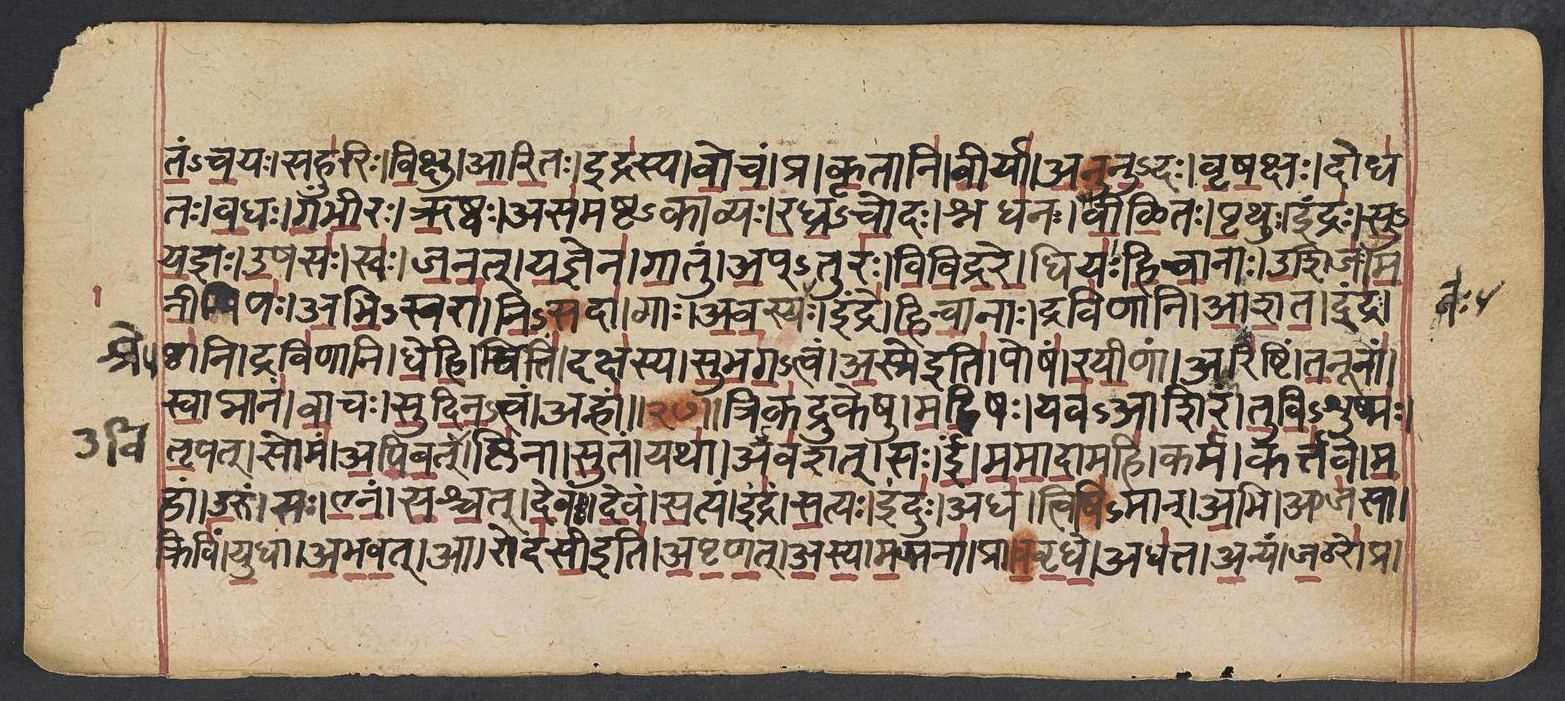
Where on the image
Penn Ms. Coll. 390 Item 41, fol. 165v (numbered 11v by the scribe) (OPenn image 167, upper leaf). Checked on the image: the Rigveda text on this page begins in RV 2.21.3 ‹-vṛtam-cayaḥ sahuriḥ vikṣu āritaḥ›. The next page with Rigveda text, fol. 166r (numbered 12r by the scribe), begins in RV 2.22.2 ‹-pra īm aricyata saḥ›. Verse 2.22.1 ends on this page.
1trika̍drukeṣu mahi̱ṣo yavā̍śiraṁ tuvi̱śuṣma̍s tṛ̱pat soma̍m apiba̱d viṣṇu̍nā su̱taṁ yathāva̍śat | sa ī̍m mamāda̱ mahi̱ karma̱ karta̍ve ma̱hām u̱ruṁ saina̍ṁ saścad de̱vo de̱vaṁ sa̱tyam indra̍ṁ sa̱tya indu̍ḥ ||
Compare: Padapāṭha (word-by-word text written in the manuscript; Sansknet e-text via GRETIL)
1tri-kadrukeṣu | mahiṣaḥ | yava-āśiram | tuvi-śuṣmaḥ | tṛpat | somam | apibat | viṣṇunā | sutam | yathā | avaśat | saḥ | īm | mamāda | mahi | karma | kartave | mahām | urum | saḥ | enam | saścat | devaḥ | devam | satyam | indram | satyaḥ | induḥ
1At the Trikadrukas the Great and Strong hath drunk drink blent with meal. With Vishṇu hath he quaffed the poured out Soma juice, all that he would. That hath so heightened him the Great, the Wide, to do his mighty work. So may the God attain the God, true Indu Indra who is true.
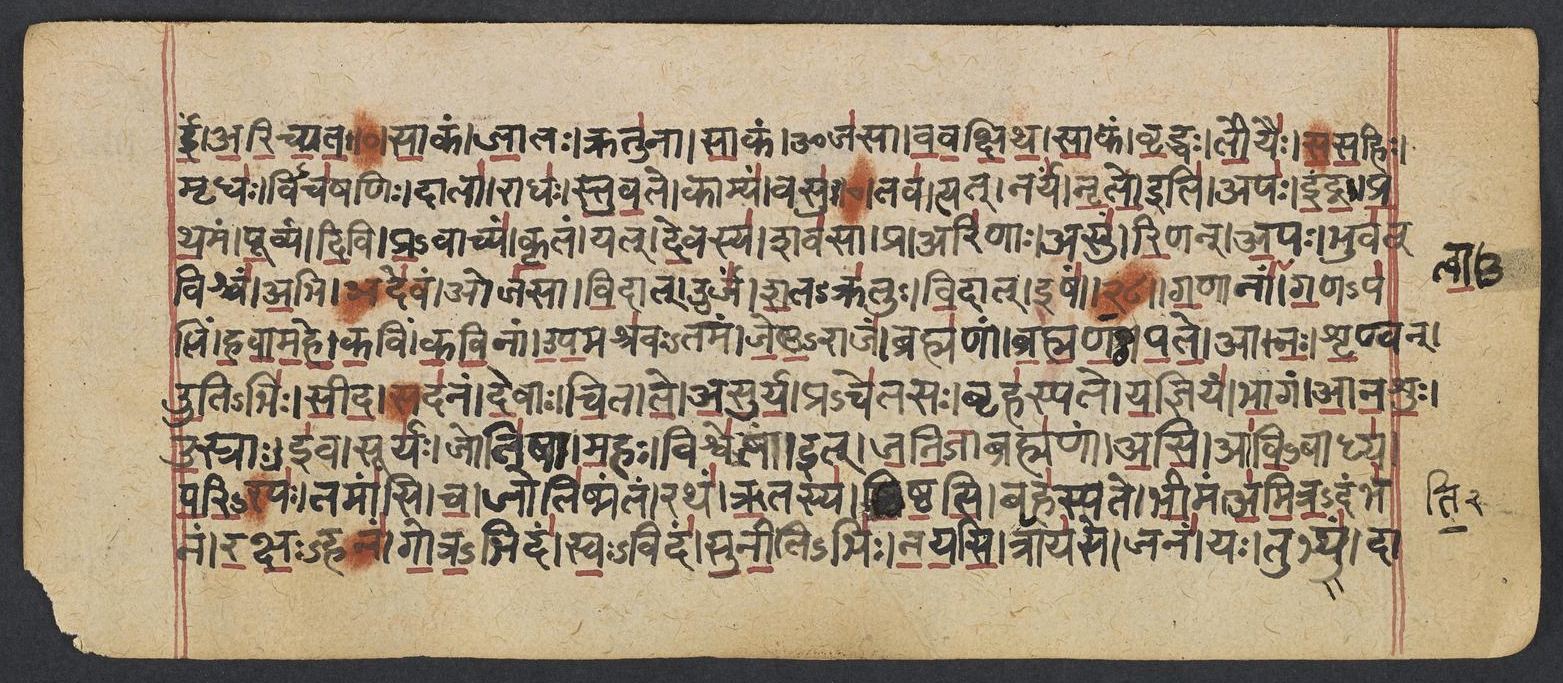
Where on the image
Penn Ms. Coll. 390 Item 41, fol. 166r (numbered 12r by the scribe) (OPenn image 167, lower leaf). Checked on the image: the Rigveda text on this page begins in RV 2.22.2 ‹-pra īm aricyata saḥ›. The next page with Rigveda text, fol. 166v (numbered 12v by the scribe), begins in RV 2.23.4 ‹na tam aṃhaḥ aśnavat›. Verses 2.22.2-4 end on this page; 2.22.2 begins on fol. 165v (numbered 11v by the scribe).
2adha̱ tviṣī̍mām̐ a̱bhy oja̍sā̱ krivi̍ṁ yu̱dhābha̍va̱d ā roda̍sī apṛṇad asya ma̱jmanā̱ pra vā̍vṛdhe | adha̍ttā̱nyaṁ ja̱ṭhare̱ prem a̍ricyata̱ saina̍ṁ saścad de̱vo de̱vaṁ sa̱tyam indra̍ṁ sa̱tya indu̍ḥ ||
3sā̱kaṁ jā̱taḥ kratu̍nā sā̱kam oja̍sā vavakṣitha sā̱kaṁ vṛ̱ddho vī̱ryai̍ḥ sāsa̱hir mṛdho̱ vica̍rṣaṇiḥ | dātā̱ rādha̍ḥ stuva̱te kāmya̱ṁ vasu̱ saina̍ṁ saścad de̱vo de̱vaṁ sa̱tyam indra̍ṁ sa̱tya indu̍ḥ ||
4tava̱ tyan narya̍ṁ nṛ̱to 'pa̍ indra pratha̱mam pū̱rvyaṁ di̱vi pra̱vācya̍ṁ kṛ̱tam | yad de̱vasya̱ śava̍sā̱ prāri̍ṇā̱ asu̍ṁ ri̱ṇann a̱paḥ | bhuva̱d viśva̍m a̱bhy āde̍va̱m oja̍sā vi̱dād ūrja̍ṁ śa̱takra̍tur vi̱dād iṣa̍m ||
Compare: Padapāṭha (word-by-word text written in the manuscript; Sansknet e-text via GRETIL)
2adha | tviṣi-mān | abhi | ojasā | krivim | yudhā | abhavat | ā | rodasī iti | apṛṇat | asya | majmanā | pra | vavṛdhe | adhatta | anyam | jaṭhare | pra | īm | aricyata | saḥ | enam | saścat | devaḥ | devam | satyam | indram | satyaḥ | induḥ
3sākam | jātaḥ | kratunā | sākam | ojasā | vavakṣitha | sākam | vṛddhaḥ | vīryaiḥ | sasahiḥ | mṛdhaḥ | vicarṣaṇiḥ | dātā | rādhaḥ | stuvate | kāmyam | vasu | saḥ | enam | saścat | devaḥ | devam | satyam | indram | satyaḥ | induḥ
4tava | tyat | naryam | nṛtaḥ | apa | indra | prathamam | pūrvyam | divi | pra-vācyam | kṛtam | yat | devasya | śavasā | pra | ariṇā | asum | riṇan | apaḥ | bhuvat | viśvam | abhi | adevam | ojasā | vidāt | ūrjam | śata-kratuḥ | vidāt | iṣam
2So he resplendent in the battle overcame Krivi by might. He with his majesty hath filled the earth and heaven, and waxen strong. One share of the libation hath he swallowed down: one share he left. So may the God attend the God, true Indu Indra who is true.
3Brought forth together with wisdom and mighty power thou grewest great; with hero deeds subduing the malevolent, most swift in act; Giving prosperity, and lovely wealth to him who praiseth thee. So may the God attend the God, true Indu Indra who is true.
4This, Indra, was thy hero deed, Dancer, thy first and ancient work, worthy to be told forth in heaven, What time thou sentest down life with a God's own power, freeing the floods. All that is godless may he conquer with his might, and, Lord of Hundred Powers, find for us strength and food.
Notes
- Sanskrit: Aufrecht's edition (1877) with the Vedic accents, as entered by van Nooten and Holland (GRETIL).
- English: Ralph T. H. Griffith, The Hymns of the Rigveda (1889-1892; 2nd ed. 1896-1897), from the VedaWeb digital text; OCR slips in that text were corrected against the printed 2nd edition (data/sources/rigveda/griffith_errata.json).
- Padapāṭha (edition text): Sansknet e-text via GRETIL (CC BY-NC-SA 4.0).
Cite
Sources
- Source: Penn Ms. Coll. 390 Item 41 (undated (catalogued with Penn's 18th-19th c. Vedic manuscripts)), OPenn, Public Domain Mark + Aufrecht's accented text (GRETIL) + Griffith's English (VedaWeb) (holding institution)
- Critical edition: Aufrecht (1877), accented e-text via GRETIL
← previous · → next · v cycle view · l back to library