Rigveda 2.25: To Brahmanaspati
Introduction
Rigveda 2.25 is a hymn of 5 verses addressed to Brahmanaspati. It stands in book (maṇḍala) 2, the family book of Gṛtsamada. The Rigveda is the oldest collection of Sanskrit hymns, composed in the second half of the second millennium BCE and handed down orally for many centuries before it was written down.
The manuscript shown is Penn Ms. Coll. 390 Item 41 (University of Pennsylvania), an undated paper manuscript of the padapāṭha (the word-by-word recitation text, in which every word is written separately and compounds are split) of the whole Ṛgveda in Devanāgarī, 884 leaves in fascicles, 7-9 lines to the page, accents in red; this hymn stands on fol. 169r-169v. Each section below gives the verses that end on one page; the page boundaries were read on the images (the opening words of every page), not counted out. Where the manuscript is a padapāṭha (the word-by-word recitation text), the section shows Aufrecht's continuous (saṃhitā) text first and, as the edition text, the padapāṭha of the same verses, which is the form written on the page.
How was this verified? (Provenance)
Where on the image
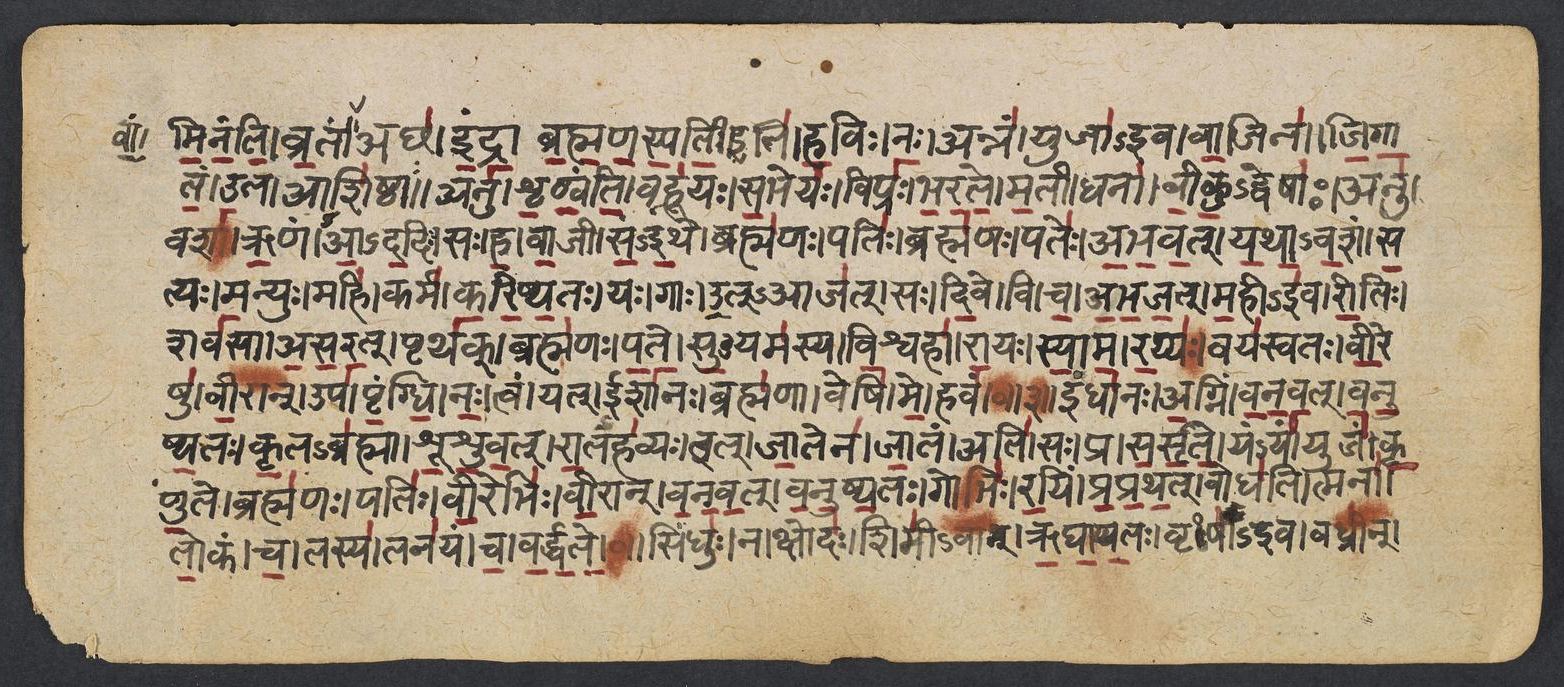
Penn Ms. Coll. 390 Item 41, fol. 169r (numbered 2r by the scribe) (OPenn image 170, lower leaf). Checked on the image: the Rigveda text on this page begins in RV 2.24.12 ‹minanti vratam vām accha›. The next page with Rigveda text, fol. 169v (numbered 2v by the scribe), begins in RV 2.25.3 ‹abhi vaṣṭi ojasā agneḥ-iva›. Verses 2.25.1-2 end on this page.
1indhā̍no a̱gniṁ va̍navad vanuṣya̱taḥ kṛ̱tabra̍hmā śūśuvad rā̱taha̍vya̱ it | jā̱tena̍ jā̱tam ati̱ sa pra sa̍rsṛte̱ yaṁ-ya̱ṁ yuja̍ṁ kṛṇu̱te brahma̍ṇa̱s pati̍ḥ ||
2vī̱rebhi̍r vī̱rān va̍navad vanuṣya̱to gobhī̍ ra̱yim pa̍pratha̱d bodha̍ti̱ tmanā̍ | to̱kaṁ ca̱ tasya̱ tana̍yaṁ ca vardhate̱ yaṁ-ya̱ṁ yuja̍ṁ kṛṇu̱te brahma̍ṇa̱s pati̍ḥ ||
Compare: Padapāṭha (word-by-word text written in the manuscript; Sansknet e-text via GRETIL)
1indhānaḥ | agnim | vanavat | vanuṣyataḥ | kṛta-brahmā | śūśuvat | rāta-havyaḥ | it | jātena | jātam | ati | saḥ | pra | sarsṛte | yam-yam | yujam | kṛṇute | brahmaṇaḥ | patiḥ
2vīrebhiḥ | vīrān | vanavat | vanuṣyataḥ | gobhiḥ | rayim | paprathat | bodhati | tmanā | tokam | ca | tasya | tanayam | ca | vardhate | yam-yam | yujam | kṛṇute | brahmaṇaḥ | patiḥ
1HE lighting up the flame shall conquer enemies: strong shall he be who offers prayer and brings his gift. He with his seed spreads forth beyond another's seed, whomever Brahmaṇaspati takes for his friend.
2With heroes he shall overcome his hero foes, and spread his wealth by kine wise by himself is be. His children and his children's children grow in strength, whomever Brahmaṇaspati takes for his friend.
Where on the image
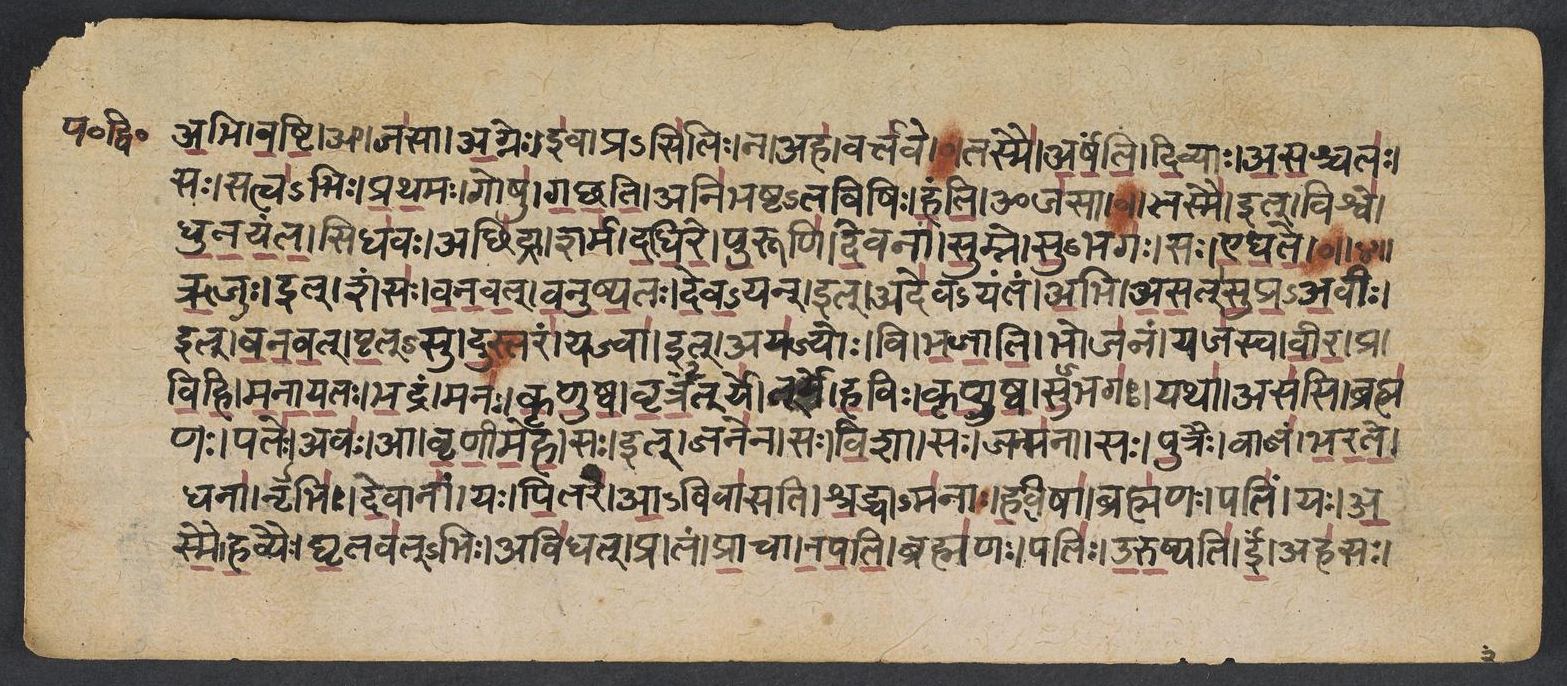
Penn Ms. Coll. 390 Item 41, fol. 169v (numbered 2v by the scribe) (OPenn image 171, upper leaf). Checked on the image: the Rigveda text on this page begins in RV 2.25.3 ‹abhi vaṣṭi ojasā agneḥ-iva›. The next page with Rigveda text, fol. 170r (numbered 3r by the scribe), begins in RV 2.26.4 ‹rakṣati riṣaḥ aṃhoḥ cit›. Verses 2.25.3-5 end on this page; 2.25.3 begins on fol. 169r (numbered 2r by the scribe).
3sindhu̱r na kṣoda̱ḥ śimī̍vām̐ ṛghāya̱to vṛṣe̍va̱ vadhrī̍m̐r a̱bhi va̱ṣṭy oja̍sā | a̱gner i̍va̱ prasi̍ti̱r nāha̱ varta̍ve̱ yaṁ-ya̱ṁ yuja̍ṁ kṛṇu̱te brahma̍ṇa̱s pati̍ḥ ||
4tasmā̍ arṣanti di̱vyā a̍sa̱ścata̱ḥ sa satva̍bhiḥ pratha̱mo goṣu̍ gacchati | ani̍bhṛṣṭataviṣir ha̱nty oja̍sā̱ yaṁ-ya̱ṁ yuja̍ṁ kṛṇu̱te brahma̍ṇa̱s pati̍ḥ ||
5tasmā̱ id viśve̍ dhunayanta̱ sindha̱vo 'cchi̍drā̱ śarma̍ dadhire pu̱rūṇi̍ | de̱vānā̍ṁ su̱mne su̱bhaga̱ḥ sa e̍dhate̱ yaṁ-ya̱ṁ yuja̍ṁ kṛṇu̱te brahma̍ṇa̱s pati̍ḥ ||
Compare: Padapāṭha (word-by-word text written in the manuscript; Sansknet e-text via GRETIL)
3sindhuḥ | na | kṣodaḥ | śimī-vān | ṛghāyataḥ | vṛṣāiva | vadhrīn | abhi | vaṣṭi | ojasā | agneḥ-iva | pra-sitiḥ | na | aha | vartave | yam-yam | yujam | kṛṇute | brahmaṇaḥ | patiḥ
4tasmai | arṣanti | divyāḥ | asaścataḥ | saḥ | satva-bhiḥ | prathamaḥ | goṣu | gacchati | anibhṛṣṭa-taviṣiḥ | hanti | ojasā | yam-yam | yujam | kṛṇute | brahmaṇaḥ | patiḥ
5tasmai | it | viśve | dhunayanta | sindhavaḥ | acchidrā | śarma | dadhire | purūṇi | devānām | sumne | su-bhagaḥ | saḥ | edhate | yam-yam | yujam | kṛṇute | brahmaṇaḥ | patiḥ
3He, mighty like a raving river's billowy flood, as a bull conquers oxen, overcomes with strength. Like Agni's blazing rush he may not be restrained, whomever Brahmaṇaspati takes for his friend.
4For him the floods of heaven flow never failing down: first with the heroes he goes forth to war for kine. He slays in unabated vigour with great might, whomever Brahmaṇaspati takes for his friend.
5All roaring rivers pour their waters down for him, and many a flawless shelter hath been granted him. Blest with the happiness of Gods he prospers well, whomever Brahmaṇaspati takes for his friend.
Notes
- Sanskrit: Aufrecht's edition (1877) with the Vedic accents, as entered by van Nooten and Holland (GRETIL).
- English: Ralph T. H. Griffith, The Hymns of the Rigveda (1889-1892; 2nd ed. 1896-1897), from the VedaWeb digital text; OCR slips in that text were corrected against the printed 2nd edition (data/sources/rigveda/griffith_errata.json).
- Padapāṭha (edition text): Sansknet e-text via GRETIL (CC BY-NC-SA 4.0).
Cite
Sources
- Source: Penn Ms. Coll. 390 Item 41 (undated (catalogued with Penn's 18th-19th c. Vedic manuscripts)), OPenn, Public Domain Mark + Aufrecht's accented text (GRETIL) + Griffith's English (VedaWeb) (holding institution)
- Critical edition: Aufrecht (1877), accented e-text via GRETIL
← previous · → next · v cycle view · l back to library