Rigveda 2.26: To Brahmanaspati
Introduction
Rigveda 2.26 is a hymn of 4 verses addressed to Brahmanaspati. It stands in book (maṇḍala) 2, the family book of Gṛtsamada. The Rigveda is the oldest collection of Sanskrit hymns, composed in the second half of the second millennium BCE and handed down orally for many centuries before it was written down.
The manuscript shown is Penn Ms. Coll. 390 Item 41 (University of Pennsylvania), an undated paper manuscript of the padapāṭha (the word-by-word recitation text, in which every word is written separately and compounds are split) of the whole Ṛgveda in Devanāgarī, 884 leaves in fascicles, 7-9 lines to the page, accents in red; this hymn stands on fol. 169v-170r. Each section below gives the verses that end on one page; the page boundaries were read on the images (the opening words of every page), not counted out. Where the manuscript is a padapāṭha (the word-by-word recitation text), the section shows Aufrecht's continuous (saṃhitā) text first and, as the edition text, the padapāṭha of the same verses, which is the form written on the page.
How was this verified? (Provenance)
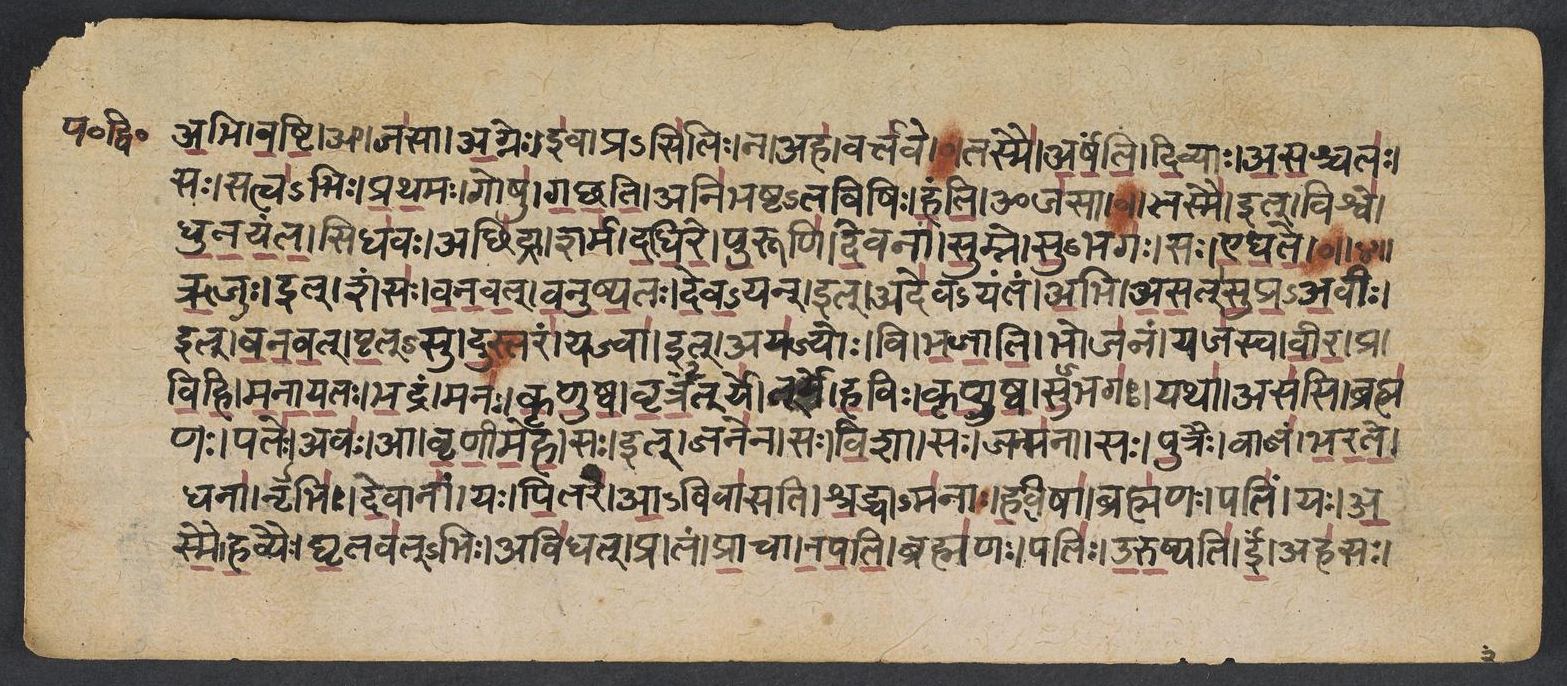
Where on the image
Penn Ms. Coll. 390 Item 41, fol. 169v (numbered 2v by the scribe) (OPenn image 171, upper leaf). Checked on the image: the Rigveda text on this page begins in RV 2.25.3 ‹abhi vaṣṭi ojasā agneḥ-iva›. The next page with Rigveda text, fol. 170r (numbered 3r by the scribe), begins in RV 2.26.4 ‹rakṣati riṣaḥ aṃhoḥ cit›. Verses 2.26.1-3 end on this page.
1ṛ̱jur ic chaṁso̍ vanavad vanuṣya̱to de̍va̱yann id ade̍vayantam a̱bhy a̍sat | su̱prā̱vīr id va̍navat pṛ̱tsu du̱ṣṭara̱ṁ yajved aya̍jyo̱r vi bha̍jāti̱ bhoja̍nam ||
2yaja̍sva vīra̱ pra vi̍hi manāya̱to bha̱dram mana̍ḥ kṛṇuṣva vṛtra̱tūrye̍ | ha̱viṣ kṛ̍ṇuṣva su̱bhago̱ yathāsa̍si̱ brahma̍ṇa̱s pate̱r ava̱ ā vṛ̍ṇīmahe ||
3sa ij jane̍na̱ sa vi̱śā sa janma̍nā̱ sa pu̱trair vāja̍m bharate̱ dhanā̱ nṛbhi̍ḥ | de̱vānā̱ṁ yaḥ pi̱tara̍m ā̱vivā̍sati śra̱ddhāma̍nā ha̱viṣā̱ brahma̍ṇa̱s pati̍m ||
Compare: Padapāṭha (word-by-word text written in the manuscript; Sansknet e-text via GRETIL)
1ṛjuḥ | it | śaṃsaḥ | vanavat | vanuṣyataḥ | devayan | it | adeva-yantam | abhi | asat | supra-avīḥ | it | vanavat | pṛt-su | dustaram | yajvā | it | ayajyoḥ | vi | bhajāti | bhojanam
2yajasva | vīra | pra | vihi | manāyataḥ | bhadram | manaḥ | kṛṇuṣva | vṛtra-tūrye | haviḥ | kṛṇuṣva | su-bhagaḥ | yathā | asasi | brahmaṇaḥ | pateḥ | avaḥ | ā | vṛṇīmahe
3saḥ | it | janena | saḥ | viśā | saḥ | janmanā | saḥ | putraiḥ | vājam | bharate | dhanā | nṛ-bhiḥ | devānām | yaḥ | pitaram | āvivāsati | śraddhāmanāḥ | haviṣā | brahmaṇaḥ | patim
1THE righteous singer shall o'ercome his enemies, and he who serves the Gods subdue the godless man. The zealous man shall vanquish the invincible, the worshipper share the food of him who worships not.
2Worship, thou hero, chase the arrogant afar: put on auspicious courage for the fight with foes. Prepare oblation so that thou mayst have success. we crave the favouring help of Brahmaṇaspati.
3He with his folk, his house, his family, his sons, gains booty for himself, and, with the heroes, wealth,believing Who with oblation and a true heart serves Brahmaṇaspati the Father of the Gods.
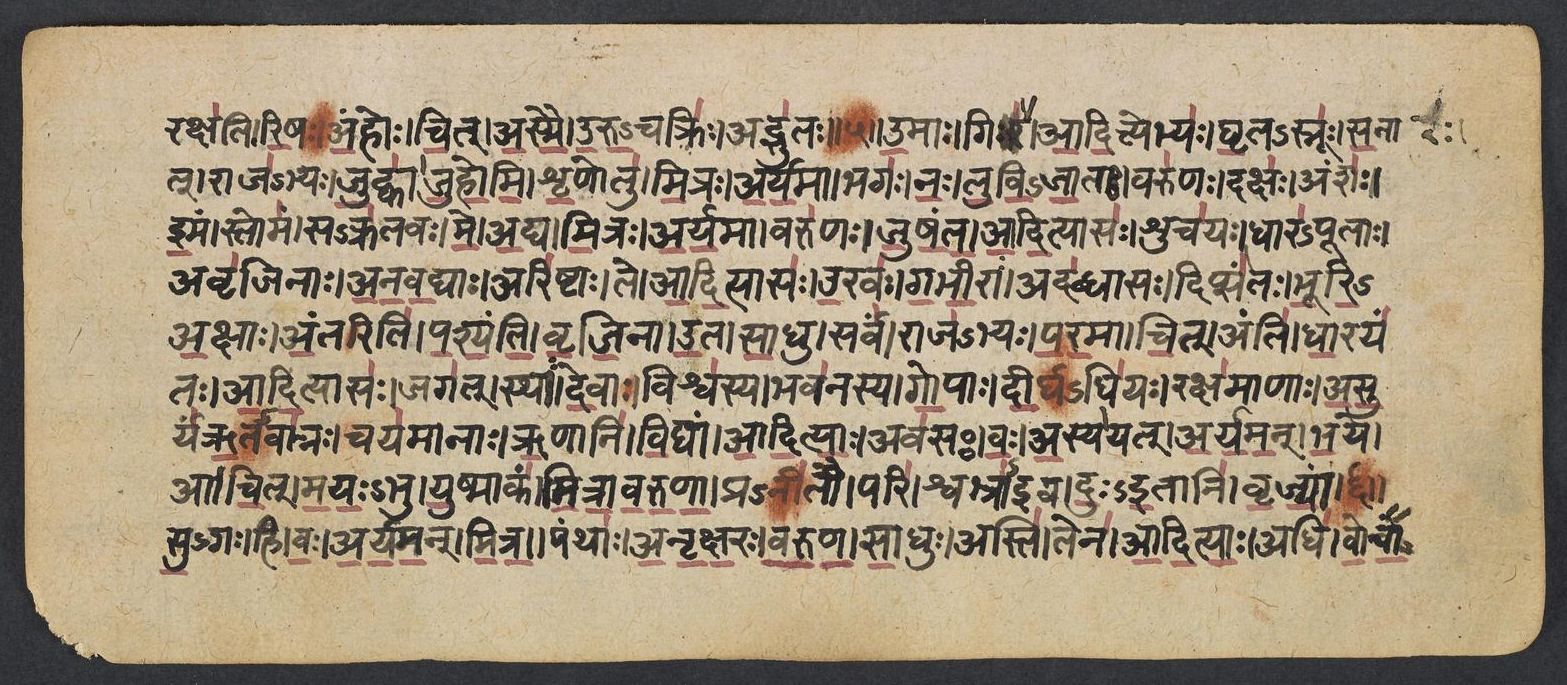
Where on the image
Penn Ms. Coll. 390 Item 41, fol. 170r (numbered 3r by the scribe) (OPenn image 171, lower leaf). Checked on the image: the Rigveda text on this page begins in RV 2.26.4 ‹rakṣati riṣaḥ aṃhoḥ cit›. The next page with Rigveda text, fol. 170v (numbered 3v by the scribe), begins in RV 2.27.6 ‹-vocata naḥ yacchata naḥ›. Verse 2.26.4 ends on this page; 2.26.4 begins on fol. 169v (numbered 2v by the scribe).
4yo a̍smai ha̱vyair ghṛ̱tava̍dbhi̱r avi̍dha̱t pra tam prā̱cā na̍yati̱ brahma̍ṇa̱s pati̍ḥ | u̱ru̱ṣyatī̱m aṁha̍so̱ rakṣa̍tī ri̱ṣo̱3̱̍ 'ṁhoś ci̍d asmā uru̱cakri̱r adbhu̍taḥ ||
Compare: Padapāṭha (word-by-word text written in the manuscript; Sansknet e-text via GRETIL)
4yaḥ | asmai | havyaiḥ | ghṛtavat-bhiḥ | avidhat | pra | tam | prācā | nayati | brahmaṇaḥ | patiḥ | uruṣyatīm | aṃhasaḥ | rakṣati | riṣaḥ | aṃhoḥ | cit | asmai | uru-cakriḥ | adbhutaḥ
4Whoso hath honoured him with offerings rich in oil, him Brahmaṇaspati leads forward on his way, Saves him from sorrow, frees him from his enemy, and is his wonderful deliverer from woe.
Notes
- Sanskrit: Aufrecht's edition (1877) with the Vedic accents, as entered by van Nooten and Holland (GRETIL).
- English: Ralph T. H. Griffith, The Hymns of the Rigveda (1889-1892; 2nd ed. 1896-1897), from the VedaWeb digital text; OCR slips in that text were corrected against the printed 2nd edition (data/sources/rigveda/griffith_errata.json).
- Padapāṭha (edition text): Sansknet e-text via GRETIL (CC BY-NC-SA 4.0).
Cite
Sources
- Source: Penn Ms. Coll. 390 Item 41 (undated (catalogued with Penn's 18th-19th c. Vedic manuscripts)), OPenn, Public Domain Mark + Aufrecht's accented text (GRETIL) + Griffith's English (VedaWeb) (holding institution)
- Critical edition: Aufrecht (1877), accented e-text via GRETIL
← previous · → next · v cycle view · l back to library