Rigveda 2.37: Cycle of the gods
Introduction
Rigveda 2.37 is a hymn of 6 verses addressed to cycle of the gods. It stands in book (maṇḍala) 2, the family book of Gṛtsamada. The Rigveda is the oldest collection of Sanskrit hymns, composed in the second half of the second millennium BCE and handed down orally for many centuries before it was written down.
The manuscript shown is Penn Ms. Coll. 390 Item 41 (University of Pennsylvania), an undated paper manuscript of the padapāṭha (the word-by-word recitation text, in which every word is written separately and compounds are split) of the whole Ṛgveda in Devanāgarī, 884 leaves in fascicles, 7-9 lines to the page, accents in red; this hymn stands on fol. 179r-179v. Each section below gives the verses that end on one page; the page boundaries were read on the images (the opening words of every page), not counted out. Where the manuscript is a padapāṭha (the word-by-word recitation text), the section shows Aufrecht's continuous (saṃhitā) text first and, as the edition text, the padapāṭha of the same verses, which is the form written on the page.
How was this verified? (Provenance)
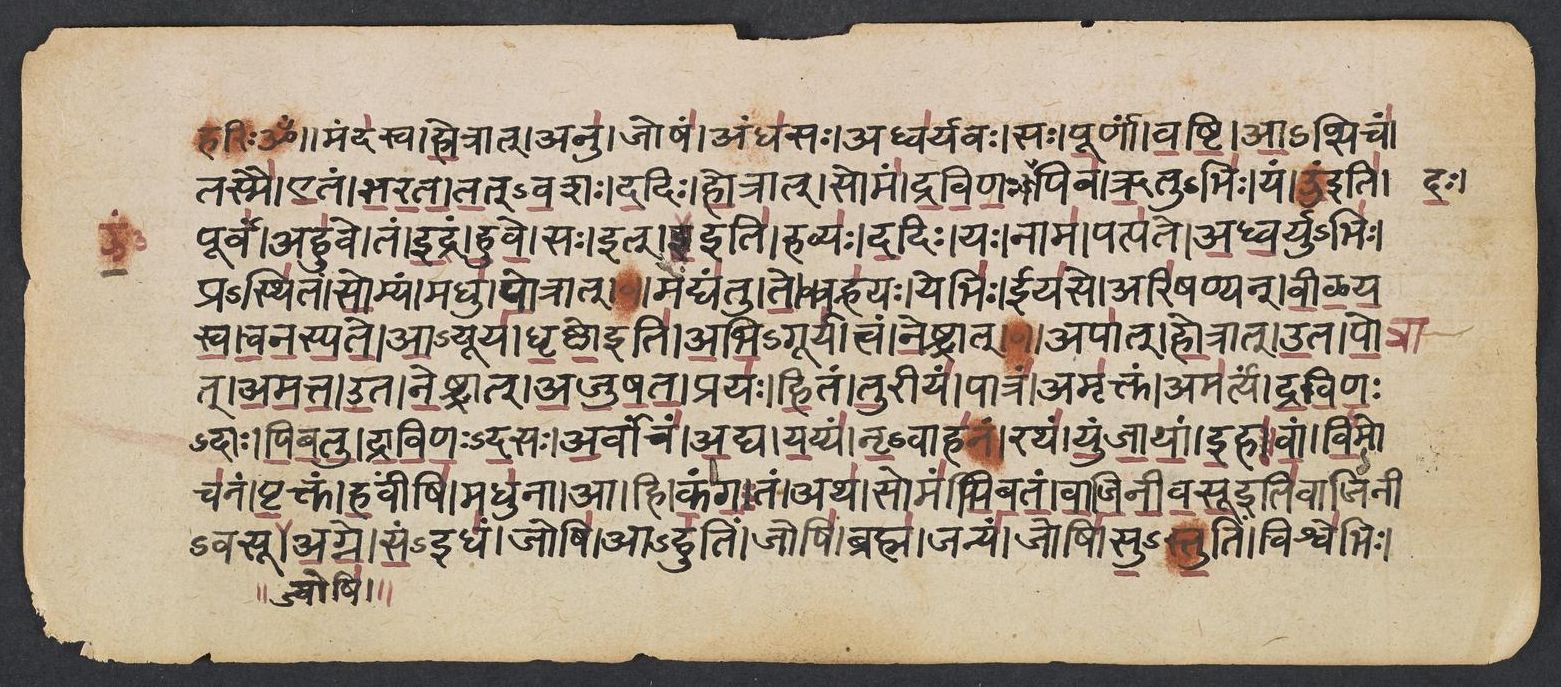
Where on the image
Penn Ms. Coll. 390 Item 41, fol. 179r (numbered 1r by the scribe) (OPenn image 180, lower leaf). Checked on the image: the Rigveda text on this page begins in RV 2.37.1 ‹mandasva hotrāt anu joṣam›. Line 1 opens with hariḥ oṃ, then 2.37.1 (mandasva hotrāt anu joṣam andhasaḥ). The next page with Rigveda text, fol. 179v (numbered 1v by the scribe), begins in RV 2.37.6 ‹viśvān ṛtunā vaso iti›. Verses 2.37.1-5 end on this page.
1manda̍sva ho̱trād anu̱ joṣa̱m andha̱so 'dhva̍ryava̱ḥ sa pū̱rṇāṁ va̍ṣṭy ā̱sica̍m | tasmā̍ e̱tam bha̍rata tadva̱śo da̱dir ho̱trāt soma̍ṁ draviṇoda̱ḥ piba̍ ṛ̱tubhi̍ḥ ||
2yam u̱ pūrva̱m ahu̍ve̱ tam i̱daṁ hu̍ve̱ sed u̱ havyo̍ da̱dir yo nāma̱ patya̍te | a̱dhva̱ryubhi̱ḥ prasthi̍taṁ so̱myam madhu̍ po̱trāt soma̍ṁ draviṇoda̱ḥ piba̍ ṛ̱tubhi̍ḥ ||
3medya̍ntu te̱ vahna̍yo̱ yebhi̱r īya̱se 'ri̍ṣaṇyan vīḻayasvā vanaspate | ā̱yūyā̍ dhṛṣṇo abhi̱gūryā̱ tvaṁ ne̱ṣṭrāt soma̍ṁ draviṇoda̱ḥ piba̍ ṛ̱tubhi̍ḥ ||
4apā̍d dho̱trād u̱ta po̱trād a̍matto̱ta ne̱ṣṭrād a̍juṣata̱ prayo̍ hi̱tam | tu̱rīya̱m pātra̱m amṛ̍kta̱m ama̍rtyaṁ draviṇo̱dāḥ pi̍batu drāviṇoda̱saḥ ||
5a̱rvāñca̍m a̱dya ya̱yya̍ṁ nṛ̱vāha̍ṇa̱ṁ ratha̍ṁ yuñjāthām i̱ha vā̍ṁ vi̱moca̍nam | pṛ̱ṅktaṁ ha̱vīṁṣi̱ madhu̱nā hi ka̍ṁ ga̱tam athā̱ soma̍m pibataṁ vājinīvasū ||
Compare: Padapāṭha (word-by-word text written in the manuscript; Sansknet e-text via GRETIL)
1mandasva | hotrāt | anu | joṣam | andhasaḥ | adhvaryavaḥ | saḥ | pūrṇām | vaṣṭi | āsicam | tasmai | etam | bharata | tat-vaśaḥ | dadiḥ | hotrāt | somam | draviṇaḥ-daḥ | piba | ṛtu-bhiḥ
2yam | oṃ iti | pūrvam | ahuve | tam | idam | huve | saḥ | it | / oṃ iti | havyaḥ | dadiḥ | yaḥ | nāma | patyate | adhvaryu-bhiḥ | pra-sthitam | somyam | madhu | potrāt | somam | draviṇaḥ-daḥ | piba | ṛtu-bhiḥ
3medyantu | te | vahnayaḥ | yebhiḥ | īyase | ariṣaṇyan | vīḷayasva | vanaspate | āyūya | dhṛṣṇo iti | abhi-gūrya | tvam | neṣṭrāt | somam | draviṇaḥ-daḥ | piba | ṛtu-bhiḥ
4apāt | hotrāt | uta | potrāt | amatta | uta | neṣṭrāt | ajuṣata | prayaḥ | hitam | turīyam | pātram | amṛktam | amartyam | draviṇaḥ-dāḥ | pibatu | drāviṇodasaḥ
5arvāñcam | adya | yayyam | nṛ-vāhanam | ratham | yuñjāthām | iha | vām | vi-mocanam | pṛṅktam | havīṃṣi | madhunā | ā | hi | kam | gatam | atha | somam | pibatam | vājinīvasūitivājinī-vasū
1Enjoy thy fill of meath out of the Hotar's cup: Adhvaryus he desires a full draught poured for him. Bring it him: seeking this he gives. Granter of Wealth, drink Soma with the Rtus from the Hotar's cup.
2He whom of old I called on, him I call on now. He is to be invoked; his name is He who Gives, Here brought by priests is Soma meath. Granter of Wealth, drink Soma with the Rtus from the Potar's cup.
3Fat may the horses be wherewith thou speedest on: Lord of the Wood, unharming, strengthen thou thyself. Drawing and seizing, Bold One, thou who grantest wealth, drink Soma with the Rtus from the Neshṭar's cup.
4From Hotar's cup and Potar's he hath drunk and joyed: the proffered food hath pleased him from the Neshṭar's bowl. The fourth cup undisturbed, immortal, let him drink who giveth wealth, the cup of the wealth-giving God.
5Yoke, O ye Twain, to-day your hero-bearing car, swift-moving hitherward: your loosing-place is here. Mix the oblations, then come hither with the meath, and drink the Soma, ye rich in abundant strength.
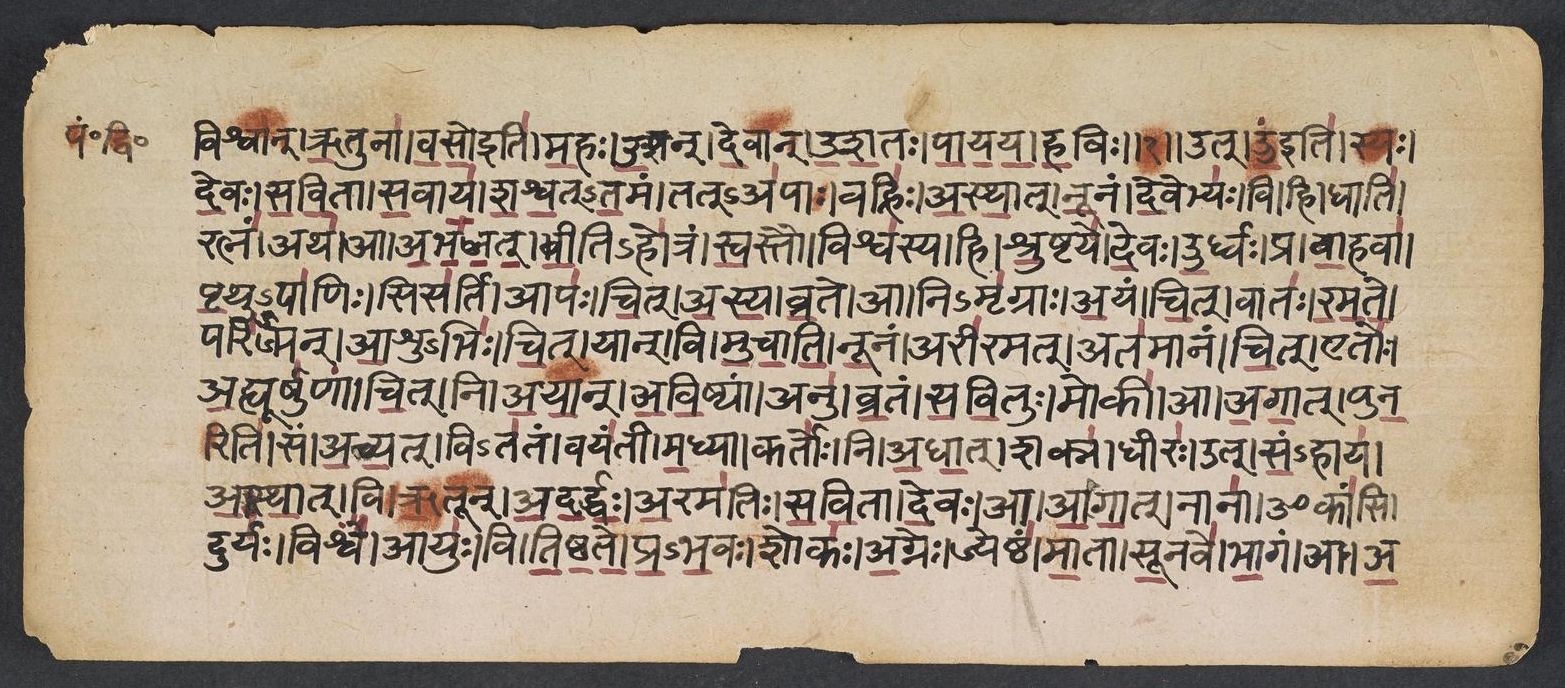
Where on the image
Penn Ms. Coll. 390 Item 41, fol. 179v (numbered 1v by the scribe) (OPenn image 181, upper leaf). Checked on the image: the Rigveda text on this page begins in RV 2.37.6 ‹viśvān ṛtunā vaso iti›. The next page with Rigveda text, fol. 180r (numbered 2r by the scribe), begins in RV 2.38.5 ‹-adhāt anu asya ketam›. Verse 2.37.6 ends on this page; 2.37.6 begins on fol. 179r (numbered 1r by the scribe).
6joṣy a̍gne sa̱midha̱ṁ joṣy āhu̍ti̱ṁ joṣi̱ brahma̱ janya̱ṁ joṣi̍ suṣṭu̱tim | viśve̍bhi̱r viśvā̍m̐ ṛ̱tunā̍ vaso ma̱ha u̱śan de̱vām̐ u̍śa̱taḥ pā̍yayā ha̱viḥ ||
Compare: Padapāṭha (word-by-word text written in the manuscript; Sansknet e-text via GRETIL)
6joṣi | agne | sam-idham | joṣi | āhutim | joṣi | brahma | janyam | joṣi | su-stutim | viśvebhiḥ | viśvān | ṛtunā | vaso iti | mahaḥ | uśan | devān | uśataḥ | pāyaya | haviḥ
6Agni, accept the fuel and our offered gift: accept the prayer of man, accept our eulogy, Do thou with all, with Rtu, O thou Excellent, fain, make the great Gods all fain taste the gift we bring.
Notes
- Sanskrit: Aufrecht's edition (1877) with the Vedic accents, as entered by van Nooten and Holland (GRETIL).
- English: Ralph T. H. Griffith, The Hymns of the Rigveda (1889-1892; 2nd ed. 1896-1897), from the VedaWeb digital text; OCR slips in that text were corrected against the printed 2nd edition (data/sources/rigveda/griffith_errata.json).
- Padapāṭha (edition text): Sansknet e-text via GRETIL (CC BY-NC-SA 4.0).
Cite
Sources
- Source: Penn Ms. Coll. 390 Item 41 (undated (catalogued with Penn's 18th-19th c. Vedic manuscripts)), OPenn, Public Domain Mark + Aufrecht's accented text (GRETIL) + Griffith's English (VedaWeb) (holding institution)
- Critical edition: Aufrecht (1877), accented e-text via GRETIL
← previous · → next · v cycle view · l back to library