Rigveda 2.43: Bird of omen
Introduction
Rigveda 2.43 is a hymn of 3 verses addressed to bird of omen. It stands in book (maṇḍala) 2, the family book of Gṛtsamada. The Rigveda is the oldest collection of Sanskrit hymns, composed in the second half of the second millennium BCE and handed down orally for many centuries before it was written down.
The manuscript shown is Penn Ms. Coll. 390 Item 41 (University of Pennsylvania), an undated paper manuscript of the padapāṭha (the word-by-word recitation text, in which every word is written separately and compounds are split) of the whole Ṛgveda in Devanāgarī, 884 leaves in fascicles, 7-9 lines to the page, accents in red; this hymn stands on fol. 182v-183r. Each section below gives the verses that end on one page; the page boundaries were read on the images (the opening words of every page), not counted out. Where the manuscript is a padapāṭha (the word-by-word recitation text), the section shows Aufrecht's continuous (saṃhitā) text first and, as the edition text, the padapāṭha of the same verses, which is the form written on the page.
How was this verified? (Provenance)
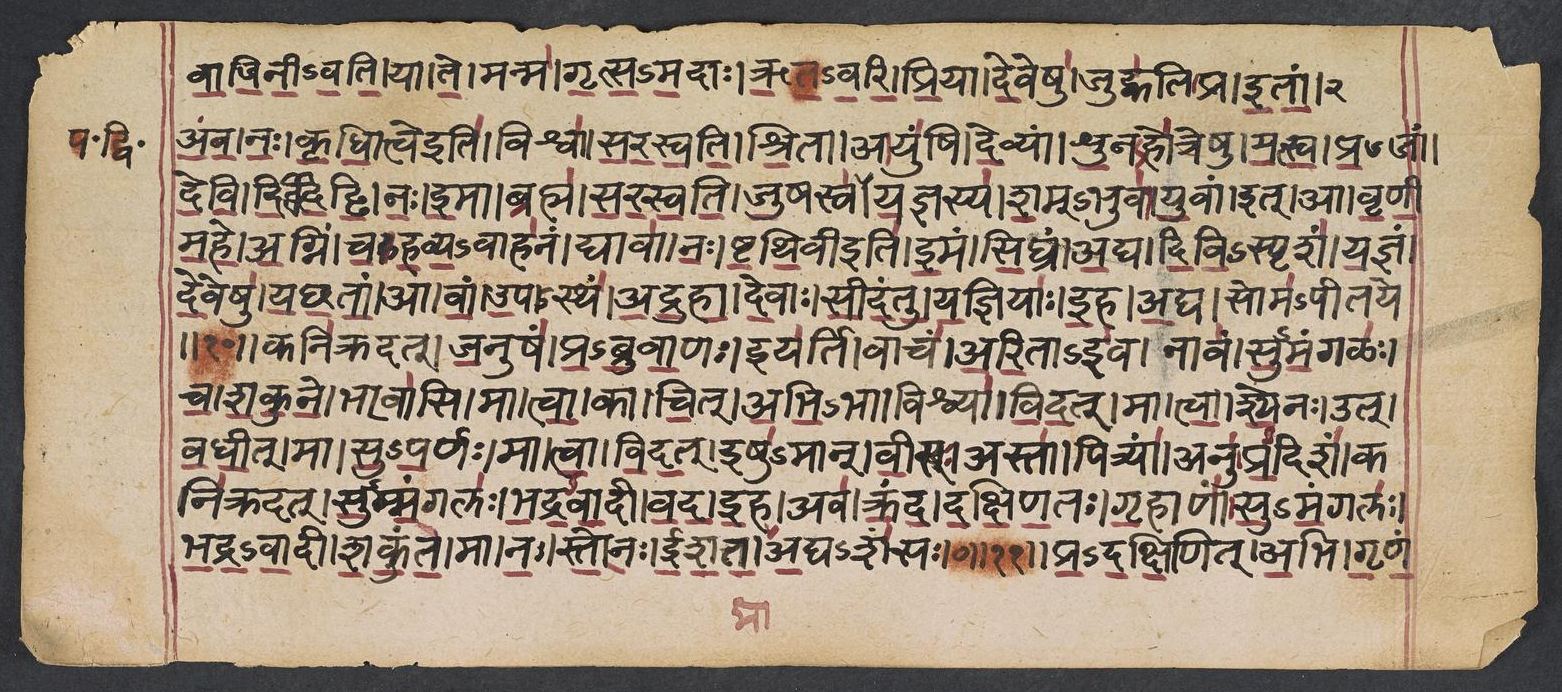
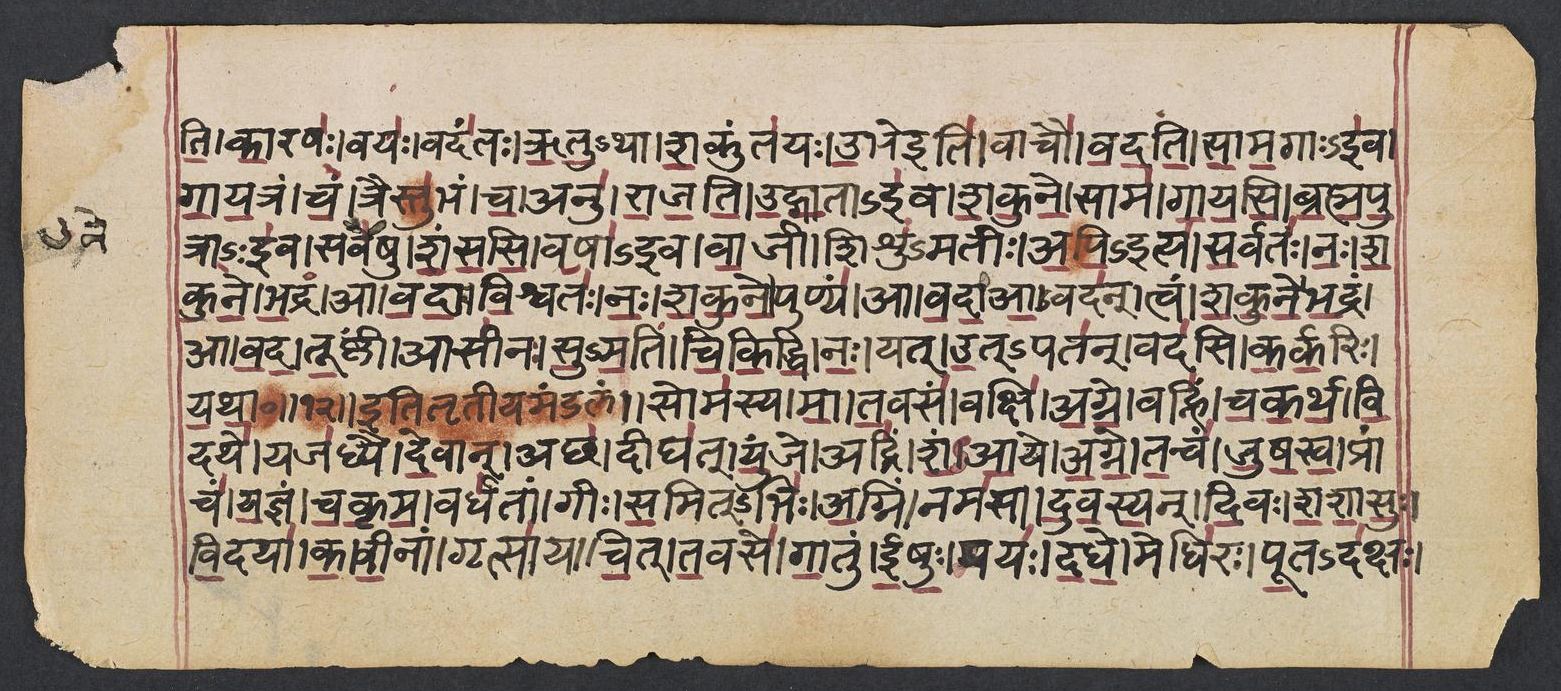
Where on the image
Penn Ms. Coll. 390 Item 41, fol. 183r (numbered 5r by the scribe) (OPenn image 184, lower leaf). Checked on the image: the Rigveda text on this page begins in RV 2.43.1 ‹-gṛṇanti kāravaḥ vayaḥ vadantaḥ›. The next page with Rigveda text, fol. 183v (numbered 5v by the scribe), begins in RV 3.1.3 ‹divaḥ su-bandhuḥ januṣā pṛthivyāḥ›. Verses 2.43.1-3 end on this page; 2.43.1 begins on fol. 182v (numbered 4v by the scribe).
1pra̱da̱kṣi̱ṇid a̱bhi gṛ̍ṇanti kā̱ravo̱ vayo̱ vada̍nta ṛtu̱thā śa̱kunta̍yaḥ | u̱bhe vācau̍ vadati sāma̱gā i̍va gāya̱traṁ ca̱ traiṣṭu̍bha̱ṁ cānu̍ rājati ||
2u̱dgā̱teva̍ śakune̱ sāma̍ gāyasi brahmapu̱tra i̍va̱ sava̍neṣu śaṁsasi | vṛṣe̍va vā̱jī śiśu̍matīr a̱pītyā̍ sa̱rvato̍ naḥ śakune bha̱dram ā va̍da vi̱śvato̍ naḥ śakune̱ puṇya̱m ā va̍da ||
3ā̱vada̱m̐s tvaṁ śa̍kune bha̱dram ā va̍da tū̱ṣṇīm āsī̍naḥ suma̱tiṁ ci̍kiddhi naḥ | yad u̱tpata̱n vada̍si karka̱rir ya̍thā bṛ̱had va̍dema vi̱dathe̍ su̱vīrā̍ḥ ||
Compare: Padapāṭha (word-by-word text written in the manuscript; Sansknet e-text via GRETIL)
1pra-dakṣiṇit | abhi | gṛṇanti | kāravaḥ | vayaḥ | vadantaḥ | ṛtu-thā | śakuntayaḥ | ubhe iti | vācau | vadati | sāma-gāḥ-iva | gāyatram | ca | traistubham | ca | anu | rājati
2udgātāiva | śakune | sāma | gāyasi | brahmaputraḥ-iva | savaneṣu | śaṃsasi | vṛṣāiva | vājī | śiśu-matīḥ | api-itya | sarvataḥ | naḥ | śakune | bhadram | ā | vada | viśvataḥ | naḥ | śakune | puṇyam | ā | vada
3āvadan | tvam | sakune | bhadram | ā | vada | tūṣṇīm | āsīnaḥ | su-matim | cikiddhi | naḥ | yat | ut-patan | vadasi | karkariḥ | yathā | bṛhat | vadema | v
1HERE on the right sing forth chanters of hymns of praise, even the winged birds that in due season speak. He, like: a Sâma-chanter utters both the notes, skilled in the mode of Trishṭup and of Gâyatrî.
2Thou like the chanter-priest chantest the Sâma, Bird; thou singest at libations like a Brahman's son. Even as a vigorous horse when he comes near the mare, announce to us good fortune, Bird, on every side, proclaim in all directions happy luck, O Bird.
3When singing here, O Bird. announce good luck to us, and when thou sittest still think on us with kind thoughts. When flying off thou singest thou art like a lute. With brave sons in assembly may we speak aloud.
Notes
- Sanskrit: Aufrecht's edition (1877) with the Vedic accents, as entered by van Nooten and Holland (GRETIL).
- English: Ralph T. H. Griffith, The Hymns of the Rigveda (1889-1892; 2nd ed. 1896-1897), from the VedaWeb digital text; OCR slips in that text were corrected against the printed 2nd edition (data/sources/rigveda/griffith_errata.json).
- Padapāṭha (edition text): Sansknet e-text via GRETIL (CC BY-NC-SA 4.0).
Cite
Sources
- Source: Penn Ms. Coll. 390 Item 41 (undated (catalogued with Penn's 18th-19th c. Vedic manuscripts)), OPenn, Public Domain Mark + Aufrecht's accented text (GRETIL) + Griffith's English (VedaWeb) (holding institution)
- Critical edition: Aufrecht (1877), accented e-text via GRETIL
← previous · → next · v cycle view · l back to library