Rigveda 3.11: To Agni
Introduction
Rigveda 3.11 is a hymn of 9 verses addressed to Agni. It stands in book (maṇḍala) 3, the family book of Viśvāmitra. The Rigveda is the oldest collection of Sanskrit hymns, composed in the second half of the second millennium BCE and handed down orally for many centuries before it was written down.
The manuscript shown is Penn Ms. Coll. 390 Item 41 (University of Pennsylvania), an undated paper manuscript of the padapāṭha (the word-by-word recitation text, in which every word is written separately and compounds are split) of the whole Ṛgveda in Devanāgarī, 884 leaves in fascicles, 7-9 lines to the page, accents in red; this hymn stands on fol. 196v-197r. Each section below gives the verses that end on one page; the page boundaries were read on the images (the opening words of every page), not counted out. Where the manuscript is a padapāṭha (the word-by-word recitation text), the section shows Aufrecht's continuous (saṃhitā) text first and, as the edition text, the padapāṭha of the same verses, which is the form written on the page.
How was this verified? (Provenance)
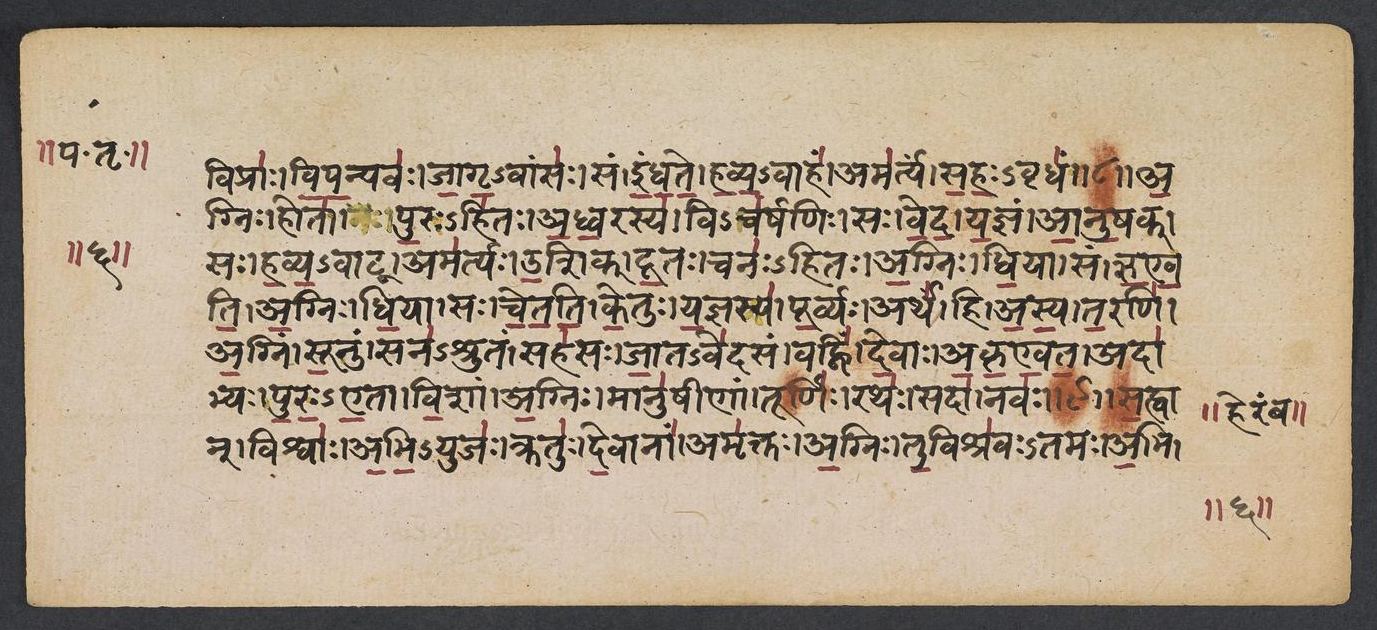
Where on the image
Penn Ms. Coll. 390 Item 41, fol. 196v (numbered 6v by the scribe) (OPenn image 198, upper leaf). Checked on the image: the Rigveda text on this page begins in RV 3.10.9 ‹viprāḥ vipanyavaḥ jāgṛ-vāṃsaḥ sam›. The next page with Rigveda text, fol. 197r (numbered 7r by the scribe), begins in RV 3.11.7 ‹prayāṃsi vāhasā dāśvān aśnoti›. Verses 3.11.1-6 end on this page.
1a̱gnir hotā̍ pu̱rohi̍to 'dhva̱rasya̱ vica̍rṣaṇiḥ | sa ve̍da ya̱jñam ā̍nu̱ṣak ||
2sa ha̍vya̱vāḻ ama̍rtya u̱śig dū̱taś cano̍hitaḥ | a̱gnir dhi̱yā sam ṛ̍ṇvati ||
3a̱gnir dhi̱yā sa ce̍tati ke̱tur ya̱jñasya̍ pū̱rvyaḥ | artha̱ṁ hy a̍sya ta̱raṇi̍ ||
4a̱gniṁ sū̱nuṁ sana̍śruta̱ṁ saha̍so jā̱tave̍dasam | vahni̍ṁ de̱vā a̍kṛṇvata ||
5adā̍bhyaḥ purae̱tā vi̱śām a̱gnir mānu̍ṣīṇām | tūrṇī̱ ratha̱ḥ sadā̱ nava̍ḥ ||
6sā̱hvān viśvā̍ abhi̱yuja̱ḥ kratu̍r de̱vānā̱m amṛ̍ktaḥ | a̱gnis tu̱viśra̍vastamaḥ ||
Compare: Padapāṭha (word-by-word text written in the manuscript; Sansknet e-text via GRETIL)
1agniḥ | hotā | puraḥ-hitaḥ | adhvarasya | vi-carṣaṇiḥ | saḥ | veda | yajñam | ānuṣak
2saḥ | havya-vāṭ | amartyaḥ | uśik | dūtaḥ | canaḥ-hitaḥ | agniḥ | dhiyā | sam | ṛṇvati
3agniḥ | dhiyā | saḥ | cetati | ketuḥ | yajñasya | pūrvyaḥ | artham | hi | asya | taraṇi
4agnim | sūnum | sana-śrutam | sahasaḥ | jāta-vedasam | vahnim | devāḥ | akṛṇvata
5adābhyaḥ | puraḥ-etā | viśām | agniḥ | mānuṣīṇām | tūrṇiḥ | rathaḥ | sadā | navaḥ
6sāhvān | viśvāḥ | abhi-yujaḥ | kratuḥ | devānām | amṛktaḥ | agniḥ | tuviśravaḥ-tamaḥ
1AGNI is Priest, the great High Priest of sacrifice, most swift in act: He knows the rite in constant course.
2Oblation-bearer, deathless, well inclined, an eager messenger, Agni comes nigh us with the thought.
3Ensign of sacrifice from of old, Agni well knoweth with his thought To prosper this man's aim and hope.
4Agni, illustrious from old time, the Son of Strength who knows all life, The Gods have made to their Priest.
5Infallible is Agni, he who goes before the tribes of men, A chariot swift and ever new.
6Strength of the Gods which none may harm, subduing all his enemies, Agni is mightiest in fame.
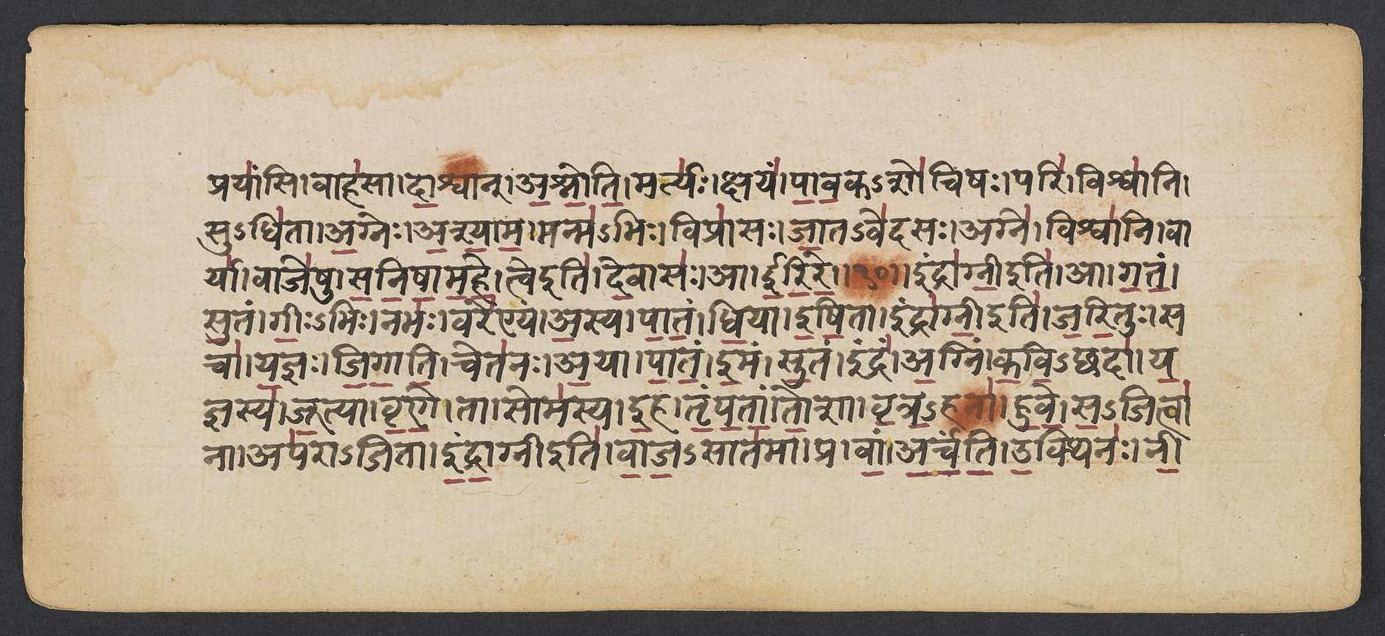
Where on the image
Penn Ms. Coll. 390 Item 41, fol. 197r (numbered 7r by the scribe) (OPenn image 198, lower leaf). Checked on the image: the Rigveda text on this page begins in RV 3.11.7 ‹prayāṃsi vāhasā dāśvān aśnoti›. The next page with Rigveda text, fol. 197v (numbered 7v by the scribe), begins in RV 3.12.5 ‹-nītha-vidaḥ jaritāraḥ indrāgnī iti›. Verses 3.11.7-9 end on this page; 3.11.7 begins on fol. 196v (numbered 6v by the scribe).
7a̱bhi prayā̍ṁsi̱ vāha̍sā dā̱śvām̐ a̍śnoti̱ martya̍ḥ | kṣaya̍m pāva̱kaśo̍ciṣaḥ ||
8pari̱ viśvā̍ni̱ sudhi̍tā̱gner a̍śyāma̱ manma̍bhiḥ | viprā̍so jā̱tave̍dasaḥ ||
9agne̱ viśvā̍ni̱ vāryā̱ vāje̍ṣu saniṣāmahe | tve de̱vāsa̱ eri̍re ||
Compare: Padapāṭha (word-by-word text written in the manuscript; Sansknet e-text via GRETIL)
7abhi | prayāṃsi | vāhasā | dāśvān | aśnoti | martyaḥ | kṣayam | pāvaka-śociṣaḥ
8pari | viśvāni | su-dhitā | agneḥ | aśyāma | manma-bhiḥ | viprāsaḥ | jāta-vedasaḥ
9agne | viśvāni | vāryā | vājeṣu | saniṣāmahe | tve iti | devāsaḥ | ā | īrire
7By offering sacred food to him the mortal worshipper obtains. A home from him whose light makes pure.
8From Agni, by our hymns, may we gain all things that bring happiness, Singers of him who knows all life.
9O Agni, in our deeds of might may we obtain all precious things: Tle Gods are centred all in thee.
Notes
- Sanskrit: Aufrecht's edition (1877) with the Vedic accents, as entered by van Nooten and Holland (GRETIL).
- English: Ralph T. H. Griffith, The Hymns of the Rigveda (1889-1892; 2nd ed. 1896-1897), from the VedaWeb digital text; OCR slips in that text were corrected against the printed 2nd edition (data/sources/rigveda/griffith_errata.json).
- Padapāṭha (edition text): Sansknet e-text via GRETIL (CC BY-NC-SA 4.0).
Cite
Sources
- Source: Penn Ms. Coll. 390 Item 41 (undated (catalogued with Penn's 18th-19th c. Vedic manuscripts)), OPenn, Public Domain Mark + Aufrecht's accented text (GRETIL) + Griffith's English (VedaWeb) (holding institution)
- Critical edition: Aufrecht (1877), accented e-text via GRETIL
← previous · → next · v cycle view · l back to library