Rigveda 3.18: To Agni
Introduction
Rigveda 3.18 is a hymn of 5 verses addressed to Agni. It stands in book (maṇḍala) 3, the family book of Viśvāmitra. The Rigveda is the oldest collection of Sanskrit hymns, composed in the second half of the second millennium BCE and handed down orally for many centuries before it was written down.
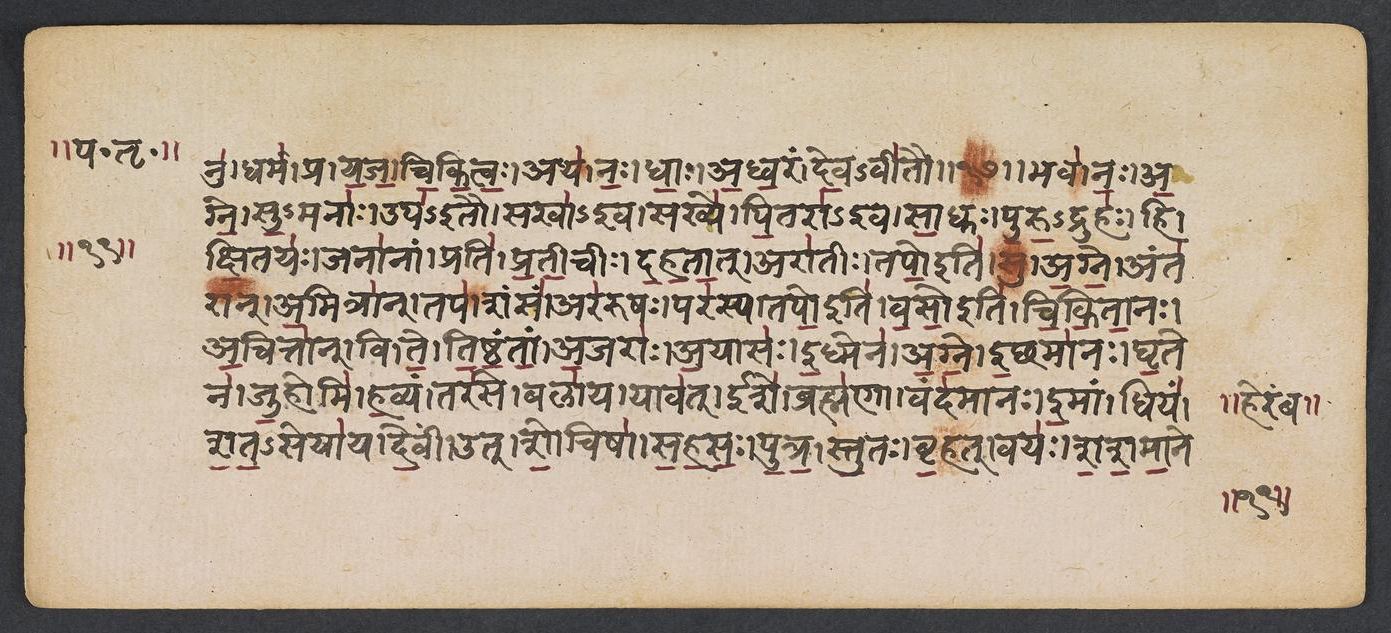
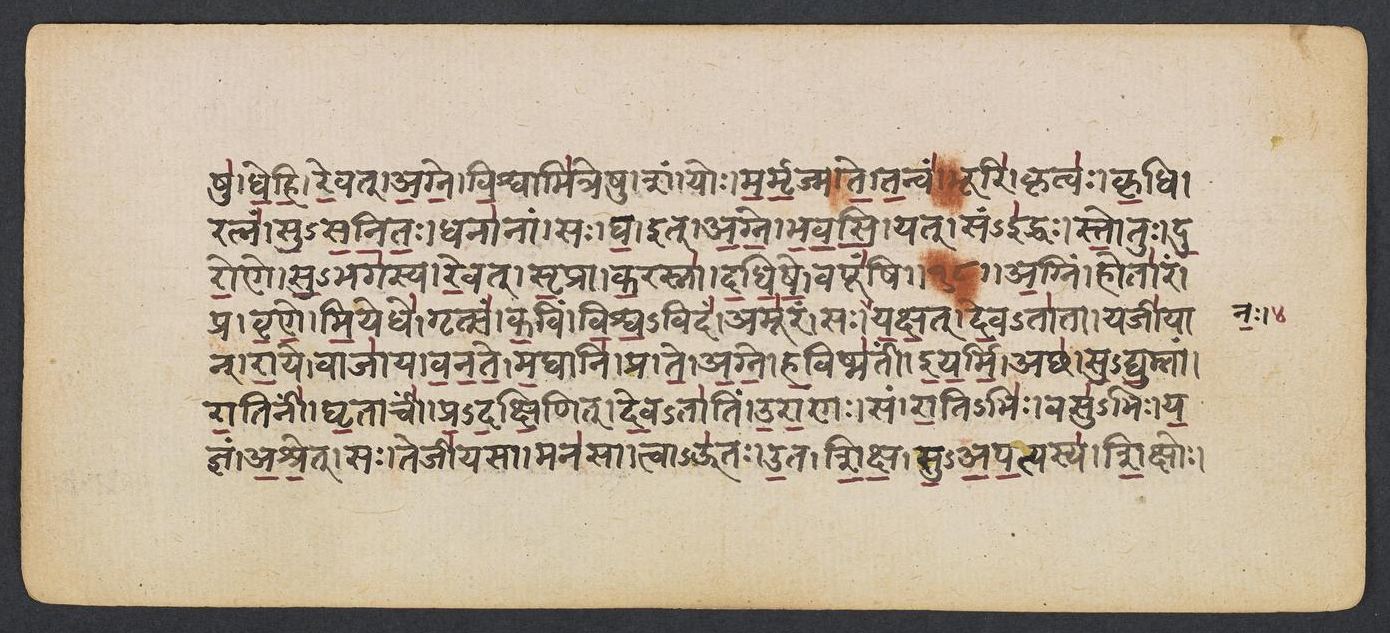
The manuscript shown is Penn Ms. Coll. 390 Item 41 (University of Pennsylvania), an undated paper manuscript of the padapāṭha (the word-by-word recitation text, in which every word is written separately and compounds are split) of the whole Ṛgveda in Devanāgarī, 884 leaves in fascicles, 7-9 lines to the page, accents in red; this hymn stands on fol. 201v-202r. Each section below gives the verses that end on one page; the page boundaries were read on the images (the opening words of every page), not counted out. Where the manuscript is a padapāṭha (the word-by-word recitation text), the section shows Aufrecht's continuous (saṃhitā) text first and, as the edition text, the padapāṭha of the same verses, which is the form written on the page.
How was this verified? (Provenance)
Where on the image
Penn Ms. Coll. 390 Item 41, fol. 201v (numbered 11v by the scribe) (OPenn image 203, upper leaf). Checked on the image: the Rigveda text on this page begins in RV 3.17.5 ‹-anu dharma pra yaja›. The next page with Rigveda text, fol. 202r (numbered 12r by the scribe), begins in RV 3.18.4 ‹-śaśamāneṣu dhehi revat agne›. Verses 3.18.1-3 end on this page.
1bhavā̍ no agne su̱manā̱ upe̍tau̱ sakhe̍va̱ sakhye̍ pi̱tare̍va sā̱dhuḥ | pu̱ru̱druho̱ hi kṣi̱tayo̱ janā̍nā̱m prati̍ pratī̱cīr da̍hatā̱d arā̍tīḥ ||
2tapo̱ ṣv a̍gne̱ anta̍rām̐ a̱mitrā̱n tapā̱ śaṁsa̱m ara̍ruṣa̱ḥ para̍sya | tapo̍ vaso cikitā̱no a̱cittā̱n vi te̍ tiṣṭhantām a̱jarā̍ a̱yāsa̍ḥ ||
3i̱dhmenā̍gna i̱cchamā̍no ghṛ̱tena̍ ju̱homi̍ ha̱vyaṁ tara̍se̱ balā̍ya | yāva̱d īśe̱ brahma̍ṇā̱ vanda̍māna i̱māṁ dhiya̍ṁ śata̱seyā̍ya de̱vīm ||
Compare: Padapāṭha (word-by-word text written in the manuscript; Sansknet e-text via GRETIL)
1bhava | naḥ | agne | su-manāḥ | upa-itau | sakhāiva | sakhye | pitarāiva | sādhuḥ | puru-druhaḥ | hi | kṣitayaḥ | janānām | prati | pratīcīḥ | dahatāt | arātīḥ
2tapo iti | su | agne | antarān | amitrān | tapa | śaṃsam | araruṣaḥ | parasya | tapo iti | vaso iti | cikitānaḥ | acittān | vi | te | tiṣṭhantām | ajarāḥ | ayāsaḥ
3idhmena | agne | icchamānaḥ | ghṛtena | juhomi | havyam | tarase | balāya | yāvat | īśe | brahmaṇā | vandamānaḥ | imām | dhiyam | śata-seyāya | devīm
1AGNI, be kind to us when we approach thee good as a friend to friend, as sire and mother. The races of mankind are great oppressors burn up malignity that strives against us.
2Agni, burn up the unfriendly who are near us, burn thou the foeman's curse who pays no worship. Burn, Vasu, thou who markest well, the foolish: let thine eternal nimble beams surround thee.
3With fuel, Agni, and with oil, desirous, mine offering I present for strength and conquest, With prayer, so far as I have power, adoring-this hymn divine to gain a hundred treasures.
Where on the image
Penn Ms. Coll. 390 Item 41, fol. 202r (numbered 12r by the scribe) (OPenn image 203, lower leaf). Checked on the image: the Rigveda text on this page begins in RV 3.18.4 ‹-śaśamāneṣu dhehi revat agne›. The next page with Rigveda text, fol. 202v (numbered 12v by the scribe), begins in RV 3.19.3 ‹agne rāyaḥ nṛ-tamasya pra-bhūtau›. Verses 3.18.4-5 end on this page; 3.18.4 begins on fol. 201v (numbered 11v by the scribe).
4uc cho̱ciṣā̍ sahasas putra stu̱to bṛ̱had vaya̍ḥ śaśamā̱neṣu̍ dhehi | re̱vad a̍gne vi̱śvāmi̍treṣu̱ śaṁ yor ma̍rmṛ̱jmā te̍ ta̱nva1̱̍m bhūri̱ kṛtva̍ḥ ||
5kṛ̱dhi ratna̍ṁ susanita̱r dhanā̍nā̱ṁ sa ghed a̍gne bhavasi̱ yat sami̍ddhaḥ | sto̱tur du̍ro̱ṇe su̱bhaga̍sya re̱vat sṛ̱prā ka̱rasnā̍ dadhiṣe̱ vapū̍ṁṣi ||
Compare: Padapāṭha (word-by-word text written in the manuscript; Sansknet e-text via GRETIL)
4ut | śociṣā | sahasaḥ | putra | stutaḥ | bṛhat | vayaḥ | śaśamāneṣu | dhehi | revat | agne | viśvāmitreṣu | śam | yoḥ | marmṛjma | te | tanvam | bhūri | kṛtvaḥ
5kṛdhi | ratnam | su-sanitaḥ | dhanānām | saḥ | gha | it | agne | bhavasi | yat | sami ddhaḥ | stotuḥ | duroṇe | su-bhagasya | revat | sṛprā | karasnā | dadhiṣe | vapūṃṣi
4Give with thy glow, thou Son of Strength, when lauded, great vital power to those who toil to serve thee. Give richly, Agni, to the Viṣvâmitras in rest and stir. Oft have we decked thy body.
5Give us, O liberal Lord, great store of riches, for, Agni, such art thou when duly kindled. Thou in the happy singer's home bestowest, amply with arms extended, things of beauty.
Notes
- Sanskrit: Aufrecht's edition (1877) with the Vedic accents, as entered by van Nooten and Holland (GRETIL).
- English: Ralph T. H. Griffith, The Hymns of the Rigveda (1889-1892; 2nd ed. 1896-1897), from the VedaWeb digital text; OCR slips in that text were corrected against the printed 2nd edition (data/sources/rigveda/griffith_errata.json).
- Padapāṭha (edition text): Sansknet e-text via GRETIL (CC BY-NC-SA 4.0).
Cite
Sources
- Source: Penn Ms. Coll. 390 Item 41 (undated (catalogued with Penn's 18th-19th c. Vedic manuscripts)), OPenn, Public Domain Mark + Aufrecht's accented text (GRETIL) + Griffith's English (VedaWeb) (holding institution)
- Critical edition: Aufrecht (1877), accented e-text via GRETIL
← previous · → next · v cycle view · l back to library