Rigveda 3.40: To Indra
Introduction
Rigveda 3.40 is a hymn of 9 verses addressed to Indra. It stands in book (maṇḍala) 3, the family book of Viśvāmitra. The Rigveda is the oldest collection of Sanskrit hymns, composed in the second half of the second millennium BCE and handed down orally for many centuries before it was written down.
The manuscript shown is Penn Ms. Coll. 390 Item 41 (University of Pennsylvania), an undated paper manuscript of the padapāṭha (the word-by-word recitation text, in which every word is written separately and compounds are split) of the whole Ṛgveda in Devanāgarī, 884 leaves in fascicles, 7-9 lines to the page, accents in red; this hymn stands on fol. 226v-227r. Each section below gives the verses that end on one page; the page boundaries were read on the images (the opening words of every page), not counted out. Where the manuscript is a padapāṭha (the word-by-word recitation text), the section shows Aufrecht's continuous (saṃhitā) text first and, as the edition text, the padapāṭha of the same verses, which is the form written on the page.
How was this verified? (Provenance)
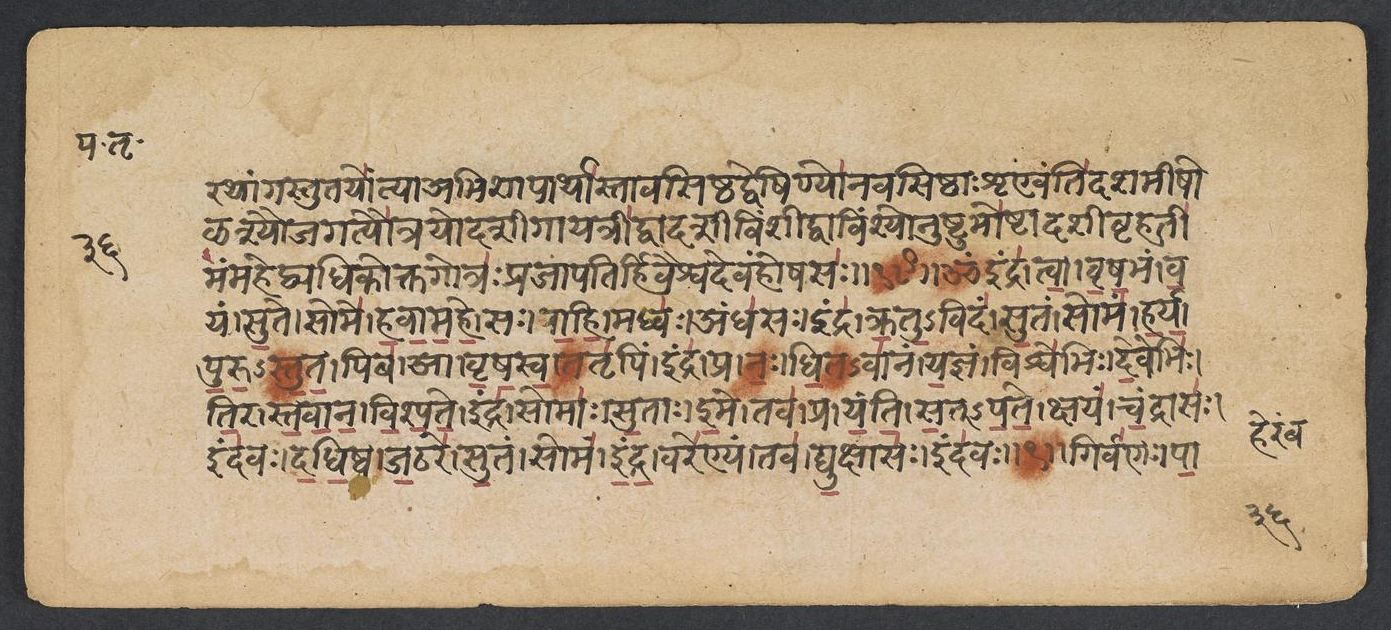
Where on the image
Penn Ms. Coll. 390 Item 41, fol. 226v (numbered 36v by the scribe) (OPenn image 228, upper leaf). Checked on the image: the Rigveda text on this page begins in RV 3.40.1 ‹indra tvā vṛṣabham vayam›. Lines 1-3 carry the anukramaṇī for aṣṭaka 3, adhyāya 3; 3.40.1 (indra tvā vṛṣabham vayam) begins in line 3 after oṃ. The next page with Rigveda text, fol. 227r (numbered 37r by the scribe), begins in RV 3.40.6 ‹-pāhi naḥ sutam madhoḥ›. Verses 3.40.1-5 end on this page.
1indra̍ tvā vṛṣa̱bhaṁ va̱yaṁ su̱te some̍ havāmahe | sa pā̍hi̱ madhvo̱ andha̍saḥ ||
2indra̍ kratu̱vida̍ṁ su̱taṁ soma̍ṁ harya puruṣṭuta | pibā vṛ̍ṣasva̱ tātṛ̍pim ||
3indra̱ pra ṇo̍ dhi̱tāvā̍naṁ ya̱jñaṁ viśve̍bhir de̱vebhi̍ḥ | ti̱ra sta̍vāna viśpate ||
4indra̱ somā̍ḥ su̱tā i̱me tava̱ pra ya̍nti satpate | kṣaya̍ṁ ca̱ndrāsa̱ inda̍vaḥ ||
5da̱dhi̱ṣvā ja̱ṭhare̍ su̱taṁ soma̍m indra̱ vare̍ṇyam | tava̍ dyu̱kṣāsa̱ inda̍vaḥ ||
Compare: Padapāṭha (word-by-word text written in the manuscript; Sansknet e-text via GRETIL)
1indra | tvā | vṛṣabham | vayam | sute | some | havāmahe | saḥ | pāhi | madhvaḥ | andhasaḥ
2indra | kratu-vidam | sutam | somam | harya | puru-stuta | piba | ā | vṛṣasva | tatṛpim
3indra | pra | naḥ | dhita-vānam | yajñam | viśvebhiḥ | devebhiḥ | tira | stavāna | viśpate
4indra | somāḥ | sutāḥ | ime | tava | pra | yanti | sat-pate | kṣayam | candrāsaḥ | indavaḥ
5dadhiṣva | jaṭhare | sutam | somam | indra | vareṇyam | tava | dyukṣāsaḥ | indavaḥ
1THEE, Indra, we invoke, the Bull, what time the Soma is expressed. So drink thou of the savoury juice.
2Indra, whom many laud, accept the strength-conferring Soma juice: Quaff, pour down drink that satisfies.
3Indra, with all the Gods promote our wealth-bestowing sacrifice, Thou highly-lauded Lord of men.
4Lord of the brave, to thee proceed these drops of Soma juice expressed, The bright drops to thy dwelling-place.
5Within thy belly, Indra, take juice, Soma the most excellent: Thine are the drops celestial.
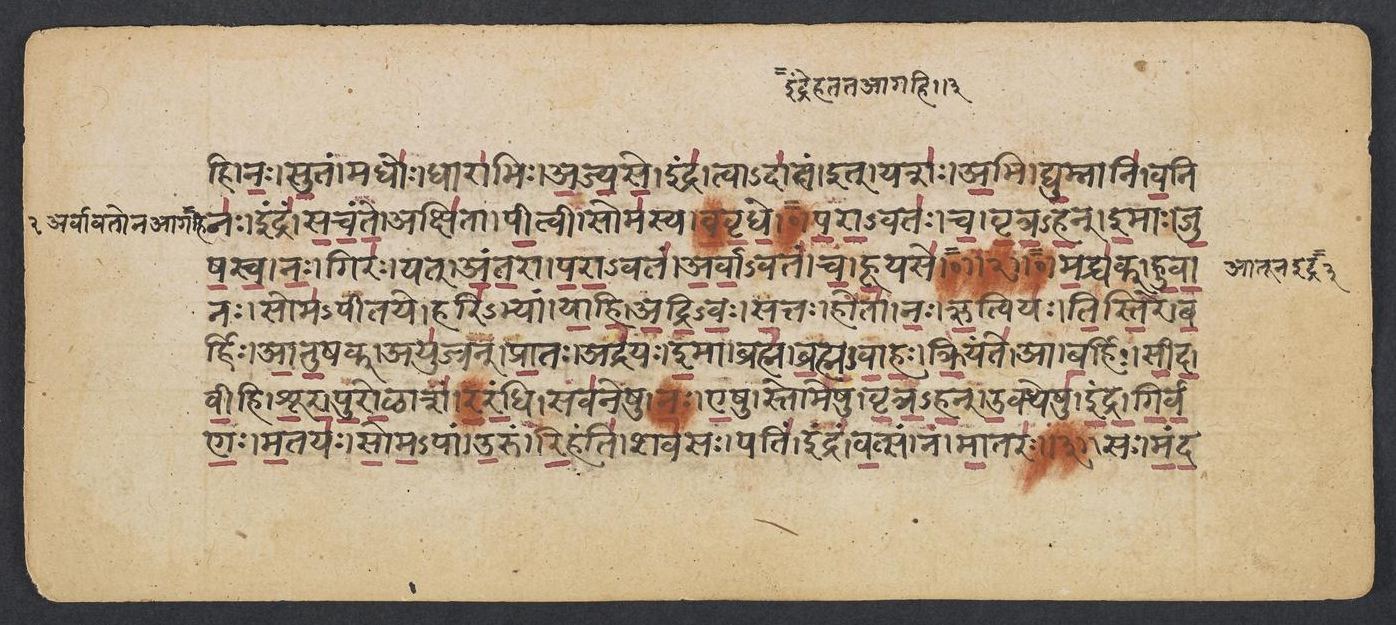
Where on the image
Penn Ms. Coll. 390 Item 41, fol. 227r (numbered 37r by the scribe) (OPenn image 228, lower leaf). Checked on the image: the Rigveda text on this page begins in RV 3.40.6 ‹-pāhi naḥ sutam madhoḥ›. The next page with Rigveda text, fol. 227v (numbered 37v by the scribe), begins in RV 3.41.6 ‹-mandasva hi andhasaḥ rādhase›. Verses 3.40.6-9 end on this page; 3.40.6 begins on fol. 226v (numbered 36v by the scribe).
6girva̍ṇaḥ pā̱hi na̍ḥ su̱tam madho̱r dhārā̍bhir ajyase | indra̱ tvādā̍ta̱m id yaśa̍ḥ ||
7a̱bhi dyu̱mnāni̍ va̱nina̱ indra̍ṁ sacante̱ akṣi̍tā | pī̱tvī soma̍sya vāvṛdhe ||
8a̱rvā̱vato̍ na̱ ā ga̍hi parā̱vata̍ś ca vṛtrahan | i̱mā ju̍ṣasva no̱ gira̍ḥ ||
9yad a̍nta̱rā pa̍rā̱vata̍m arvā̱vata̍ṁ ca hū̱yase̍ | indre̱ha tata̱ ā ga̍hi ||
Compare: Padapāṭha (word-by-word text written in the manuscript; Sansknet e-text via GRETIL)
6girvaṇaḥ | pāhi | naḥ | sutam | madhoḥ | dhārābhiḥ | ajyase | indra | tvādātam | it | yaśaḥ
7abhi | dyumnāni | vaninaḥ | indram | sacante | akṣitā | pītvī | somasya | vavṛdhe
8arvāvataḥ | naḥ | ā | gahi | parāvataḥ | ca | vṛtrahan | imāḥ | juṣasva | naḥ | giraḥ
9yat | antarā | parāvatam | arvāvatam | ca | hūyase | indra | iha | tataḥ | ā | gahi
6Drink our libation, Lord of hymns: with streams of meath thou art bedewed Our glory, Indra, is thy gift.
7To Indra go the treasures of the worshipper, which never fail: He drinks the Soma and is strong
8From far away, from near at hand, O Vr̥itra-slayer, come to us: Accept the songs we sing to thee.
9When from the space between the near and far thou art invoked by us, Thence, Indra. come thou hitherward.
Notes
- Sanskrit: Aufrecht's edition (1877) with the Vedic accents, as entered by van Nooten and Holland (GRETIL).
- English: Ralph T. H. Griffith, The Hymns of the Rigveda (1889-1892; 2nd ed. 1896-1897), from the VedaWeb digital text; OCR slips in that text were corrected against the printed 2nd edition (data/sources/rigveda/griffith_errata.json).
- Padapāṭha (edition text): Sansknet e-text via GRETIL (CC BY-NC-SA 4.0).
Cite
Sources
- Source: Penn Ms. Coll. 390 Item 41 (undated (catalogued with Penn's 18th-19th c. Vedic manuscripts)), OPenn, Public Domain Mark + Aufrecht's accented text (GRETIL) + Griffith's English (VedaWeb) (holding institution)
- Critical edition: Aufrecht (1877), accented e-text via GRETIL
← previous · → next · v cycle view · l back to library