Rigveda 3.41: To Indra
Introduction
Rigveda 3.41 is a hymn of 9 verses addressed to Indra. It stands in book (maṇḍala) 3, the family book of Viśvāmitra. The Rigveda is the oldest collection of Sanskrit hymns, composed in the second half of the second millennium BCE and handed down orally for many centuries before it was written down.
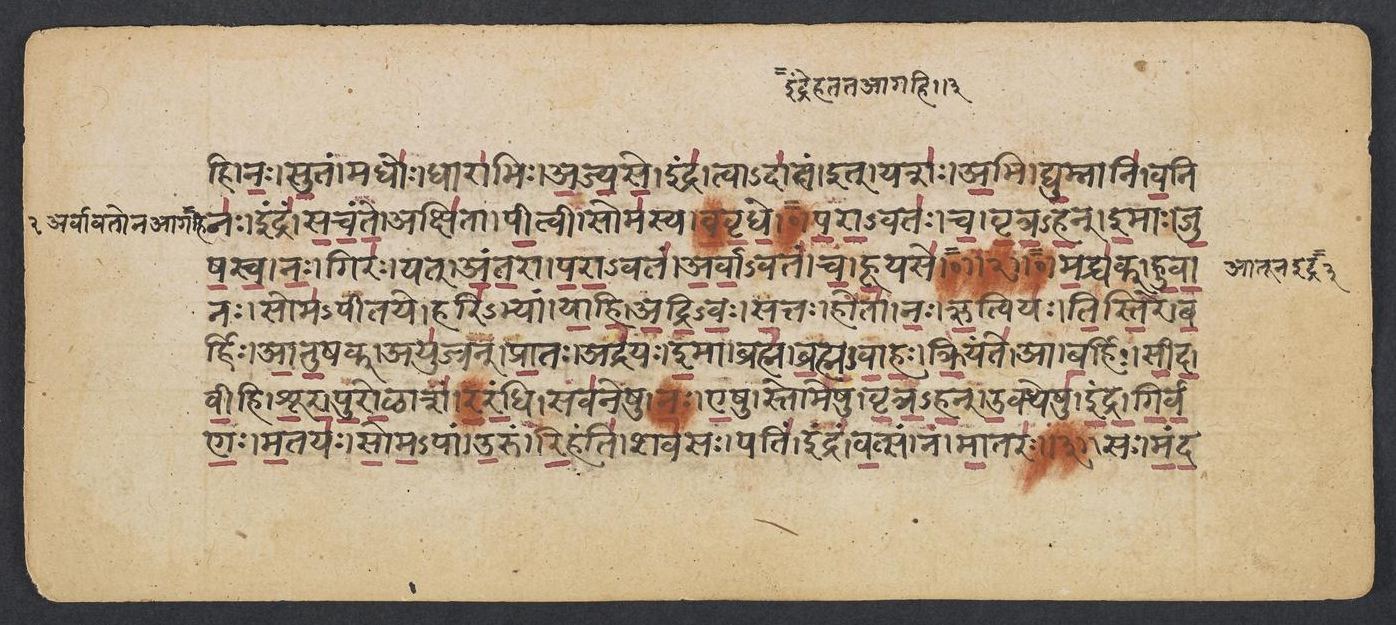
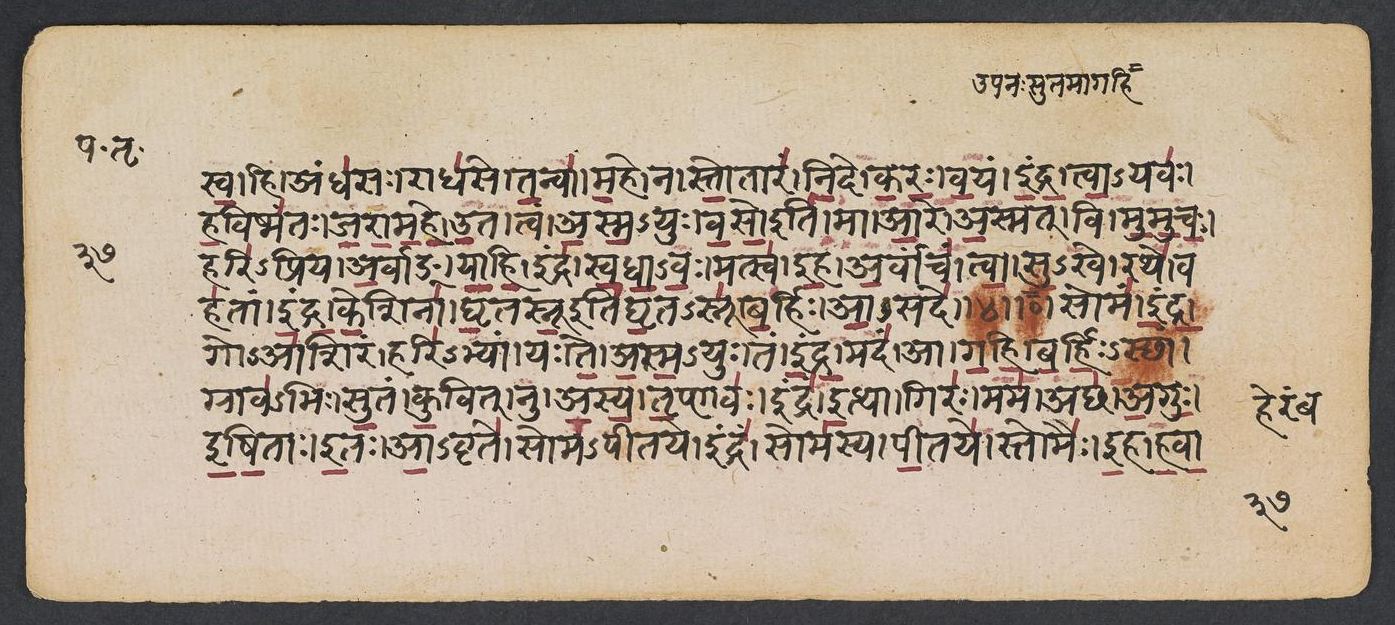
The manuscript shown is Penn Ms. Coll. 390 Item 41 (University of Pennsylvania), an undated paper manuscript of the padapāṭha (the word-by-word recitation text, in which every word is written separately and compounds are split) of the whole Ṛgveda in Devanāgarī, 884 leaves in fascicles, 7-9 lines to the page, accents in red; this hymn stands on fol. 227r-227v. Each section below gives the verses that end on one page; the page boundaries were read on the images (the opening words of every page), not counted out. Where the manuscript is a padapāṭha (the word-by-word recitation text), the section shows Aufrecht's continuous (saṃhitā) text first and, as the edition text, the padapāṭha of the same verses, which is the form written on the page.
How was this verified? (Provenance)
Where on the image
Penn Ms. Coll. 390 Item 41, fol. 227r (numbered 37r by the scribe) (OPenn image 228, lower leaf). Checked on the image: the Rigveda text on this page begins in RV 3.40.6 ‹-pāhi naḥ sutam madhoḥ›. The next page with Rigveda text, fol. 227v (numbered 37v by the scribe), begins in RV 3.41.6 ‹-mandasva hi andhasaḥ rādhase›. Verses 3.41.1-5 end on this page.
1ā tū na̍ indra ma̱drya̍g ghuvā̱naḥ soma̍pītaye | hari̍bhyāṁ yāhy adrivaḥ ||
2sa̱tto hotā̍ na ṛ̱tviya̍s tisti̱re ba̱rhir ā̍nu̱ṣak | ayu̍jran prā̱tar adra̍yaḥ ||
3i̱mā brahma̍ brahmavāhaḥ kri̱yanta̱ ā ba̱rhiḥ sī̍da | vī̱hi śū̍ra puro̱ḻāśa̍m ||
4rā̱ra̱ndhi sava̍neṣu ṇa e̱ṣu stome̍ṣu vṛtrahan | u̱ktheṣv i̍ndra girvaṇaḥ ||
5ma̱taya̍ḥ soma̱pām u̱ruṁ ri̱hanti̱ śava̍sa̱s pati̍m | indra̍ṁ va̱tsaṁ na mā̱tara̍ḥ ||
Compare: Padapāṭha (word-by-word text written in the manuscript; Sansknet e-text via GRETIL)
1ā | tu | naḥ | indra | madryak | huvānaḥ | soma-pītaye | hari-bhyām | yāhi | adri-vaḥ
2sattaḥ | hotā | naḥ | ṛtviyaḥ | tistire | barhiḥ | ānuṣak | ayujran | prātaḥ | adrayaḥ
3imā | brahma | brahma-vāhaḥ | kriyante | ā | barhiḥ | sīda | vīhi | śūra | puroḷāśam
4rarandhi | savaneṣu | naḥ | eṣu | stomeṣu | vṛtrahan | uktheṣu | indra | girvaṇaḥ
5matayaḥ | soma-pām | urum | rihanti | śavasaḥ | patim | indram | vatsam | na | mātaraḥ
1INVOKED to drink the Soma juice, come with thy Bay Steeds, Thunder-armed Come, Indra, hitherward to me.
2Our priest is seated, true to time; the grass is regularly strewn; The pressing-stones were set at morn.
3These prayers, O thou who hearest prayer are offered: seat thee on the grass. Hero, enjoy the offered cake.
4O Vr̥itra-slayer, be thou pleased with these libations, with these hymns, Song-loving Indra, with our lauds.
5Our hymns caress the Lord of Strength, vast, drinker of the Soma's juice, Indra, as mother-cows their calf.
Where on the image
Penn Ms. Coll. 390 Item 41, fol. 227v (numbered 37v by the scribe) (OPenn image 229, upper leaf). Checked on the image: the Rigveda text on this page begins in RV 3.41.6 ‹-mandasva hi andhasaḥ rādhase›. The next page with Rigveda text, fol. 228r (numbered 38r by the scribe), begins in RV 3.42.4 ‹-havāmahe ukthebhiḥ kuvit āgamat›. Verses 3.41.6-9 end on this page; 3.41.6 begins on fol. 227r (numbered 37r by the scribe).
6sa ma̍ndasvā̱ hy andha̍so̱ rādha̍se ta̱nvā̍ ma̱he | na sto̱tāra̍ṁ ni̱de ka̍raḥ ||
7va̱yam i̍ndra tvā̱yavo̍ ha̱viṣma̍nto jarāmahe | u̱ta tvam a̍sma̱yur va̍so ||
8māre a̱smad vi mu̍muco̱ hari̍priyā̱rvāṅ yā̍hi | indra̍ svadhāvo̱ matsve̱ha ||
9a̱rvāñca̍ṁ tvā su̱khe rathe̱ vaha̍tām indra ke̱śinā̍ | ghṛ̱tasnū̍ ba̱rhir ā̱sade̍ ||
Compare: Padapāṭha (word-by-word text written in the manuscript; Sansknet e-text via GRETIL)
6saḥ | mandasva | hi | andhasaḥ | rādhase | tanvā | mahe | na | stotāram | nide | karaḥ
7vayam | indra | tvāyavaḥ | haviṣmantaḥ | jarāmahe | uta | tvam | ama-yuḥ | vaso iti
8mā | āre | asmat | vi | mumucaḥ | hari-priya | ārvāṅ | yāhi | indra | svadhāvaḥ | matsva | iha
9arvāñcam | tvā | su-khe | rathe | vahatām | indra | keśinā | ghṛtasnūitighṛta-snū | barhiḥ | āsade
6Delight thee with the juice we pour for thine own great munificence: Yield not thy singer to reproach.
7We, Indra, dearly loving thee, bearing oblation, sing thee hymns Thou, Vasu, dearly lovest us.
8O thou to whom thy Bays are dear, loose not thy Horses far from us: Here glad thee, Indra, Lord divine.
9May long-maned Coursers, dropping oil, bring thee on swift car hitherward, Indra, to seat thee on the grass.
Notes
- Sanskrit: Aufrecht's edition (1877) with the Vedic accents, as entered by van Nooten and Holland (GRETIL).
- English: Ralph T. H. Griffith, The Hymns of the Rigveda (1889-1892; 2nd ed. 1896-1897), from the VedaWeb digital text; OCR slips in that text were corrected against the printed 2nd edition (data/sources/rigveda/griffith_errata.json).
- Padapāṭha (edition text): Sansknet e-text via GRETIL (CC BY-NC-SA 4.0).
Cite
Sources
- Source: Penn Ms. Coll. 390 Item 41 (undated (catalogued with Penn's 18th-19th c. Vedic manuscripts)), OPenn, Public Domain Mark + Aufrecht's accented text (GRETIL) + Griffith's English (VedaWeb) (holding institution)
- Critical edition: Aufrecht (1877), accented e-text via GRETIL
← previous · → next · v cycle view · l back to library