Rigveda 3.42: To Indra
Introduction
Rigveda 3.42 is a hymn of 9 verses addressed to Indra. It stands in book (maṇḍala) 3, the family book of Viśvāmitra. The Rigveda is the oldest collection of Sanskrit hymns, composed in the second half of the second millennium BCE and handed down orally for many centuries before it was written down.
The manuscript shown is Penn Ms. Coll. 390 Item 41 (University of Pennsylvania), an undated paper manuscript of the padapāṭha (the word-by-word recitation text, in which every word is written separately and compounds are split) of the whole Ṛgveda in Devanāgarī, 884 leaves in fascicles, 7-9 lines to the page, accents in red; this hymn stands on fol. 227v-228r. Each section below gives the verses that end on one page; the page boundaries were read on the images (the opening words of every page), not counted out. Where the manuscript is a padapāṭha (the word-by-word recitation text), the section shows Aufrecht's continuous (saṃhitā) text first and, as the edition text, the padapāṭha of the same verses, which is the form written on the page.
How was this verified? (Provenance)
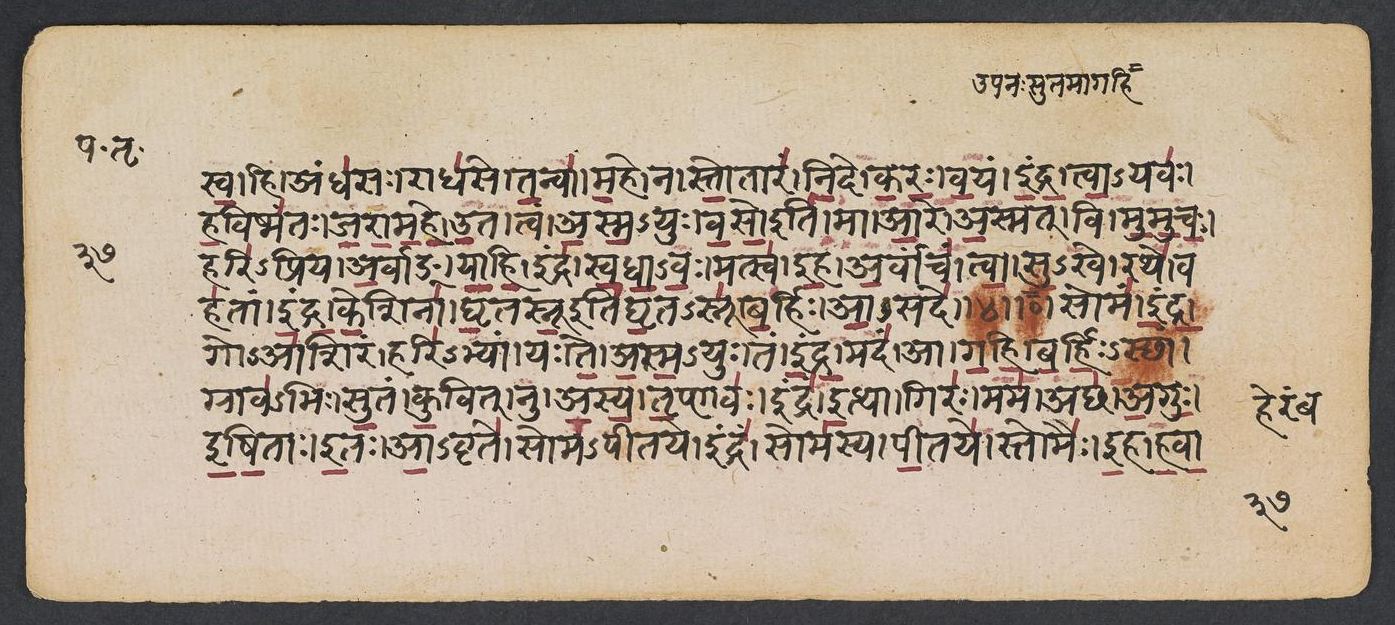
Where on the image
Penn Ms. Coll. 390 Item 41, fol. 227v (numbered 37v by the scribe) (OPenn image 229, upper leaf). Checked on the image: the Rigveda text on this page begins in RV 3.41.6 ‹-mandasva hi andhasaḥ rādhase›. The next page with Rigveda text, fol. 228r (numbered 38r by the scribe), begins in RV 3.42.4 ‹-havāmahe ukthebhiḥ kuvit āgamat›. Verses 3.42.1-3 end on this page.
1upa̍ naḥ su̱tam ā ga̍hi̱ soma̍m indra̱ gavā̍śiram | hari̍bhyā̱ṁ yas te̍ asma̱yuḥ ||
2tam i̍ndra̱ mada̱m ā ga̍hi barhi̱ḥṣṭhāṁ grāva̍bhiḥ su̱tam | ku̱vin nv a̍sya tṛ̱pṇava̍ḥ ||
3indra̍m i̱tthā giro̱ mamācchā̍gur iṣi̱tā i̱taḥ | ā̱vṛte̱ soma̍pītaye ||
Compare: Padapāṭha (word-by-word text written in the manuscript; Sansknet e-text via GRETIL)
1upa | naḥ | sutam | ā | gahi | somam | indra | go--āśiram | hari-bhyām | yaḥ | te | asma-yuḥ
2tam | indra | madam | ā | gahi barhiḥ-sthām | grāva-bhiḥ | sutam | kuvit | nu | asya | tṛṣṇavaḥ
3indram | itthā | giraḥ | mama | accha | aguḥ | iṣitāḥ | itaḥ | āvṛte | soma-pītaye
1COME to the juice that we have pressed, to Soma, Indra, blent with milk: Come, favouring us, thy Bay-drawn car!
2Come, Indra, to this gladdening drink, placed on the grass, pressed out with stones: Wilt thou not drink thy fill thereof?
3To Indra have my songs of praise gone forth, thus rapidly sent hence, To turn him to the Soma-draught.
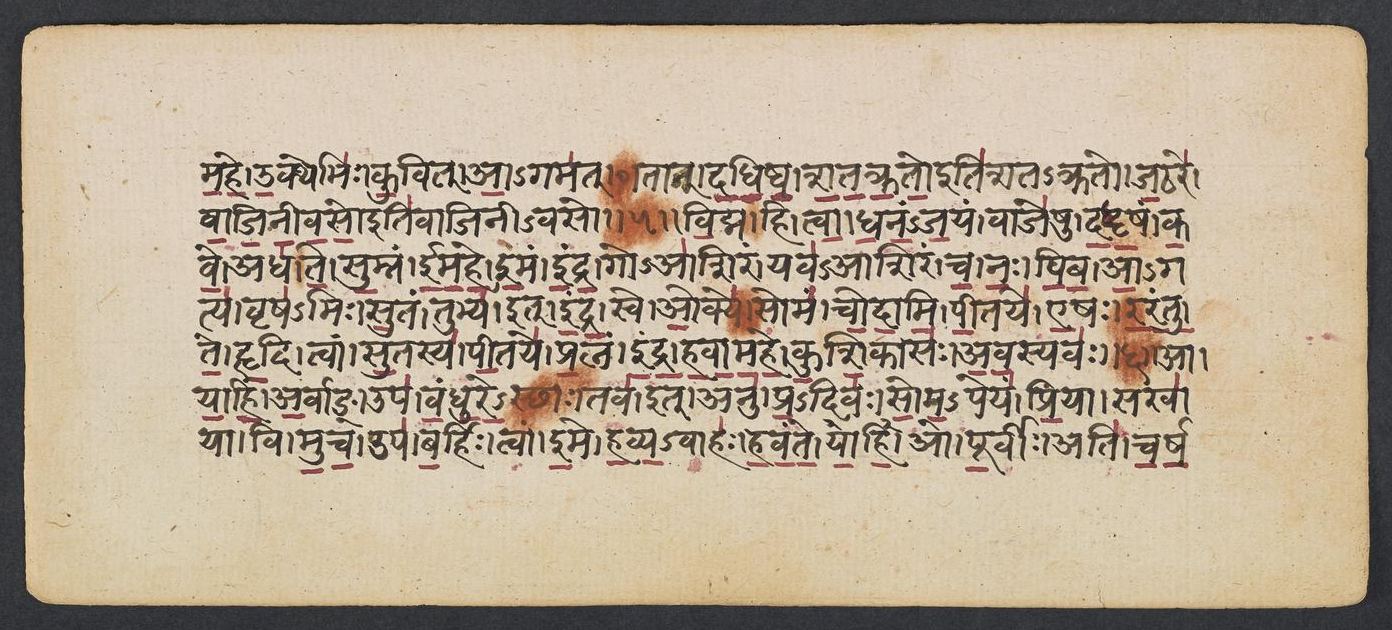
Where on the image
Penn Ms. Coll. 390 Item 41, fol. 228r (numbered 38r by the scribe) (OPenn image 229, lower leaf). Checked on the image: the Rigveda text on this page begins in RV 3.42.4 ‹-havāmahe ukthebhiḥ kuvit āgamat›. The next page with Rigveda text, fol. 228v (numbered 38v by the scribe), begins in RV 3.43.2 ‹-carṣaṇīḥ ā aryaḥ āśiṣaḥ›. Verses 3.42.4-9 end on this page; 3.42.4 begins on fol. 227v (numbered 37v by the scribe).
4indra̱ṁ soma̍sya pī̱taye̱ stomai̍r i̱ha ha̍vāmahe | u̱kthebhi̍ḥ ku̱vid ā̱gama̍t ||
5indra̱ somā̍ḥ su̱tā i̱me tān da̍dhiṣva śatakrato | ja̱ṭhare̍ vājinīvaso ||
6vi̱dmā hi tvā̍ dhanaṁja̱yaṁ vāje̍ṣu dadhṛ̱ṣaṁ ka̍ve | adhā̍ te su̱mnam ī̍mahe ||
7i̱mam i̍ndra̱ gavā̍śira̱ṁ yavā̍śiraṁ ca naḥ piba | ā̱gatyā̱ vṛṣa̍bhiḥ su̱tam ||
8tubhyed i̍ndra̱ sva o̱kye̱3̱̍ soma̍ṁ codāmi pī̱taye̍ | e̱ṣa rā̍rantu te hṛ̱di ||
9tvāṁ su̱tasya̍ pī̱taye̍ pra̱tnam i̍ndra havāmahe | ku̱śi̱kāso̍ ava̱syava̍ḥ ||
Compare: Padapāṭha (word-by-word text written in the manuscript; Sansknet e-text via GRETIL)
4indram | somasya | pītaye | stomaiḥ | iha | havāmahe | ukthebhiḥ | kuvit | āgamat
5indra | somāḥ | sutāḥ | ime | tān | dadhiṣva | śatakrato itiśata-krato | jaṭhare | vājinīvaso itivājinī-vaso
6vidma | hi | tvā | dhanam-jayam | vājeṣu | dadhṛṣam | kave | adha | te | sumnam | īmahe
7imam | indra | go--āśiram | yava-āśiram | ca | naḥ | piba | āgatya | vṛṣa-bhiḥ | sutam
8tubhya | it | indra | sve | okye | somam | codāmi | pītaye | eṣaḥ | rarantu | te | hṛdi
9tvām | sutasya | pītaye | pratnam | indra | havāmahe | kuśikāsaḥ | avasyavaḥ
4Hither with songs of praise we call Indra to drink the Soma juice: Will he not come to us by lauds?
5Indra, these Somas are expressed. Take them within thy belly, Lord Of Hundred Powers, thou Prince of Wealth.
6We know thee winner of the spoil, and resolute in battles, Sage! Therefore thy blessing we implore.
7Borne hither by thy Stallions, drink, Indra, this juice which we have pressed, Mingled with barley and with milk.
8Indra, for thee, in thine own place, I urge the Soma for thy draught: Deep in thy heart let it remain,
9We call on thee, the Ancient One, Indra, to drink the Soma juice, We Kuṣikas who seek thine aid.
Notes
- Sanskrit: Aufrecht's edition (1877) with the Vedic accents, as entered by van Nooten and Holland (GRETIL).
- English: Ralph T. H. Griffith, The Hymns of the Rigveda (1889-1892; 2nd ed. 1896-1897), from the VedaWeb digital text; OCR slips in that text were corrected against the printed 2nd edition (data/sources/rigveda/griffith_errata.json).
- Padapāṭha (edition text): Sansknet e-text via GRETIL (CC BY-NC-SA 4.0).
Cite
Sources
- Source: Penn Ms. Coll. 390 Item 41 (undated (catalogued with Penn's 18th-19th c. Vedic manuscripts)), OPenn, Public Domain Mark + Aufrecht's accented text (GRETIL) + Griffith's English (VedaWeb) (holding institution)
- Critical edition: Aufrecht (1877), accented e-text via GRETIL
← previous · → next · v cycle view · l back to library