Rigveda 3.50: To Indra
Introduction
Rigveda 3.50 is a hymn of 5 verses addressed to Indra. It stands in book (maṇḍala) 3, the family book of Viśvāmitra. The Rigveda is the oldest collection of Sanskrit hymns, composed in the second half of the second millennium BCE and handed down orally for many centuries before it was written down.
The manuscript shown is Penn Ms. Coll. 390 Item 41 (University of Pennsylvania), an undated paper manuscript of the padapāṭha (the word-by-word recitation text, in which every word is written separately and compounds are split) of the whole Ṛgveda in Devanāgarī, 884 leaves in fascicles, 7-9 lines to the page, accents in red; this hymn stands on fol. 232r-232v. Each section below gives the verses that end on one page; the page boundaries were read on the images (the opening words of every page), not counted out. Where the manuscript is a padapāṭha (the word-by-word recitation text), the section shows Aufrecht's continuous (saṃhitā) text first and, as the edition text, the padapāṭha of the same verses, which is the form written on the page.
How was this verified? (Provenance)
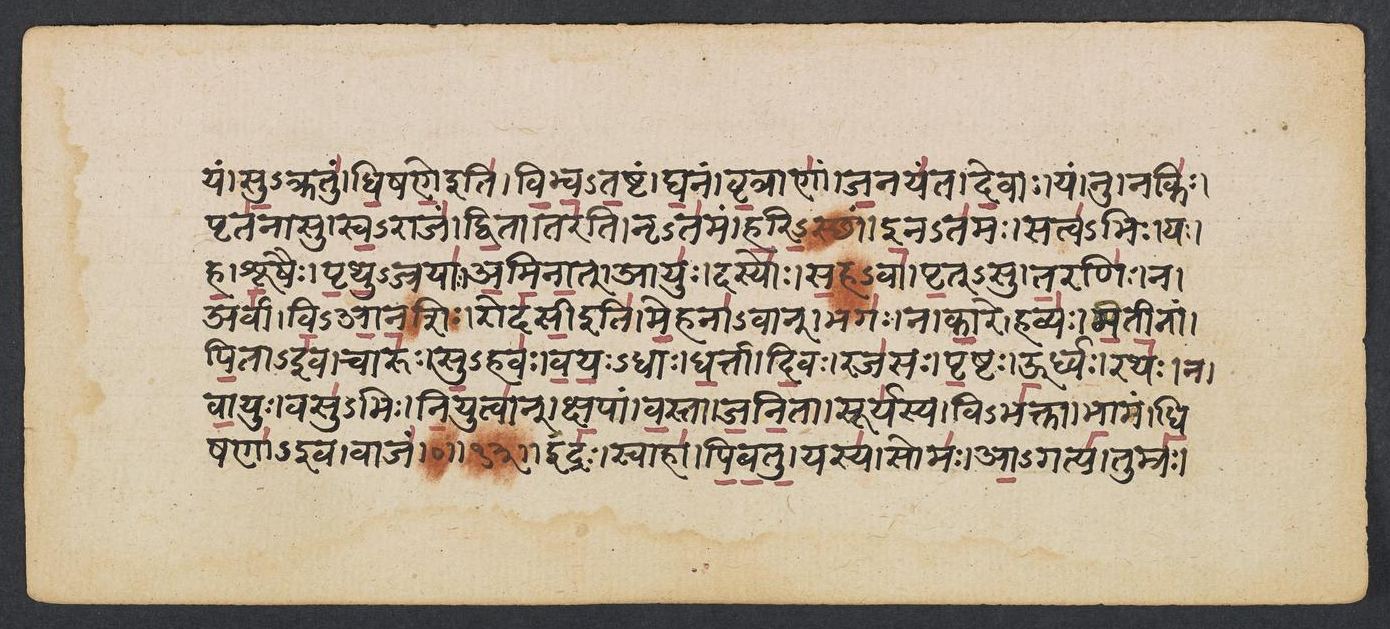
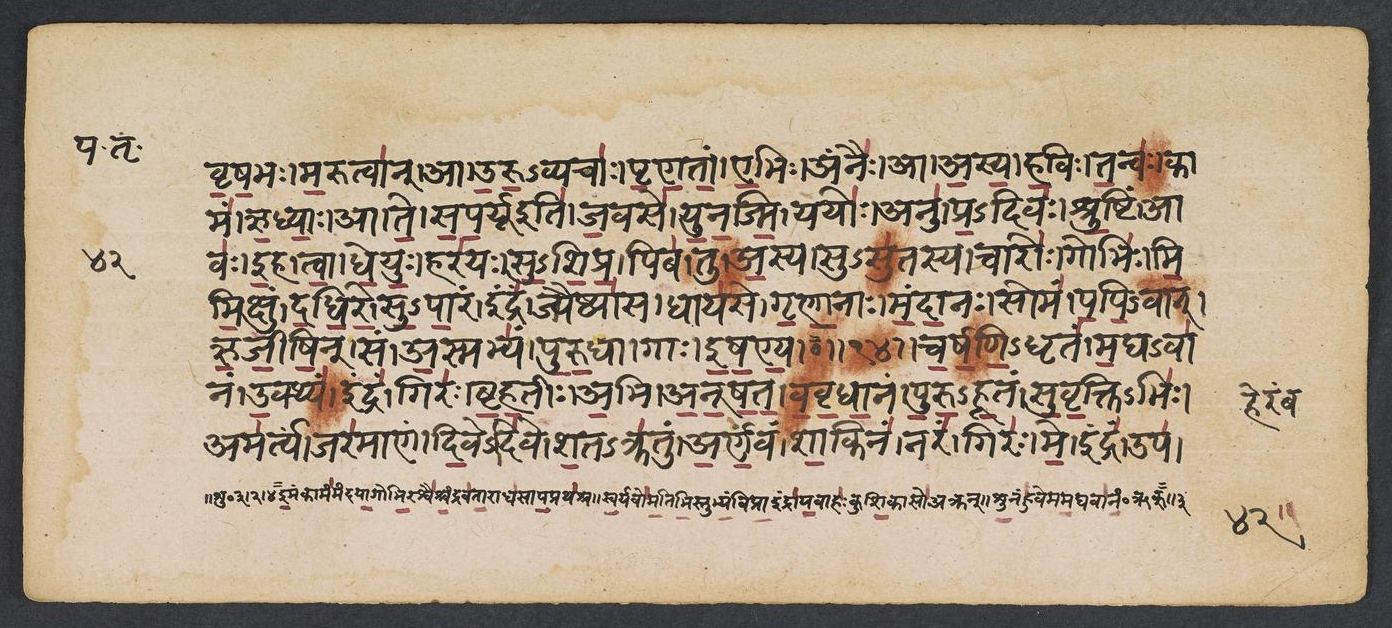
Where on the image
Penn Ms. Coll. 390 Item 41, fol. 232v (numbered 42v by the scribe) (OPenn image 234, upper leaf). Checked on the image: the Rigveda text on this page begins in RV 3.50.1 ‹vṛṣabhaḥ marutvān ā uru-vyacāḥ›. The next page with Rigveda text, fol. 233r (numbered 43r by the scribe), begins in RV 3.51.2 ‹yanti viśvataḥ vāja-sanim pūḥ-bhidam›. Verses 3.50.1-5 end on this page; 3.50.1 begins on fol. 232r (numbered 42r by the scribe).
1indra̱ḥ svāhā̍ pibatu̱ yasya̱ soma̍ ā̱gatyā̱ tumro̍ vṛṣa̱bho ma̱rutvā̍n | oru̱vyacā̍ḥ pṛṇatām e̱bhir annai̱r āsya̍ ha̱vis ta̱nva1̱̍ḥ kāma̍m ṛdhyāḥ ||
2ā te̍ sapa̱ryū ja̱vase̍ yunajmi̱ yayo̱r anu̍ pra̱diva̍ḥ śru̱ṣṭim āva̍ḥ | i̱ha tvā̍ dheyu̱r hara̍yaḥ suśipra̱ pibā̱ tv a1̱̍sya suṣu̍tasya̱ cāro̍ḥ ||
3gobhi̍r mimi̱kṣuṁ da̍dhire supā̱ram indra̱ṁ jyaiṣṭhyā̍ya̱ dhāya̍se gṛṇā̱nāḥ | ma̱ndā̱naḥ soma̍m papi̱vām̐ ṛ̍jīṣi̱n sam a̱smabhya̍m puru̱dhā gā i̍ṣaṇya ||
4i̱maṁ kāma̍m mandayā̱ gobhi̱r aśvai̍ś ca̱ndrava̍tā̱ rādha̍sā pa̱pratha̍ś ca | sva̱ryavo̍ ma̱tibhi̱s tubhya̱ṁ viprā̱ indrā̍ya̱ vāha̍ḥ kuśi̱kāso̍ akran ||
5śu̱naṁ hu̍vema ma̱ghavā̍na̱m indra̍m a̱smin bhare̱ nṛta̍ma̱ṁ vāja̍sātau | śṛ̱ṇvanta̍m u̱gram ū̱taye̍ sa̱matsu̱ ghnanta̍ṁ vṛ̱trāṇi̍ sa̱ṁjita̱ṁ dhanā̍nām ||
Compare: Padapāṭha (word-by-word text written in the manuscript; Sansknet e-text via GRETIL)
1indraḥ | svāhā | pibatu | yasya | somaḥ | āgatya | tumraḥ | vṛṣabhaḥ | marutvān | ā | uru-vyacāḥ | pṛṇatām | ebhiḥ | annaiḥ | ā | asya | haviḥ | tanvaḥ | kāmam | ṛdhyāḥ
2ā | te | saparyū iti | javase | yunajmi | yayoḥ | anu | pra-divaḥ | śruṣṭim | āvaḥ | iha | tvā | dheyuḥ | harayaḥ | su-śipra | piba | tu | asya | su-sutasya | cāroḥ
3gobhiḥ | mimikṣum | dadhire | su-pāram | indram | jyaiṣṭhyāya | dhāyase | gṛṇānāḥ | mandānaḥ | somam | papi-vān | ṛjīṣin | sam | asmabhyam | purudhā | gāḥ | iṣaṇya
4imam | kāmam | mandaya | gobhiḥ | aśvaiḥ | candra-vatā | rādhasā | paprathaḥ | ca | svaḥ-yavaḥ | mati-bhiḥ | tubhyam | viprāḥ | indrāya | vāhaḥ | kuśikāsaḥ | akran
5śunam | huvema | maghavānam | indram | asmin | bhare | nṛ-tamam | vāja-sātau | śṛṇvantam | ugram | ūtaye | samat-su | ghnantam | vṛtrāṇi | sam-jitam | dhanānām
1LET Indra drink, All-hail! for his is Soma,– the mighty Bull come, girt by Maruts, hither. Far-reaching, let him fill him with these viands, and let our offering sate his body's longing.
2I yoke thy pair of trusty Steeds for swiftness, whose faithful service from of old thou lovest. Here, fair of cheek! let thy Bay Coursers place thee: drink of this lovely welleffused libation.
3With milk they made Indra their good Preserver, lauding for help and rule the bounteous rainer. Impetuous God, when thou hast drunk the Soma, enraptured send us cattle in abundance.
4With kine and horses satisfy this longing with very splendid bounty still extend it. Seeking the light, with hymns to thee, O Indra, the Kuṣikas have brought their gift, the singers.
5Call we on Maghavan, auspicious Indra, best Hero in the fight where spoil is gathered; The Strong, who listens, who gives aid in battles, who slays the Vr̥itras, wins and gathers riches.
Notes
- Sanskrit: Aufrecht's edition (1877) with the Vedic accents, as entered by van Nooten and Holland (GRETIL).
- English: Ralph T. H. Griffith, The Hymns of the Rigveda (1889-1892; 2nd ed. 1896-1897), from the VedaWeb digital text; OCR slips in that text were corrected against the printed 2nd edition (data/sources/rigveda/griffith_errata.json).
- Padapāṭha (edition text): Sansknet e-text via GRETIL (CC BY-NC-SA 4.0).
Cite
Sources
- Source: Penn Ms. Coll. 390 Item 41 (undated (catalogued with Penn's 18th-19th c. Vedic manuscripts)), OPenn, Public Domain Mark + Aufrecht's accented text (GRETIL) + Griffith's English (VedaWeb) (holding institution)
- Critical edition: Aufrecht (1877), accented e-text via GRETIL
← previous · → next · v cycle view · l back to library