Rigveda 4.39: To Dadhikra
Introduction
Rigveda 4.39 is a hymn of 6 verses addressed to Dadhikra. It stands in book (maṇḍala) 4, the family book of Vāmadeva. The Rigveda is the oldest collection of Sanskrit hymns, composed in the second half of the second millennium BCE and handed down orally for many centuries before it was written down.
The manuscript shown is Penn Ms. Coll. 390 Item 41 (University of Pennsylvania), an undated paper manuscript of the padapāṭha (the word-by-word recitation text, in which every word is written separately and compounds are split) of the whole Ṛgveda in Devanāgarī, 884 leaves in fascicles, 7-9 lines to the page, accents in red; this hymn stands on fol. 300v-301r. Each section below gives the verses that end on one page; the page boundaries were read on the images (the opening words of every page), not counted out. Where the manuscript is a padapāṭha (the word-by-word recitation text), the section shows Aufrecht's continuous (saṃhitā) text first and, as the edition text, the padapāṭha of the same verses, which is the form written on the page.
How was this verified? (Provenance)
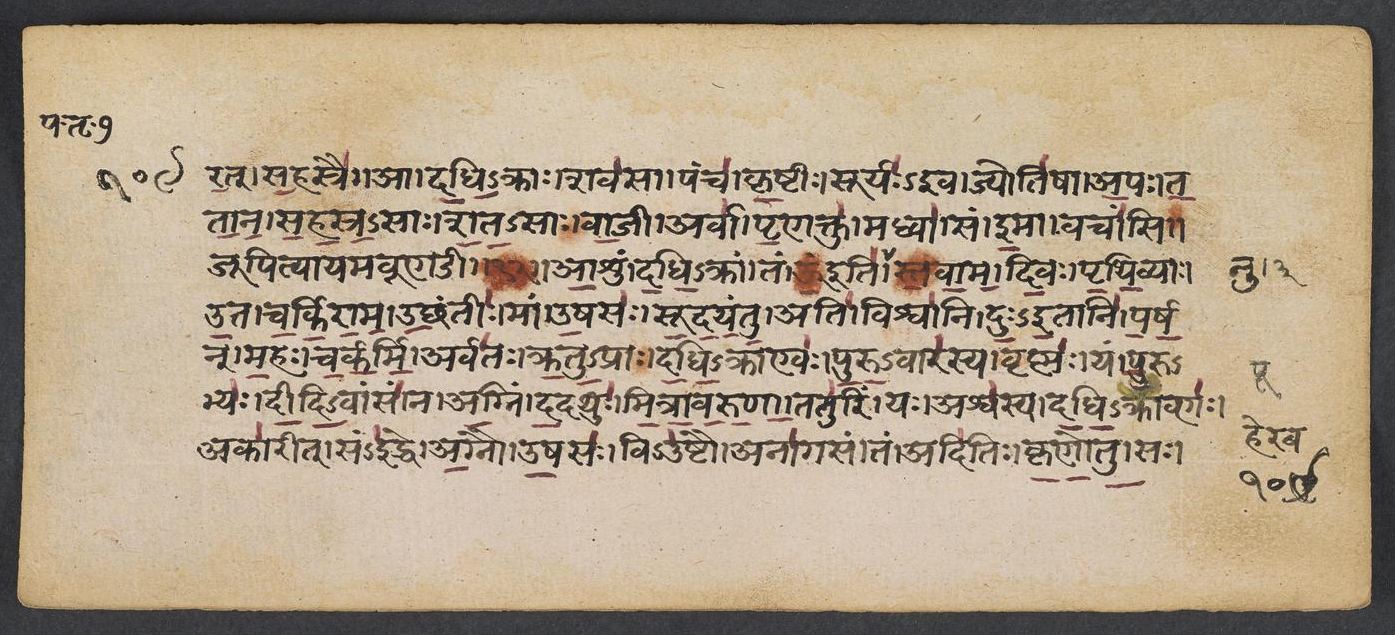
Where on the image
Penn Ms. Coll. 390 Item 41, fol. 300v (numbered 109v by the scribe) (OPenn image 301, upper leaf). Checked on the image: the Rigveda text on this page begins in RV 4.38.9 ‹-asarat sahasraiḥ›. The next page with Rigveda text, fol. 301r (numbered 110r by the scribe), begins in RV 4.39.3 ‹mitreṇa varuṇena sa-joṣāḥ›. Verses 4.39.1-2 end on this page.
1ā̱śuṁ da̍dhi̱krāṁ tam u̱ nu ṣṭa̍vāma di̱vas pṛ̍thi̱vyā u̱ta ca̍rkirāma | u̱cchantī̱r mām u̱ṣasa̍ḥ sūdaya̱ntv ati̱ viśvā̍ni duri̱tāni̍ parṣan ||
2ma̱haś ca̍rka̱rmy arva̍taḥ kratu̱prā da̍dhi̱krāvṇa̍ḥ puru̱vāra̍sya̱ vṛṣṇa̍ḥ | yam pū̱rubhyo̍ dīdi̱vāṁsa̱ṁ nāgniṁ da̱dathu̍r mitrāvaruṇā̱ tatu̍rim ||
Compare: Padapāṭha (word-by-word text written in the manuscript; Sansknet e-text via GRETIL)
1āśum | dadhi-krām | tam | oṃ iti | nu | stavāma | divaḥ | pṛthivyāḥ | uta | carkirāma | ucchantīḥ | mām | uṣasaḥ | sūdayantu | ati | viśvāni | duḥ-itāni | parṣan
2mahaḥ | carkarmi | arvataḥ | kratu-prāḥ | dadhi-krāvṇaḥ | puru-vārasya | vṛṣṇaḥ | yam | pūru-bhyaḥ | dīdi-vāṃsam | na | agnim | dadathuḥ | mitrāvaruṇā | taturi m
1Now give we praise to Dadhikrâs the rapid, and mention in our laud the Earth and Heaven. May the Dawns flushing move me to exertion, and bear me safely over every trouble.
2I praise the mighty Steed who fills my spirit, the Stallion Dadhikrâvan rich in bounties, Whom, swift of foot and shining bright as Agni, ye, Varuṇa and Mitra, gave to Pûrus.
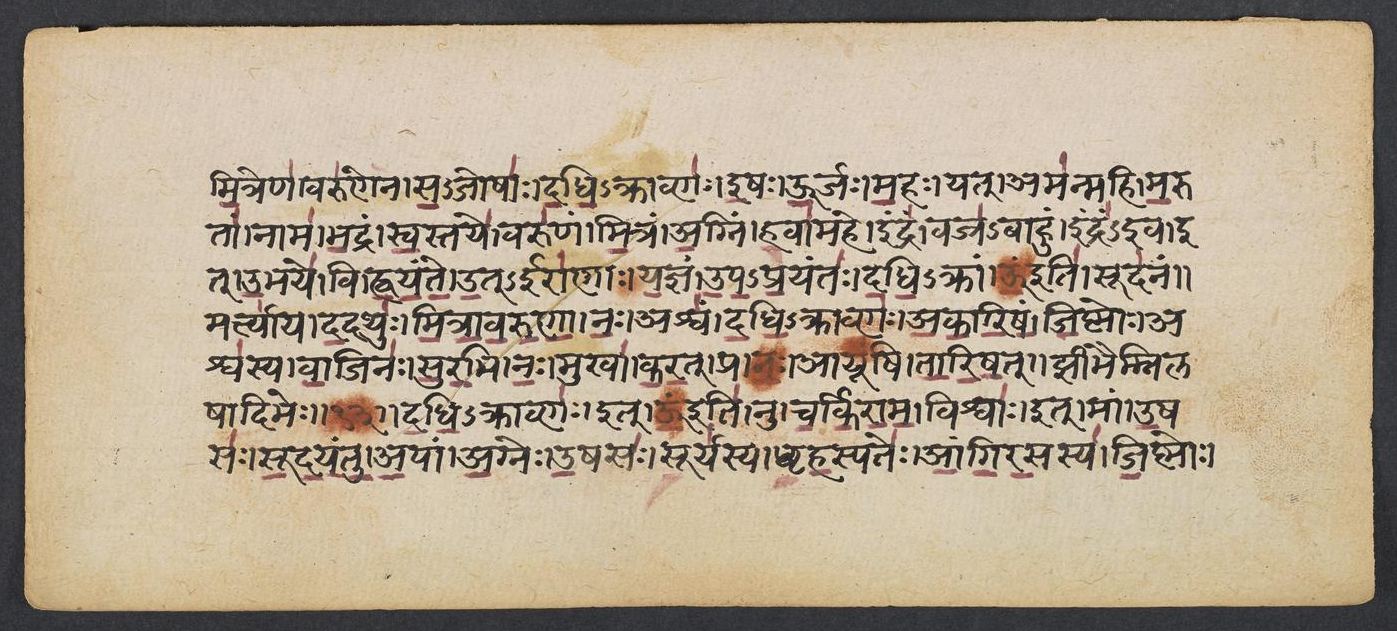
Where on the image
Penn Ms. Coll. 390 Item 41, fol. 301r (numbered 110r by the scribe) (OPenn image 301, lower leaf). Checked on the image: the Rigveda text on this page begins in RV 4.39.3 ‹mitreṇa varuṇena sa-joṣāḥ›. The next page with Rigveda text, fol. 301v (numbered 110v by the scribe), begins in RV 4.40.2 ‹satvā bhariṣaḥ go--iṣaḥ duvanya-sat›. Verses 4.39.3-6 end on this page; 4.39.3 begins on fol. 300v (numbered 109v by the scribe).
3yo aśva̍sya dadhi̱krāvṇo̱ akā̍rī̱t sami̍ddhe a̱gnā u̱ṣaso̱ vyu̍ṣṭau | anā̍gasa̱ṁ tam adi̍tiḥ kṛṇotu̱ sa mi̱treṇa̱ varu̍ṇenā sa̱joṣā̍ḥ ||
4da̱dhi̱krāvṇa̍ i̱ṣa ū̱rjo ma̱ho yad ama̍nmahi ma̱rutā̱ṁ nāma̍ bha̱dram | sva̱staye̱ varu̍ṇam mi̱tram a̱gniṁ havā̍maha̱ indra̱ṁ vajra̍bāhum ||
5indra̍m i̱ved u̱bhaye̱ vi hva̍yanta u̱dīrā̍ṇā ya̱jñam u̍papra̱yanta̍ḥ | da̱dhi̱krām u̱ sūda̍na̱m martyā̍ya da̱dathu̍r mitrāvaruṇā no̱ aśva̍m ||
6da̱dhi̱krāvṇo̍ akāriṣaṁ ji̱ṣṇor aśva̍sya vā̱jina̍ḥ | su̱ra̱bhi no̱ mukhā̍ kara̱t pra ṇa̱ āyū̍ṁṣi tāriṣat ||
Compare: Padapāṭha (word-by-word text written in the manuscript; Sansknet e-text via GRETIL)
3yaḥ | aśvasya | dadhi-krāvṇaḥ | akārīt | sam-iddhe | agnau | uṣasaḥ | vi-uṣṭau | anāgasam | tam | aditiḥ | kṛṇotu | saḥ | mitreṇa | varuṇena | sa-joṣāḥ
4dadhi-krāvṇaḥ | iṣaḥ | ūrjaḥ | mahaḥ | yat | amanmahi | marutām | nāma | bhadram | svastaye | varuṇam | mitram | agnim | havāmahe | indram | vajra-bāhum
5indram-iva | it | ubhaye | vi | hvayante | ut-īrāṇāḥ | yajñam | upa-prayantaḥ | dadhi-krām | oṃ iti | sūdanam | martyāya | dadathuḥ | mitrāvaruṇā | naḥ | aśvam
6dadhi-krāvṇaḥ | akāriṣam | jiṣṇoḥ | aśvasya | vājinaḥ | surabhi | naḥ | mukhā | karat | pra | ṇaḥ | āyūṃṣi | tāriṣat
3Him who hath honoured, when the flame is kindled at break of dawn, the Courser Dadhikrâvan, Him, of one mind with Varuṇa and Mitra may Aditi make free from all transgression.
4When we remember mighty Dadhikrâvan our food and strength, then the blest name of Maruts, Varuṇa, Mitra, we invoke for welfare, and Agni, and the thunder-wielding Indra.
5Both sides invoke him as they call on Indra when they stir forth and turn to sacrificing. To us have Varuṇa and Mitra granted the Courser Dadhikrâs, a guide for mortals.
6So have I glorified with praise strong Dadhikrâvan, conquering Steed. Sweet may he make our mouths; may he prolong the days we have to live.
Notes
- Sanskrit: Aufrecht's edition (1877) with the Vedic accents, as entered by van Nooten and Holland (GRETIL).
- English: Ralph T. H. Griffith, The Hymns of the Rigveda (1889-1892; 2nd ed. 1896-1897), from the VedaWeb digital text; OCR slips in that text were corrected against the printed 2nd edition (data/sources/rigveda/griffith_errata.json).
- Padapāṭha (edition text): Sansknet e-text via GRETIL (CC BY-NC-SA 4.0).
Cite
Sources
- Source: Penn Ms. Coll. 390 Item 41 (undated (catalogued with Penn's 18th-19th c. Vedic manuscripts)), OPenn, Public Domain Mark + Aufrecht's accented text (GRETIL) + Griffith's English (VedaWeb) (holding institution)
- Critical edition: Aufrecht (1877), accented e-text via GRETIL
← previous · → next · v cycle view · l back to library