Rigveda 4.40: To Dadhikra
Introduction
Rigveda 4.40 is a hymn of 5 verses addressed to Dadhikra. It stands in book (maṇḍala) 4, the family book of Vāmadeva. The Rigveda is the oldest collection of Sanskrit hymns, composed in the second half of the second millennium BCE and handed down orally for many centuries before it was written down.
The manuscript shown is Penn Ms. Coll. 390 Item 41 (University of Pennsylvania), an undated paper manuscript of the padapāṭha (the word-by-word recitation text, in which every word is written separately and compounds are split) of the whole Ṛgveda in Devanāgarī, 884 leaves in fascicles, 7-9 lines to the page, accents in red; this hymn stands on fol. 301r-302r. Each section below gives the verses that end on one page; the page boundaries were read on the images (the opening words of every page), not counted out. Where the manuscript is a padapāṭha (the word-by-word recitation text), the section shows Aufrecht's continuous (saṃhitā) text first and, as the edition text, the padapāṭha of the same verses, which is the form written on the page.
How was this verified? (Provenance)
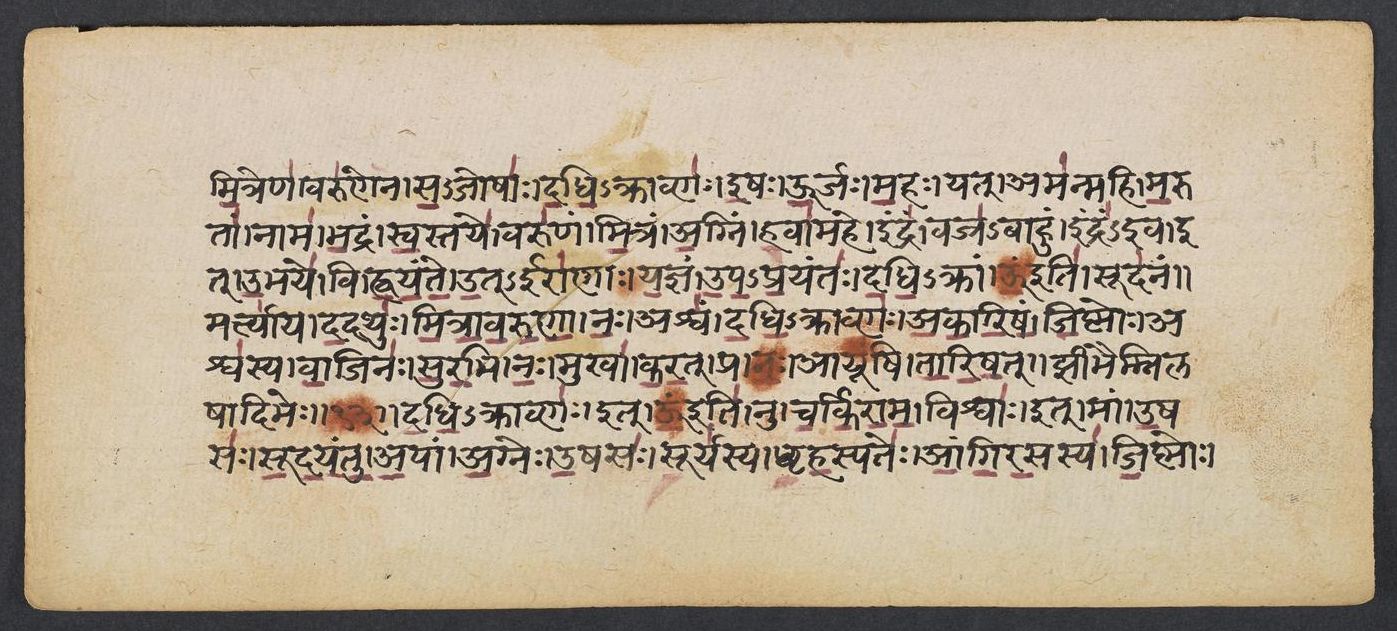
Where on the image
Penn Ms. Coll. 390 Item 41, fol. 301r (numbered 110r by the scribe) (OPenn image 301, lower leaf). Checked on the image: the Rigveda text on this page begins in RV 4.39.3 ‹mitreṇa varuṇena sa-joṣāḥ›. The next page with Rigveda text, fol. 301v (numbered 110v by the scribe), begins in RV 4.40.2 ‹satvā bhariṣaḥ go--iṣaḥ duvanya-sat›. Verse 4.40.1 ends on this page.
1da̱dhi̱krāvṇa̱ id u̱ nu ca̍rkirāma̱ viśvā̱ in mām u̱ṣasa̍ḥ sūdayantu | a̱pām a̱gner u̱ṣasa̱ḥ sūrya̍sya̱ bṛha̱spate̍r āṅgira̱sasya̍ ji̱ṣṇoḥ ||
Compare: Padapāṭha (word-by-word text written in the manuscript; Sansknet e-text via GRETIL)
1dadhi-krāvṇaḥ | it | oṃ iti | nu | cārkirāma | viśvā | it | mām | uṣasaḥ | sūdayantu | apām | agneḥ | uṣasaḥ | sūryasya | bṛhaspateḥ | āṅgirasasya | jiṣṇoḥ
1LET us recite the praise of Dadhikrâvan: may all the Mornings move me to exertion; Praise of the Lord of Waters, Dawn, and Agni, Br̥ihaspati Son of Angiras, and Sûrya.
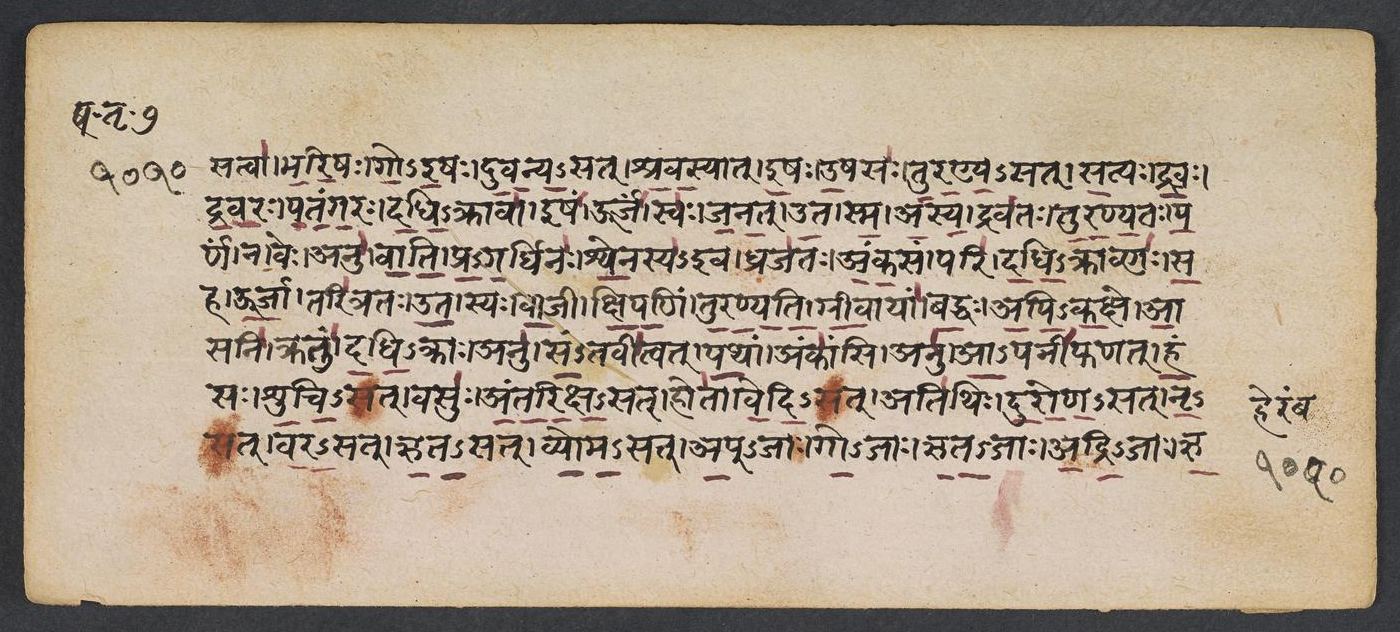
Where on the image
Penn Ms. Coll. 390 Item 41, fol. 301v (numbered 110v by the scribe) (OPenn image 302, upper leaf). Checked on the image: the Rigveda text on this page begins in RV 4.40.2 ‹satvā bhariṣaḥ go--iṣaḥ duvanya-sat›. The next page with Rigveda text, fol. 302r (numbered 111r by the scribe), begins in RV 4.40.5 ‹-ṛtam›. Verses 4.40.2-4 end on this page.
2satvā̍ bhari̱ṣo ga̍vi̱ṣo du̍vanya̱sac chra̍va̱syād i̱ṣa u̱ṣasa̍s turaṇya̱sat | sa̱tyo dra̱vo dra̍va̱raḥ pa̍taṁga̱ro da̍dhi̱krāveṣa̱m ūrja̱ṁ sva̍r janat ||
3u̱ta smā̍sya̱ drava̍tas turaṇya̱taḥ pa̱rṇaṁ na ver anu̍ vāti praga̱rdhina̍ḥ | śye̱nasye̍va̱ dhraja̍to aṅka̱sam pari̍ dadhi̱krāvṇa̍ḥ sa̱horjā tari̍trataḥ ||
4u̱ta sya vā̱jī kṣi̍pa̱ṇiṁ tu̍raṇyati grī̱vāyā̍m ba̱ddho a̍pika̱kṣa ā̱sani̍ | kratu̍ṁ dadhi̱krā anu̍ sa̱ṁtavī̍tvat pa̱thām aṅkā̱ṁsy anv ā̱panī̍phaṇat ||
Compare: Padapāṭha (word-by-word text written in the manuscript; Sansknet e-text via GRETIL)
2satvā | bhariṣaḥ | go--iṣaḥ | duvanya-sat | śravasyāt | iṣaḥ | uṣasaḥ | turaṇya-sat | satyaḥ | dravaḥ | dravaraḥ | pataṅgaraḥ | dadhi-krāvā | iṣam | ūjarm | svaḥ | janat
3uta | sma | asya | dravataḥ | turaṇyataḥ | parṇam | na | veḥ | anu | vāti | pra-gardhinaḥ | śyenasya-iva | dhrajataḥ | aṅkasam | pari | dadhi-krāvṇaḥ | saha | ūrjā | taritrataḥ
4uta | syaḥ | vājī | kṣipaṇim | turaṇyati | grīvāyām | baddhaḥ | āpi-kakṣe | āsani | kratum | dadhi-krāḥ | anu | sam-tavītvat | pathām | aṅkāṃsi | anu | āpanīphaṇat
2Brave, seeking war and booty, dwelling with the good and with the swift, may he hasten the food of Dawn. May he the true, the fleet, the lover of the course, the bird-like Dadhikrâvan, bring food, strength, and light.
3His pinion, rapid runner, fans him m his way, as of a bird that hastens onward to its aim, And, as it were a falcon's gliding through the air, strikes Dadhikrâvan's side as he speeds on with might.
4Bound by the neck and by the flanks and by the mouth, the vigorous Courser lends new swiftness to his speed. Drawing himself together, as his strength allows, Dadhikrâs springs along the windings of the paths.
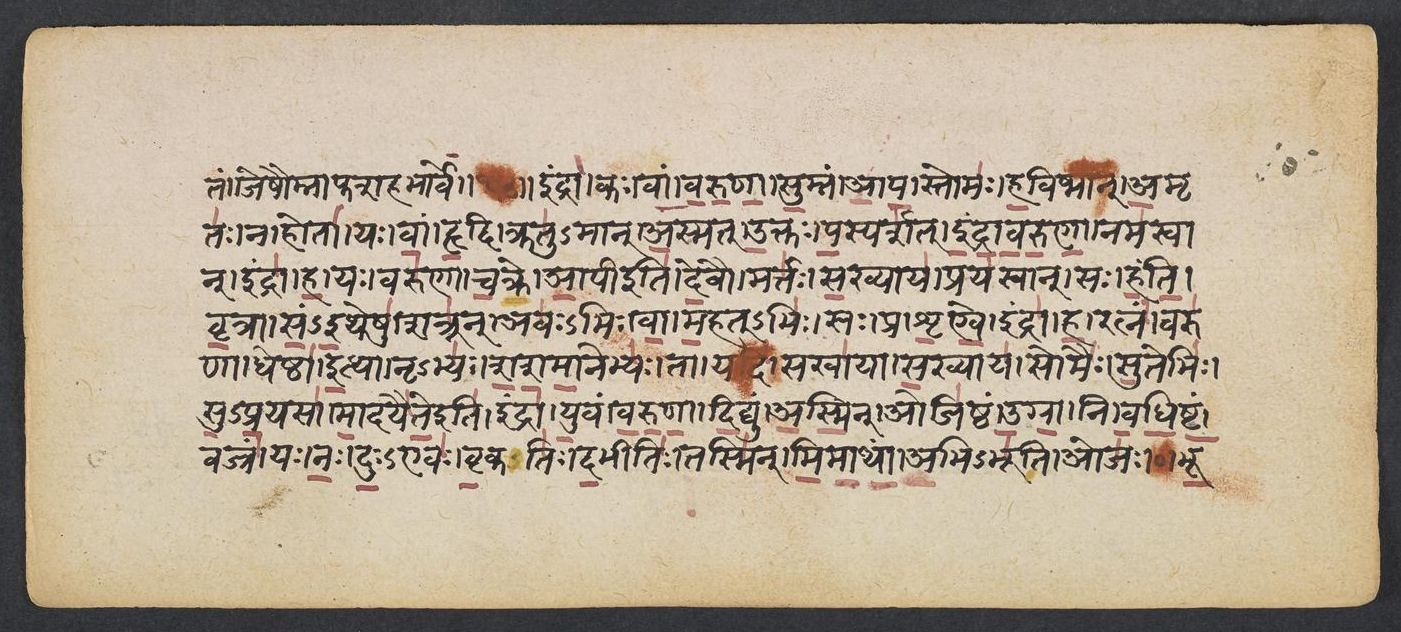
Where on the image
Penn Ms. Coll. 390 Item 41, fol. 302r (numbered 111r by the scribe) (OPenn image 302, lower leaf). Checked on the image: the Rigveda text on this page begins in RV 4.40.5 ‹-ṛtam›. The next page with Rigveda text, fol. 302v (numbered 111v by the scribe), begins in RV 4.41.5 ‹-bhūtam asyāḥ dhiyaḥ pretārā›. Verse 4.40.5 ends on this page; 4.40.5 begins on fol. 301v (numbered 110v by the scribe).
5ha̱ṁsaḥ śu̍ci̱ṣad vasu̍r antarikṣa̱sad dhotā̍ vedi̱ṣad ati̍thir duroṇa̱sat | nṛ̱ṣad va̍ra̱sad ṛ̍ta̱sad vyo̍ma̱sad a̱bjā go̱jā ṛ̍ta̱jā a̍dri̱jā ṛ̱tam ||
Compare: Padapāṭha (word-by-word text written in the manuscript; Sansknet e-text via GRETIL)
5haṃsaḥ | śuci-sat | vasuḥ | antarikṣa-sat | hotā | vedi-sat | atithiḥ | duroṇa-sat | nṛ-sat | vara-sat | ṛta-sat | vyoma-sat | abjāḥ | go--jāḥ | ṛta-jāḥ | ādri-jāḥ | ṛtam
5The Hamsa homed in light, the Vasu in mid-air, the priest beside the altar, in the house the guest, Dweller in noblest place, mid men, in truth, in sky, born of flood, kine, truth, mountain, he is holy Law.
Notes
- Sanskrit: Aufrecht's edition (1877) with the Vedic accents, as entered by van Nooten and Holland (GRETIL).
- English: Ralph T. H. Griffith, The Hymns of the Rigveda (1889-1892; 2nd ed. 1896-1897), from the VedaWeb digital text; OCR slips in that text were corrected against the printed 2nd edition (data/sources/rigveda/griffith_errata.json).
- Padapāṭha (edition text): Sansknet e-text via GRETIL (CC BY-NC-SA 4.0).
Cite
Sources
- Source: Penn Ms. Coll. 390 Item 41 (undated (catalogued with Penn's 18th-19th c. Vedic manuscripts)), OPenn, Public Domain Mark + Aufrecht's accented text (GRETIL) + Griffith's English (VedaWeb) (holding institution)
- Critical edition: Aufrecht (1877), accented e-text via GRETIL
← previous · → next · v cycle view · l back to library