Rigveda 5.10: To Agni
Introduction
Rigveda 5.10 is a hymn of 7 verses addressed to Agni. It stands in book (maṇḍala) 5, the family book of the Atri clan. The Rigveda is the oldest collection of Sanskrit hymns, composed in the second half of the second millennium BCE and handed down orally for many centuries before it was written down.
The manuscript shown is Penn Ms. Coll. 390 Item 41 (University of Pennsylvania), an undated paper manuscript of the padapāṭha (the word-by-word recitation text, in which every word is written separately and compounds are split) of the whole Ṛgveda in Devanāgarī, 884 leaves in fascicles, 7-9 lines to the page, accents in red; this hymn stands on fol. 329r-329v. Each section below gives the verses that end on one page; the page boundaries were read on the images (the opening words of every page), not counted out. Where the manuscript is a padapāṭha (the word-by-word recitation text), the section shows Aufrecht's continuous (saṃhitā) text first and, as the edition text, the padapāṭha of the same verses, which is the form written on the page.
How was this verified? (Provenance)
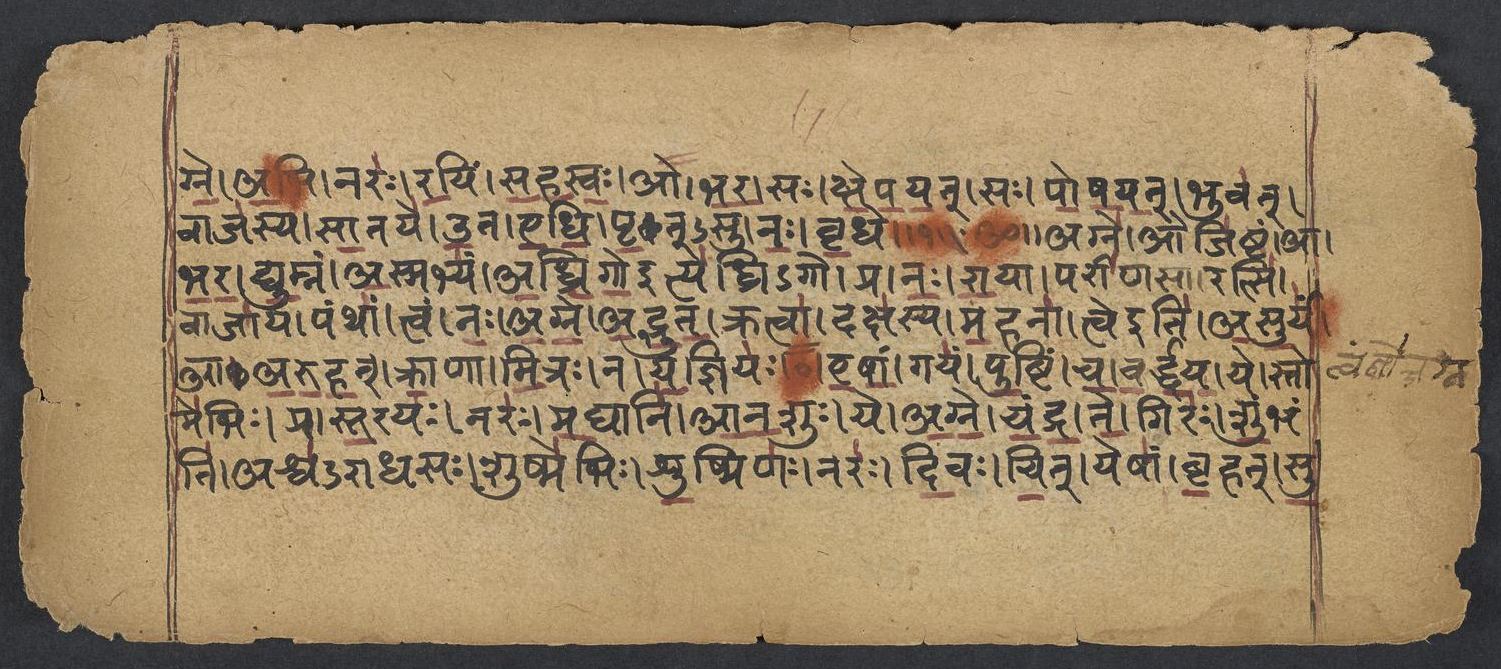
Where on the image
Penn Ms. Coll. 390 Item 41, fol. 329r (numbered 2r by the scribe) (OPenn image 329, lower leaf). Checked on the image: the Rigveda text on this page begins in RV 5.9.7 ‹-agne abhi naraḥ rayim›. The next page with Rigveda text, fol. 329v (numbered 2v by the scribe), begins in RV 5.10.4 ‹-su-kīrtiḥ bodhati tmanā›. Verses 5.10.1-3 end on this page.
1agna̱ oji̍ṣṭha̱m ā bha̍ra dyu̱mnam a̱smabhya̍m adhrigo | pra no̍ rā̱yā parī̍ṇasā̱ ratsi̱ vājā̍ya̱ panthā̍m ||
2tvaṁ no̍ agne adbhuta̱ kratvā̱ dakṣa̍sya ma̱ṁhanā̍ | tve a̍su̱rya1̱̍m āru̍hat krā̱ṇā mi̱tro na ya̱jñiya̍ḥ ||
3tvaṁ no̍ agna eṣā̱ṁ gaya̍m pu̱ṣṭiṁ ca̍ vardhaya | ye stome̍bhi̱ḥ pra sū̱rayo̱ naro̍ ma̱ghāny ā̍na̱śuḥ ||
Compare: Padapāṭha (word-by-word text written in the manuscript; Sansknet e-text via GRETIL)
1agne | ojiṣṭham | ā | bhara | dyumnam | asmabhyam | adhrigo ity adhri-go | pra | naḥ | rāyā | parīṇasā | ratsi | vājāya | panthām
2tvam | naḥ | agne | adbhuta | kratvā | dakṣasya | maṃhanā | tve iti | asuryam | ā | aruhat | krāṇā | mitraḥ | na | yajñiyaḥ
3tvam | naḥ | agne | eṣām | gayam | puṣṭim | ca | vardhaya | ye | stomebhiḥ | pra | sūrayaḥ | naraḥ | maghāni | ānaśuḥ
1BRING us most mighty splendour thou, Agni, resistless on thy way. With overflowing store of wealth mark out for us a path to strength.
2Ours art thou, wondrous Agni, bywisdom and bounteousness of power. The might of Asuras rests on thee, like Mitra worshipful in act.
3Agni, increase our means of life, increase the house and home of these, The men, the princes who have won great riches through our hymns of praise.
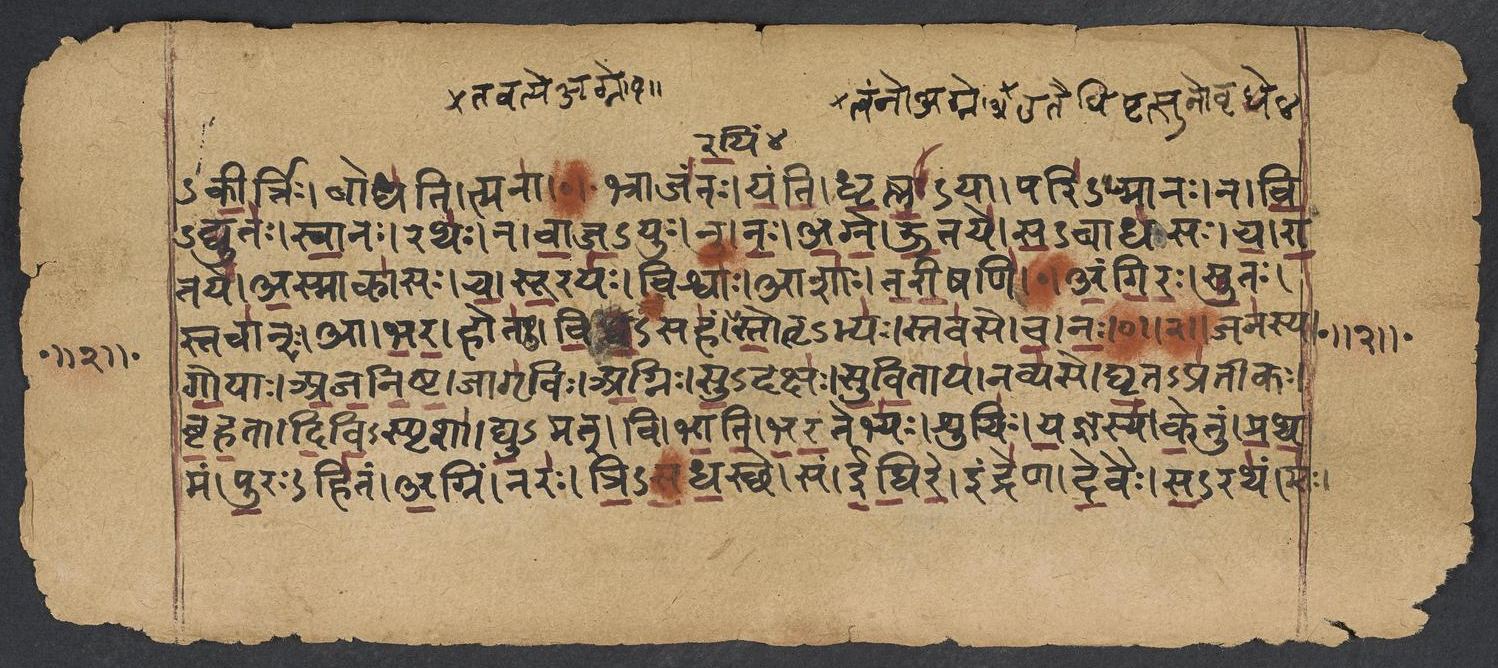
Where on the image
Penn Ms. Coll. 390 Item 41, fol. 329v (numbered 2v by the scribe) (OPenn image 330, upper leaf). Checked on the image: the Rigveda text on this page begins in RV 5.10.4 ‹-su-kīrtiḥ bodhati tmanā›. The next page with Rigveda text, fol. 330r (numbered 3r by the scribe), begins in RV 5.11.2 ‹barhiṣi sīdat ni hotā›. Verses 5.10.4-7 end on this page; 5.10.4 begins on fol. 329r (numbered 2r by the scribe).
4ye a̍gne candra te̱ gira̍ḥ śu̱mbhanty aśva̍rādhasaḥ | śuṣme̍bhiḥ śu̱ṣmiṇo̱ naro̍ di̱vaś ci̱d yeṣā̍m bṛ̱hat su̍kī̱rtir bodha̍ti̱ tmanā̍ ||
5tava̱ tye a̍gne a̱rcayo̱ bhrāja̍nto yanti dhṛṣṇu̱yā | pari̍jmāno̱ na vi̱dyuta̍ḥ svā̱no ratho̱ na vā̍ja̱yuḥ ||
6nū no̍ agna ū̱taye̍ sa̱bādha̍saś ca rā̱taye̍ | a̱smākā̍saś ca sū̱rayo̱ viśvā̱ āśā̍s tarī̱ṣaṇi̍ ||
7tvaṁ no̍ agne aṅgiraḥ stu̱taḥ stavā̍na̱ ā bha̍ra | hota̍r vibhvā̱saha̍ṁ ra̱yiṁ sto̱tṛbhya̱ḥ stava̍se ca na u̱taidhi̍ pṛ̱tsu no̍ vṛ̱dhe ||
Compare: Padapāṭha (word-by-word text written in the manuscript; Sansknet e-text via GRETIL)
4ye | agne | candra | te | giraḥ | śumbhanti | aśva-rādhasaḥ | śuṣmebhiḥ | śuṣmiṇaḥ | naraḥ | divaḥ | cit | yeṣām | bṛhat | su-kīrtiḥ | bodhati | tmanā
5tava | tye | agne | arcayaḥ | bhrājantaḥ | yanti | dhṛṣṇu-yā | pari-jmānaḥ | na | vi-dyutaḥ | svānaḥ | rathaḥ | na | vājayuḥ
6nu | naḥ | agne | ūtaye | sa-bādhasaḥ | ca | rātaye | asmākāsaḥ | ca | sūrayaḥ | vi śvāḥ | āsāḥ | tarīṣaṇi
7tvam | naḥ | agne | aṅgiraḥ | stutaḥ | stavānaḥ | ā | bhara | hotaḥ | vibhva-saham | rayim | stotṛ-bhyaḥ | stavase | ca | naḥ | uta | edhi | pṛt-su | naḥ | vṛdhe
4Bright Agni, they who deck their songs for thee have horses as their meed. The men are mighty in their might, they whose high laud, as that of heaven, awakes thee of its own accord.
5O Agni, those resplendent flames of thine go valorously forth, Like lightnings flashing round us, like a rattling car that seeks the spoil.
6Now, Agni, come to succour us; let priests draw nigh to offer gifts; And let the patrons of our rites subdue all regions of the earth.
7Bring to us, Agni, Angiras, lauded of old and lauded now, Invoker! wealth to quell the strong, that singers may extol thee. Be near us in fight for our success.
Notes
- Sanskrit: Aufrecht's edition (1877) with the Vedic accents, as entered by van Nooten and Holland (GRETIL).
- English: Ralph T. H. Griffith, The Hymns of the Rigveda (1889-1892; 2nd ed. 1896-1897), from the VedaWeb digital text; OCR slips in that text were corrected against the printed 2nd edition (data/sources/rigveda/griffith_errata.json).
- Padapāṭha (edition text): Sansknet e-text via GRETIL (CC BY-NC-SA 4.0).
Cite
Sources
- Source: Penn Ms. Coll. 390 Item 41 (undated (catalogued with Penn's 18th-19th c. Vedic manuscripts)), OPenn, Public Domain Mark + Aufrecht's accented text (GRETIL) + Griffith's English (VedaWeb) (holding institution)
- Critical edition: Aufrecht (1877), accented e-text via GRETIL
← previous · → next · v cycle view · l back to library