Rigveda 5.35: To Indra
Introduction
Rigveda 5.35 is a hymn of 8 verses addressed to Indra. It stands in book (maṇḍala) 5, the family book of the Atri clan. The Rigveda is the oldest collection of Sanskrit hymns, composed in the second half of the second millennium BCE and handed down orally for many centuries before it was written down.
The manuscript shown is Penn Ms. Coll. 390 Item 41 (University of Pennsylvania), an undated paper manuscript of the padapāṭha (the word-by-word recitation text, in which every word is written separately and compounds are split) of the whole Ṛgveda in Devanāgarī, 884 leaves in fascicles, 7-9 lines to the page, accents in red; this hymn stands on fol. 349r-350r. Each section below gives the verses that end on one page; the page boundaries were read on the images (the opening words of every page), not counted out. Where the manuscript is a padapāṭha (the word-by-word recitation text), the section shows Aufrecht's continuous (saṃhitā) text first and, as the edition text, the padapāṭha of the same verses, which is the form written on the page.
How was this verified? (Provenance)
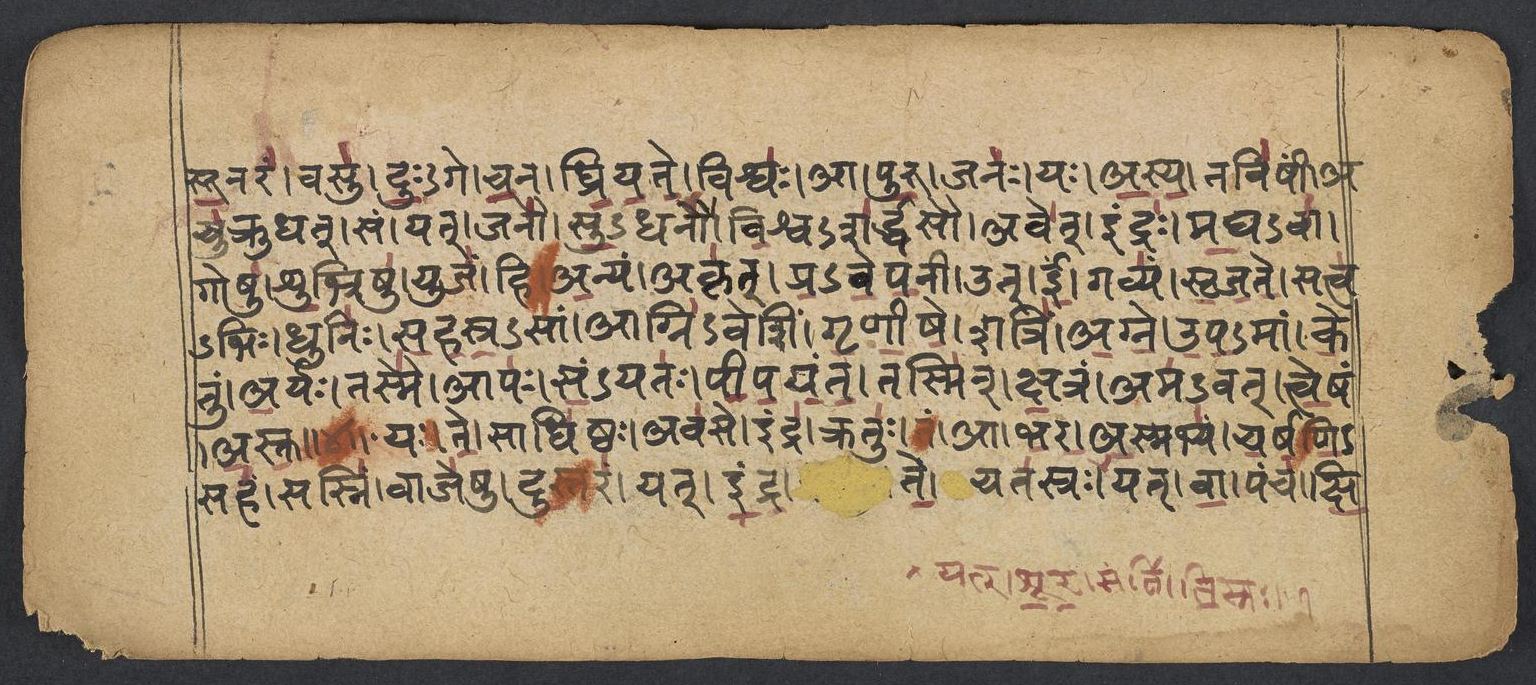
Where on the image
Penn Ms. Coll. 390 Item 41, fol. 349r (numbered 22r by the scribe) (OPenn image 349, lower leaf). Checked on the image: the Rigveda text on this page begins in RV 5.34.7 ‹sūnaram vasu duḥ-ge cana›. The next page with Rigveda text, fol. 349v (numbered 22v by the scribe), begins in RV 5.35.2 ‹-kṣitīnām avaḥ tat su›. Verse 5.35.1 ends on this page.
1yas te̱ sādhi̱ṣṭho 'va̍sa̱ indra̱ kratu̱ṣ ṭam ā bha̍ra | a̱smabhya̍ṁ carṣaṇī̱saha̱ṁ sasni̱ṁ vāje̍ṣu du̱ṣṭara̍m ||
Compare: Padapāṭha (word-by-word text written in the manuscript; Sansknet e-text via GRETIL)
1yaḥ | te | sādhiṣṭhaḥ | avase | indra | kratuḥ | ṭam | ā | bhara | asmabhyam | carṣaṇ i-saham | sasnim | vājeṣu | dustaram
1INDRA, for our assistance bring that most effectual power of thine, Which conquers men for us, and wins the spoil, invincible in fight.
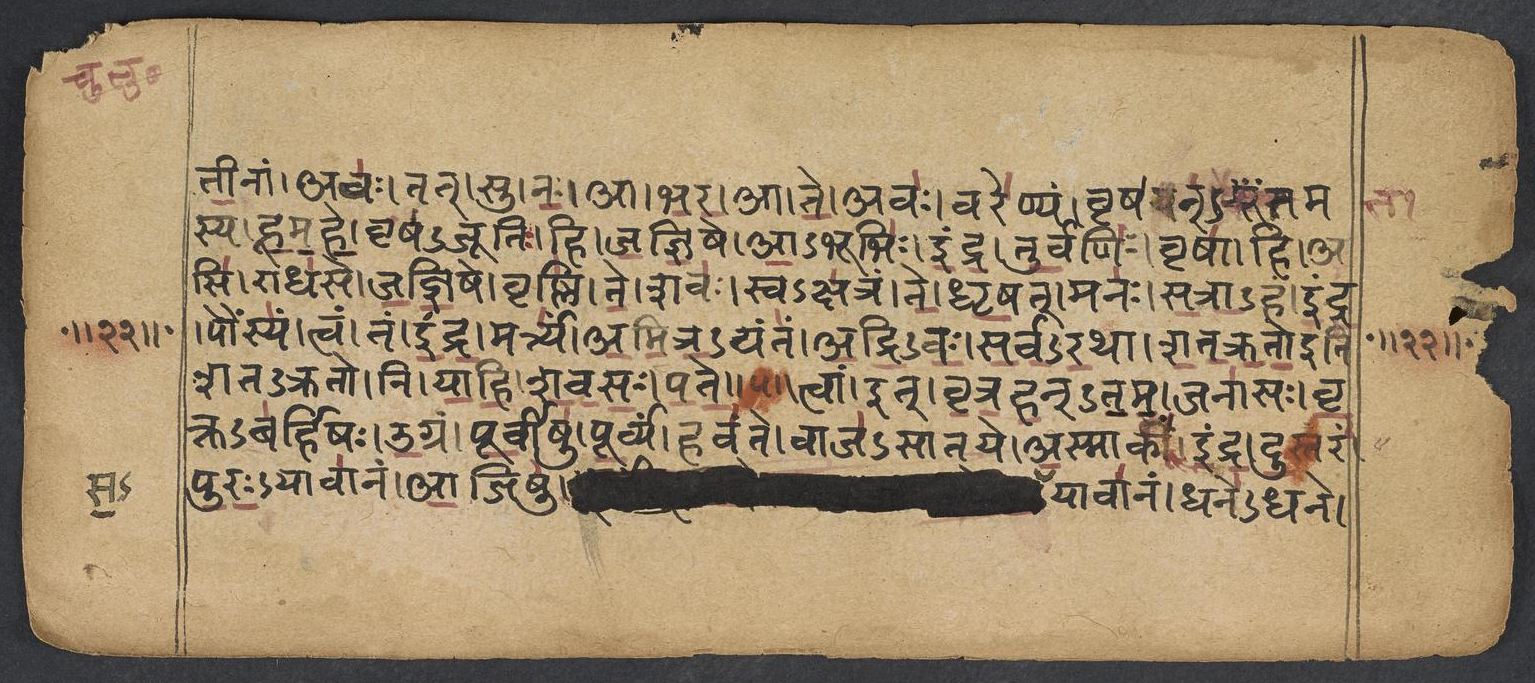
Where on the image
Penn Ms. Coll. 390 Item 41, fol. 349v (numbered 22v by the scribe) (OPenn image 350, upper leaf). Checked on the image: the Rigveda text on this page begins in RV 5.35.2 ‹-kṣitīnām avaḥ tat su›. The next page with Rigveda text, fol. 350r (numbered 23r by the scribe), begins in RV 5.35.7 ‹vāja-yantam ava ratham›. Verses 5.35.2-6 end on this page; 5.35.2 begins on fol. 349r (numbered 22r by the scribe).
2yad i̍ndra te̱ cata̍sro̱ yac chū̍ra̱ santi̍ ti̱sraḥ | yad vā̱ pañca̍ kṣitī̱nām ava̱s tat su na̱ ā bha̍ra ||
3ā te 'vo̱ vare̍ṇya̱ṁ vṛṣa̍ntamasya hūmahe | vṛṣa̍jūti̱r hi ja̍jñi̱ṣa ā̱bhūbhi̍r indra tu̱rvaṇi̍ḥ ||
4vṛṣā̱ hy asi̱ rādha̍se jajñi̱ṣe vṛṣṇi̍ te̱ śava̍ḥ | svakṣa̍traṁ te dhṛ̱ṣan mana̍ḥ satrā̱ham i̍ndra̱ pauṁsya̍m ||
5tvaṁ tam i̍ndra̱ martya̍m amitra̱yanta̍m adrivaḥ | sa̱rva̱ra̱thā śa̍takrato̱ ni yā̍hi śavasas pate ||
6tvām id vṛ̍trahantama̱ janā̍so vṛ̱ktaba̍rhiṣaḥ | u̱gram pū̱rvīṣu̍ pū̱rvyaṁ hava̍nte̱ vāja̍sātaye ||
Compare: Padapāṭha (word-by-word text written in the manuscript; Sansknet e-text via GRETIL)
2yat | indra | te | catasraḥ | yat | śūra | santi | tisraḥ | yat | vā | pañca | kṣitīnām | avaḥ | tat | su | naḥ | ā | bhara
3ā | te | avaḥ | vareṇyam | vṛṣan-tamasya | hūmahe | vṛṣa-jūtiḥ | hi | jajñiṣe | ābhūbhiḥ | indra | turvaṇiḥ
4vṛṣā | hi | asi | rādhase | jajñiṣe | vṛṣṇi | te | śavaḥ | sva-kṣatram | te | dhṛṣam | manaḥ | satrāham | indra | paiṃsyam
5tvam | tam | indra | martyam | amitra-yantam | adri-vaḥ | sarva-rathā | śatakrato itiśata-krato | ni | yāhi | śavasaḥ | pate
6tvām | it | vṛtrahan-tama | janāsaḥ | vṛkta-barhiṣaḥ | ugram | pūrvīṣu | pūrvyam | havante | vāja-sātaye
2Indra, whatever aids be thine, four be they, or, O Hero, three, Or those of the Five Tribes of men, bring quickly all that help to us.
3The aid most excellent of thee the Mightiest hitherward we call, For thou wast born with hero might, conquering, Indra, with the Strong.
4Mighty to prosper us wast thou born, and mighty is the strength thou hast. In native power thy soul is firm: thy valour, Indra, slays a host.
5O Ṣatakratu, Lord of Strength, O Indra, Caster of the Stone. With all thy chariot's force assail the man who shows himself thy foe.
6For, Mightiest Vr̥itra-slayer, thee, fierce, foremost among many, folk Whose sacred grass is trimmed invite to battle where the spoil is won.
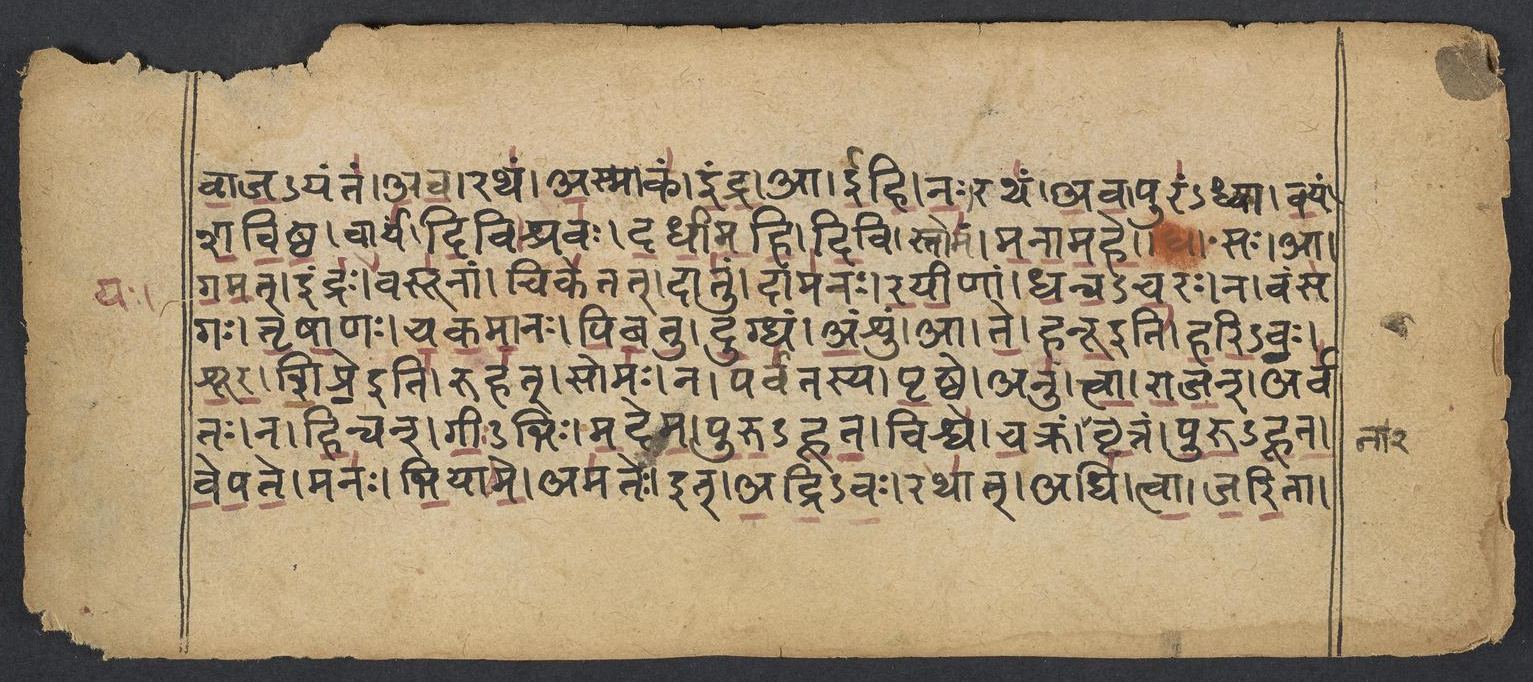
Where on the image
Penn Ms. Coll. 390 Item 41, fol. 350r (numbered 23r by the scribe) (OPenn image 350, lower leaf). Checked on the image: the Rigveda text on this page begins in RV 5.35.7 ‹vāja-yantam ava ratham›. The next page with Rigveda text, fol. 350v (numbered 23v by the scribe), begins in RV 5.36.3 ‹sadāvṛdha kuvit nu stoṣam›. Verses 5.35.7-8 end on this page; 5.35.7 begins on fol. 349v (numbered 22v by the scribe).
7a̱smāka̍m indra du̱ṣṭara̍m puro̱yāvā̍nam ā̱jiṣu̍ | sa̱yāvā̍na̱ṁ dhane̍-dhane vāja̱yanta̍m avā̱ ratha̍m ||
8a̱smāka̍m i̱ndrehi̍ no̱ ratha̍m avā̱ pura̍ṁdhyā | va̱yaṁ śa̍viṣṭha̱ vārya̍ṁ di̱vi śravo̍ dadhīmahi di̱vi stoma̍m manāmahe ||
Compare: Padapāṭha (word-by-word text written in the manuscript; Sansknet e-text via GRETIL)
7asmākam | indra | dustaram | puraḥ-yāvānam | ājiṣu | sa-yāvānam | dhane--dhane | vāja-yantam | ava | ratham
8asmākam | indra | ā | ihi | naḥ | ratham | ava | puram-dhyā | vayam | śaviṣṭha | vāryam | divi | śravaḥ | dadhīmahi | divi | stomam | manāmahe
7Indra, do thou protect our car that mingles foremost in the fights, That bears its part in every fray, invincible and seeking spoil.
8Come to us, Indra, and protect our car with thine intelligence. May we, O Mightiest One, obtain excellent fame at break of day, and meditate our hymn at dawn.
Notes
- Sanskrit: Aufrecht's edition (1877) with the Vedic accents, as entered by van Nooten and Holland (GRETIL).
- English: Ralph T. H. Griffith, The Hymns of the Rigveda (1889-1892; 2nd ed. 1896-1897), from the VedaWeb digital text; OCR slips in that text were corrected against the printed 2nd edition (data/sources/rigveda/griffith_errata.json).
- Padapāṭha (edition text): Sansknet e-text via GRETIL (CC BY-NC-SA 4.0).
Cite
Sources
- Source: Penn Ms. Coll. 390 Item 41 (undated (catalogued with Penn's 18th-19th c. Vedic manuscripts)), OPenn, Public Domain Mark + Aufrecht's accented text (GRETIL) + Griffith's English (VedaWeb) (holding institution)
- Critical edition: Aufrecht (1877), accented e-text via GRETIL
← previous · → next · v cycle view · l back to library