Rigveda 5.38: To Indra
Introduction
Rigveda 5.38 is a hymn of 5 verses addressed to Indra. It stands in book (maṇḍala) 5, the family book of the Atri clan. The Rigveda is the oldest collection of Sanskrit hymns, composed in the second half of the second millennium BCE and handed down orally for many centuries before it was written down.
The manuscript shown is Penn Ms. Coll. 390 Item 41 (University of Pennsylvania), an undated paper manuscript of the padapāṭha (the word-by-word recitation text, in which every word is written separately and compounds are split) of the whole Ṛgveda in Devanāgarī, 884 leaves in fascicles, 7-9 lines to the page, accents in red; this hymn stands on fol. 351v-352r. Each section below gives the verses that end on one page; the page boundaries were read on the images (the opening words of every page), not counted out. Where the manuscript is a padapāṭha (the word-by-word recitation text), the section shows Aufrecht's continuous (saṃhitā) text first and, as the edition text, the padapāṭha of the same verses, which is the form written on the page.
How was this verified? (Provenance)
Where on the image
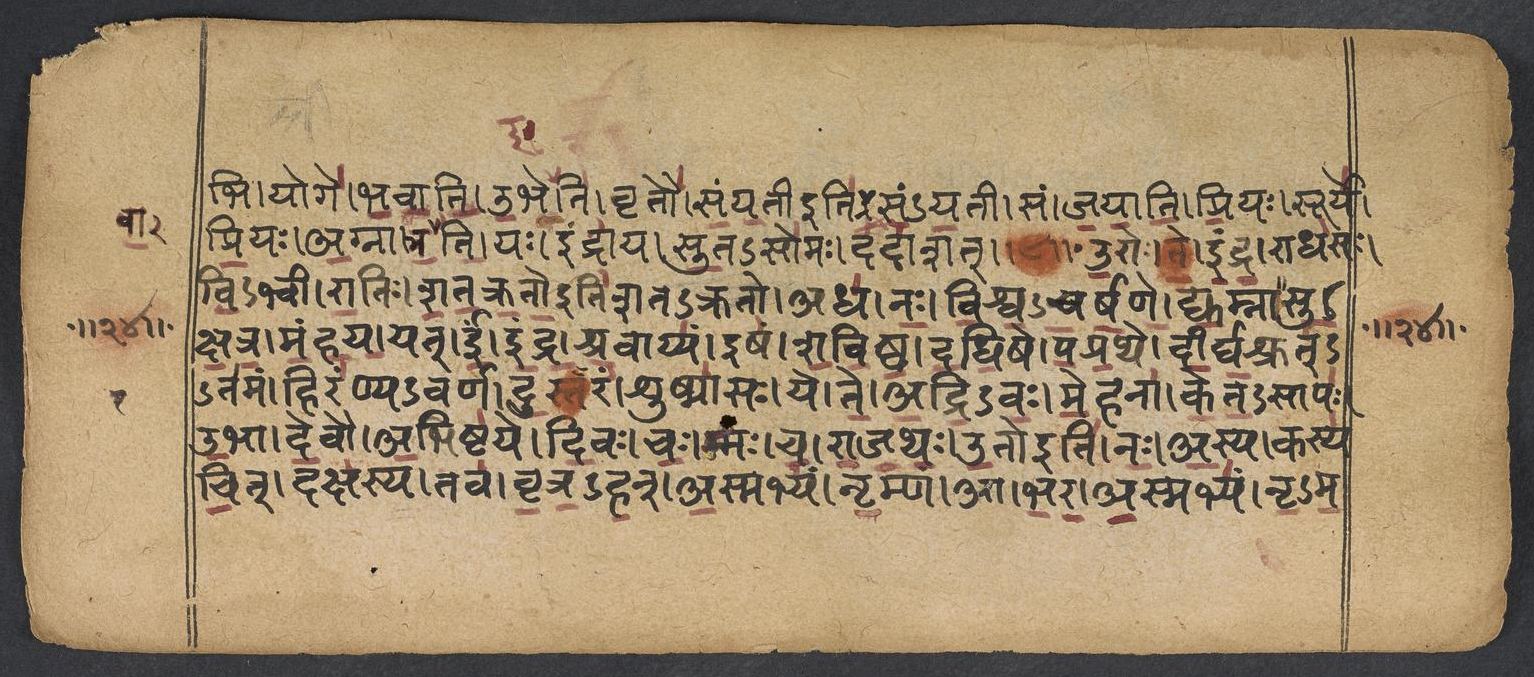
Penn Ms. Coll. 390 Item 41, fol. 351v (numbered 24v by the scribe) (OPenn image 352, upper leaf). Checked on the image: the Rigveda text on this page begins in RV 5.37.5 ‹-abhi yoge bhavāti ubhe›. The next page with Rigveda text, fol. 352r (numbered 25r by the scribe), begins in RV 5.38.4 ‹-nṛ-manasyase›. Verses 5.38.1-3 end on this page.
1u̱roṣ ṭa̍ indra̱ rādha̍so vi̱bhvī rā̱tiḥ śa̍takrato | adhā̍ no viśvacarṣaṇe dyu̱mnā su̍kṣatra maṁhaya ||
2yad ī̍m indra śra̱vāyya̱m iṣa̍ṁ śaviṣṭha dadhi̱ṣe | pa̱pra̱the dī̍rgha̱śrutta̍ma̱ṁ hira̍ṇyavarṇa du̱ṣṭara̍m ||
3śuṣmā̍so̱ ye te̍ adrivo me̱hanā̍ keta̱sāpa̍ḥ | u̱bhā de̱vāv a̱bhiṣṭa̍ye di̱vaś ca̱ gmaś ca̍ rājathaḥ ||
Compare: Padapāṭha (word-by-word text written in the manuscript; Sansknet e-text via GRETIL)
1uroḥ | te | indra | rādhasaḥ | vi-bhvī | rātiḥ | śatakrato itiśata-krato | adha | naḥ | viśva-carṣaṇe | dyumnā | su-kṣatra | maṃhaya
2yat | īm | indra | śravāyyam | iṣam | śaviṣṭha | dadhiṣe | paprathe | dīrghaśrut-tamam | hiraṇya-varṇa | dustaram
3śuṣmāsaḥ | ye | te | adri-vaḥ | mehanā | keta-sāpaḥ | ubhā | devau | abhiṣṭaye | divaḥ | ca | gmaḥ | ca | rājathaḥ
1WIDE, Indra Ṣatakratu, spreads the bounty of thine ample grace: So, Lord of fair dominion, Friend of all men, give us splendid wealth.
2The food which, Mightiest Indra, thou possessest worthy of renown Is bruited as most widely famed, invincible, O Golden-hued!
3O Darter of the Stone, the powers which readily obey thy will,– Divinities, both thou and they, ye rule, to guard them, earth and heaven.
Where on the image
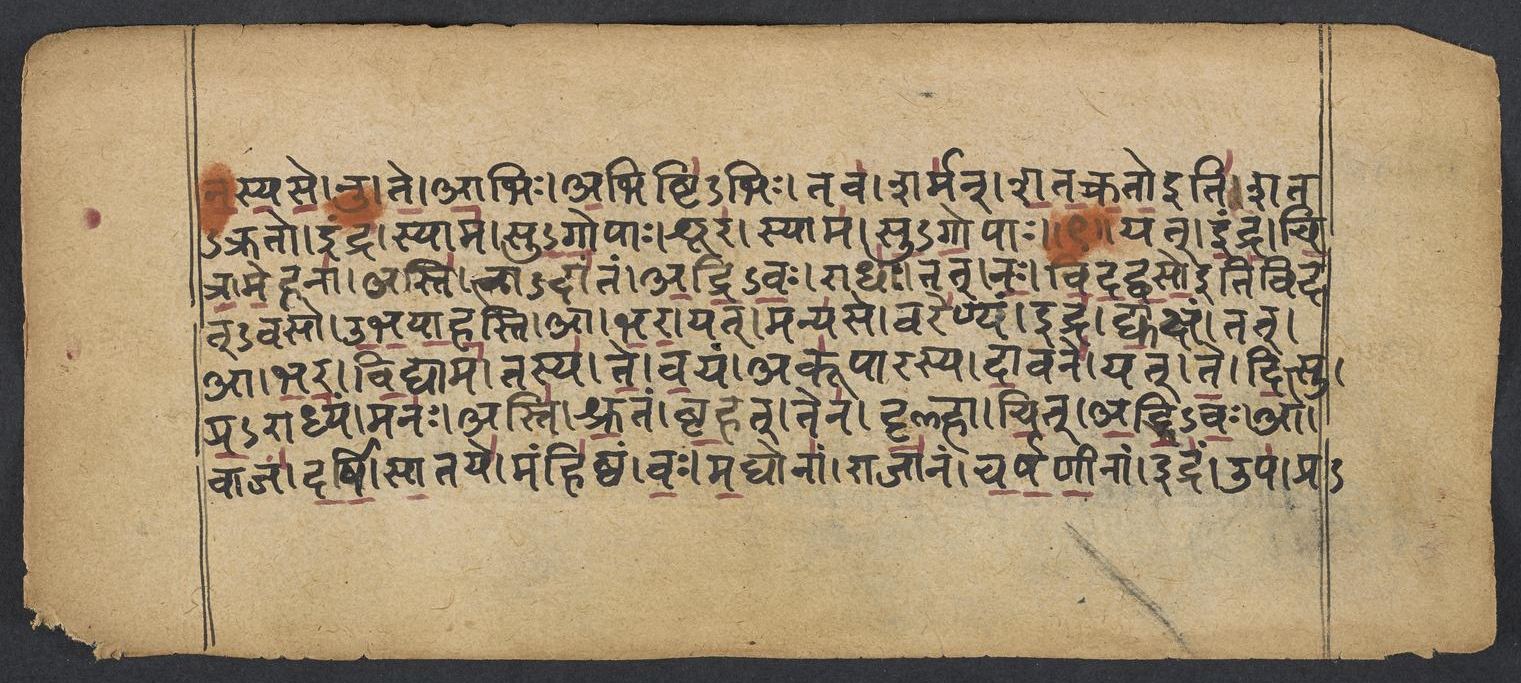
Penn Ms. Coll. 390 Item 41, fol. 352r (numbered 25r by the scribe) (OPenn image 352, lower leaf). Checked on the image: the Rigveda text on this page begins in RV 5.38.4 ‹-nṛ-manasyase›. The next page with Rigveda text, fol. 352v (numbered 25v by the scribe), begins in RV 5.39.4 ‹-pra-śastaye pūrvībhiḥ jujuṣe giraḥ›. Verses 5.38.4-5 end on this page; 5.38.4 begins on fol. 351v (numbered 24v by the scribe).
4u̱to no̍ a̱sya kasya̍ ci̱d dakṣa̍sya̱ tava̍ vṛtrahan | a̱smabhya̍ṁ nṛ̱mṇam ā bha̍rā̱smabhya̍ṁ nṛmaṇasyase ||
5nū ta̍ ā̱bhir a̱bhiṣṭi̍bhi̱s tava̱ śarma̍ñ chatakrato | indra̱ syāma̍ sugo̱pāḥ śūra̱ syāma̍ sugo̱pāḥ ||
Compare: Padapāṭha (word-by-word text written in the manuscript; Sansknet e-text via GRETIL)
4uto iti | naḥ | asya | kasya | cit | dakṣasya | tava | vṛtra-han | asmabhyam | nṛmṇam | ā | bhāra | asmabhyam | nṛ-manasyase
5nu | te | ābhiḥ | abhiṣṭi-bhiḥ | tava | śarman | śatakrato itiśata-krato | indra | syāma | su-gopāḥ | śūra | syāma | su-gopāḥ
4And from whatever power of thine, O Vr̥itra-slayer, it may be, Bring thou to us heroic strength: thou hast a man's regard for us.
5In thy protection, with these aids of thine, O Lord of Hundred Powers, Indra, may we be guarded well, Hero, may we be guarded well.
Notes
- Sanskrit: Aufrecht's edition (1877) with the Vedic accents, as entered by van Nooten and Holland (GRETIL).
- English: Ralph T. H. Griffith, The Hymns of the Rigveda (1889-1892; 2nd ed. 1896-1897), from the VedaWeb digital text; OCR slips in that text were corrected against the printed 2nd edition (data/sources/rigveda/griffith_errata.json).
- Padapāṭha (edition text): Sansknet e-text via GRETIL (CC BY-NC-SA 4.0).
Cite
Sources
- Source: Penn Ms. Coll. 390 Item 41 (undated (catalogued with Penn's 18th-19th c. Vedic manuscripts)), OPenn, Public Domain Mark + Aufrecht's accented text (GRETIL) + Griffith's English (VedaWeb) (holding institution)
- Critical edition: Aufrecht (1877), accented e-text via GRETIL
← previous · → next · v cycle view · l back to library