Rigveda 5.39: To Indra
Introduction
Rigveda 5.39 is a hymn of 5 verses addressed to Indra. It stands in book (maṇḍala) 5, the family book of the Atri clan. The Rigveda is the oldest collection of Sanskrit hymns, composed in the second half of the second millennium BCE and handed down orally for many centuries before it was written down.
The manuscript shown is Penn Ms. Coll. 390 Item 41 (University of Pennsylvania), an undated paper manuscript of the padapāṭha (the word-by-word recitation text, in which every word is written separately and compounds are split) of the whole Ṛgveda in Devanāgarī, 884 leaves in fascicles, 7-9 lines to the page, accents in red; this hymn stands on fol. 352r-352v. Each section below gives the verses that end on one page; the page boundaries were read on the images (the opening words of every page), not counted out. Where the manuscript is a padapāṭha (the word-by-word recitation text), the section shows Aufrecht's continuous (saṃhitā) text first and, as the edition text, the padapāṭha of the same verses, which is the form written on the page.
How was this verified? (Provenance)
Where on the image
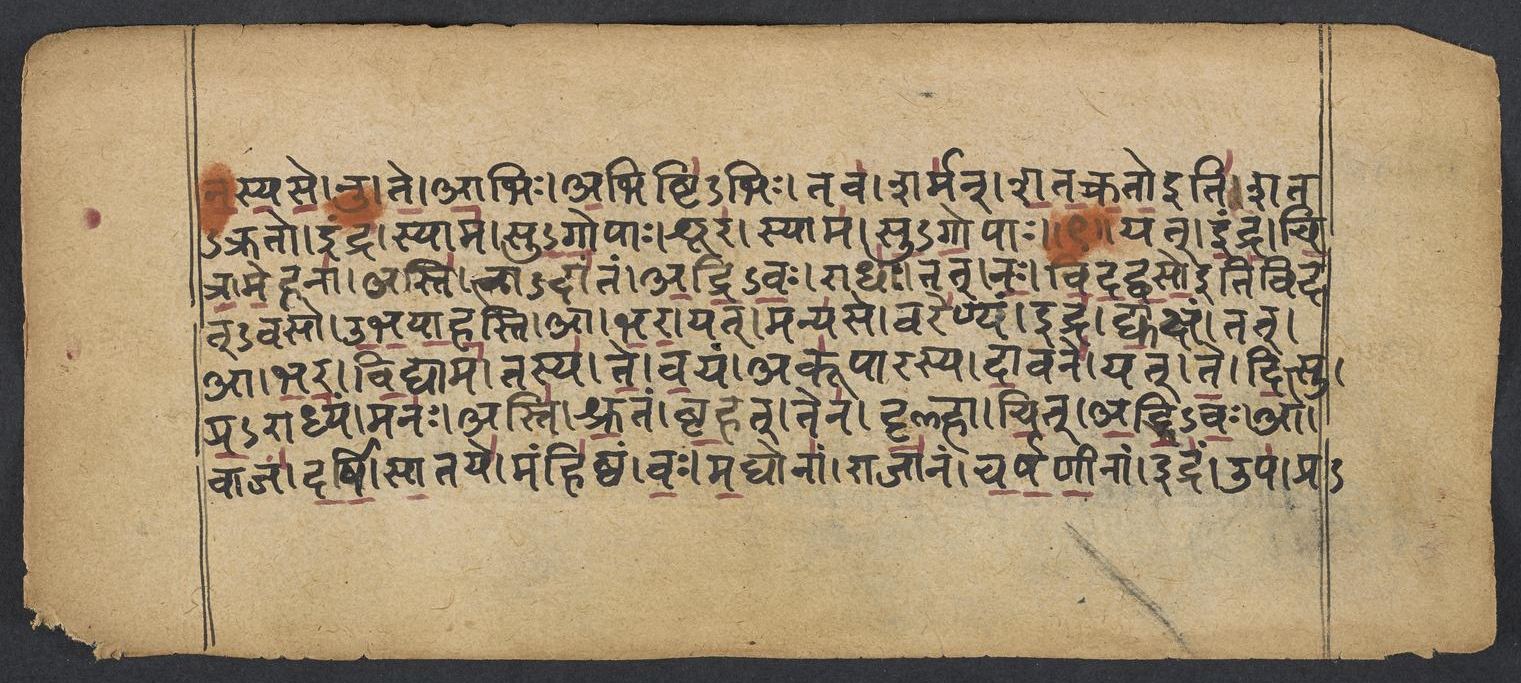
Penn Ms. Coll. 390 Item 41, fol. 352r (numbered 25r by the scribe) (OPenn image 352, lower leaf). Checked on the image: the Rigveda text on this page begins in RV 5.38.4 ‹-nṛ-manasyase›. The next page with Rigveda text, fol. 352v (numbered 25v by the scribe), begins in RV 5.39.4 ‹-pra-śastaye pūrvībhiḥ jujuṣe giraḥ›. Verses 5.39.1-3 end on this page.
1yad i̍ndra citra me̱hanāsti̱ tvādā̍tam adrivaḥ | rādha̱s tan no̍ vidadvasa ubhayāha̱sty ā bha̍ra ||
2yan manya̍se̱ vare̍ṇya̱m indra̍ dyu̱kṣaṁ tad ā bha̍ra | vi̱dyāma̱ tasya̍ te va̱yam akū̍pārasya dā̱vane̍ ||
3yat te̍ di̱tsu pra̱rādhya̱m mano̱ asti̍ śru̱tam bṛ̱hat | tena̍ dṛ̱ḻhā ci̍d adriva̱ ā vāja̍ṁ darṣi sā̱taye̍ ||
Compare: Padapāṭha (word-by-word text written in the manuscript; Sansknet e-text via GRETIL)
1yat | indra | citra | mehanā | asti | tvādātam | adri-vaḥ | rādhaḥ | tat | naḥ | vidadvaso itividat-vaso | ubhayāhasti | ā | bhara
2yat | manyase | vareṇyam | indra | dyukṣam | tat | ā | bhara | vidyāma | tasya | te | vayam | akūpārasya | dāvane
3yat | te | ditsu | pra-rādhyam | manaḥ | asti | sṛutam | bṛhat | tena | dṛḷhā | cit | adri-vaḥ | ā | vājam | darṣi | sātaye
1STONE-DARTING Indra. Wondrous One, what wealth is richly given from thee, That bounty, Treasure-Finder! bring filling both thy hands, to us.
2Bring what thou deemest worth the wish, O Indra, that which is in heaven. So may we know thee as thou art, boundless in thy munificence.
3Thy lofty spirit, far-renowned as fain to give and prompt to win,– With this thou rendest e'en the firm, Stone-Darter! so to gain thee strength.
Where on the image
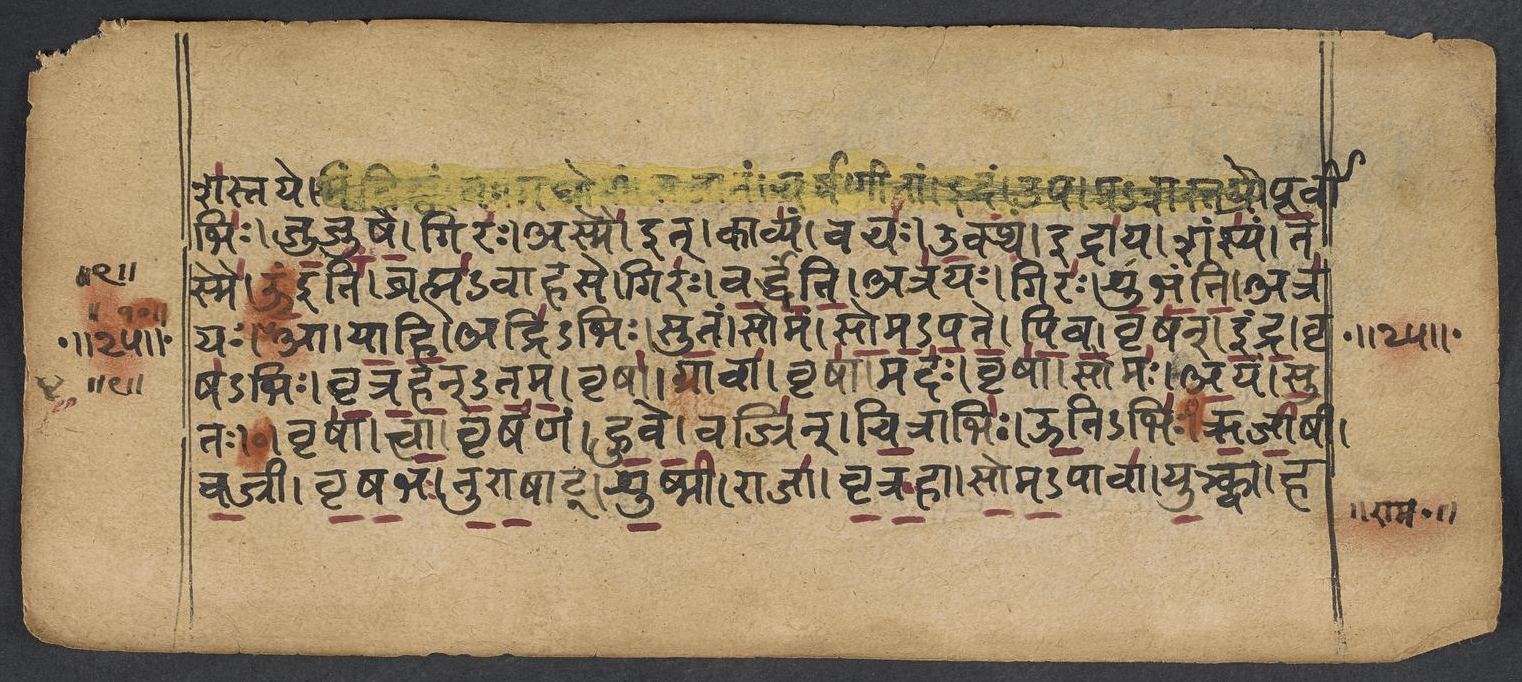
Penn Ms. Coll. 390 Item 41, fol. 352v (numbered 25v by the scribe) (OPenn image 353, upper leaf). Checked on the image: the Rigveda text on this page begins in RV 5.39.4 ‹-pra-śastaye pūrvībhiḥ jujuṣe giraḥ›. The next page with Rigveda text, fol. 353r (numbered 26r by the scribe), begins in RV 5.40.4 ‹-hari-bhyām upa yāsat arvāṅ›. Verses 5.39.4-5 end on this page; 5.39.4 begins on fol. 352r (numbered 25r by the scribe).
4maṁhi̍ṣṭhaṁ vo ma̱ghonā̱ṁ rājā̍naṁ carṣaṇī̱nām | indra̱m upa̱ praśa̍staye pū̱rvībhi̍r jujuṣe̱ gira̍ḥ ||
5asmā̱ it kāvya̱ṁ vaca̍ u̱ktham indrā̍ya̱ śaṁsya̍m | tasmā̍ u̱ brahma̍vāhase̱ giro̍ vardha̱nty atra̍yo̱ gira̍ḥ śumbha̱nty atra̍yaḥ ||
Compare: Padapāṭha (word-by-word text written in the manuscript; Sansknet e-text via GRETIL)
4maṃhiṣṭham | vaḥ | maghonām | rājānam | carṣaṇīnām | indram | upa | pra-śastaye | pūrvībhiḥ | jujuṣe | giraḥ
5asmai | it | kāvyam | vacaḥ | uktham | indrāya | śaṃsyam | tasmai | oṃ iti | brahma-vāhase | giraḥ | vardhanti | atrayaḥ | giraḥ | śumbhanti | atrayaḥ
4Singers with many songs have made Indra propitious to their fame, Him who is King of human kind, most liberal of your wealthy ones.
5To him, to Indra must be sung the poet's word, the hymn of praise. To him, accepter of the prayer, the Atris raise their songs on high, the Atris beautify their songs.
Notes
- Sanskrit: Aufrecht's edition (1877) with the Vedic accents, as entered by van Nooten and Holland (GRETIL).
- English: Ralph T. H. Griffith, The Hymns of the Rigveda (1889-1892; 2nd ed. 1896-1897), from the VedaWeb digital text; OCR slips in that text were corrected against the printed 2nd edition (data/sources/rigveda/griffith_errata.json).
- Padapāṭha (edition text): Sansknet e-text via GRETIL (CC BY-NC-SA 4.0).
Cite
Sources
- Source: Penn Ms. Coll. 390 Item 41 (undated (catalogued with Penn's 18th-19th c. Vedic manuscripts)), OPenn, Public Domain Mark + Aufrecht's accented text (GRETIL) + Griffith's English (VedaWeb) (holding institution)
- Critical edition: Aufrecht (1877), accented e-text via GRETIL
← previous · → next · v cycle view · l back to library