Rigveda 6.34: To Indra
Introduction
Rigveda 6.34 is a hymn of 5 verses addressed to Indra. It stands in book (maṇḍala) 6, the family book of Bharadvāja. The Rigveda is the oldest collection of Sanskrit hymns, composed in the second half of the second millennium BCE and handed down orally for many centuries before it was written down.
The manuscript shown is Penn Ms. Coll. 390 Item 41 (University of Pennsylvania), an undated paper manuscript of the padapāṭha (the word-by-word recitation text, in which every word is written separately and compounds are split) of the whole Ṛgveda in Devanāgarī, 884 leaves in fascicles, 7-9 lines to the page, accents in red; this hymn stands on fol. 444r-444v. Each section below gives the verses that end on one page; the page boundaries were read on the images (the opening words of every page), not counted out. Where the manuscript is a padapāṭha (the word-by-word recitation text), the section shows Aufrecht's continuous (saṃhitā) text first and, as the edition text, the padapāṭha of the same verses, which is the form written on the page.
How was this verified? (Provenance)
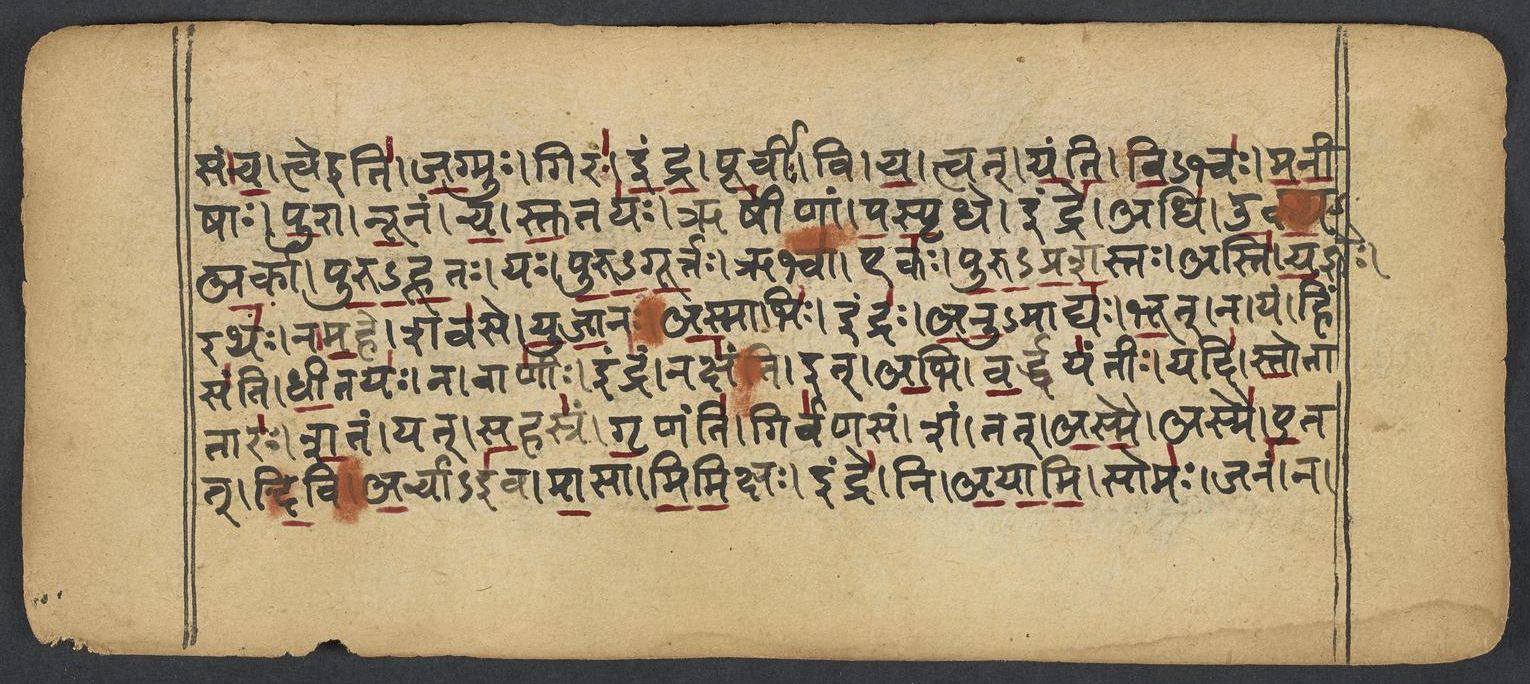
Where on the image
Penn Ms. Coll. 390 Item 41, fol. 444r (numbered 117r by the scribe) (OPenn image 444, lower leaf). Checked on the image: the Rigveda text on this page begins in RV 6.34.1 ‹sam ca tve iti›. The next page with Rigveda text, fol. 444v (numbered 117v by the scribe), begins in RV 6.34.4 ‹dhanvan abhi sam yat›. Verses 6.34.1-3 end on this page.
1saṁ ca̱ tve ja̱gmur gira̍ indra pū̱rvīr vi ca̱ tvad ya̍nti vi̱bhvo̍ manī̱ṣāḥ | pu̱rā nū̱naṁ ca̍ stu̱taya̱ ṛṣī̍ṇām paspṛ̱dhra indre̱ adhy u̍kthā̱rkā ||
2pu̱ru̱hū̱to yaḥ pu̍rugū̱rta ṛbhvā̱m̐ eka̍ḥ purupraśa̱sto asti̍ ya̱jñaiḥ | ratho̱ na ma̱he śava̍se yujā̱no̱3̱̍ 'smābhi̱r indro̍ anu̱mādyo̍ bhūt ||
3na yaṁ hiṁsa̍nti dhī̱tayo̱ na vāṇī̱r indra̱ṁ nakṣa̱ntīd a̱bhi va̱rdhaya̍ntīḥ | yadi̍ sto̱tāra̍ḥ śa̱taṁ yat sa̱hasra̍ṁ gṛ̱ṇanti̱ girva̍ṇasa̱ṁ śaṁ tad a̍smai ||
Compare: Padapāṭha (word-by-word text written in the manuscript; Sansknet e-text via GRETIL)
1sam | ca | tve iti | jagmuḥ | giraḥ | indra | pūrvīḥ | vi | ca | tvat | yanti | vi-bhvaḥ | manīṣāḥ | purā | nūnam | ca | stutayaḥ | ṛṣīṇām | paspṛdhre | indre | adhi | uktha-arkā
2puru-hūtaḥ | yaḥ | puru-gūrtaḥ | ṛbhvā | ekaḥ | puru-praśastaḥ | asti | yajñaiḥ | rathaḥ | na | mahe | śavase | yujānaḥ | asmābhiḥ | indraḥ | anu-mādyaḥ | bhūt
3na | yam | hiṃsanti | dhītayaḥ | na | vāṇīḥ | indram | nakṣanti | it | abhi | vadharyantīḥ | yadi | stotāraḥ | śatam | yat | sahasram | gṛṇanti | girvaṇasam | śam | tat | asmai
1FULL Many songs have met in thee, O Indra, and many a noble thought from thee proceedeth. Now and of old the eulogies of sages, their holy hymns and lauds, have yearned for Indra.
2He, praised of many, bold, invoked of many, alone is glorified at sacrifices. Like a car harnessed for some great achievement, Indra must be the cause of our rejoicing.
3They make their way to Indra and exalt him, bim whom no prayers and no laudations trouble; For when a hundred or a thousand singers. laud him who loves the song their praise delights him.
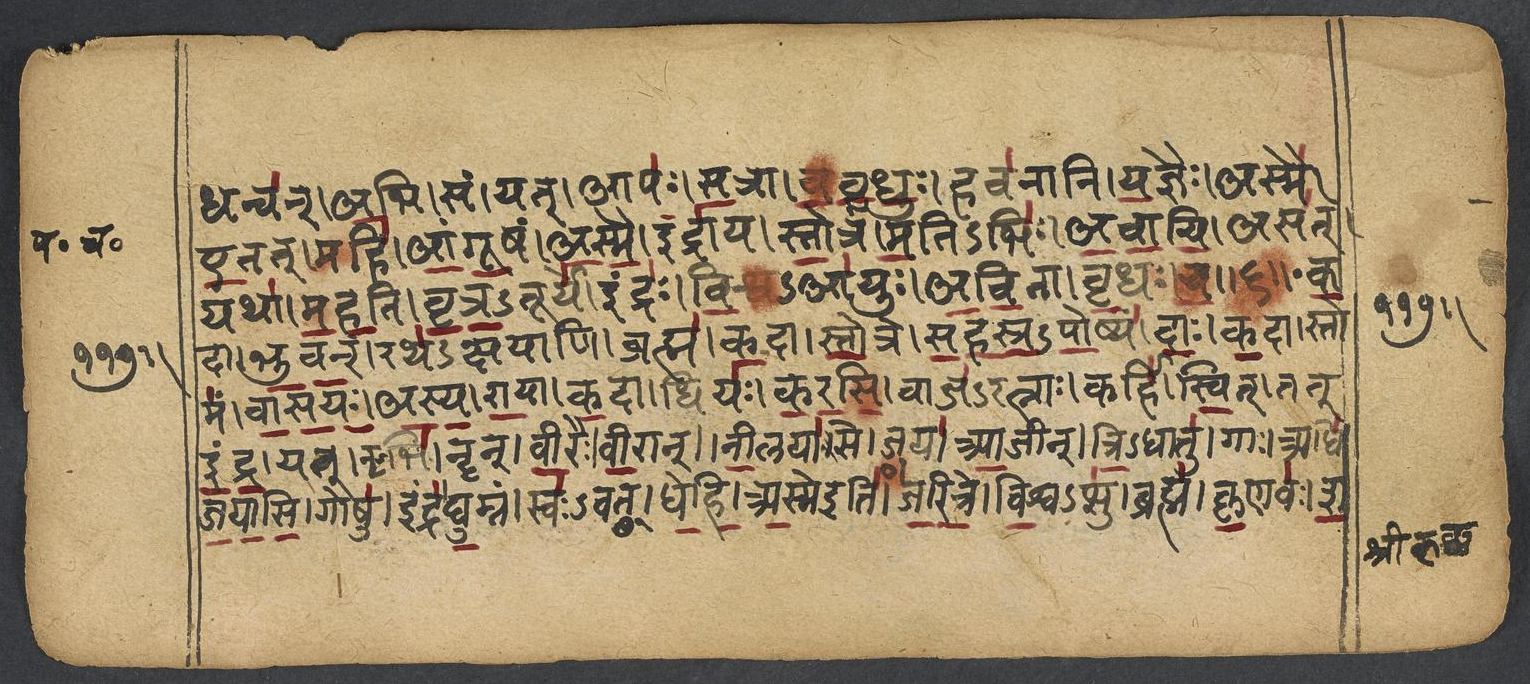
Where on the image
Penn Ms. Coll. 390 Item 41, fol. 444v (numbered 117v by the scribe) (OPenn image 445, upper leaf). Checked on the image: the Rigveda text on this page begins in RV 6.34.4 ‹dhanvan abhi sam yat›. The next page with Rigveda text, fol. 445r (numbered 118r by the scribe), begins in RV 6.35.3 ‹-śaviṣṭha kadā dhiyaḥ na›. Verses 6.34.4-5 end on this page; 6.34.4 begins on fol. 444r (numbered 117r by the scribe).
4asmā̍ e̱tad di̱vy a1̱̍rceva̍ mā̱sā mi̍mi̱kṣa indre̱ ny a̍yāmi̱ soma̍ḥ | jana̱ṁ na dhanva̍nn a̱bhi saṁ yad āpa̍ḥ sa̱trā vā̍vṛdhu̱r hava̍nāni ya̱jñaiḥ ||
5asmā̍ e̱tan mahy ā̍ṅgū̱ṣam a̍smā̱ indrā̍ya sto̱tram ma̱tibhi̍r avāci | asa̱d yathā̍ maha̱ti vṛ̍tra̱tūrya̱ indro̍ vi̱śvāyu̍r avi̱tā vṛ̱dhaś ca̍ ||
Compare: Padapāṭha (word-by-word text written in the manuscript; Sansknet e-text via GRETIL)
4asmai | etat | divi | arcāiva | māsā | mimikṣaḥ | indre | ni | ayāmi | somaḥ | janam | na | dhanvan | abhi | sam | yat | āpaḥ | satrāḥ | vavṛdhuḥ | havanāni | yajñaiḥ
5asmai | etat | mahi | āṅgūṣam | asmai | indrāya | stotram | mati-bhiḥ | avāci | asat | yathā | mahati | vṛtra-tūrye | indraḥ | viśva-āyuḥ | avitā | vṛdhaḥ | ca
4As brightness mingles with the Moon in heaven, the offered Soma yearns to mix with Indra. Like water brought to men in desert places, our gifts at sacrifice have still refreshed him.
5To him this mighty eulogy, to Indra hath this our laud been uttered by the poets, That in the great encounter with the foemen, Loved of all life, Indra may guard and help us.
Notes
- Sanskrit: Aufrecht's edition (1877) with the Vedic accents, as entered by van Nooten and Holland (GRETIL).
- English: Ralph T. H. Griffith, The Hymns of the Rigveda (1889-1892; 2nd ed. 1896-1897), from the VedaWeb digital text; OCR slips in that text were corrected against the printed 2nd edition (data/sources/rigveda/griffith_errata.json).
- Padapāṭha (edition text): Sansknet e-text via GRETIL (CC BY-NC-SA 4.0).
Cite
Sources
- Source: Penn Ms. Coll. 390 Item 41 (undated (catalogued with Penn's 18th-19th c. Vedic manuscripts)), OPenn, Public Domain Mark + Aufrecht's accented text (GRETIL) + Griffith's English (VedaWeb) (holding institution)
- Critical edition: Aufrecht (1877), accented e-text via GRETIL
← previous · → next · v cycle view · l back to library