Rigveda 6.35: To Indra
Introduction
Rigveda 6.35 is a hymn of 5 verses addressed to Indra. It stands in book (maṇḍala) 6, the family book of Bharadvāja. The Rigveda is the oldest collection of Sanskrit hymns, composed in the second half of the second millennium BCE and handed down orally for many centuries before it was written down.
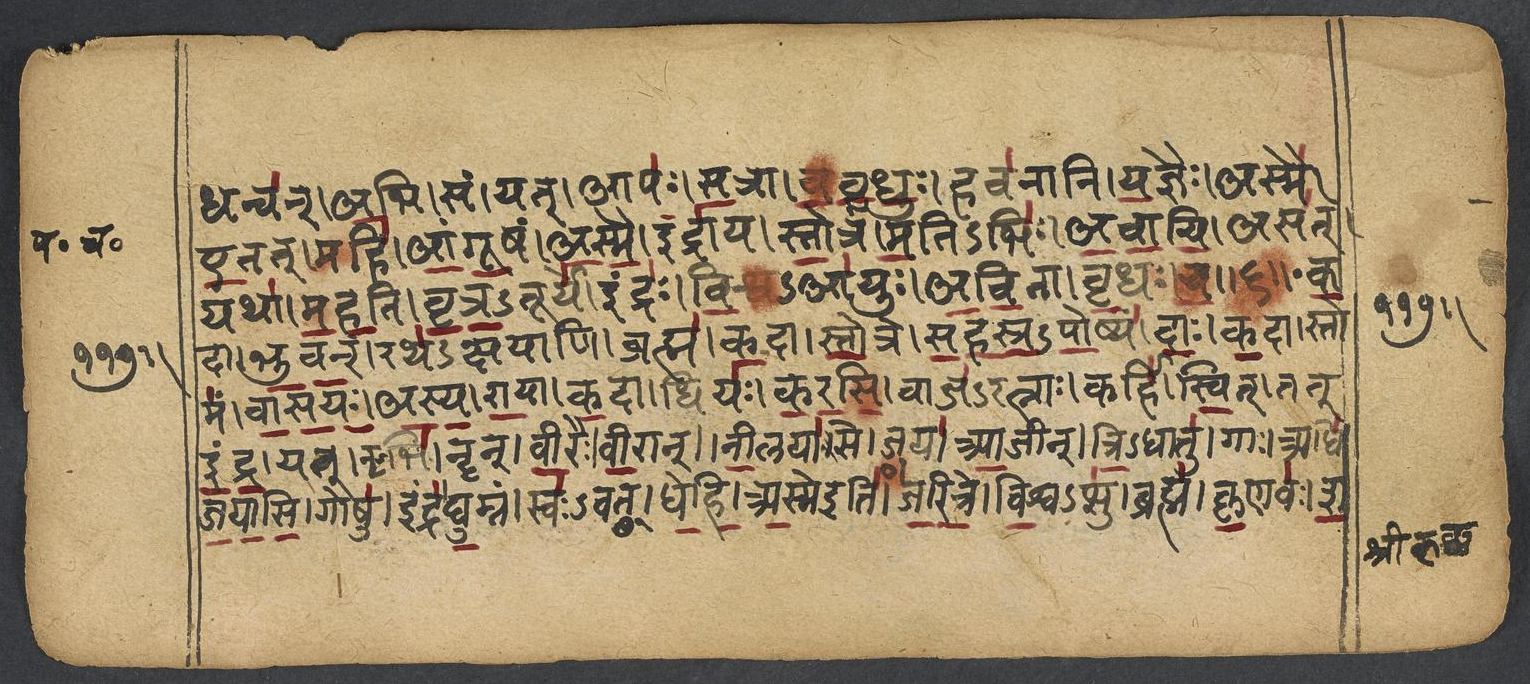
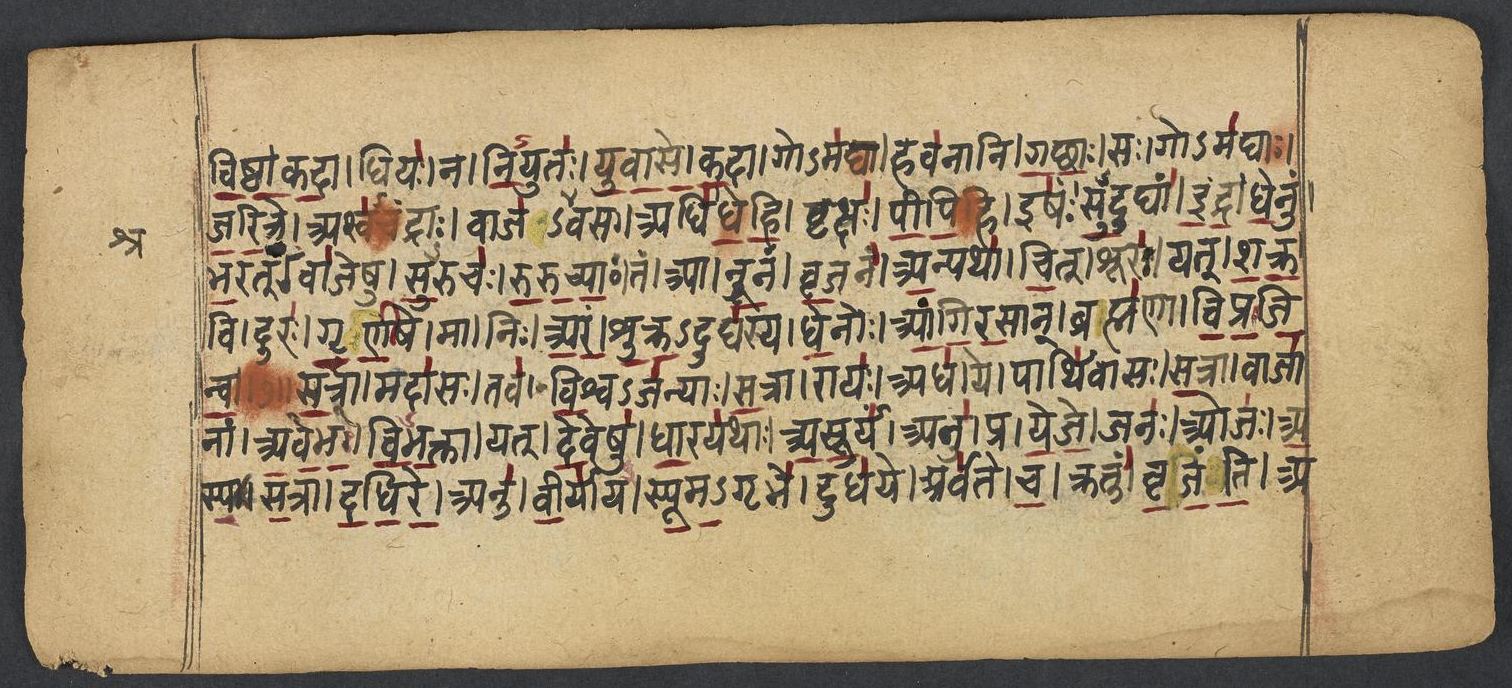
The manuscript shown is Penn Ms. Coll. 390 Item 41 (University of Pennsylvania), an undated paper manuscript of the padapāṭha (the word-by-word recitation text, in which every word is written separately and compounds are split) of the whole Ṛgveda in Devanāgarī, 884 leaves in fascicles, 7-9 lines to the page, accents in red; this hymn stands on fol. 444v-445r. Each section below gives the verses that end on one page; the page boundaries were read on the images (the opening words of every page), not counted out. Where the manuscript is a padapāṭha (the word-by-word recitation text), the section shows Aufrecht's continuous (saṃhitā) text first and, as the edition text, the padapāṭha of the same verses, which is the form written on the page.
How was this verified? (Provenance)
Where on the image
Penn Ms. Coll. 390 Item 41, fol. 444v (numbered 117v by the scribe) (OPenn image 445, upper leaf). Checked on the image: the Rigveda text on this page begins in RV 6.34.4 ‹dhanvan abhi sam yat›. The next page with Rigveda text, fol. 445r (numbered 118r by the scribe), begins in RV 6.35.3 ‹-śaviṣṭha kadā dhiyaḥ na›. Verses 6.35.1-2 end on this page.
1ka̱dā bhu̍va̱n ratha̍kṣayāṇi̱ brahma̍ ka̱dā sto̱tre sa̍hasrapo̱ṣya̍ṁ dāḥ | ka̱dā stoma̍ṁ vāsayo 'sya rā̱yā ka̱dā dhiya̍ḥ karasi̱ vāja̍ratnāḥ ||
2karhi̍ svi̱t tad i̍ndra̱ yan nṛbhi̱r nṝn vī̱rair vī̱rān nī̱ḻayā̍se̱ jayā̱jīn | tri̱dhātu̱ gā adhi̍ jayāsi̱ goṣv indra̍ dyu̱mnaṁ sva̍rvad dhehy a̱sme ||
Compare: Padapāṭha (word-by-word text written in the manuscript; Sansknet e-text via GRETIL)
1kadā | bhuvan | ratha-kṣayāṇi | brahma | kadā | stotre | sahasra-poṣyam | dāḥ | kadā | stomam | vāsayaḥ | asya | rāyā | kadā | dhiyaḥ | karasi | vāja-ratnāḥ
2karhi | svit | tat | indra | yat | nṛ-bhiḥ | nṝn | vīraiḥ | vīrān | nīḷayāse | jaya | ājīn | tri-dhātu | gāḥ | adhi | jayāsi | goṣu | indra | dyumnam | svaḥ-vat | dhehi | asme iti
1WHEN shall our prayers rest in thy car beside thee? When dost thou give the singer food for thousands? When wilt thou clothe this poet's laud with plenty, and when wilt thou enrich our hymns with booty?
2When wilt thou gather men with men, O Indra, heroes with heroes, and prevail in combat? Thou shalt win triply kine in frays for cattle, so, Indra, give thou us celestial glory.
Where on the image
Penn Ms. Coll. 390 Item 41, fol. 445r (numbered 118r by the scribe) (OPenn image 445, lower leaf). Checked on the image: the Rigveda text on this page begins in RV 6.35.3 ‹-śaviṣṭha kadā dhiyaḥ na›. The next page with Rigveda text, fol. 445v (numbered 118v by the scribe), begins in RV 6.36.2 ‹-api vṛtra-hatye›. Verses 6.35.3-5 end on this page; 6.35.3 begins on fol. 444v (numbered 117v by the scribe).
3karhi̍ svi̱t tad i̍ndra̱ yaj ja̍ri̱tre vi̱śvapsu̱ brahma̍ kṛ̱ṇava̍ḥ śaviṣṭha | ka̱dā dhiyo̱ na ni̱yuto̍ yuvāse ka̱dā goma̍ghā̱ hava̍nāni gacchāḥ ||
4sa goma̍ghā jari̱tre aśva̍ścandrā̱ vāja̍śravaso̱ adhi̍ dhehi̱ pṛkṣa̍ḥ | pī̱pi̱hīṣa̍ḥ su̱dughā̍m indra dhe̱num bha̱radvā̍jeṣu su̱ruco̍ rurucyāḥ ||
5tam ā nū̱naṁ vṛ̱jana̍m a̱nyathā̍ ci̱c chūro̱ yac cha̍kra̱ vi duro̍ gṛṇī̱ṣe | mā nir a̍raṁ śukra̱dugha̍sya dhe̱nor ā̍ṅgira̱sān brahma̍ṇā vipra jinva ||
Compare: Padapāṭha (word-by-word text written in the manuscript; Sansknet e-text via GRETIL)
3karhi | svit | tat | indra | yat | jaritre | viśva-psu | brahma | kṛṇavaḥ | śaviṣṭha | kadā | dhiyaḥ | na | ni-yutaḥ | yuvāse | kadā | go--maghā | havanāni | gacchāḥ
4saḥ | go--maghāḥ | jaritre | aśva-candrāḥ | vāja-śravasaḥ | adhi | dhehi | pṛkṣaḥ | pīpihi | iṣaḥ | su-dughām | indra | dhenum | bharat-vājeṣu | su-rucaḥ | rurucyāḥ
5tam | ā | nūnam | vṛjanam | anyathā | cit | śūraḥ | yat | śakra | vi | duraḥ | gṛṇīṣe | mā | niḥ | aram | śukra-dughasya | dhenoḥ | āṅgirasān | brahmaṇā | vipra | jinva
3Yea, when wilt thou, O Indra, thou Most Mighty, make the prayer all-sustaining for the singer? When wilt thou yoke, as we yoke songs, thy Horses, and come to offerings that bring wealth in cattle?
4Grant to the Singer food with store of cattle, splendid with horses and the fame of riches. Send food to swell the milch-cow good at milking: bright be its shine among the Bharadvâjas.
5Lead otherwise this present foeman, Ṣakra! Hence art thou praised as Hero, foe destroyer Him who gives pure gifts may I praise unceasing. Sage, quicken the Angirases by devotion.
Notes
- Sanskrit: Aufrecht's edition (1877) with the Vedic accents, as entered by van Nooten and Holland (GRETIL).
- English: Ralph T. H. Griffith, The Hymns of the Rigveda (1889-1892; 2nd ed. 1896-1897), from the VedaWeb digital text; OCR slips in that text were corrected against the printed 2nd edition (data/sources/rigveda/griffith_errata.json).
- Padapāṭha (edition text): Sansknet e-text via GRETIL (CC BY-NC-SA 4.0).
Cite
Sources
- Source: Penn Ms. Coll. 390 Item 41 (undated (catalogued with Penn's 18th-19th c. Vedic manuscripts)), OPenn, Public Domain Mark + Aufrecht's accented text (GRETIL) + Griffith's English (VedaWeb) (holding institution)
- Critical edition: Aufrecht (1877), accented e-text via GRETIL
← previous · → next · v cycle view · l back to library