Rigveda 6.39: To Indra
Introduction
Rigveda 6.39 is a hymn of 5 verses addressed to Indra. It stands in book (maṇḍala) 6, the family book of Bharadvāja. The Rigveda is the oldest collection of Sanskrit hymns, composed in the second half of the second millennium BCE and handed down orally for many centuries before it was written down.
The manuscript shown is Penn Ms. Coll. 390 Item 41 (University of Pennsylvania), an undated paper manuscript of the padapāṭha (the word-by-word recitation text, in which every word is written separately and compounds are split) of the whole Ṛgveda in Devanāgarī, 884 leaves in fascicles, 7-9 lines to the page, accents in red; this hymn stands on fol. 447r-447v. Each section below gives the verses that end on one page; the page boundaries were read on the images (the opening words of every page), not counted out. Where the manuscript is a padapāṭha (the word-by-word recitation text), the section shows Aufrecht's continuous (saṃhitā) text first and, as the edition text, the padapāṭha of the same verses, which is the form written on the page.
How was this verified? (Provenance)
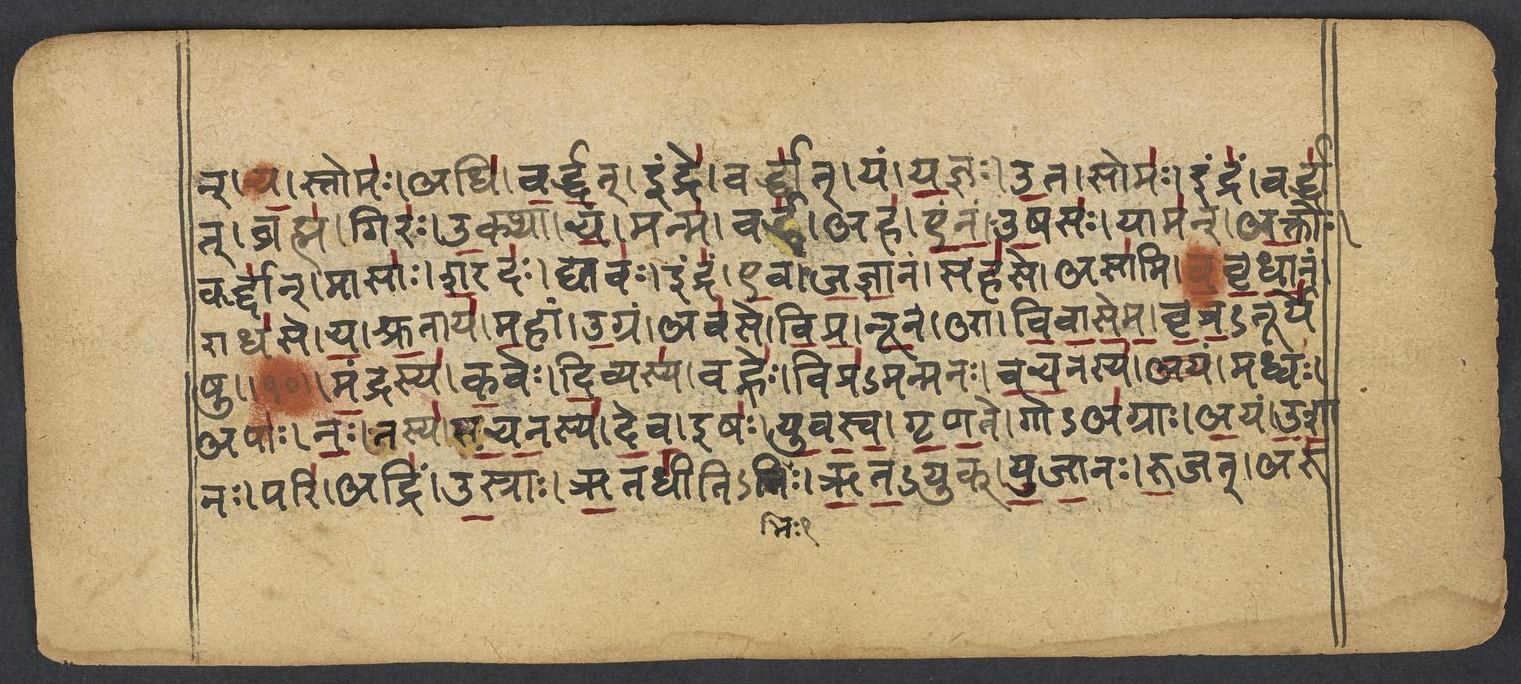
Where on the image
Penn Ms. Coll. 390 Item 41, fol. 447r (numbered 120r by the scribe) (OPenn image 447, lower leaf). Checked on the image: the Rigveda text on this page begins in RV 6.38.3 ‹-mahān ca stomaḥ adhi›. The next page with Rigveda text, fol. 447v (numbered 120v by the scribe), begins in RV 6.39.2 ‹-arugṇam vi valasya sānum›. Verse 6.39.1 ends on this page.
1ma̱ndrasya̍ ka̱ver di̱vyasya̱ vahne̱r vipra̍manmano vaca̱nasya̱ madhva̍ḥ | apā̍ na̱s tasya̍ saca̱nasya̍ de̱veṣo̍ yuvasva gṛṇa̱te goa̍grāḥ ||
Compare: Padapāṭha (word-by-word text written in the manuscript; Sansknet e-text via GRETIL)
1mandrasya | kaveḥ | divyasya | vahneḥ | vipra-manmanaḥ | vacanasya | madhvaḥ | apa | naḥ | tasya | sacanasya | deva | iṣaḥ | yuvasva | gṛṇate | go--agrāḥ
1OF this our charming, our celestial Soma, eloquent, wise, Priest, with inspired devotion, Of this thy close attendant, hast thou drunken. God, send the singer food with milk to grace it.
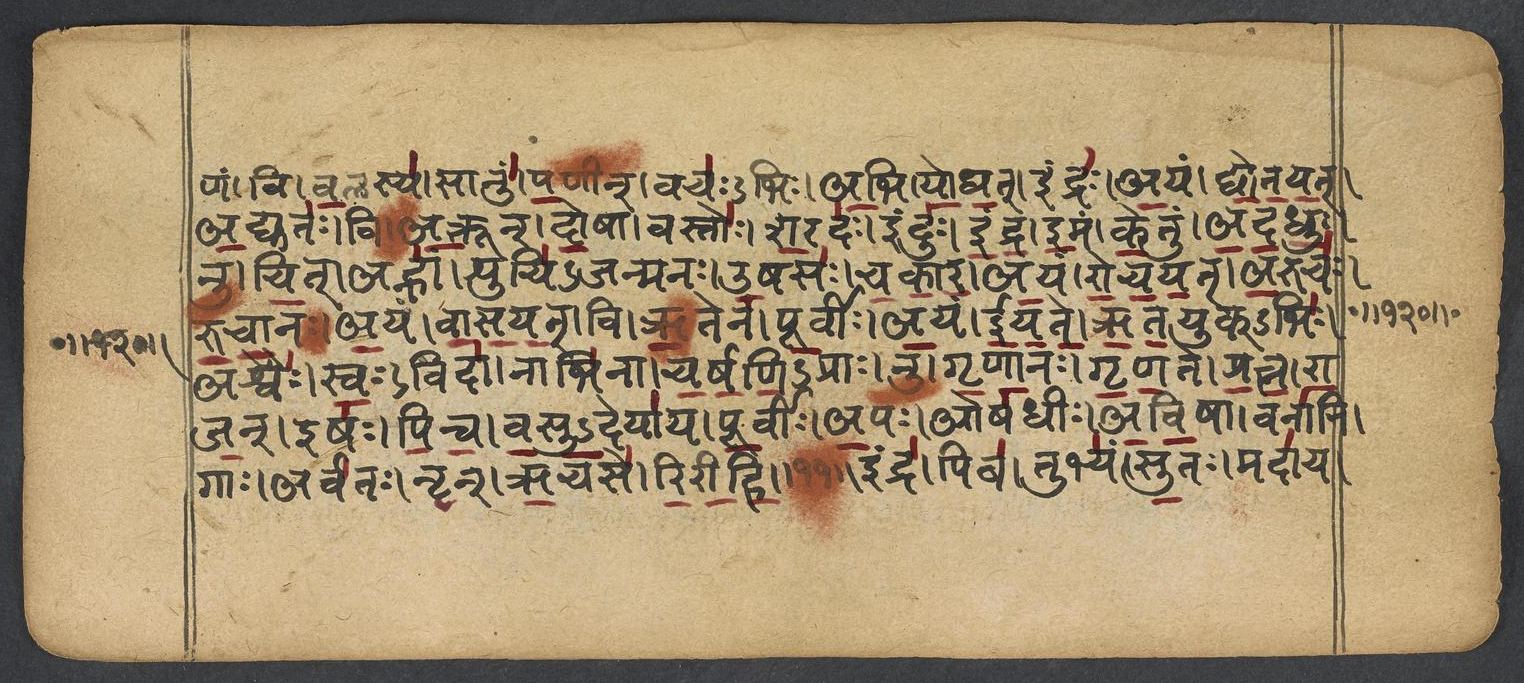
Where on the image
Penn Ms. Coll. 390 Item 41, fol. 447v (numbered 120v by the scribe) (OPenn image 448, upper leaf). Checked on the image: the Rigveda text on this page begins in RV 6.39.2 ‹-arugṇam vi valasya sānum›. The next page with Rigveda text, fol. 448r (numbered 121r by the scribe), begins in RV 6.40.1 ‹ava sya harī iti›. Verses 6.39.2-5 end on this page; 6.39.2 begins on fol. 447r (numbered 120r by the scribe).
2a̱yam u̍śā̱naḥ pary adri̍m u̱srā ṛ̱tadhī̍tibhir ṛta̱yug yu̍jā̱naḥ | ru̱jad aru̍gṇa̱ṁ vi va̱lasya̱ sānu̍m pa̱ṇīm̐r vaco̍bhir a̱bhi yo̍dha̱d indra̍ḥ ||
3a̱yaṁ dyo̍tayad a̱dyuto̱ vy a1̱̍ktūn do̱ṣā vasto̍ḥ śa̱rada̱ indu̍r indra | i̱maṁ ke̱tum a̍dadhu̱r nū ci̱d ahnā̱ṁ śuci̍janmana u̱ṣasa̍ś cakāra ||
4a̱yaṁ ro̍cayad a̱ruco̍ rucā̱no̱3̱̍ 'yaṁ vā̍saya̱d vy ṛ1̱̍tena̍ pū̱rvīḥ | a̱yam ī̍yata ṛta̱yugbhi̱r aśvai̍ḥ sva̱rvidā̱ nābhi̍nā carṣaṇi̱prāḥ ||
5nū gṛ̍ṇā̱no gṛ̍ṇa̱te pra̍tna rāja̱nn iṣa̍ḥ pinva vasu̱deyā̍ya pū̱rvīḥ | a̱pa oṣa̍dhīr avi̱ṣā vanā̍ni̱ gā arva̍to̱ nṝn ṛ̱case̍ rirīhi ||
Compare: Padapāṭha (word-by-word text written in the manuscript; Sansknet e-text via GRETIL)
2ayam | uśānaḥ | pari | adrim | usrāḥ | ṛtadhīti-bhiḥ | ṛta-yuk | yujānaḥ | rujayt | arugṇam | vi | valasya | sānum | paṇīn | vacaḥ-bhiḥ | abhi | yodhat | indraḥ
3ayam | dyotayat | adyutaḥ | vi | aktūn | doṣā | vastoḥ | śaradaḥ | induḥ | indra | imam | ketum | adadhuḥ | nu | cit | ahnām | śuci-janmanaḥ | uṣasaḥ | cakāra
4ayam | rocayat | arucaḥ | rucānaḥ | ayam | vāsayat | vi | ṛtena | pūrvīḥ | ayam | īyate | ṛtayuk-bhiḥ | aśvaiḥ | svaḥ-vidā | nābhinā | carṣaṇi-prāḥ
5nu | gṛṇānaḥ | gṛṇate | pratna | rājan | iṣaḥ | pinva | vasu-deyāya | pūrvīḥ | apaḥ | oṣadhīḥ | aviṣā | vanāni | gāḥ | arvataḥ | nṝn | ṛcase | rirīhi
2Craving the kine, rushing against the mountain led on by Law, with holyminded comrades, He broke the never-broken ridge of Vala. With words of might Indra subdued the Paṇis.
3This Indu lighted darksome nights, O Indra, throughout the years, at morning and at evening. Him have they stablished as the days' bright ensign. He made the Mornings to be born in splendour.
4He shone and caused to shine the worlds that shone not. By Law he lighted up the host of Mornings. He moves with Steeds yoked by eternal Order, contenting men with nave that finds the sunlight.
5Now, praised, O Ancient King! fill thou the singer with plenteous food that he may deal forth treasures. Give waters, herbs that have no poison, forests, and kine, and steeds, and men, to him who lauds thee.
Notes
- Sanskrit: Aufrecht's edition (1877) with the Vedic accents, as entered by van Nooten and Holland (GRETIL).
- English: Ralph T. H. Griffith, The Hymns of the Rigveda (1889-1892; 2nd ed. 1896-1897), from the VedaWeb digital text; OCR slips in that text were corrected against the printed 2nd edition (data/sources/rigveda/griffith_errata.json).
- Padapāṭha (edition text): Sansknet e-text via GRETIL (CC BY-NC-SA 4.0).
Cite
Sources
- Source: Penn Ms. Coll. 390 Item 41 (undated (catalogued with Penn's 18th-19th c. Vedic manuscripts)), OPenn, Public Domain Mark + Aufrecht's accented text (GRETIL) + Griffith's English (VedaWeb) (holding institution)
- Critical edition: Aufrecht (1877), accented e-text via GRETIL
← previous · → next · v cycle view · l back to library