Rigveda 6.53: To Pusan
Introduction
Rigveda 6.53 is a hymn of 10 verses addressed to Pusan. It stands in book (maṇḍala) 6, the family book of Bharadvāja. The Rigveda is the oldest collection of Sanskrit hymns, composed in the second half of the second millennium BCE and handed down orally for many centuries before it was written down.
The manuscript shown is Penn Ms. Coll. 390 Item 41 (University of Pennsylvania), an undated paper manuscript of the padapāṭha (the word-by-word recitation text, in which every word is written separately and compounds are split) of the whole Ṛgveda in Devanāgarī, 884 leaves in fascicles, 7-9 lines to the page, accents in red; this hymn stands on fol. 472v-473v. Each section below gives the verses that end on one page; the page boundaries were read on the images (the opening words of every page), not counted out. Where the manuscript is a padapāṭha (the word-by-word recitation text), the section shows Aufrecht's continuous (saṃhitā) text first and, as the edition text, the padapāṭha of the same verses, which is the form written on the page.
How was this verified? (Provenance)
Where on the image
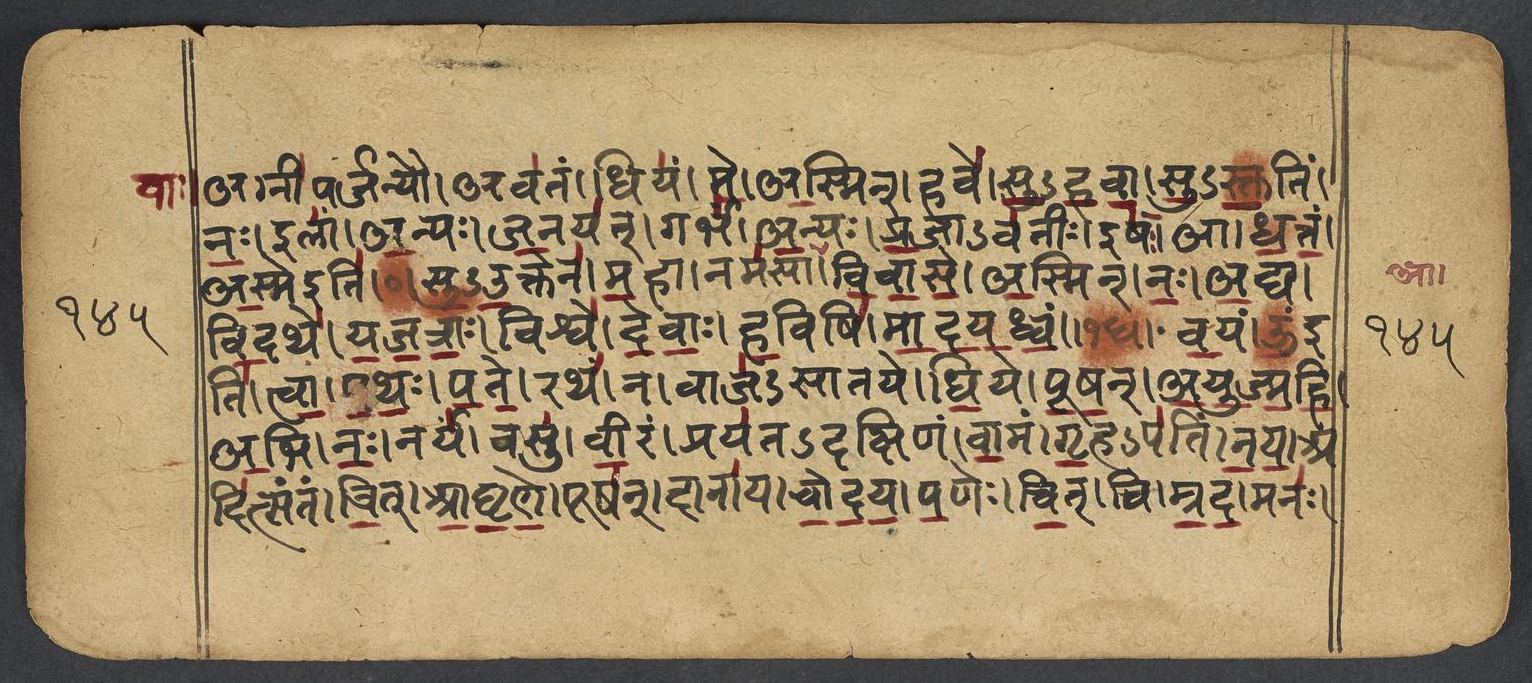
Penn Ms. Coll. 390 Item 41, fol. 472v (numbered 145v by the scribe) (OPenn image 473, upper leaf). Checked on the image: the Rigveda text on this page begins in RV 6.52.16 ‹agnīparjanyau avatam dhiyam me›. The next page with Rigveda text, fol. 473r (numbered 146r by the scribe), begins in RV 6.53.4 ‹vi pathaḥ vāja-sātaye cinuhi›. Verses 6.53.1-3 end on this page.
1va̱yam u̍ tvā pathas pate̱ ratha̱ṁ na vāja̍sātaye | dhi̱ye pū̍ṣann ayujmahi ||
2a̱bhi no̱ narya̱ṁ vasu̍ vī̱ram praya̍tadakṣiṇam | vā̱maṁ gṛ̱hapa̍tiṁ naya ||
3adi̍tsantaṁ cid āghṛṇe̱ pūṣa̱n dānā̍ya codaya | pa̱ṇeś ci̱d vi mra̍dā̱ mana̍ḥ ||
Compare: Padapāṭha (word-by-word text written in the manuscript; Sansknet e-text via GRETIL)
1vayam | oṃ iti | tvā | pathaḥ | pate | ratham | na | vāja-sātaye | dhiye | pūṣan | ayujmahi
2abhi | naḥ | naryam | vasu | vīram | prayata-dakṣiṇam | vāmam | gṛha-patim | naya
3aditsantam | cit | āghṛṇe | pūṣan | dānāya | codaya | paṇeḥ | cit | vi | mrada | manaḥ
1LORD of the path, O Pûshan, we have yoked and bound thee to our hymn, Even as a car, to win the prize.
2Bring us the wealth that men require, a manly master of a house, Free-handed with the liberal meed.
3Even him who would not give, do thou, O glowing Pûshan, urge to give, And make the niggard's soul grow soft.
Where on the image
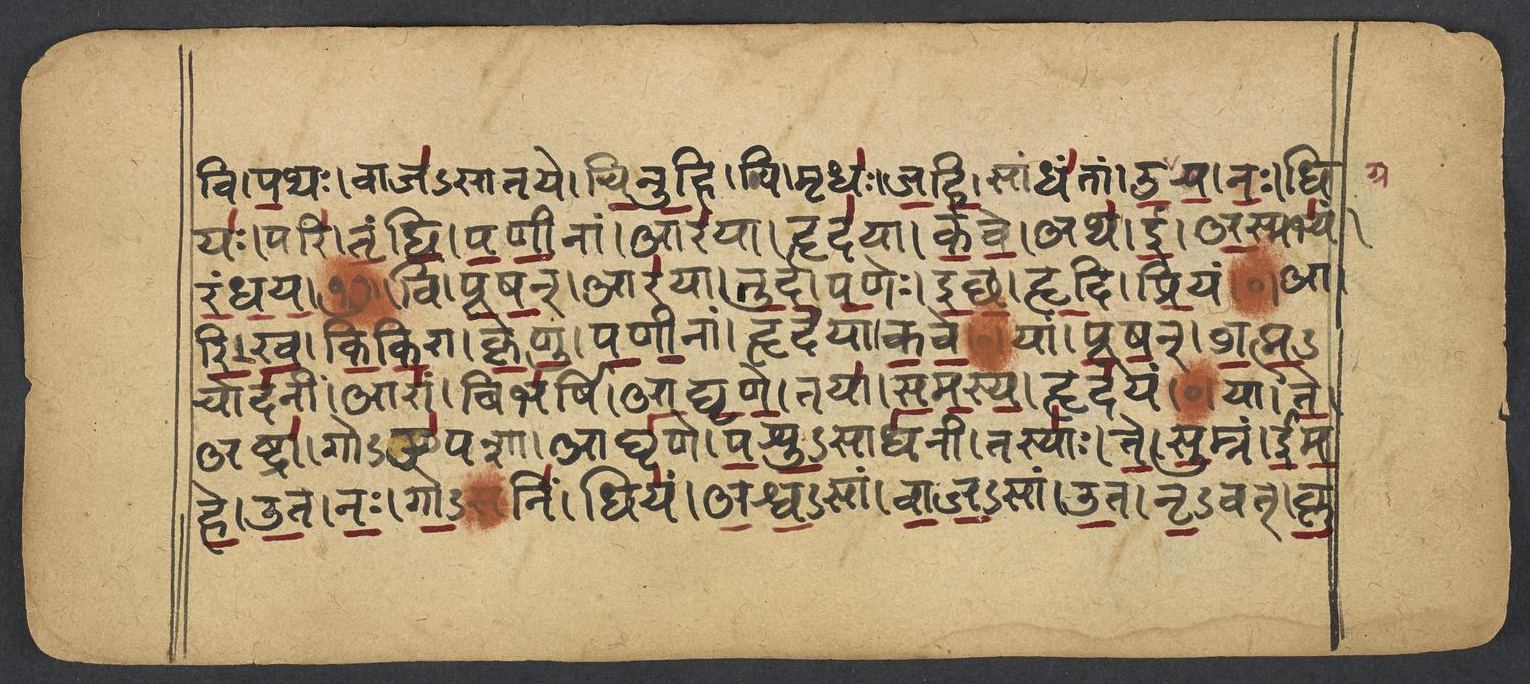
Penn Ms. Coll. 390 Item 41, fol. 473r (numbered 146r by the scribe) (OPenn image 473, lower leaf). Checked on the image: the Rigveda text on this page begins in RV 6.53.4 ‹vi pathaḥ vāja-sātaye cinuhi›. The next page with Rigveda text, fol. 473v (numbered 146v by the scribe), begins in RV 6.53.10 ‹-kṛṇuhi vītaye›. Verses 6.53.4-9 end on this page.
4vi pa̱tho vāja̍sātaye cinu̱hi vi mṛdho̍ jahi | sādha̍ntām ugra no̱ dhiya̍ḥ ||
5pari̍ tṛndhi paṇī̱nām āra̍yā̱ hṛda̍yā kave | athe̍m a̱smabhya̍ṁ randhaya ||
6vi pū̍ṣa̱nn āra̍yā tuda pa̱ṇer i̍ccha hṛ̱di pri̱yam | athe̍m a̱smabhya̍ṁ randhaya ||
7ā ri̍kha kiki̱rā kṛ̍ṇu paṇī̱nāṁ hṛda̍yā kave | athe̍m a̱smabhya̍ṁ randhaya ||
8yām pū̍ṣan brahma̱coda̍nī̱m ārā̱m bibha̍rṣy āghṛṇe | tayā̍ samasya̱ hṛda̍ya̱m ā ri̍kha kiki̱rā kṛ̍ṇu ||
9yā te̱ aṣṭrā̱ goo̍pa̱śāghṛ̍ṇe paśu̱sādha̍nī | tasyā̍s te su̱mnam ī̍mahe ||
Compare: Padapāṭha (word-by-word text written in the manuscript; Sansknet e-text via GRETIL)
4vi | pathaḥ | vāja-sātaye | cinuhi | vi | mṛdhaḥ | jahi | sādhantām | ugra | naḥ | dhiyaḥ
5pari | tṛndhipaṇīnām | ārayā | hṛdayā | kave | atha | īm | asmabhyam | randhaya
6vi | pūṣan | ārayā | tuda paṇeḥ | iccha | hṛdi | priyam | atha | īm | asmabhyam | randhaya
7ā | rikha | kikirā | kṛṇu | paṇīnām | hṛdayā | kave | atha | īm | asmabhyam | randhaya
8yām | pūṣan | brahma-codanīm | ārām | bibharṣi | āghṛṇe | tayā | samasya | hṛdayam | ā | rikha | kikirā | kṛṇu
9yā | te | aṣṭrā | go--opaśā | āghṛṇe | paśu-sādhanī | tasyāḥ | te | sumnam | īmahe
4Clear paths that we may win the prize; scatter our enemies afar. Strong God, be all our thoughts fulfilled.
5Penetrate with an awl, O Sage, the hearts of avaricious churls, And make them subject to our will.
6Thrust with thine awl, O Pûshan: seek that which the niggard's heart holds dear, And make him subject to our will.
7Tear up and rend in pieces, Sage, the hearts of avaricious churls, And make them subject to our will.
8Thou, glowing Pûshan, carriest an awl that urges men to prayer; Therewith do thou tear up and rend to shreds the heart of every one.
9Thou bearest, glowing Lord! a goad with horny point that guides the cows Thence do we seek thy gift of bliss.
Where on the image
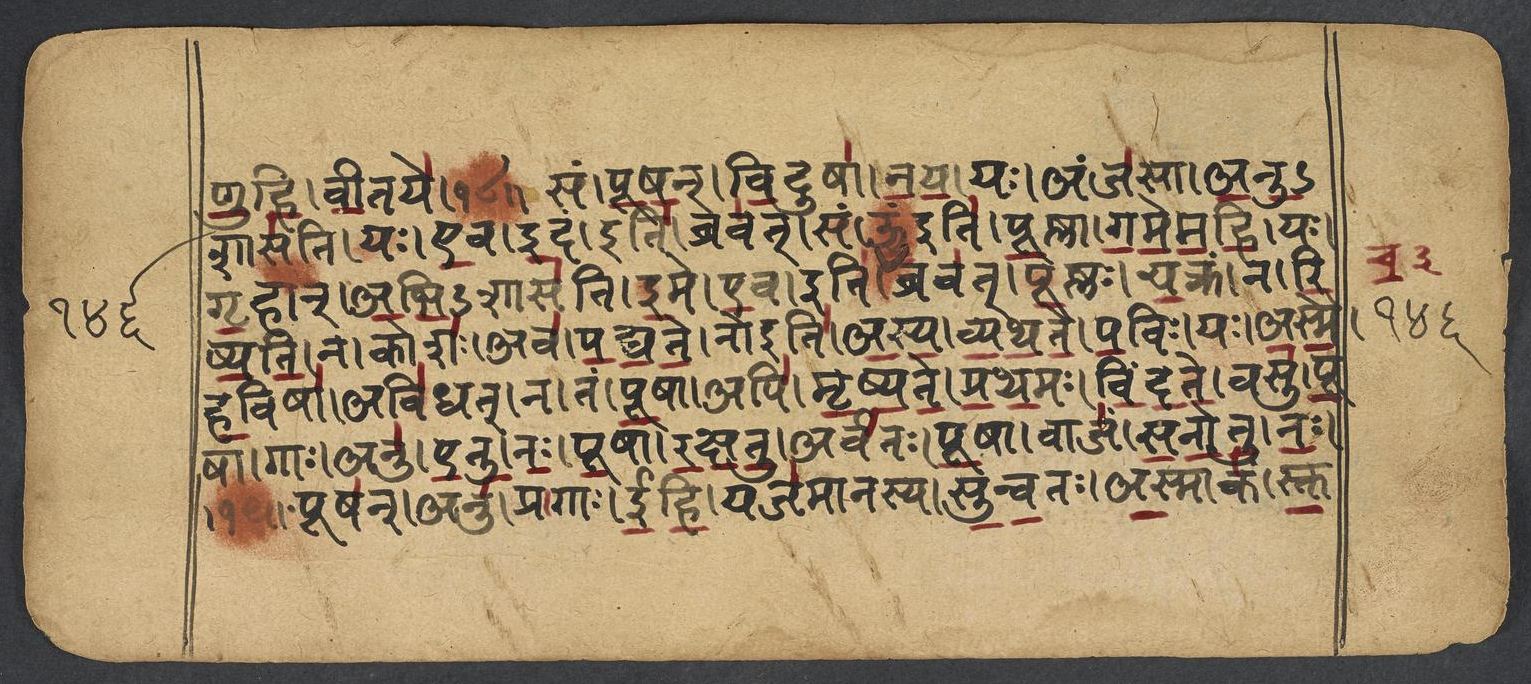
Penn Ms. Coll. 390 Item 41, fol. 473v (numbered 146v by the scribe) (OPenn image 474, upper leaf). Checked on the image: the Rigveda text on this page begins in RV 6.53.10 ‹-kṛṇuhi vītaye›. The next page with Rigveda text, fol. 474r (numbered 147r by the scribe), begins in RV 6.54.6 ‹-stuvatām uta›. Verse 6.53.10 ends on this page; 6.53.10 begins on fol. 473r (numbered 146r by the scribe).
10u̱ta no̍ go̱ṣaṇi̱ṁ dhiya̍m aśva̱sāṁ vā̍ja̱sām u̱ta | nṛ̱vat kṛ̍ṇuhi vī̱taye̍ ||
Compare: Padapāṭha (word-by-word text written in the manuscript; Sansknet e-text via GRETIL)
10uta | naḥ | go--saṇim | dhiyam | aśvasām | vājasām | uta | nṛ-vat | kṛṇuhi | vītaye
10And make this hymn of ours produce kine, horses, and a store of wealth For our delight and use as men.
Notes
- Sanskrit: Aufrecht's edition (1877) with the Vedic accents, as entered by van Nooten and Holland (GRETIL).
- English: Ralph T. H. Griffith, The Hymns of the Rigveda (1889-1892; 2nd ed. 1896-1897), from the VedaWeb digital text; OCR slips in that text were corrected against the printed 2nd edition (data/sources/rigveda/griffith_errata.json).
- Padapāṭha (edition text): Sansknet e-text via GRETIL (CC BY-NC-SA 4.0).
Cite
Sources
- Source: Penn Ms. Coll. 390 Item 41 (undated (catalogued with Penn's 18th-19th c. Vedic manuscripts)), OPenn, Public Domain Mark + Aufrecht's accented text (GRETIL) + Griffith's English (VedaWeb) (holding institution)
- Critical edition: Aufrecht (1877), accented e-text via GRETIL
← previous · → next · v cycle view · l back to library