Rigveda 6.54: To Pusan
Introduction
Rigveda 6.54 is a hymn of 10 verses addressed to Pusan. It stands in book (maṇḍala) 6, the family book of Bharadvāja. The Rigveda is the oldest collection of Sanskrit hymns, composed in the second half of the second millennium BCE and handed down orally for many centuries before it was written down.
The manuscript shown is Penn Ms. Coll. 390 Item 41 (University of Pennsylvania), an undated paper manuscript of the padapāṭha (the word-by-word recitation text, in which every word is written separately and compounds are split) of the whole Ṛgveda in Devanāgarī, 884 leaves in fascicles, 7-9 lines to the page, accents in red; this hymn stands on fol. 473v-474r. Each section below gives the verses that end on one page; the page boundaries were read on the images (the opening words of every page), not counted out. Where the manuscript is a padapāṭha (the word-by-word recitation text), the section shows Aufrecht's continuous (saṃhitā) text first and, as the edition text, the padapāṭha of the same verses, which is the form written on the page.
How was this verified? (Provenance)
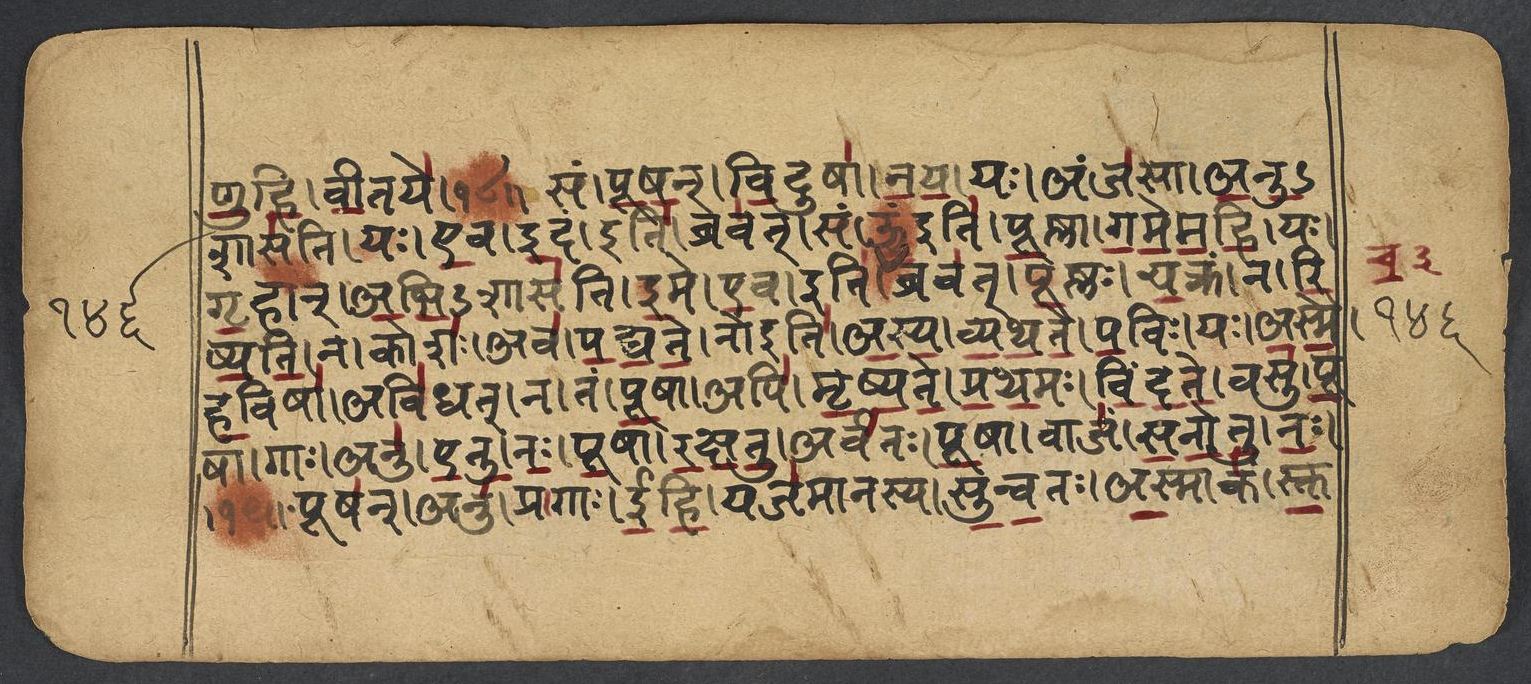
Where on the image
Penn Ms. Coll. 390 Item 41, fol. 473v (numbered 146v by the scribe) (OPenn image 474, upper leaf). Checked on the image: the Rigveda text on this page begins in RV 6.53.10 ‹-kṛṇuhi vītaye›. The next page with Rigveda text, fol. 474r (numbered 147r by the scribe), begins in RV 6.54.6 ‹-stuvatām uta›. Verses 6.54.1-5 end on this page.
1sam pū̍ṣan vi̱duṣā̍ naya̱ yo añja̍sānu̱śāsa̍ti | ya e̱vedam iti̱ brava̍t ||
2sam u̍ pū̱ṣṇā ga̍memahi̱ yo gṛ̱hām̐ a̍bhi̱śāsa̍ti | i̱ma e̱veti̍ ca̱ brava̍t ||
3pū̱ṣṇaś ca̱kraṁ na ri̍ṣyati̱ na kośo 'va̍ padyate | no a̍sya vyathate pa̱viḥ ||
4yo a̍smai ha̱viṣāvi̍dha̱n na tam pū̱ṣāpi̍ mṛṣyate | pra̱tha̱mo vi̍ndate̱ vasu̍ ||
5pū̱ṣā gā anv e̍tu naḥ pū̱ṣā ra̍kṣa̱tv arva̍taḥ | pū̱ṣā vāja̍ṁ sanotu naḥ ||
Compare: Padapāṭha (word-by-word text written in the manuscript; Sansknet e-text via GRETIL)
1sam | pūṣan | viduṣā | naya | yaḥ | añjasā | anu-śāsati | yaḥ | eva | idam iti | bravat
2sam | oṃ iti | pūṣṇā | gamemahi | yaḥ | gṛhān | abhi-śāsati | ime | eva | iti | ca | bravat
3pūṣṇaḥ | cakram | na | riṣyati | na | koaḥ | ava | padyate | no iti | asya | vyathate | paviḥ
4yaḥ | asmai | haviṣā | avidhat | na | tam | pūṣā | api | mṛṣyate | prathamaḥ | vindate | vasu
5pūṣā | gāḥ | anu | etu | naḥ | pūṣā | rākṣatu | arvataḥ | pūṣā | vājam | sanotu | naḥ
1O Pûshan, bring us to the man who knows, who shall direct us straight, And say unto us, It is here.
2May we go forth with Pûshan who shall point the houses out to us, And say to us, These same are they.
3Unharmed is Pûshan's chariot wheel; the box ne'er falleth to the ground, Nor doth the loosened felly shake.
4Pûshan forgetteth not the man who serveth him with offered gift: That man is first to gather wealth.
5May Pûshan follow near our kine; may Pûshan keep our horses safe: May Pûshan gather gear for us.
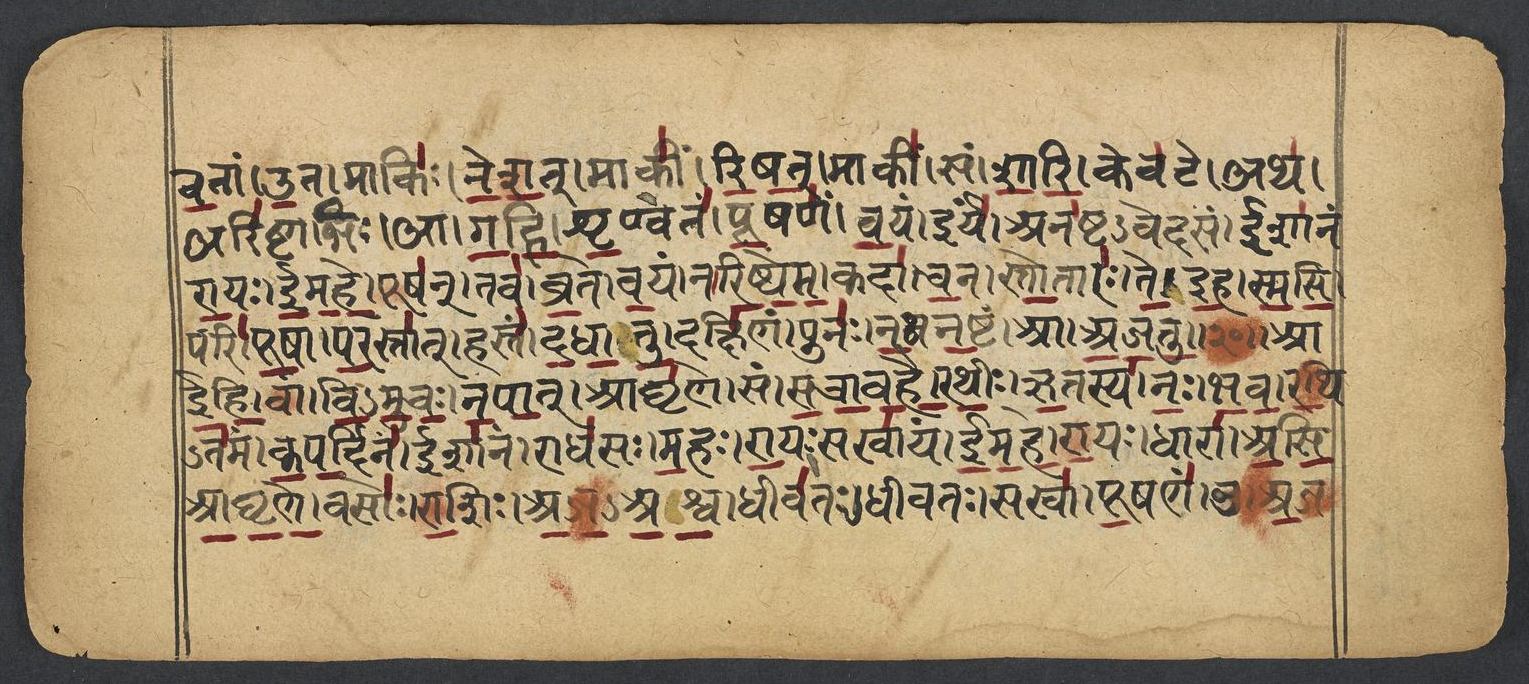
Where on the image
Penn Ms. Coll. 390 Item 41, fol. 474r (numbered 147r by the scribe) (OPenn image 474, lower leaf). Checked on the image: the Rigveda text on this page begins in RV 6.54.6 ‹-stuvatām uta›. The next page with Rigveda text, fol. 474v (numbered 147v by the scribe), begins in RV 6.55.4 ‹-aja-aśvam upa stoṣāma vājinam›. Verses 6.54.6-10 end on this page; 6.54.6 begins on fol. 473v (numbered 146v by the scribe).
6pūṣa̱nn anu̱ pra gā i̍hi̱ yaja̍mānasya sunva̱taḥ | a̱smāka̍ṁ stuva̱tām u̱ta ||
7māki̍r neśa̱n mākī̍ṁ riṣa̱n mākī̱ṁ saṁ śā̍ri̱ keva̍ṭe | athāri̍ṣṭābhi̱r ā ga̍hi ||
8śṛ̱ṇvanta̍m pū̱ṣaṇa̍ṁ va̱yam irya̱m ana̍ṣṭavedasam | īśā̍naṁ rā̱ya ī̍mahe ||
9pūṣa̱n tava̍ vra̱te va̱yaṁ na ri̍ṣyema̱ kadā̍ ca̱na | sto̱tāra̍s ta i̱ha sma̍si ||
10pari̍ pū̱ṣā pa̱rastā̱d dhasta̍ṁ dadhātu̱ dakṣi̍ṇam | puna̍r no na̱ṣṭam āja̍tu ||
Compare: Padapāṭha (word-by-word text written in the manuscript; Sansknet e-text via GRETIL)
6pūṣan | anu | pra | gāḥ | ihi | yajamānasya | sunvataḥ | asmākam | stuvatām | uta
7mākiḥ | neśam | mākīm | riṣan | mākīm | sam | śāri | kevaṭe | atha | ariṣṭābhiḥ | ā | gāhi
8śṛṇvantam | pūṣaṇam | vayam | iryam | anaṣṭa-vedasam | īśānam | rāyaḥ | īmahe
9pūṣan | tava | vrate | vayam | na | riṣyema | kadā | cana | stotāraḥ | te | iha | smasi
10pari | pūṣā | parastāt | hastam | dadhātu | dakṣiṇam | punaḥ | naḥ | naṣṭam | ā | ajatu
6Follow the kine of him who pours libations out and worships thee; And ours who sing thee songs of praise.
7Let none be lost, none injured, none sink in a pit and break a limb. Return with these all safe and sound.
8Pûshan who listens to our prayers, the Strong whose wealth is never lost, The Lord of riches, we implore.
9Secure in thy protecting care, O Pûshan, never may we fail. We here are they who sing thy praise.
10From out the distance, far and wide, may Pûshan stretch his right hand forth, And drive our lost again to us.
Notes
- Sanskrit: Aufrecht's edition (1877) with the Vedic accents, as entered by van Nooten and Holland (GRETIL).
- English: Ralph T. H. Griffith, The Hymns of the Rigveda (1889-1892; 2nd ed. 1896-1897), from the VedaWeb digital text; OCR slips in that text were corrected against the printed 2nd edition (data/sources/rigveda/griffith_errata.json).
- Padapāṭha (edition text): Sansknet e-text via GRETIL (CC BY-NC-SA 4.0).
Cite
Sources
- Source: Penn Ms. Coll. 390 Item 41 (undated (catalogued with Penn's 18th-19th c. Vedic manuscripts)), OPenn, Public Domain Mark + Aufrecht's accented text (GRETIL) + Griffith's English (VedaWeb) (holding institution)
- Critical edition: Aufrecht (1877), accented e-text via GRETIL
← previous · → next · v cycle view · l back to library