Rigveda 6.56: To Pusan
Introduction
Rigveda 6.56 is a hymn of 6 verses addressed to Pusan. It stands in book (maṇḍala) 6, the family book of Bharadvāja. The Rigveda is the oldest collection of Sanskrit hymns, composed in the second half of the second millennium BCE and handed down orally for many centuries before it was written down.
The manuscript shown is Penn Ms. Coll. 390 Item 41 (University of Pennsylvania), an undated paper manuscript of the padapāṭha (the word-by-word recitation text, in which every word is written separately and compounds are split) of the whole Ṛgveda in Devanāgarī, 884 leaves in fascicles, 7-9 lines to the page, accents in red; this hymn stands on fol. 474v-475r. Each section below gives the verses that end on one page; the page boundaries were read on the images (the opening words of every page), not counted out. Where the manuscript is a padapāṭha (the word-by-word recitation text), the section shows Aufrecht's continuous (saṃhitā) text first and, as the edition text, the padapāṭha of the same verses, which is the form written on the page.
How was this verified? (Provenance)
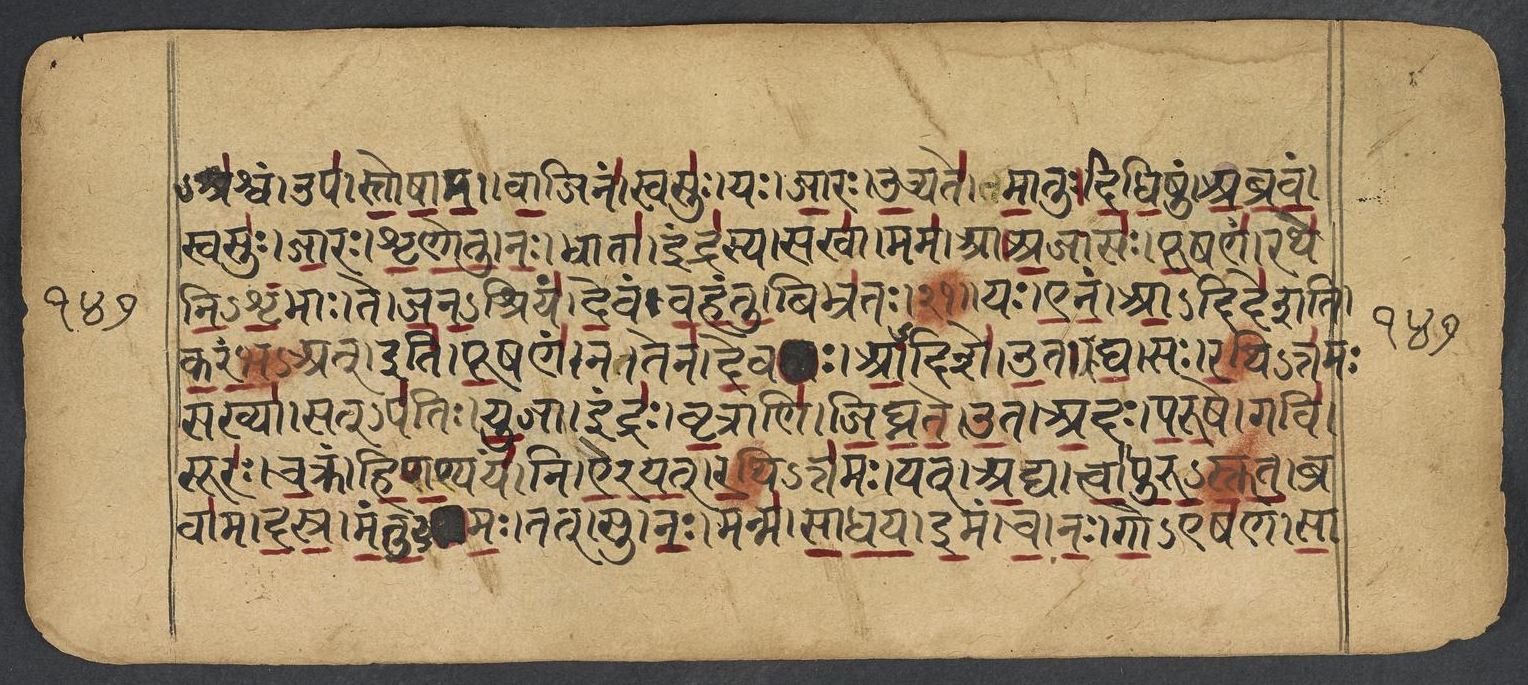
Where on the image
Penn Ms. Coll. 390 Item 41, fol. 474v (numbered 147v by the scribe) (OPenn image 475, upper leaf). Checked on the image: the Rigveda text on this page begins in RV 6.55.4 ‹-aja-aśvam upa stoṣāma vājinam›. The next page with Rigveda text, fol. 475r (numbered 148r by the scribe), begins in RV 6.56.5 ‹-sātaye sīsadhaḥ gaṇam ārāt›. Verses 6.56.1-4 end on this page.
1ya e̍nam ā̱dide̍śati kara̱mbhād iti̍ pū̱ṣaṇa̍m | na tena̍ de̱va ā̱diśe̍ ||
2u̱ta ghā̱ sa ra̱thīta̍ma̱ḥ sakhyā̱ satpa̍tir yu̱jā | indro̍ vṛ̱trāṇi̍ jighnate ||
3u̱tādaḥ pa̍ru̱ṣe gavi̱ sūra̍ś ca̱kraṁ hi̍ra̱ṇyaya̍m | ny ai̍rayad ra̱thīta̍maḥ ||
4yad a̱dya tvā̍ puruṣṭuta̱ bravā̍ma dasra mantumaḥ | tat su no̱ manma̍ sādhaya ||
Compare: Padapāṭha (word-by-word text written in the manuscript; Sansknet e-text via GRETIL)
1yaḥ | enam | ādideśati | karambha-at | iti | pūṣaṇam | na | tena | devaḥ | ādiśe
2uta | gha | saḥ | rathi-tamaḥ | sakhyā | sat-patiḥ | yujā | indraḥ | vṛtrāṇi | jighnate
3uta | adaḥ | paruṣe | gavi | sūraḥ | cakram | hiraṇyayam | ni | airayat | rathi-tamaḥ
4yad adya | tvā | puru-stuta | bravāma | dasra | mantu-maḥ | tat | su | naḥ | manma | sādhaya
1WHOSO remembers Pûshan as eater of mingled curd and meal Need think no more upon the God.
2And he is best of charioteers. Indra, the hero's Lord, allied With him as Friend, destroys the foes.
3And there the best of charioteers hath guided through the speckled cloud The golden wheel of Sûra's car.
4Whate'er we speak this day to thee, Wise, Wondrous God whom many praise, Give thou fulfilment of our thought.
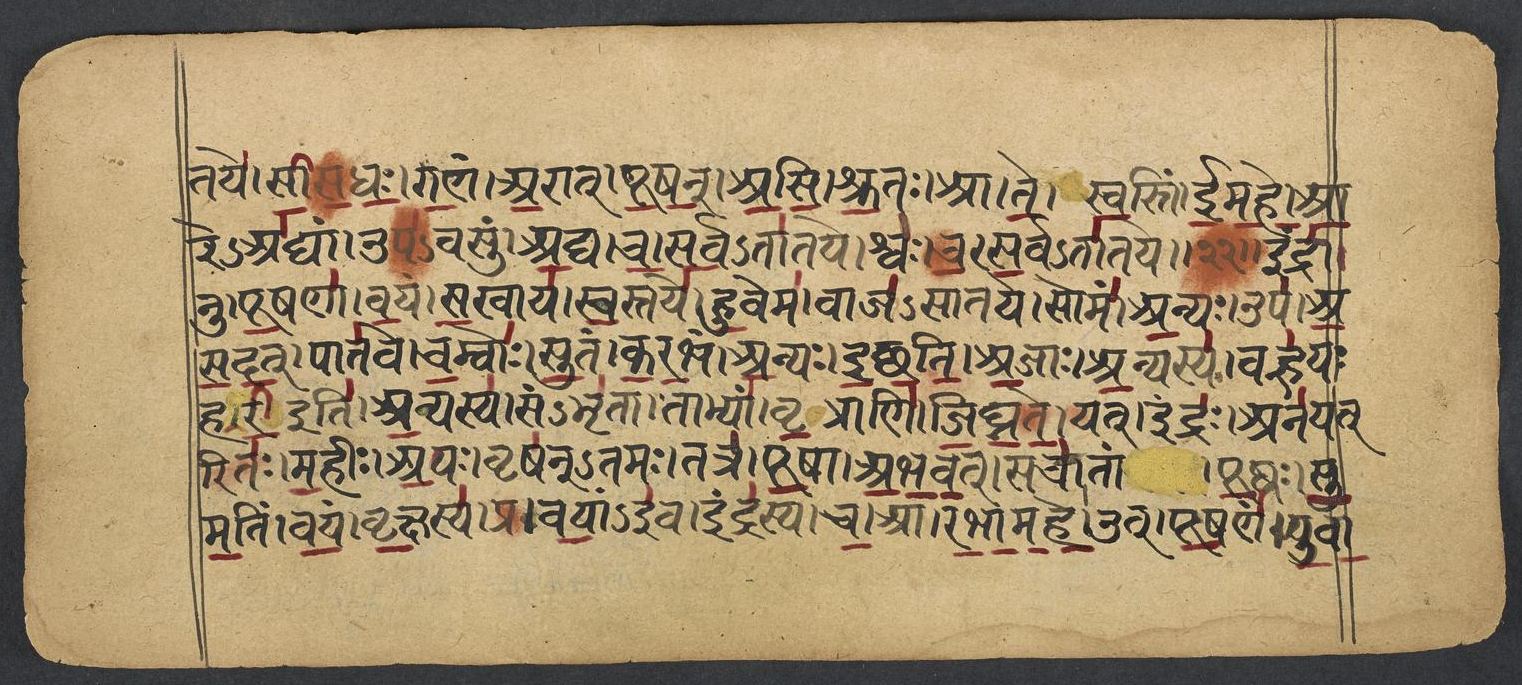
Where on the image
Penn Ms. Coll. 390 Item 41, fol. 475r (numbered 148r by the scribe) (OPenn image 475, lower leaf). Checked on the image: the Rigveda text on this page begins in RV 6.56.5 ‹-sātaye sīsadhaḥ gaṇam ārāt›. The next page with Rigveda text, fol. 475v (numbered 148v by the scribe), begins in RV 6.57.6 ‹-yuvāmahe abhīśūn-iva sārathiḥ mahyai›. Verses 6.56.5-6 end on this page; 6.56.5 begins on fol. 474v (numbered 147v by the scribe).
5i̱maṁ ca̍ no ga̱veṣa̍ṇaṁ sā̱taye̍ sīṣadho ga̱ṇam | ā̱rāt pū̍ṣann asi śru̱taḥ ||
6ā te̍ sva̱stim ī̍maha ā̱rea̍ghā̱m upā̍vasum | a̱dyā ca̍ sa̱rvatā̍taye̱ śvaś ca̍ sa̱rvatā̍taye ||
Compare: Padapāṭha (word-by-word text written in the manuscript; Sansknet e-text via GRETIL)
5imam | ca | naḥ | go--eṣaṇam | sātaye | sīsadhaḥ | gaṇam | ārāt | pūṣan | asi | śrutaḥ
6ā | te | svastim | īmahe | āre--aghām | upa-vasum | adya | ca | sarva-tātaye | śvaḥ | ca | sarva-tātaye
5Lead on this company of ours, that longs for kine, to win the spoil: Thou, Pûshan, art renowned afar.
6Prosperity we crave from thee, afar from sin and near to wealth, Tending to perfect happiness both for to. morrow and to-day.
Notes
- Sanskrit: Aufrecht's edition (1877) with the Vedic accents, as entered by van Nooten and Holland (GRETIL).
- English: Ralph T. H. Griffith, The Hymns of the Rigveda (1889-1892; 2nd ed. 1896-1897), from the VedaWeb digital text; OCR slips in that text were corrected against the printed 2nd edition (data/sources/rigveda/griffith_errata.json).
- Padapāṭha (edition text): Sansknet e-text via GRETIL (CC BY-NC-SA 4.0).
Cite
Sources
- Source: Penn Ms. Coll. 390 Item 41 (undated (catalogued with Penn's 18th-19th c. Vedic manuscripts)), OPenn, Public Domain Mark + Aufrecht's accented text (GRETIL) + Griffith's English (VedaWeb) (holding institution)
- Critical edition: Aufrecht (1877), accented e-text via GRETIL
← previous · → next · v cycle view · l back to library