Rigveda 6.57: To Pusan
Introduction
Rigveda 6.57 is a hymn of 6 verses addressed to Pusan. It stands in book (maṇḍala) 6, the family book of Bharadvāja. The Rigveda is the oldest collection of Sanskrit hymns, composed in the second half of the second millennium BCE and handed down orally for many centuries before it was written down.
The manuscript shown is Penn Ms. Coll. 390 Item 41 (University of Pennsylvania), an undated paper manuscript of the padapāṭha (the word-by-word recitation text, in which every word is written separately and compounds are split) of the whole Ṛgveda in Devanāgarī, 884 leaves in fascicles, 7-9 lines to the page, accents in red; this hymn stands on fol. 475r-475v. Each section below gives the verses that end on one page; the page boundaries were read on the images (the opening words of every page), not counted out. Where the manuscript is a padapāṭha (the word-by-word recitation text), the section shows Aufrecht's continuous (saṃhitā) text first and, as the edition text, the padapāṭha of the same verses, which is the form written on the page.
How was this verified? (Provenance)
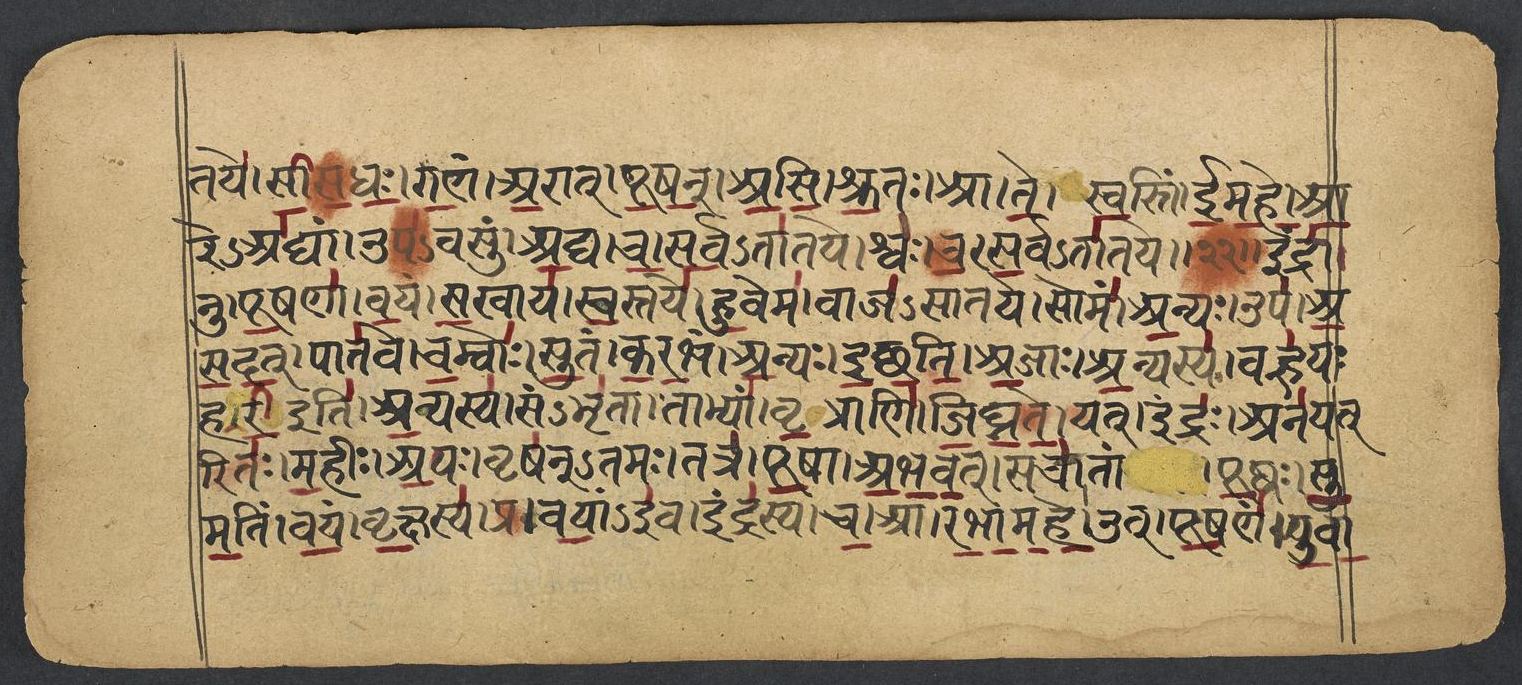
Where on the image
Penn Ms. Coll. 390 Item 41, fol. 475r (numbered 148r by the scribe) (OPenn image 475, lower leaf). Checked on the image: the Rigveda text on this page begins in RV 6.56.5 ‹-sātaye sīsadhaḥ gaṇam ārāt›. The next page with Rigveda text, fol. 475v (numbered 148v by the scribe), begins in RV 6.57.6 ‹-yuvāmahe abhīśūn-iva sārathiḥ mahyai›. Verses 6.57.1-5 end on this page.
1indrā̱ nu pū̱ṣaṇā̍ va̱yaṁ sa̱khyāya̍ sva̱staye̍ | hu̱vema̱ vāja̍sātaye ||
2soma̍m a̱nya upā̍sada̱t pāta̍ve ca̱mvo̍ḥ su̱tam | ka̱ra̱mbham a̱nya i̍cchati ||
3a̱jā a̱nyasya̱ vahna̍yo̱ harī̍ a̱nyasya̱ sambhṛ̍tā | tābhyā̍ṁ vṛ̱trāṇi̍ jighnate ||
4yad indro̱ ana̍ya̱d rito̍ ma̱hīr a̱po vṛṣa̍ntamaḥ | tatra̍ pū̱ṣābha̍va̱t sacā̍ ||
5tām pū̱ṣṇaḥ su̍ma̱tiṁ va̱yaṁ vṛ̱kṣasya̱ pra va̱yām i̍va | indra̍sya̱ cā ra̍bhāmahe ||
Compare: Padapāṭha (word-by-word text written in the manuscript; Sansknet e-text via GRETIL)
1indrā | nu | pūṣaṇā | vayam | sakhyāya | svastaye | huvema | vāja-sātaye
2somam | anyaḥ | upa | asadat | pātave | camvoḥ | sutam | karambham | anyaḥ | icchati
3ajāḥ | anyasya | vahnayaḥ | harī iti | anyasya | sam-bhṛtā | / tābhyām | vṛtrāṇi | jighnate
4yat | indraḥ | anayat | ritaḥ | mahīḥ | apaḥ | vṛṣan-tamaḥ | tatra | pūṣā | abhavat | sacā
5tām | pūṣṇaḥ | su-matim | vayam | vṛkṣasya | pra | vayām-iva | indrasya | ca | ā | rabhāmahe
1INDRA and Pûshan will we call for friend ship and prosperity And for the winning of the spoil.
2One by the Soma sits to drink juice which the mortar hath expressed: The other longs for curd and meal.
3Goats are the team that draws the one: the other hath Bay Steeds at hand; With both of these he slays the fiends.
4When Indra, wondrous strong, brought down the streams, the mighty waterfloods, Pûshan was standing by his side.
5To this, to Pûshan's favouring love, and Indra's, may we closely cling, As to a tree's extended bough.
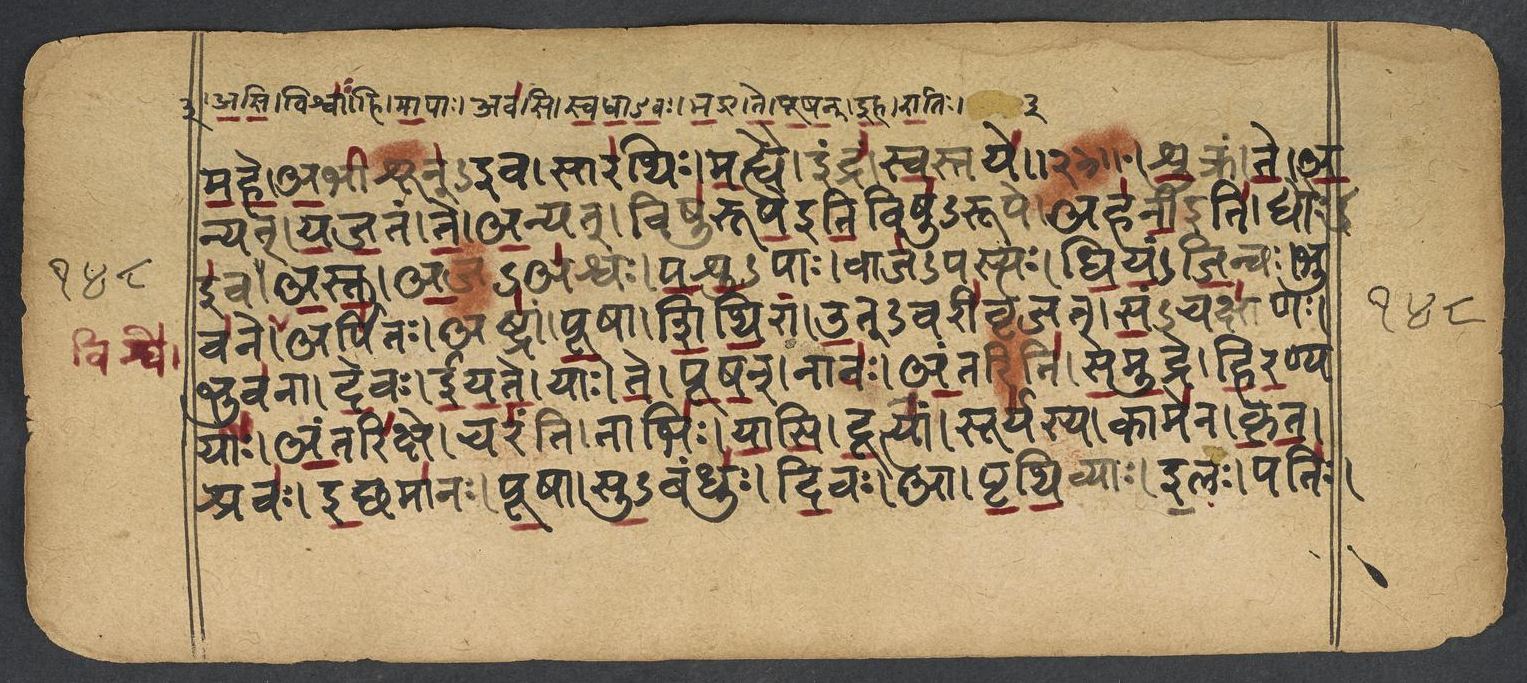
Where on the image
Penn Ms. Coll. 390 Item 41, fol. 475v (numbered 148v by the scribe) (OPenn image 476, upper leaf). Checked on the image: the Rigveda text on this page begins in RV 6.57.6 ‹-yuvāmahe abhīśūn-iva sārathiḥ mahyai›. The next page with Rigveda text, fol. 476r (numbered 149r by the scribe), begins in RV 6.58.4 ‹magha-vā dasma-vacārḥ yam devāsaḥ›. Verse 6.57.6 ends on this page; 6.57.6 begins on fol. 475r (numbered 148r by the scribe).
6ut pū̱ṣaṇa̍ṁ yuvāmahe̱ 'bhīśū̍m̐r iva̱ sāra̍thiḥ | ma̱hyā indra̍ṁ sva̱staye̍ ||
Compare: Padapāṭha (word-by-word text written in the manuscript; Sansknet e-text via GRETIL)
6ut | pūṣaṇam | yuvāmahe | abhīśūn-iva | sārathiḥ | mahyai | indram | svastaye
6As one who drives a car draws in his reins, may we draw Pûshan near, And Indra, for our great success.
Notes
- Sanskrit: Aufrecht's edition (1877) with the Vedic accents, as entered by van Nooten and Holland (GRETIL).
- English: Ralph T. H. Griffith, The Hymns of the Rigveda (1889-1892; 2nd ed. 1896-1897), from the VedaWeb digital text; OCR slips in that text were corrected against the printed 2nd edition (data/sources/rigveda/griffith_errata.json).
- Padapāṭha (edition text): Sansknet e-text via GRETIL (CC BY-NC-SA 4.0).
Cite
Sources
- Source: Penn Ms. Coll. 390 Item 41 (undated (catalogued with Penn's 18th-19th c. Vedic manuscripts)), OPenn, Public Domain Mark + Aufrecht's accented text (GRETIL) + Griffith's English (VedaWeb) (holding institution)
- Critical edition: Aufrecht (1877), accented e-text via GRETIL
← previous · → next · v cycle view · l back to library