Rigveda 6.58: To Pusan
Introduction
Rigveda 6.58 is a hymn of 4 verses addressed to Pusan. It stands in book (maṇḍala) 6, the family book of Bharadvāja. The Rigveda is the oldest collection of Sanskrit hymns, composed in the second half of the second millennium BCE and handed down orally for many centuries before it was written down.
The manuscript shown is Penn Ms. Coll. 390 Item 41 (University of Pennsylvania), an undated paper manuscript of the padapāṭha (the word-by-word recitation text, in which every word is written separately and compounds are split) of the whole Ṛgveda in Devanāgarī, 884 leaves in fascicles, 7-9 lines to the page, accents in red; this hymn stands on fol. 475v-476r. Each section below gives the verses that end on one page; the page boundaries were read on the images (the opening words of every page), not counted out. Where the manuscript is a padapāṭha (the word-by-word recitation text), the section shows Aufrecht's continuous (saṃhitā) text first and, as the edition text, the padapāṭha of the same verses, which is the form written on the page.
How was this verified? (Provenance)
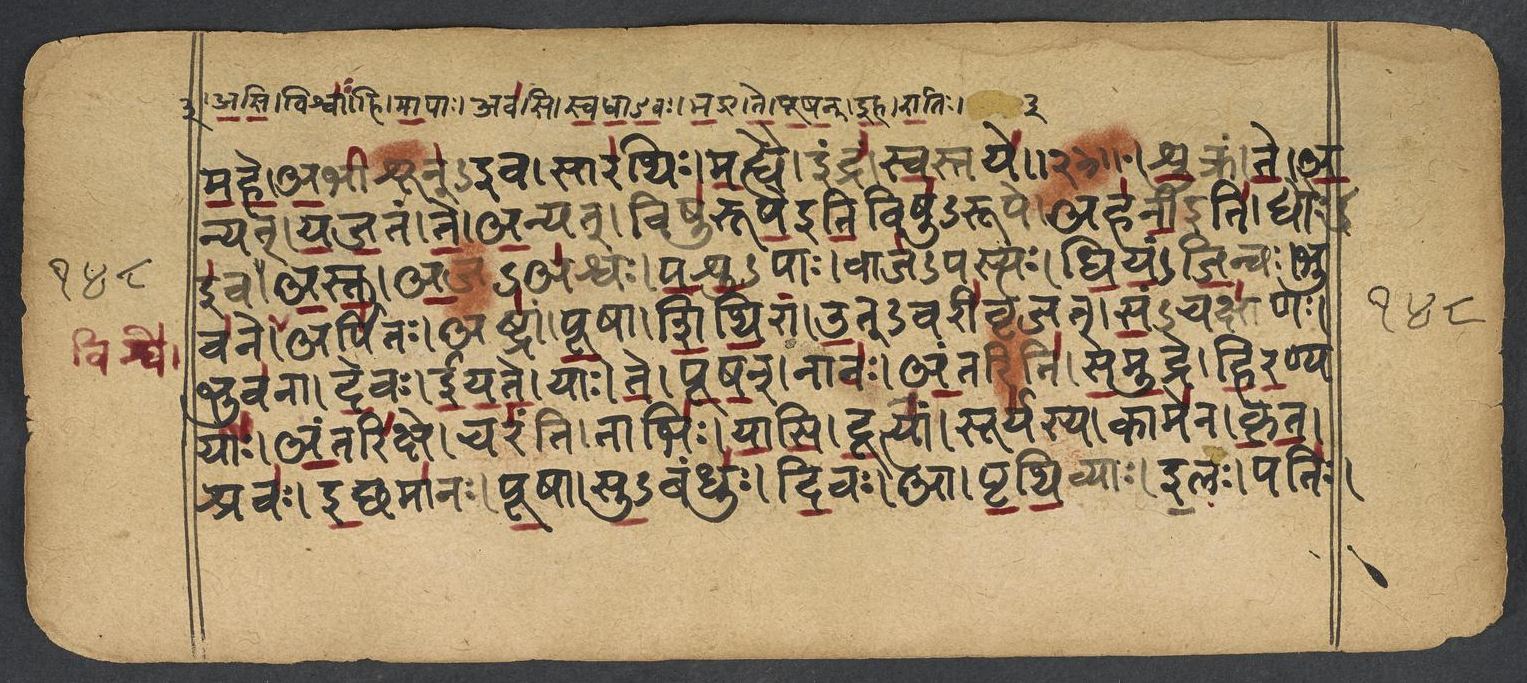
Where on the image
Penn Ms. Coll. 390 Item 41, fol. 475v (numbered 148v by the scribe) (OPenn image 476, upper leaf). Checked on the image: the Rigveda text on this page begins in RV 6.57.6 ‹-yuvāmahe abhīśūn-iva sārathiḥ mahyai›. The next page with Rigveda text, fol. 476r (numbered 149r by the scribe), begins in RV 6.58.4 ‹magha-vā dasma-vacārḥ yam devāsaḥ›. Verses 6.58.1-3 end on this page.
1śu̱kraṁ te̍ a̱nyad ya̍ja̱taṁ te̍ a̱nyad viṣu̍rūpe̱ aha̍nī̱ dyaur i̍vāsi | viśvā̱ hi mā̱yā ava̍si svadhāvo bha̱drā te̍ pūṣann i̱ha rā̱tir a̍stu ||
2a̱jāśva̍ḥ paśu̱pā vāja̍pastyo dhiyaṁji̱nvo bhuva̍ne̱ viśve̱ arpi̍taḥ | aṣṭrā̍m pū̱ṣā śi̍thi̱rām u̱dvarī̍vṛjat sa̱ṁcakṣā̍ṇo̱ bhuva̍nā de̱va ī̍yate ||
3yās te̍ pūṣa̱n nāvo̍ a̱ntaḥ sa̍mu̱dre hi̍ra̱ṇyayī̍r a̱ntari̍kṣe̱ cara̍nti | tābhi̍r yāsi dū̱tyāṁ sūrya̍sya̱ kāme̍na kṛta̱ śrava̍ i̱cchamā̍naḥ ||
Compare: Padapāṭha (word-by-word text written in the manuscript; Sansknet e-text via GRETIL)
1śukram | te | anyat | yajatam | te | anyat | viṣurūpeitiviṣu-rūpe | ahanī iti | dyauḥ-iva | asi | viśvāḥ | hi | māyāḥ | avasi | svadhāvaḥ | bhadrā | te | pūṣan | iha | rātiḥ | astu
2aja-aśvaḥ | paśu-pāḥ | vāja-pastyaḥ | dhiyam-jinvaḥ | bhuvane | viśve | arpitaḥ | aṣṭrām | pūṣā | śithirām | ut-varīvṛjat | sam-cakṣāṇaḥ | bhuvanā | devaḥ | īyate
3yāḥ | te | pūṣan | nāvaḥ | antariti | samudre | hiraṇyayīḥ | antarikṣe | caranti | tābhiḥ | yāsi | dūtyām | sūryasya | kāmena | kṛta | śravaḥ | icchamānaḥ
1LIKE heaven art thou: one form is bright, one holy, like Day and Night dissimilar in colour. All magic powers thou aidest, self-depen. dent! Auspicious be thy bounty here, O Pûshan.
2Goat-borne, the guard of cattle, he whose home is strength, inspirer of the hymn, set over all the world; Brandishing here and there his lightly. moving goad, beholding every creature, Pûshan, God, goes forth.
3O Pûshan, with thy golden ships that travel across the ocean, in the air's mid-region, Thou goest on an embassy to Sûrya, subdued by love, desirous of the glory.
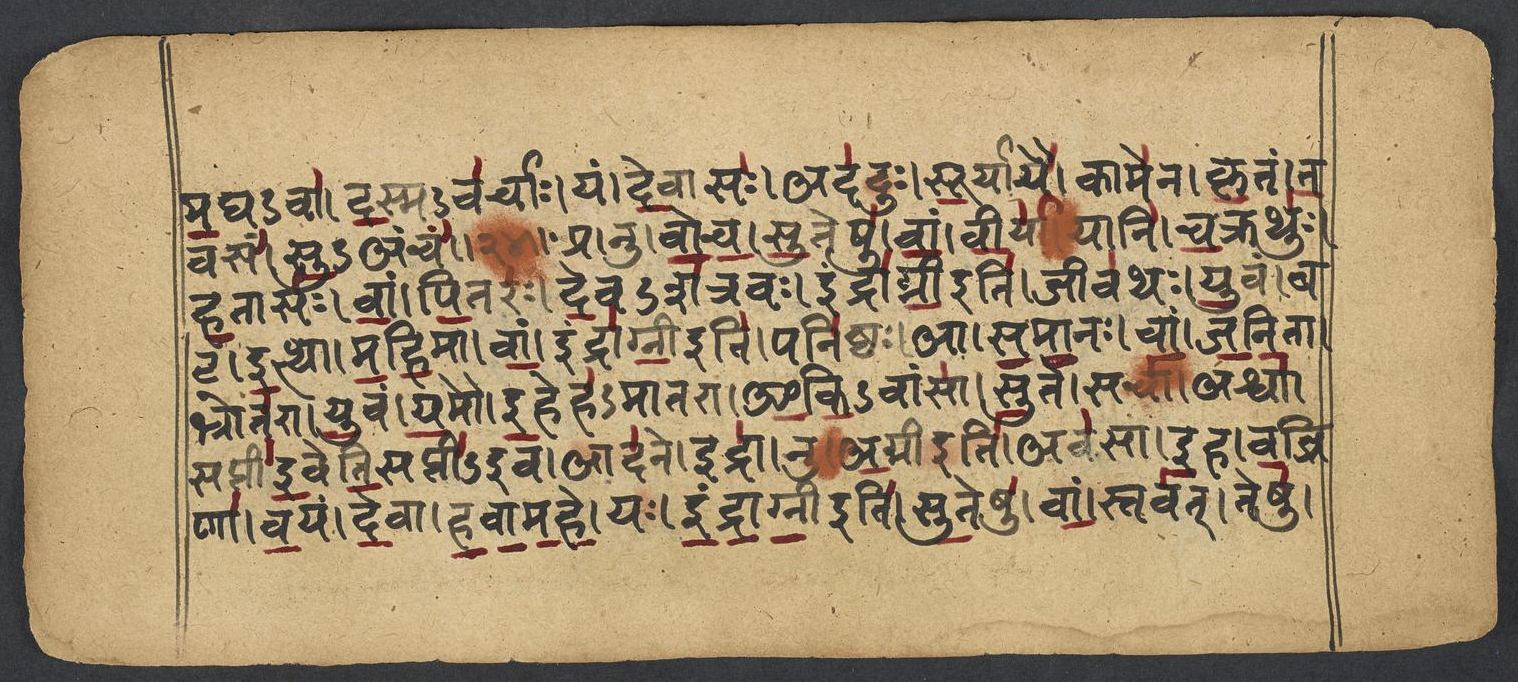
Where on the image
Penn Ms. Coll. 390 Item 41, fol. 476r (numbered 149r by the scribe) (OPenn image 476, lower leaf). Checked on the image: the Rigveda text on this page begins in RV 6.58.4 ‹magha-vā dasma-vacārḥ yam devāsaḥ›. The next page with Rigveda text, fol. 476v (numbered 149v by the scribe), begins in RV 6.59.4 ‹-teṣu ṛta-vṛdhā joṣa-vākam vadataḥ›. Verse 6.58.4 ends on this page; 6.58.4 begins on fol. 475v (numbered 148v by the scribe).
4pū̱ṣā su̱bandhu̍r di̱va ā pṛ̍thi̱vyā i̱ḻas pati̍r ma̱ghavā̍ da̱smava̍rcāḥ | yaṁ de̱vāso̱ ada̍duḥ sū̱ryāyai̱ kāme̍na kṛ̱taṁ ta̱vasa̱ṁ svañca̍m ||
Compare: Padapāṭha (word-by-word text written in the manuscript; Sansknet e-text via GRETIL)
4pūṣā | su-bandhuḥ | divaḥ | ā | pṛthivyāḥ | iḷaḥ | patiḥ | magha-vā | dasma-vacārḥ | yam | devāsaḥ | adaduḥ | sūryāyai | kāmena | kṛtam | tavasam | su-añcam
4Near kinsman of the heaven and earth is Pûshan, liberal, Lord of food, of wondrous lustre, Whom strong and vigorous and swiftlymoving, subdued by love, the Deities gave to Sûryâ.
Notes
- Sanskrit: Aufrecht's edition (1877) with the Vedic accents, as entered by van Nooten and Holland (GRETIL).
- English: Ralph T. H. Griffith, The Hymns of the Rigveda (1889-1892; 2nd ed. 1896-1897), from the VedaWeb digital text; OCR slips in that text were corrected against the printed 2nd edition (data/sources/rigveda/griffith_errata.json).
- Padapāṭha (edition text): Sansknet e-text via GRETIL (CC BY-NC-SA 4.0).
Cite
Sources
- Source: Penn Ms. Coll. 390 Item 41 (undated (catalogued with Penn's 18th-19th c. Vedic manuscripts)), OPenn, Public Domain Mark + Aufrecht's accented text (GRETIL) + Griffith's English (VedaWeb) (holding institution)
- Critical edition: Aufrecht (1877), accented e-text via GRETIL
← previous · → next · v cycle view · l back to library