Rigveda 6.8: To Agni Vaisvanara
Introduction
Rigveda 6.8 is a hymn of 7 verses addressed to Agni Vaisvanara. It stands in book (maṇḍala) 6, the family book of Bharadvāja. The Rigveda is the oldest collection of Sanskrit hymns, composed in the second half of the second millennium BCE and handed down orally for many centuries before it was written down.
The manuscript shown is Penn Ms. Coll. 390 Item 41 (University of Pennsylvania), an undated paper manuscript of the padapāṭha (the word-by-word recitation text, in which every word is written separately and compounds are split) of the whole Ṛgveda in Devanāgarī, 884 leaves in fascicles, 7-9 lines to the page, accents in red; this hymn stands on fol. 410r-411r. Each section below gives the verses that end on one page; the page boundaries were read on the images (the opening words of every page), not counted out. Where the manuscript is a padapāṭha (the word-by-word recitation text), the section shows Aufrecht's continuous (saṃhitā) text first and, as the edition text, the padapāṭha of the same verses, which is the form written on the page.
How was this verified? (Provenance)
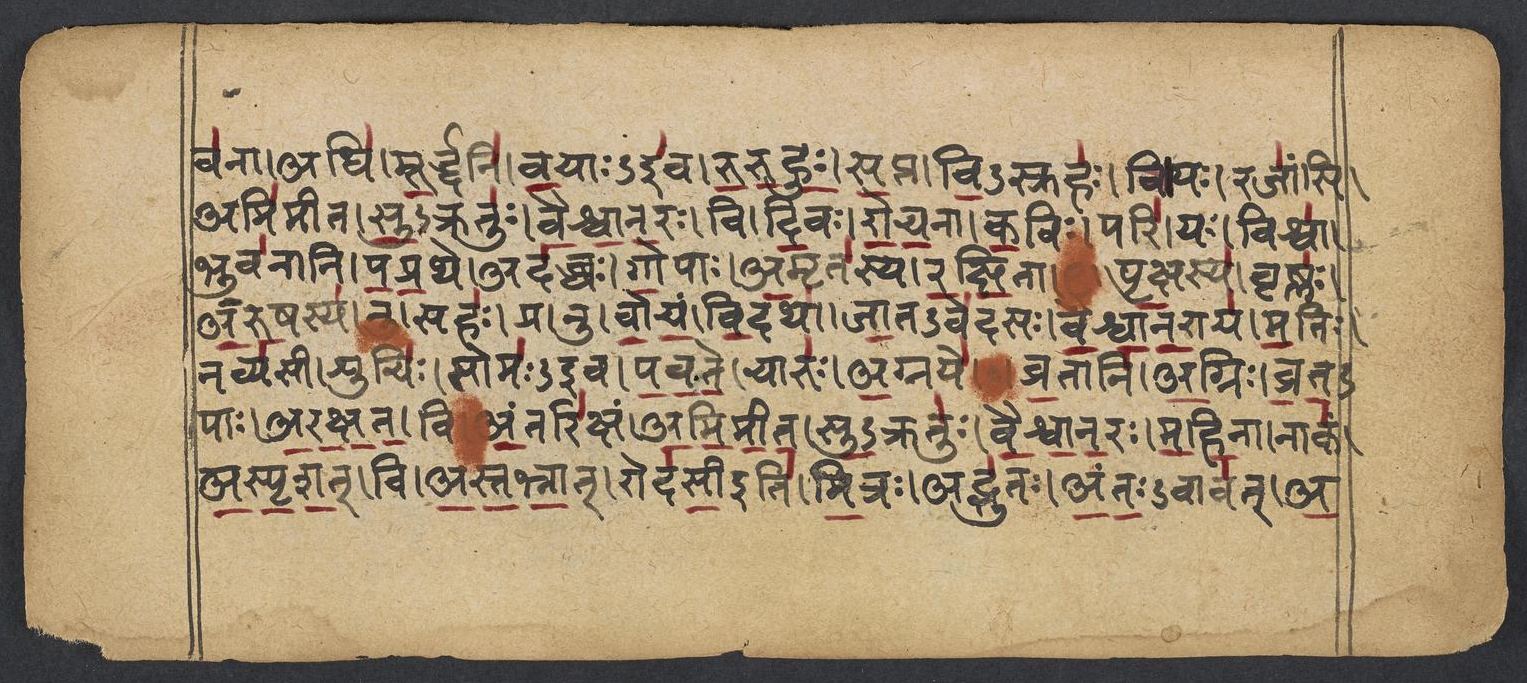
Where on the image
Penn Ms. Coll. 390 Item 41, fol. 410r (numbered 83r by the scribe) (OPenn image 410, lower leaf). Checked on the image: the Rigveda text on this page begins in RV 6.7.6 ‹-bhuvanā adhi mūrdhani vayāḥ-iva›. The next page with Rigveda text, fol. 410v (numbered 83v by the scribe), begins in RV 6.8.3 ‹-akṛṇot jyotiṣā tamaḥ vi›. Verses 6.8.1-2 end on this page.
1pṛ̱kṣasya̱ vṛṣṇo̍ aru̱ṣasya̱ nū saha̱ḥ pra nu vo̍caṁ vi̱dathā̍ jā̱tave̍dasaḥ | vai̱śvā̱na̱rāya̍ ma̱tir navya̍sī̱ śuci̱ḥ soma̍ iva pavate̱ cāru̍r a̱gnaye̍ ||
2sa jāya̍mānaḥ para̱me vyo̍mani vra̱tāny a̱gnir vra̍ta̱pā a̍rakṣata | vy a1̱̍ntari̍kṣam amimīta su̱kratu̍r vaiśvāna̱ro ma̍hi̱nā nāka̍m aspṛśat ||
Compare: Padapāṭha (word-by-word text written in the manuscript; Sansknet e-text via GRETIL)
1pṛkṣasya | vṛṣṇaḥ | aruṣasya | nu | sahaḥ | pra | nu | vocam | vidathā | jāta-vedasaḥ | vaiśvānarāya | matiḥ | navyasī | śuciḥ | somaḥ-iva | pavate | cāruḥ | agnaye
2saḥ | jāyamānaḥ | parame | vi-omani | vratāni | agniḥ | vrata-pāḥ | arakṣata | vi | antarikṣam | amimīta | su-kratuḥ | vaiśvānaraḥ | mahinā | nākam | aspṛśat
1AT Jâtavedas' holy gathering I will tell aloud the conquering might of the swift red-hued Steer. A pure and fresher hymn flows to Vaiṣvânara, even as for Agni lovely Soma is made pure.
2That Agni, when in loftiest heaven he sprang to life, Guardian of Holy Laws, kept and observed them well. Exceeding wise, he measured out the firmament. Vaiṣvânara attained to heaven by mightiness.
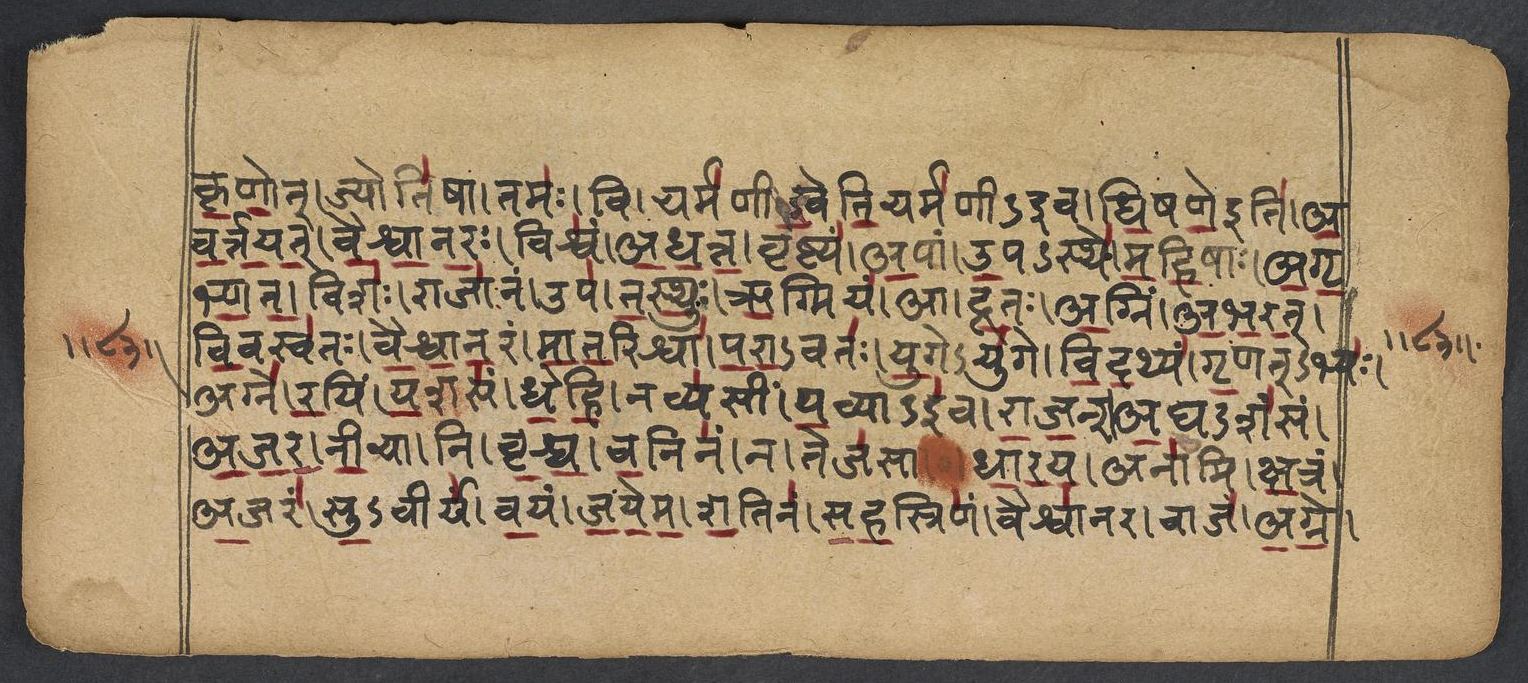
Where on the image
Penn Ms. Coll. 390 Item 41, fol. 410v (numbered 83v by the scribe) (OPenn image 411, upper leaf). Checked on the image: the Rigveda text on this page begins in RV 6.8.3 ‹-akṛṇot jyotiṣā tamaḥ vi›. The next page with Rigveda text, fol. 411r (numbered 84r by the scribe), begins in RV 6.8.6 ‹tava ūti-bhiḥ›. Verses 6.8.3-5 end on this page; 6.8.3 begins on fol. 410r (numbered 83r by the scribe).
3vy a̍stabhnā̱d roda̍sī mi̱tro adbhu̍to 'nta̱rvāva̍d akṛṇo̱j jyoti̍ṣā̱ tama̍ḥ | vi carma̍ṇīva dhi̱ṣaṇe̍ avartayad vaiśvāna̱ro viśva̍m adhatta̱ vṛṣṇya̍m ||
4a̱pām u̱pasthe̍ mahi̱ṣā a̍gṛbhṇata̱ viśo̱ rājā̍na̱m upa̍ tasthur ṛ̱gmiya̍m | ā dū̱to a̱gnim a̍bharad vi̱vasva̍to vaiśvāna̱ram mā̍ta̱riśvā̍ parā̱vata̍ḥ ||
5yu̱ge-yu̍ge vida̱thya̍ṁ gṛ̱ṇadbhyo 'gne̍ ra̱yiṁ ya̱śasa̍ṁ dhehi̱ navya̍sīm | pa̱vyeva̍ rājann a̱ghaśa̍ṁsam ajara nī̱cā ni vṛ̍śca va̱nina̱ṁ na teja̍sā ||
Compare: Padapāṭha (word-by-word text written in the manuscript; Sansknet e-text via GRETIL)
3vi | astabhnāt | rodasī iti | mitraḥ | adbhutaḥ | antaḥ-vāvat | akṛṇot | jyotiṣā | tamaḥ | vi | carmaṇīivet icarmaṇī-iva | dhiṣaṇeiti | avartayat | vaiśvānaraḥ | viśvam | adhatta | vṛṣṇyam
4apām | upa-sthe | mahiṣāḥ | agṛbhṇata | viśaḥ | rājānam | upa | tasthuḥ | ṛgmiyam | ā | dūtaḥ | agnim | abharat | vivasvataḥ | vaiśvānaram | mātariśvā | parāvataḥ
5yuge--yuge | vidathyam | gṛṇat-bhyaḥ | agne | rayim | yaśasam | dhehi | navyasīm | pavyāiva | rājan | agha-śaṃsam | ajara | nīcā | ni | vṛśca | vaninam | na | tejasā
3Wonderful Mitra propped the heaven and earth apart, and covered and concealed the darkness with his light. He made the two bowls part asunder like two skins. Vaiṣvânara put forth all his creative power.
4The Mighty seized him in the bosom of the floods: the people waited on the King who should be praised. As envoy of Vivasvan Mâtariṣvan brought Agni Vaiṣvânara hither from far away.
5In every age bestow upon the singers wealth, worthy of holy synods, glorious, ever new. King, undecaying, as it were with sharpened bolt, smite down the sinner like a tree with lightningflash.
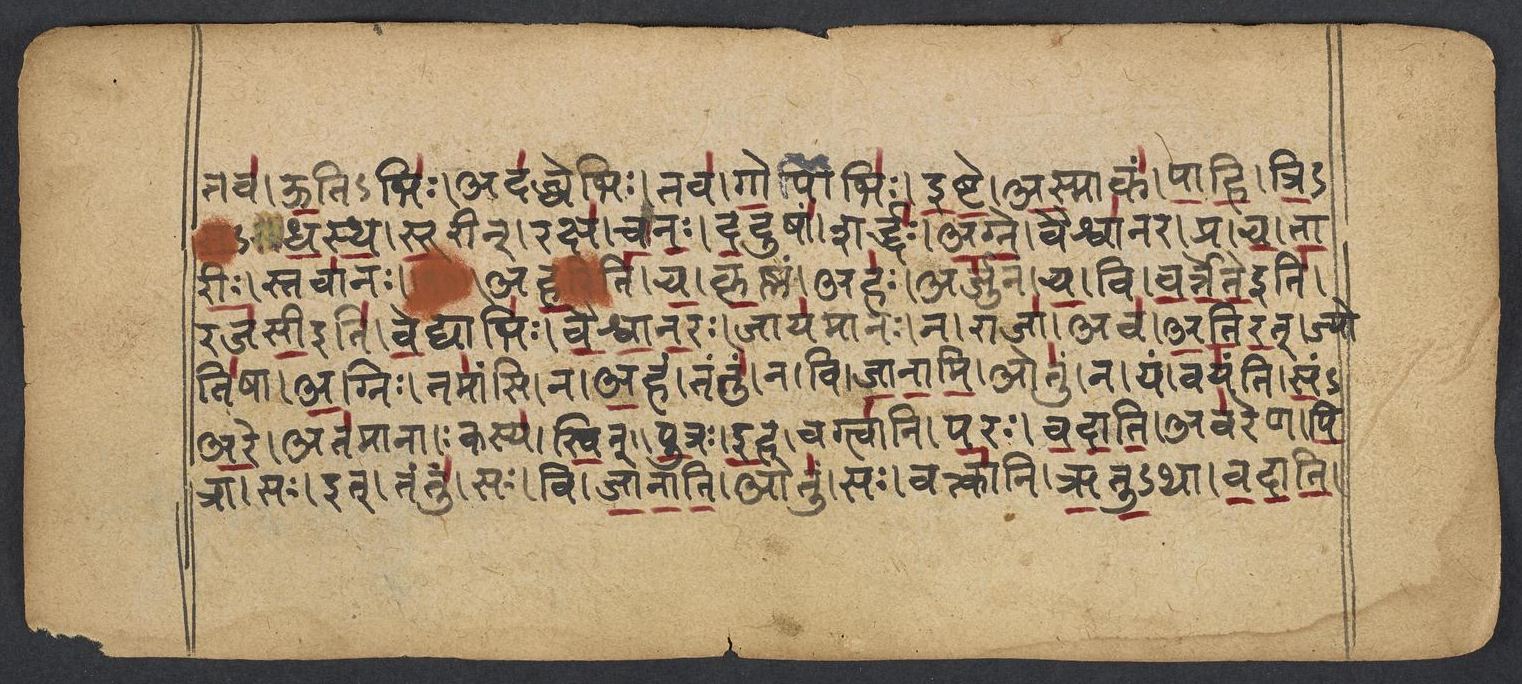
Where on the image
Penn Ms. Coll. 390 Item 41, fol. 411r (numbered 84r by the scribe) (OPenn image 411, lower leaf). Checked on the image: the Rigveda text on this page begins in RV 6.8.6 ‹tava ūti-bhiḥ›. The next page with Rigveda text, fol. 411v (numbered 84v by the scribe), begins in RV 6.9.3 ‹-vadāti yaḥ īm ciketat›. Verses 6.8.6-7 end on this page; 6.8.6 begins on fol. 410v (numbered 83v by the scribe).
6a̱smāka̍m agne ma̱ghava̍tsu dhāra̱yānā̍mi kṣa̱tram a̱jara̍ṁ su̱vīrya̍m | va̱yaṁ ja̍yema śa̱tina̍ṁ saha̱sriṇa̱ṁ vaiśvā̍nara̱ vāja̍m agne̱ tavo̱tibhi̍ḥ ||
7ada̍bdhebhi̱s tava̍ go̱pābhi̍r iṣṭe̱ 'smāka̍m pāhi triṣadhastha sū̱rīn | rakṣā̍ ca no da̱duṣā̱ṁ śardho̍ agne̱ vaiśvā̍nara̱ pra ca̍ tārī̱ḥ stavā̍naḥ ||
Compare: Padapāṭha (word-by-word text written in the manuscript; Sansknet e-text via GRETIL)
6asmākam | agne | maghavat-su | dhāraya | anāmi | kṣatram | ajaram | su-vīryam | vayam | jayema | śatinam | sahasriṇam | vaiśvānara | vājam | agne | tava | ūti-bhiḥ
7adabdhebhiḥ | tava | gopābhiḥ | iṣṭe | asmākam | pāhi | tri-sadastha | sūrīn | rakṣa | ca | naḥ | daduṣām | śardhaḥ | agne | vaiśvānara | pra | ca | tārīḥ | stavānaḥ
6Do thou bestow, O Agni, on our wealthy chiefs, rule, with good heroes, undecaying, bending not. So may we win for us strength. O Vaiṣvânara, hundredfold, thousandfold, O Agni, by thy help.
7O thou who dwellest in three places, Helper, keep with effective guards our princely patrons. Keep our band, Agni, who have brought thee presents. Lengthen their lives, Vaiṣvânara, when lauded.
Notes
- Sanskrit: Aufrecht's edition (1877) with the Vedic accents, as entered by van Nooten and Holland (GRETIL).
- English: Ralph T. H. Griffith, The Hymns of the Rigveda (1889-1892; 2nd ed. 1896-1897), from the VedaWeb digital text; OCR slips in that text were corrected against the printed 2nd edition (data/sources/rigveda/griffith_errata.json).
- Padapāṭha (edition text): Sansknet e-text via GRETIL (CC BY-NC-SA 4.0).
Cite
Sources
- Source: Penn Ms. Coll. 390 Item 41 (undated (catalogued with Penn's 18th-19th c. Vedic manuscripts)), OPenn, Public Domain Mark + Aufrecht's accented text (GRETIL) + Griffith's English (VedaWeb) (holding institution)
- Critical edition: Aufrecht (1877), accented e-text via GRETIL
← previous · → next · v cycle view · l back to library