Rigveda 7.10: To Agni
Introduction
Rigveda 7.10 is a hymn of 5 verses addressed to Agni. It stands in book (maṇḍala) 7, the family book of Vasiṣṭha. The Rigveda is the oldest collection of Sanskrit hymns, composed in the second half of the second millennium BCE and handed down orally for many centuries before it was written down.
The manuscript shown is Penn Ms. Coll. 390 Item 41 (University of Pennsylvania), an undated paper manuscript of the padapāṭha (the word-by-word recitation text, in which every word is written separately and compounds are split) of the whole Ṛgveda in Devanāgarī, 884 leaves in fascicles, 7-9 lines to the page, accents in red; this hymn stands on fol. 499r-499v. Each section below gives the verses that end on one page; the page boundaries were read on the images (the opening words of every page), not counted out. Where the manuscript is a padapāṭha (the word-by-word recitation text), the section shows Aufrecht's continuous (saṃhitā) text first and, as the edition text, the padapāṭha of the same verses, which is the form written on the page.
How was this verified? (Provenance)
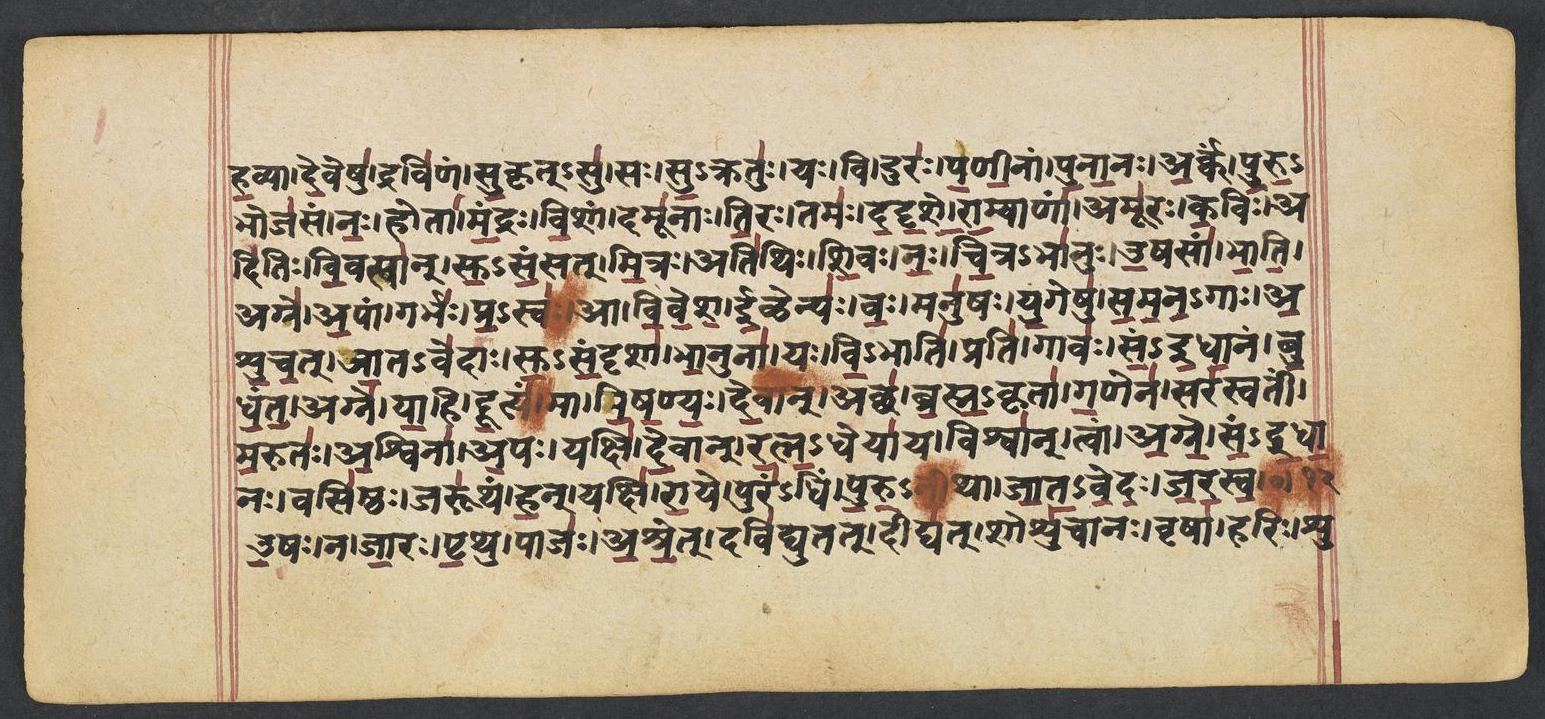
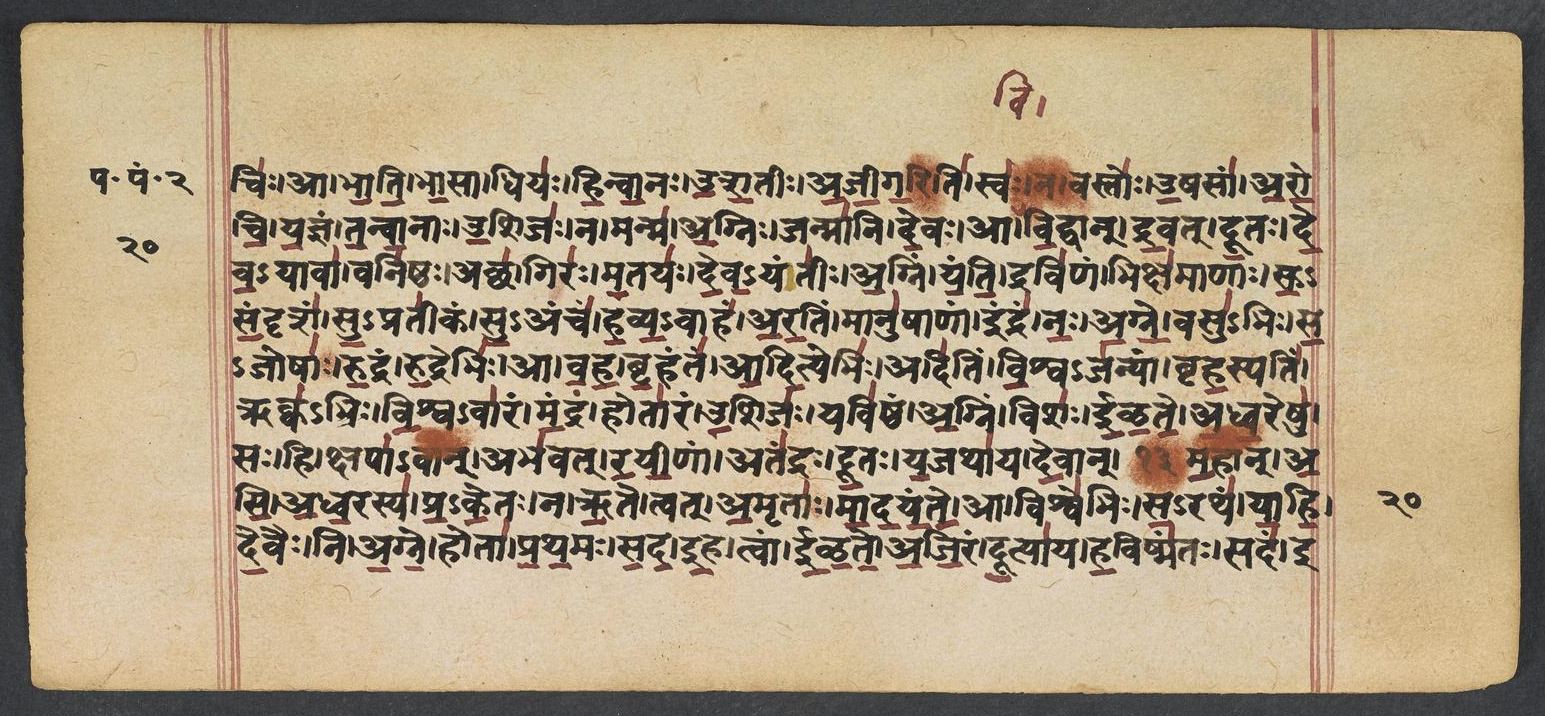
Where on the image
Penn Ms. Coll. 390 Item 41, fol. 499v (numbered 20v by the scribe) (OPenn image 500, upper leaf). Checked on the image: the Rigveda text on this page begins in RV 7.10.1 ‹-śuciḥ ā bhāti bhāsā›. The next page with Rigveda text, fol. 500r (numbered 21r by the scribe), begins in RV 7.11.2 ‹-it mānuṣāsaḥ yasya devaiḥ›. Verses 7.10.1-5 end on this page; 7.10.1 begins on fol. 499r (numbered 20r by the scribe).
1u̱ṣo na jā̱raḥ pṛ̱thu pājo̍ aśre̱d davi̍dyuta̱d dīdya̱c chośu̍cānaḥ | vṛṣā̱ hari̱ḥ śuci̱r ā bhā̍ti bhā̱sā dhiyo̍ hinvā̱na u̍śa̱tīr a̍jīgaḥ ||
2sva1̱̍r ṇa vasto̍r u̱ṣasā̍m aroci ya̱jñaṁ ta̍nvā̱nā u̱śijo̱ na manma̍ | a̱gnir janmā̍ni de̱va ā vi vi̱dvān dra̱vad dū̱to de̍va̱yāvā̱ vani̍ṣṭhaḥ ||
3acchā̱ giro̍ ma̱tayo̍ deva̱yantī̍r a̱gniṁ ya̍nti̱ dravi̍ṇa̱m bhikṣa̍māṇāḥ | su̱sa̱ṁdṛśa̍ṁ su̱pratī̍ka̱ṁ svañca̍ṁ havya̱vāha̍m ara̱tim mānu̍ṣāṇām ||
4indra̍ṁ no agne̱ vasu̍bhiḥ sa̱joṣā̍ ru̱draṁ ru̱drebhi̱r ā va̍hā bṛ̱hanta̍m | ā̱di̱tyebhi̱r adi̍tiṁ vi̱śvaja̍nyā̱m bṛha̱spati̱m ṛkva̍bhir vi̱śvavā̍ram ||
5ma̱ndraṁ hotā̍ram u̱śijo̱ yavi̍ṣṭham a̱gniṁ viśa̍ īḻate adhva̱reṣu̍ | sa hi kṣapā̍vā̱m̐ abha̍vad rayī̱ṇām ata̍ndro dū̱to ya̱jathā̍ya de̱vān ||
Compare: Padapāṭha (word-by-word text written in the manuscript; Sansknet e-text via GRETIL)
1uṣaḥ | na | jāraḥ | pṛthu | pājaḥ | aśret | davidyutat | dīdyat | śośucānaḥ | vṛṣā | har iḥ | śuciḥ | ā | bhāti | bhāsā | dhiyaḥ | hinvānaḥ | uśatīḥ | ajīgariti
2svaḥ | na | vastoḥ | uṣasām | aroci | yajñam | tanvānāḥ | uśijaḥ | na | manma | agniḥ | janmāni | devaḥ | ā | vi | vidvān | dravat | dūtaḥ | deva-yāvā | vaniṣṭhaḥ
3accha | giraḥ | matayaḥ | deva-yantīḥ | agnim | yanti | draviṇam | bhikṣamāṇāḥ | su-sandṛśam | su-pratīkam | su-añcam | havya-vāham | aratim | mānuṣāṇām
4indram | naḥ | agne | vasu-bhiḥ | sa-joṣāḥ | rudram | rudrebhiḥ | ā | vaha | bṛhantam | ādityebhiḥ | aditim | viśva-janyām | bṛhaspatim | ṛkva-bhiḥ | viśva-vāram
5mandram | hotāram | uśijaḥ | yaviṣṭham | agnim | viśaḥ | īḷate | adhvareṣu | saḥ | hi | kṣapāvān | abhavat | rayīṇām | atandraḥ | dūtaḥ | yajathāya | devān
1HE hath sent forth, bright, radiant, and refulgent, like the Dawn's Lover, his far-spreading lustre. Pure in his splendour shines the golden Hero: our longing thoughts hath he aroused and wakened.
2He, like the Sun, hath shone while Morn is breaking, and priests who weave the sacrifice sing praises, Agni, the God, who knows their generations and visits Gods, most bounteous, rapid envoy.
3Our songs and holy hymns go forth to Agni, seeking the God and asking him for riches, Him fair to see, of goodly aspect, mighty, men's messenger who carries their oblations.
4joined with the Vasus, Agni, bring thou Indra bring hither mighty Rudra with the Rudras, Aditi good to all men with Âdityas, Br̥ihaspati All-bounteous, with the Singers.
5Men eagerly implore at sacrifices Agni, Most Youthful God, the joyous Herald. For he is Lord and Ruler over riches, and for Gods' worship an unwearied envoy.
Notes
- Sanskrit: Aufrecht's edition (1877) with the Vedic accents, as entered by van Nooten and Holland (GRETIL).
- English: Ralph T. H. Griffith, The Hymns of the Rigveda (1889-1892; 2nd ed. 1896-1897), from the VedaWeb digital text; OCR slips in that text were corrected against the printed 2nd edition (data/sources/rigveda/griffith_errata.json).
- Padapāṭha (edition text): Sansknet e-text via GRETIL (CC BY-NC-SA 4.0).
Cite
Sources
- Source: Penn Ms. Coll. 390 Item 41 (undated (catalogued with Penn's 18th-19th c. Vedic manuscripts)), OPenn, Public Domain Mark + Aufrecht's accented text (GRETIL) + Griffith's English (VedaWeb) (holding institution)
- Critical edition: Aufrecht (1877), accented e-text via GRETIL
← previous · → next · v cycle view · l back to library