Rigveda 7.101: To Parjanya
Introduction
Rigveda 7.101 is a hymn of 6 verses addressed to Parjanya. It stands in book (maṇḍala) 7, the family book of Vasiṣṭha. The Rigveda is the oldest collection of Sanskrit hymns, composed in the second half of the second millennium BCE and handed down orally for many centuries before it was written down.
The manuscript shown is Penn Ms. Coll. 390 Item 41 (University of Pennsylvania), an undated paper manuscript of the padapāṭha (the word-by-word recitation text, in which every word is written separately and compounds are split) of the whole Ṛgveda in Devanāgarī, 884 leaves in fascicles, 7-9 lines to the page, accents in red; this hymn stands on fol. 555v-556r. Each section below gives the verses that end on one page; the page boundaries were read on the images (the opening words of every page), not counted out. Where the manuscript is a padapāṭha (the word-by-word recitation text), the section shows Aufrecht's continuous (saṃhitā) text first and, as the edition text, the padapāṭha of the same verses, which is the form written on the page.
How was this verified? (Provenance)
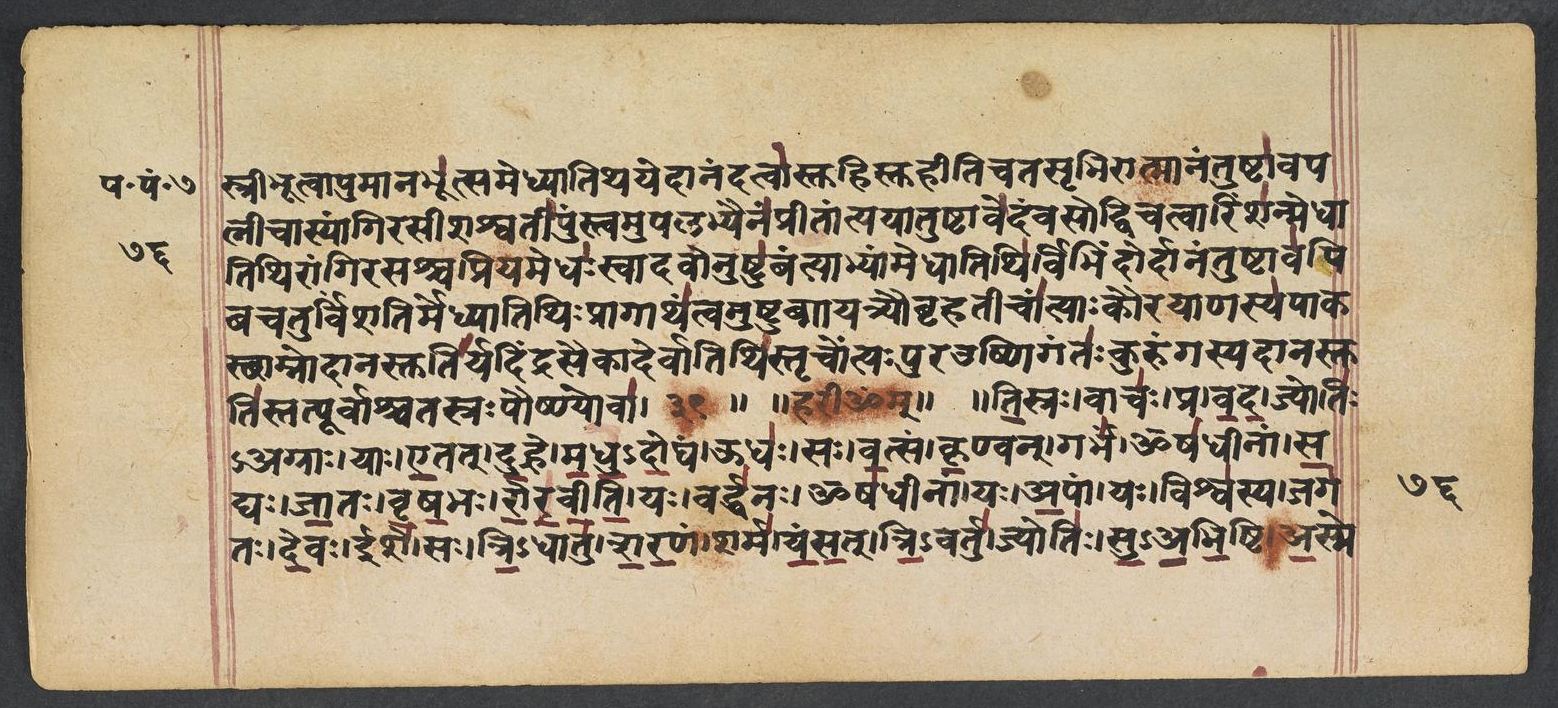
Where on the image
Penn Ms. Coll. 390 Item 41, fol. 555v (numbered 76v by the scribe) (OPenn image 556, upper leaf). Checked on the image: the Rigveda text on this page begins in RV 7.101.1 ‹tisraḥ vācaḥ pra vada›. Lines 1-6 end the anukramaṇī; 7.101.1 (tisraḥ vācaḥ pra vada jyotiḥagrāḥ) begins in line 6 after hariḥ oṃ. The next page with Rigveda text, fol. 556r (numbered 77r by the scribe), begins in RV 7.101.2 ‹-asme iti›. Verse 7.101.1 ends on this page.
1ti̱sro vāca̱ḥ pra va̍da̱ jyoti̍ragrā̱ yā e̱tad du̱hre ma̍dhudo̱gham ūdha̍ḥ | sa va̱tsaṁ kṛ̱ṇvan garbha̱m oṣa̍dhīnāṁ sa̱dyo jā̱to vṛ̍ṣa̱bho ro̍ravīti ||
Compare: Padapāṭha (word-by-word text written in the manuscript; Sansknet e-text via GRETIL)
1tisraḥ | vācaḥ | pra | vada | jyotiḥ-agrāḥ | yāḥ | etat | duhre | madhu-dogham | ūdhaḥ | saḥ | vatsam | kṛṇvan | garbham | oṣadhīnām | sadyaḥ | jātaḥ | vṛṣabhaḥ | roravīti
1SPEAK forth three words, the words which light precedeth, which milk this udder that produceth nectar. Quickly made manifest, the Bull hath bellowed, engendering the germ of plants, the Infant.
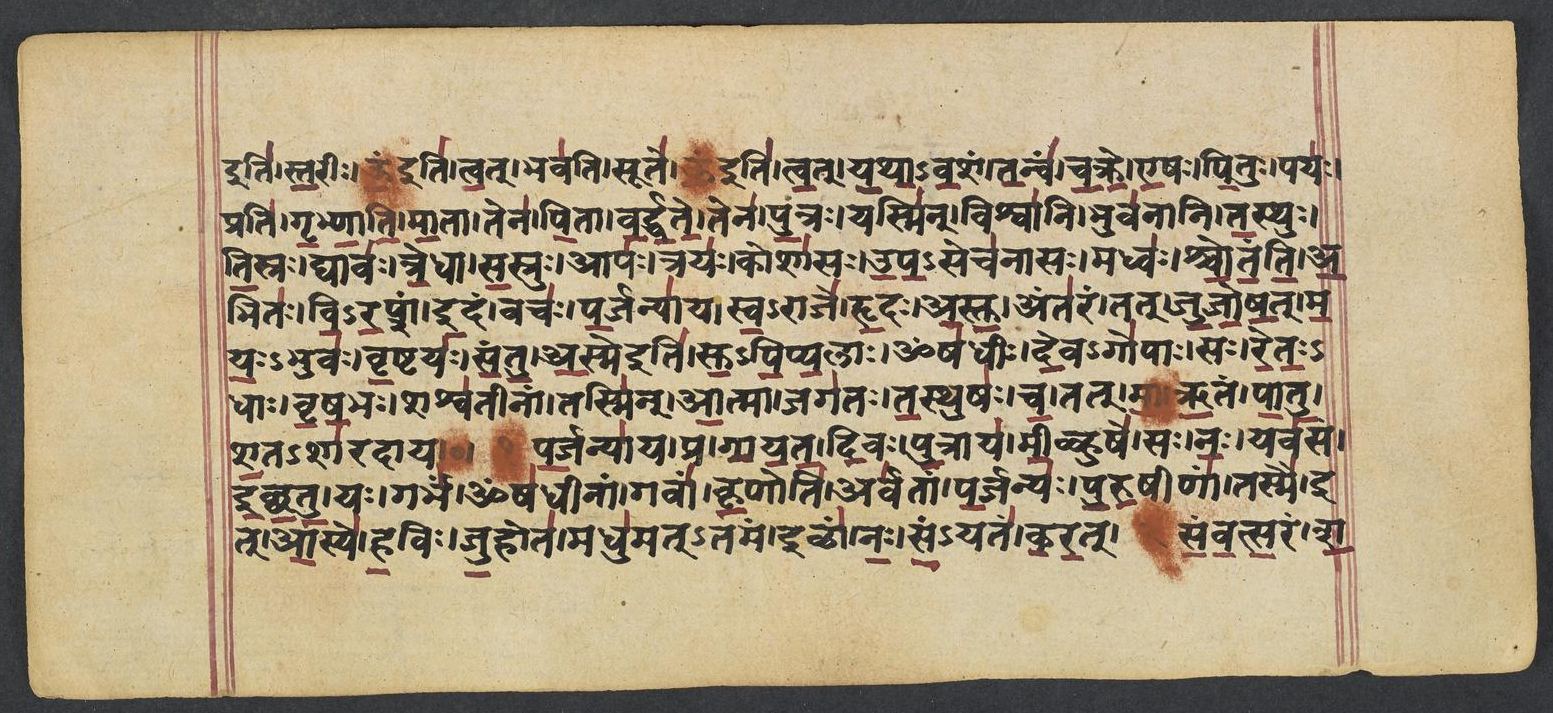
Where on the image
Penn Ms. Coll. 390 Item 41, fol. 556r (numbered 77r by the scribe) (OPenn image 556, lower leaf). Checked on the image: the Rigveda text on this page begins in RV 7.101.2 ‹-asme iti›. The next page with Rigveda text, fol. 556v (numbered 77v by the scribe), begins in RV 7.103.1 ‹-śaśayānāḥ brāhmaṇāḥ vrata-cāriṇaḥ vācam›. Verses 7.101.2-6 end on this page; 7.101.2 begins on fol. 555v (numbered 76v by the scribe).
2yo vardha̍na̱ oṣa̍dhīnā̱ṁ yo a̱pāṁ yo viśva̍sya̱ jaga̍to de̱va īśe̍ | sa tri̱dhātu̍ śara̱ṇaṁ śarma̍ yaṁsat tri̱vartu̱ jyoti̍ḥ svabhi̱ṣṭy a1̱̍sme ||
3sta̱rīr u̍ tva̱d bhava̍ti̱ sūta̍ u tvad yathāva̱śaṁ ta̱nva̍ṁ cakra e̱ṣaḥ | pi̱tuḥ paya̱ḥ prati̍ gṛbhṇāti mā̱tā tena̍ pi̱tā va̍rdhate̱ tena̍ pu̱traḥ ||
4yasmi̱n viśvā̍ni̱ bhuva̍nāni ta̱sthus ti̱sro dyāva̍s tre̱dhā sa̱srur āpa̍ḥ | traya̱ḥ kośā̍sa upa̱seca̍nāso̱ madhva̍ḥ ścotanty a̱bhito̍ vira̱pśam ||
5i̱daṁ vaca̍ḥ pa̱rjanyā̍ya sva̱rāje̍ hṛ̱do a̱stv anta̍ra̱ṁ taj ju̍joṣat | ma̱yo̱bhuvo̍ vṛ̱ṣṭaya̍ḥ santv a̱sme su̍pippa̱lā oṣa̍dhīr de̱vago̍pāḥ ||
6sa re̍to̱dhā vṛ̍ṣa̱bhaḥ śaśva̍tīnā̱ṁ tasmi̍nn ā̱tmā jaga̍tas ta̱sthuṣa̍ś ca | tan ma̍ ṛ̱tam pā̍tu śa̱taśā̍radāya yū̱yam pā̍ta sva̱stibhi̱ḥ sadā̍ naḥ ||
Compare: Padapāṭha (word-by-word text written in the manuscript; Sansknet e-text via GRETIL)
2yaḥ | vardhanaḥ | oṣadhīnām | yaḥ | apām | yaḥ | viśvasya | jagataḥ | devaḥ | īśe | saḥ | tri-dhātu | śaraṇam | śarma | yaṃsat | tri-vartu | jyotiḥ | su-abhiṣṭi | asme iti
3starīḥ | oṃ iti | tvat | bhavati | sūtaḥ | oṃ iti | tvat | yathāvaśam | tanvam | cakre | eṣaḥ | pituḥ | payaḥ | prati | gṛbhṇāti | mātā | tena | pitā | vardhate | tena | putraḥ
4yasmin | viśvāni | bhuvanāni | tasthuḥ | tisraḥ | dyāvaḥ | tredhā | sasuḥ | āpaḥ | trayaḥ | kośāsaḥ | upa-secanāsaḥ | madhvaḥ | ścotanti | abhitaḥ | vi-rapśam
5idam | vacaḥ | parjanyāya | sva-rāje | hṛdaḥ | astu | antaram | tat | jujoṣat | mayaḥ-bhuvaḥ | vṛṣṭayaḥ | santu | asme iti | su-pippalāḥ | oṣadhīḥ | deva-gopāḥ
6saḥ | retaḥ-dhāḥ | vṛṣabhaḥ | śaśvatīnām | tasmin | ātmā | jagataḥ | tusthuṣaḥ | ca | tat | mā | ṛtam | pātu | śata-śāradāya | yūyam | pāta | svasti-bhiḥ | sadā | naḥ
2Giver of growth to plants, the God who ruleth over the waters and all moving creatures, Vouchsafe us triple shelter for our refuge, and threefold light to succour and befriend us.
3Now he is sterile, now begetteth offspring, even as he willeth doth he change his figure. The Father's genial flow bedews the Mother; therewith the Sire, therewith the son is nourished.
4In him all living creatures have their being, and the three heavens with triplyflowing waters. Three reservoirs that sprinkle down their treasure shed their sweet streams around him with a murmur.
5May this my song to Sovran Lord Parjanya come near unto his heart and give him pleasure. May we obtain the showers that bring enjoyment, and God-protected plants with goodly fruitage.
6He is the Bull of all, and their impregner lie holds the life of all things fixed and moving. May this rite save me till my hundredth autumn. Preserve us evermore, ye Gods, with blessings.
Notes
- Sanskrit: Aufrecht's edition (1877) with the Vedic accents, as entered by van Nooten and Holland (GRETIL).
- English: Ralph T. H. Griffith, The Hymns of the Rigveda (1889-1892; 2nd ed. 1896-1897), from the VedaWeb digital text; OCR slips in that text were corrected against the printed 2nd edition (data/sources/rigveda/griffith_errata.json).
- Padapāṭha (edition text): Sansknet e-text via GRETIL (CC BY-NC-SA 4.0).
Cite
Sources
- Source: Penn Ms. Coll. 390 Item 41 (undated (catalogued with Penn's 18th-19th c. Vedic manuscripts)), OPenn, Public Domain Mark + Aufrecht's accented text (GRETIL) + Griffith's English (VedaWeb) (holding institution)
- Critical edition: Aufrecht (1877), accented e-text via GRETIL
← previous · → next · v cycle view · l back to library