Rigveda 7.102: To Parjanya
Introduction
Rigveda 7.102 is a hymn of 3 verses addressed to Parjanya. It stands in book (maṇḍala) 7, the family book of Vasiṣṭha. The Rigveda is the oldest collection of Sanskrit hymns, composed in the second half of the second millennium BCE and handed down orally for many centuries before it was written down.
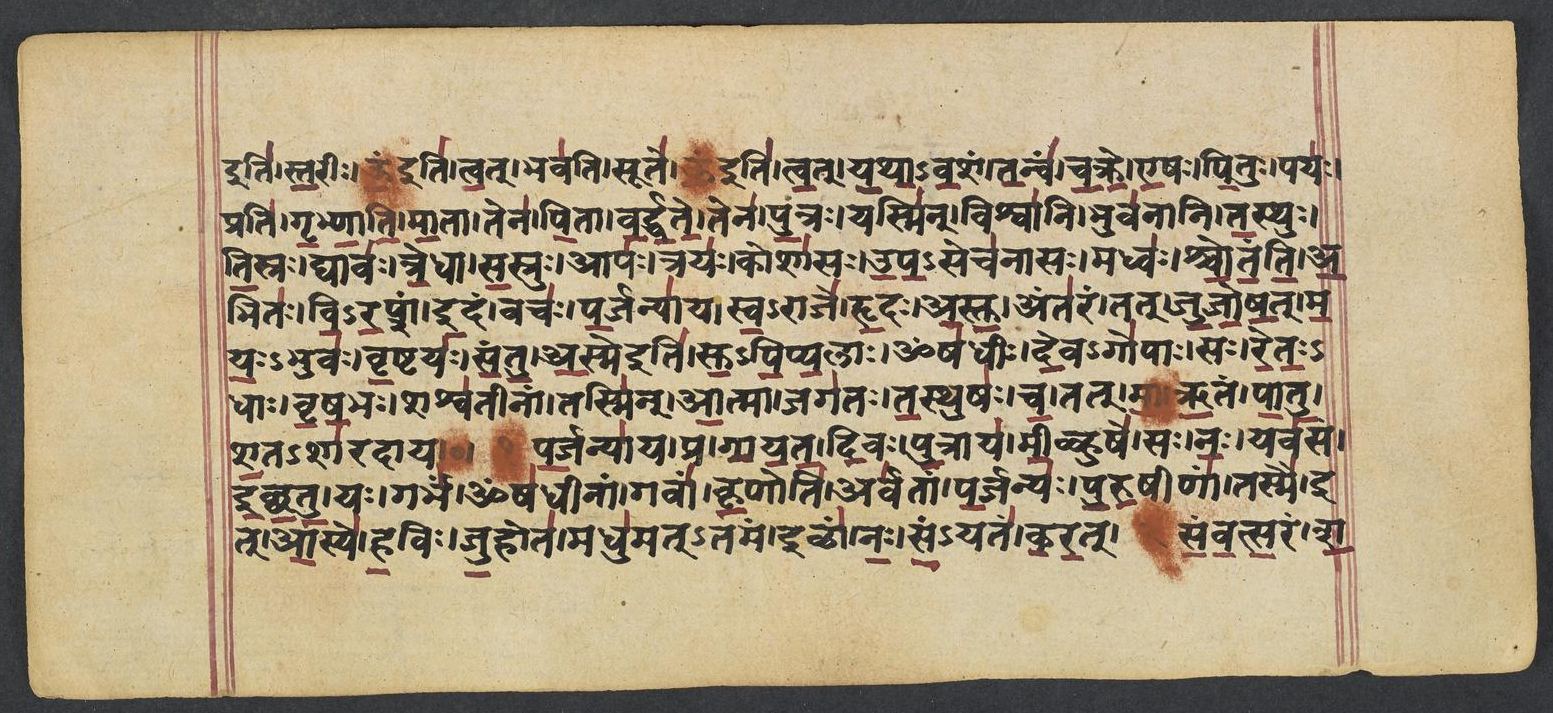
The manuscript shown is Penn Ms. Coll. 390 Item 41 (University of Pennsylvania), an undated paper manuscript of the padapāṭha (the word-by-word recitation text, in which every word is written separately and compounds are split) of the whole Ṛgveda in Devanāgarī, 884 leaves in fascicles, 7-9 lines to the page, accents in red; this hymn stands on fol. 556r. Each section below gives the verses that end on one page; the page boundaries were read on the images (the opening words of every page), not counted out. Where the manuscript is a padapāṭha (the word-by-word recitation text), the section shows Aufrecht's continuous (saṃhitā) text first and, as the edition text, the padapāṭha of the same verses, which is the form written on the page.
How was this verified? (Provenance)
Where on the image
Penn Ms. Coll. 390 Item 41, fol. 556r (numbered 77r by the scribe) (OPenn image 556, lower leaf). Checked on the image: the Rigveda text on this page begins in RV 7.101.2 ‹-asme iti›. The next page with Rigveda text, fol. 556v (numbered 77v by the scribe), begins in RV 7.103.1 ‹-śaśayānāḥ brāhmaṇāḥ vrata-cāriṇaḥ vācam›. Verses 7.102.1-3 end on this page.
1pa̱rjanyā̍ya̱ pra gā̍yata di̱vas pu̱trāya̍ mī̱ḻhuṣe̍ | sa no̱ yava̍sam icchatu ||
2yo garbha̱m oṣa̍dhīnā̱ṁ gavā̍ṁ kṛ̱ṇoty arva̍tām | pa̱rjanya̍ḥ puru̱ṣīṇā̍m ||
3tasmā̱ id ā̱sye̍ ha̱vir ju̱hotā̱ madhu̍mattamam | iḻā̍ṁ naḥ sa̱ṁyata̍ṁ karat ||
Compare: Padapāṭha (word-by-word text written in the manuscript; Sansknet e-text via GRETIL)
1parjanyāya | pra | gāyata | divaḥ | putrāya | mīḷhuṣe | saḥ | naḥ | yavasam | icchatu
2yaḥ | garbham | oṣadhīnām | gavām | kṛṇoti | arvatām | parjanyaḥ | puruṣīṇām
3tasmai | it | āsye | haviḥ | juhota | madhumat-tamam | iḷām | naḥ | sam-yatam | karat
1SING forth and laud Parjanya, son of Heaven, who sends the gift of rain May he provide our pasturage.
2Parjanya is the God who forms in kine, in mares, in plants of earth, And womankind, the germ of life.
3Offer and pour into his mouth oblation rich in savoury juice: May he for ever give us food.
Notes
- Sanskrit: Aufrecht's edition (1877) with the Vedic accents, as entered by van Nooten and Holland (GRETIL).
- English: Ralph T. H. Griffith, The Hymns of the Rigveda (1889-1892; 2nd ed. 1896-1897), from the VedaWeb digital text; OCR slips in that text were corrected against the printed 2nd edition (data/sources/rigveda/griffith_errata.json).
- Padapāṭha (edition text): Sansknet e-text via GRETIL (CC BY-NC-SA 4.0).
Cite
Sources
- Source: Penn Ms. Coll. 390 Item 41 (undated (catalogued with Penn's 18th-19th c. Vedic manuscripts)), OPenn, Public Domain Mark + Aufrecht's accented text (GRETIL) + Griffith's English (VedaWeb) (holding institution)
- Critical edition: Aufrecht (1877), accented e-text via GRETIL
← previous · → next · v cycle view · l back to library