Rigveda 7.15: To Agni
Introduction
Rigveda 7.15 is a hymn of 15 verses addressed to Agni. It stands in book (maṇḍala) 7, the family book of Vasiṣṭha. The Rigveda is the oldest collection of Sanskrit hymns, composed in the second half of the second millennium BCE and handed down orally for many centuries before it was written down.
The manuscript shown is Penn Ms. Coll. 390 Item 41 (University of Pennsylvania), an undated paper manuscript of the padapāṭha (the word-by-word recitation text, in which every word is written separately and compounds are split) of the whole Ṛgveda in Devanāgarī, 884 leaves in fascicles, 7-9 lines to the page, accents in red; this hymn stands on fol. 500v-501v. Each section below gives the verses that end on one page; the page boundaries were read on the images (the opening words of every page), not counted out. Where the manuscript is a padapāṭha (the word-by-word recitation text), the section shows Aufrecht's continuous (saṃhitā) text first and, as the edition text, the padapāṭha of the same verses, which is the form written on the page.
How was this verified? (Provenance)
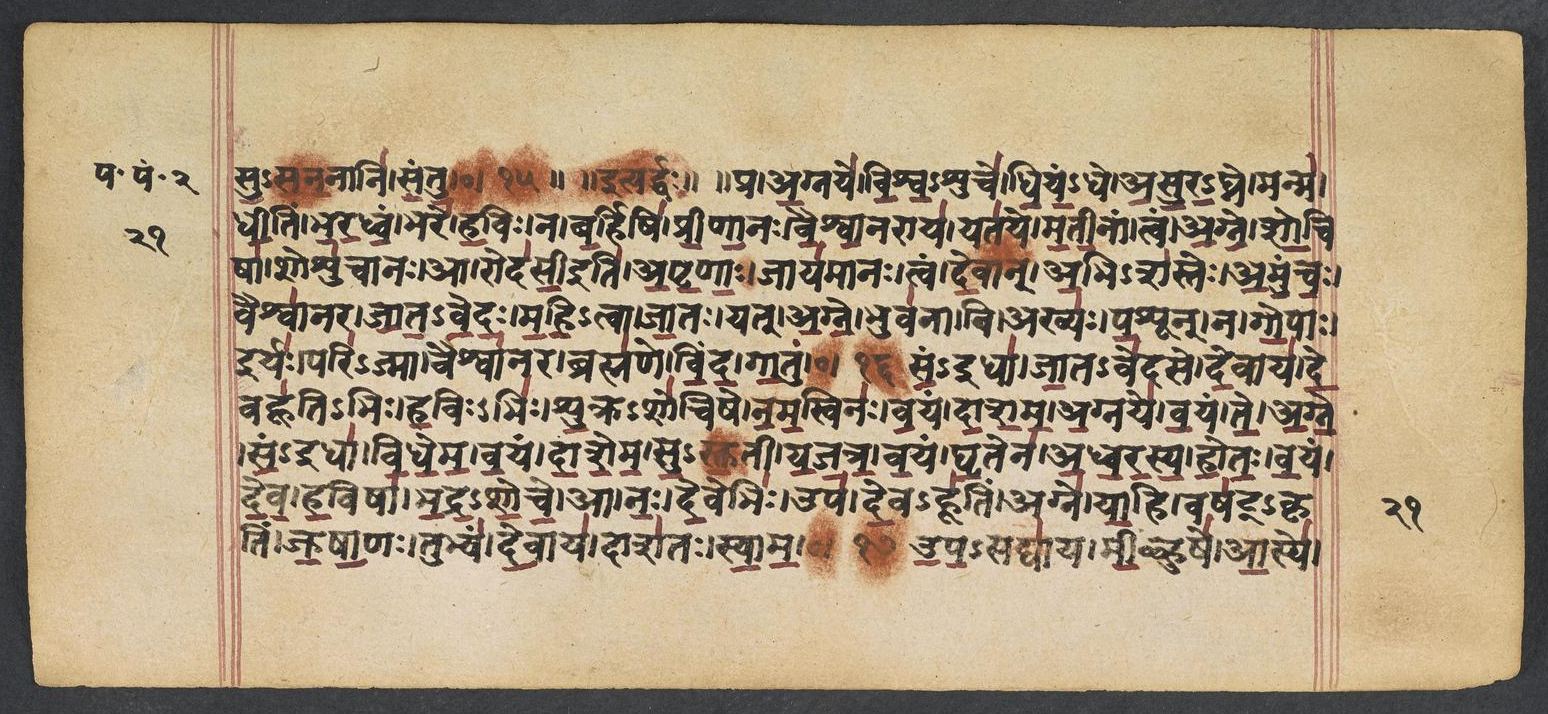
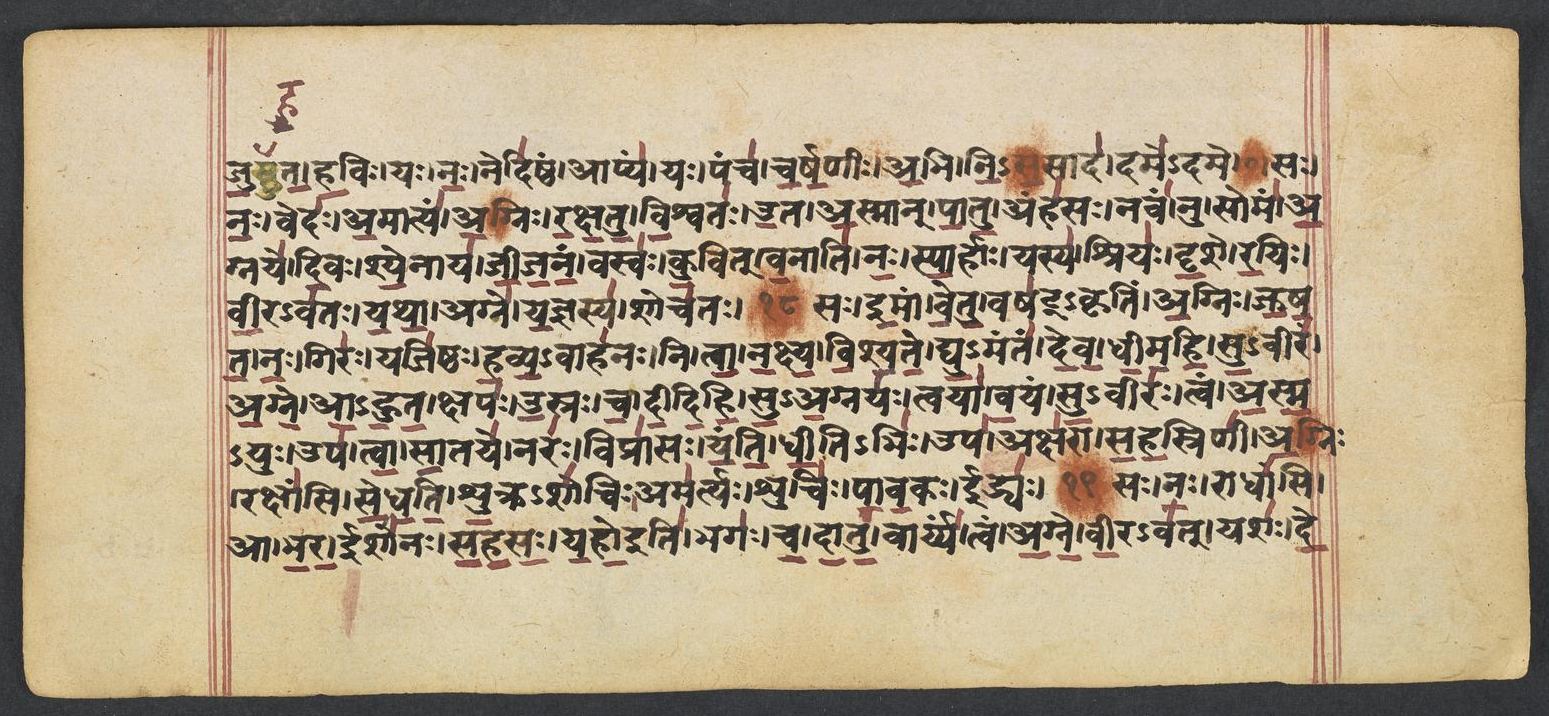
Where on the image
Penn Ms. Coll. 390 Item 41, fol. 501r (numbered 22r by the scribe) (OPenn image 501, lower leaf). Checked on the image: the Rigveda text on this page begins in RV 7.15.1 ‹juhuta haviḥ yaḥ naḥ›. The next page with Rigveda text, fol. 501v (numbered 22v by the scribe), begins in RV 7.15.12 ‹-devaḥ ca savitā bhagaḥ›. Verses 7.15.1-11 end on this page; 7.15.1 begins on fol. 500v (numbered 21v by the scribe).
1u̱pa̱sadyā̍ya mī̱ḻhuṣa̍ ā̱sye̍ juhutā ha̱viḥ | yo no̱ nedi̍ṣṭha̱m āpya̍m ||
2yaḥ pañca̍ carṣa̱ṇīr a̱bhi ni̍ṣa̱sāda̱ dame̍-dame | ka̱vir gṛ̱hapa̍ti̱r yuvā̍ ||
3sa no̱ vedo̍ a̱mātya̍m a̱gnī ra̍kṣatu vi̱śvata̍ḥ | u̱tāsmān pā̱tv aṁha̍saḥ ||
4nava̱ṁ nu stoma̍m a̱gnaye̍ di̱vaḥ śye̱nāya̍ jījanam | vasva̍ḥ ku̱vid va̱nāti̍ naḥ ||
5spā̱rhā yasya̱ śriyo̍ dṛ̱śe ra̱yir vī̱rava̍to yathā | agre̍ ya̱jñasya̱ śoca̍taḥ ||
6semāṁ ve̍tu̱ vaṣa̍ṭkṛtim a̱gnir ju̍ṣata no̱ gira̍ḥ | yaji̍ṣṭho havya̱vāha̍naḥ ||
7ni tvā̍ nakṣya viśpate dyu̱manta̍ṁ deva dhīmahi | su̱vīra̍m agna āhuta ||
8kṣapa̍ u̱sraś ca̍ dīdihi sva̱gnaya̱s tvayā̍ va̱yam | su̱vīra̱s tvam a̍sma̱yuḥ ||
9upa̍ tvā sā̱taye̱ naro̱ viprā̍so yanti dhī̱tibhi̍ḥ | upākṣa̍rā saha̱sriṇī̍ ||
10a̱gnī rakṣā̍ṁsi sedhati śu̱kraśo̍ci̱r ama̍rtyaḥ | śuci̍ḥ pāva̱ka īḍya̍ḥ ||
11sa no̱ rādhā̱ṁsy ā bha̱reśā̍naḥ sahaso yaho | bhaga̍ś ca dātu̱ vārya̍m ||
Compare: Padapāṭha (word-by-word text written in the manuscript; Sansknet e-text via GRETIL)
1upa-sadyāya | mīḷhuṣe | āsye | juhuta | haviḥ | yaḥ | naḥ | nediṣṭham | āpyam
2yaḥ | pañca | carṣaṇīḥ | abhi | ni-sasāda | dame--dame | kaviḥ | gṛha-patiḥ | yuvā
3saḥ | naḥ | vedaḥ | amātyam | agniḥ | rakṣatu | viśvataḥ | uta | asmān | pātu | aṃhasaḥ
4navam | nu | stomam | agnaye | divaḥ | śyenāya | jījanam | vasvaḥ | kuvit | vanāti | naḥ
5spārhā | yasya | śriyaḥ | dṛśe | rayiḥ | vīra-vataḥ | yathā | agre | yajñasya | śocataḥ
6saḥ | imām | vetu | vaṣaṭ-kṛtim | agniḥ | juṣata | naḥ | giraḥ | yajiṣṭhaḥ | havya-vāhanaḥ
7ni | tvā | nakṣya | viśpate | dyu-mantam | deva | dhīmahi | su-vīram | agne | āhuta
8kṣapaḥ | usraḥ | ca | dīdihi | su-agnayaḥ | tvayā | vayam | su-vīraḥ | tvam | asma-yuḥ
9upa | tvā | sātaye | naraḥ | viprāsaḥ | yanti | dhīti-bhiḥ | upa | akṣarā | sahasr iṇī
10agniḥ | rakṣāṃsi | sedhati | śukra-śociḥ | amartyaḥ | śuciḥ | pāvakaḥ | īḍyaḥ
11saḥ | naḥ | rādhāṃsi | ā | bhara | īśānaḥ | sahasaḥ | yaho iti | bhagaḥ | ca | dātu | vāryam
1OFFER oblations in his mouth, the bounteous God's whom we must serve. His who is nearest kin to us:
2Who for the Fivefold People's sake hath seated him in every home Wise, Youthful, Master of the house.
3On all sides may that Agni guard our household folk and property; May he deliver us from woe.
4I have begotten this new hymn for Agni, Falcon of the sky: Will he not give us of his wealth?
5Whose glories when he glows in front of sacrifice are fair to see, Like wealth of one with hero sons.
6May he enjoy this hallowed gift, Agni accept our songs, who bears Oblations, best of worshippers.
7Lord of the house, whom men must seek, we set thee down, O Worshipped Onel Bright, rich in heroes, Agni! God
8Shine forth at night and morn: through thee with fires are we provided well. Thou, rich in heroes, art our Friend.
9The men come near thee for their gain, the singers with their songs of praise: Speech, thousandfold, comes near to thee.
10Bright, Purifier, meet for praise, Immortal with refulgent glow, Agni drives Raksasas away.
11As such, bring us abundant wealth, young Child of Strength, for this thou canst May Bhaga give us what is choice.
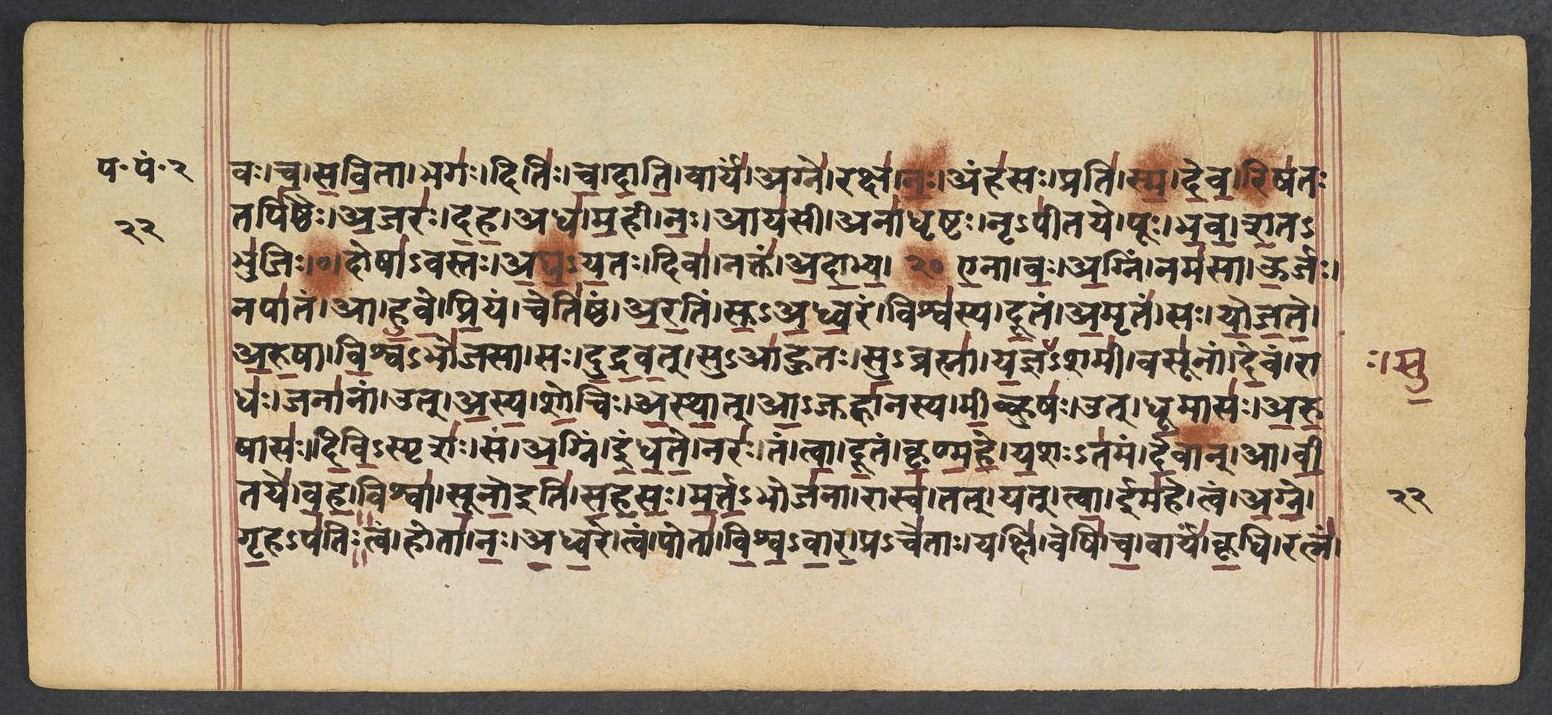
Where on the image
Penn Ms. Coll. 390 Item 41, fol. 501v (numbered 22v by the scribe) (OPenn image 502, upper leaf). Checked on the image: the Rigveda text on this page begins in RV 7.15.12 ‹-devaḥ ca savitā bhagaḥ›. The next page with Rigveda text, fol. 502r (numbered 23r by the scribe), begins in RV 7.16.6 ‹yajamānāya sukrato itisu-krato tvam›. Verses 7.15.12-15 end on this page; 7.15.12 begins on fol. 501r (numbered 22r by the scribe).
12tvam a̍gne vī̱rava̱d yaśo̍ de̱vaś ca̍ savi̱tā bhaga̍ḥ | diti̍ś ca dāti̱ vārya̍m ||
13agne̱ rakṣā̍ ṇo̱ aṁha̍sa̱ḥ prati̍ ṣma deva̱ rīṣa̍taḥ | tapi̍ṣṭhair a̱jaro̍ daha ||
14adhā̍ ma̱hī na̱ āya̱sy anā̍dhṛṣṭo̱ nṛpī̍taye | pūr bha̍vā śa̱tabhu̍jiḥ ||
15tvaṁ na̍ḥ pā̱hy aṁha̍so̱ doṣā̍vastar aghāya̱taḥ | divā̱ nakta̍m adābhya ||
Compare: Padapāṭha (word-by-word text written in the manuscript; Sansknet e-text via GRETIL)
12tvam | agne | vīra-vat | yaśaḥ | devaḥ | ca | savitā | bhagaḥ | ditiḥ | ca | dāti | vāyarm
13agne | rakṣa | naḥ | aṃhasaḥ | prati | sma | deva | riṣataḥ | tapiṣṭhaiḥ | ajaraḥ | daha
14agne | mahī | naḥ | āyasī | anādhṛṣṭaḥ | nṛ-pītaye | pūḥ | bhava | śata-bhujiḥ
15tvam | naḥ | pāhi | aṃhasaḥ | doṣāvastaḥ | agha-yataḥ | divā | naktam | adābhya
12Thou, Agni, givest hero fame: Bhaga and Savitar the God, And Did give us what is good.
13Agni, preserve us from distress: consume our enemies, O God, Eternal, with the hottest flames.
14And, irresistible, be thou a mighty iron fort to us, With hundred walls for man's defence.
15Do thou preserve us, eve and morn, from sorrow, from the wicked men, Infallible! by day and night.
Notes
- Sanskrit: Aufrecht's edition (1877) with the Vedic accents, as entered by van Nooten and Holland (GRETIL).
- English: Ralph T. H. Griffith, The Hymns of the Rigveda (1889-1892; 2nd ed. 1896-1897), from the VedaWeb digital text; OCR slips in that text were corrected against the printed 2nd edition (data/sources/rigveda/griffith_errata.json).
- Padapāṭha (edition text): Sansknet e-text via GRETIL (CC BY-NC-SA 4.0).
Cite
Sources
- Source: Penn Ms. Coll. 390 Item 41 (undated (catalogued with Penn's 18th-19th c. Vedic manuscripts)), OPenn, Public Domain Mark + Aufrecht's accented text (GRETIL) + Griffith's English (VedaWeb) (holding institution)
- Critical edition: Aufrecht (1877), accented e-text via GRETIL
← previous · → next · v cycle view · l back to library