Rigveda 7.17: To Agni
Introduction
Rigveda 7.17 is a hymn of 7 verses addressed to Agni. It stands in book (maṇḍala) 7, the family book of Vasiṣṭha. The Rigveda is the oldest collection of Sanskrit hymns, composed in the second half of the second millennium BCE and handed down orally for many centuries before it was written down.
The manuscript shown is Penn Ms. Coll. 390 Item 41 (University of Pennsylvania), an undated paper manuscript of the padapāṭha (the word-by-word recitation text, in which every word is written separately and compounds are split) of the whole Ṛgveda in Devanāgarī, 884 leaves in fascicles, 7-9 lines to the page, accents in red; this hymn stands on fol. 502r-502v. Each section below gives the verses that end on one page; the page boundaries were read on the images (the opening words of every page), not counted out. Where the manuscript is a padapāṭha (the word-by-word recitation text), the section shows Aufrecht's continuous (saṃhitā) text first and, as the edition text, the padapāṭha of the same verses, which is the form written on the page.
How was this verified? (Provenance)
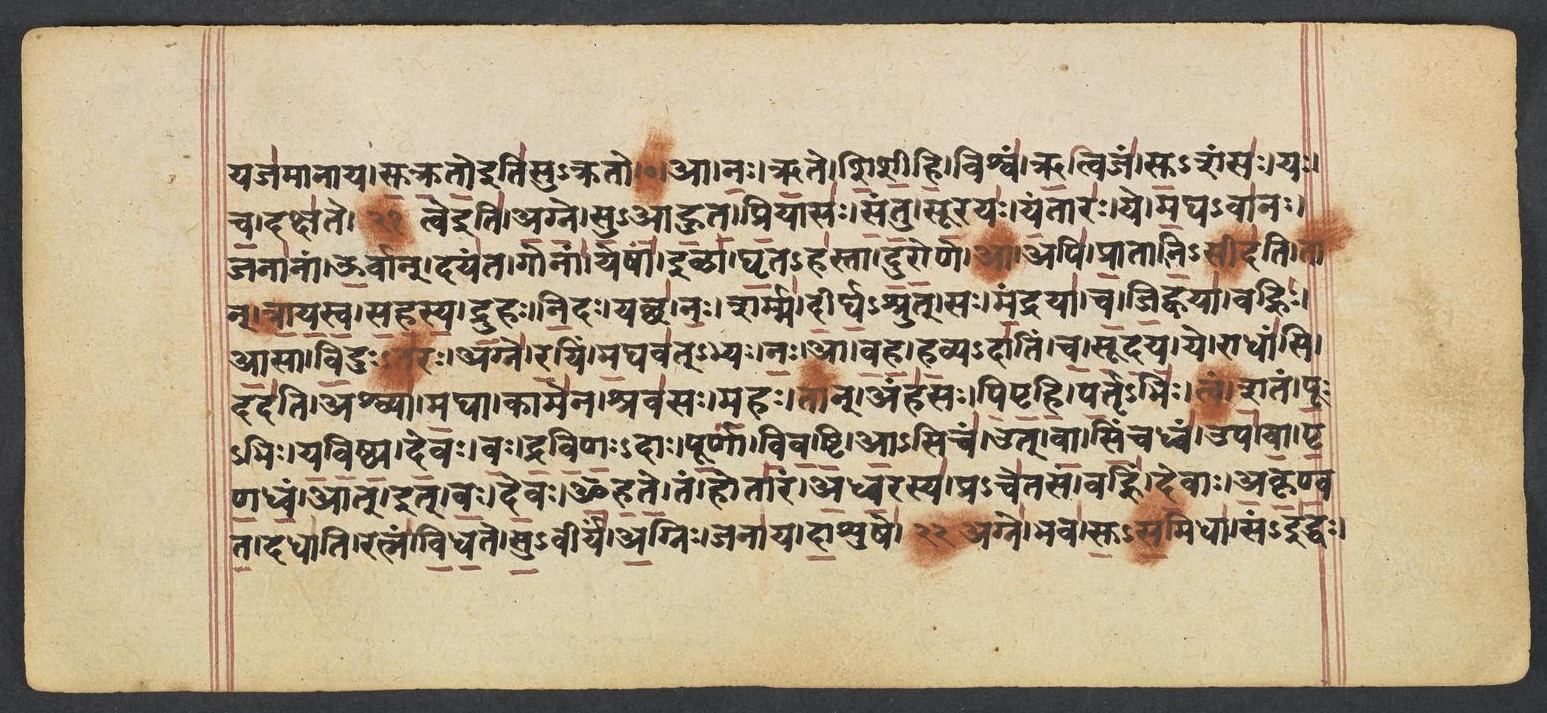
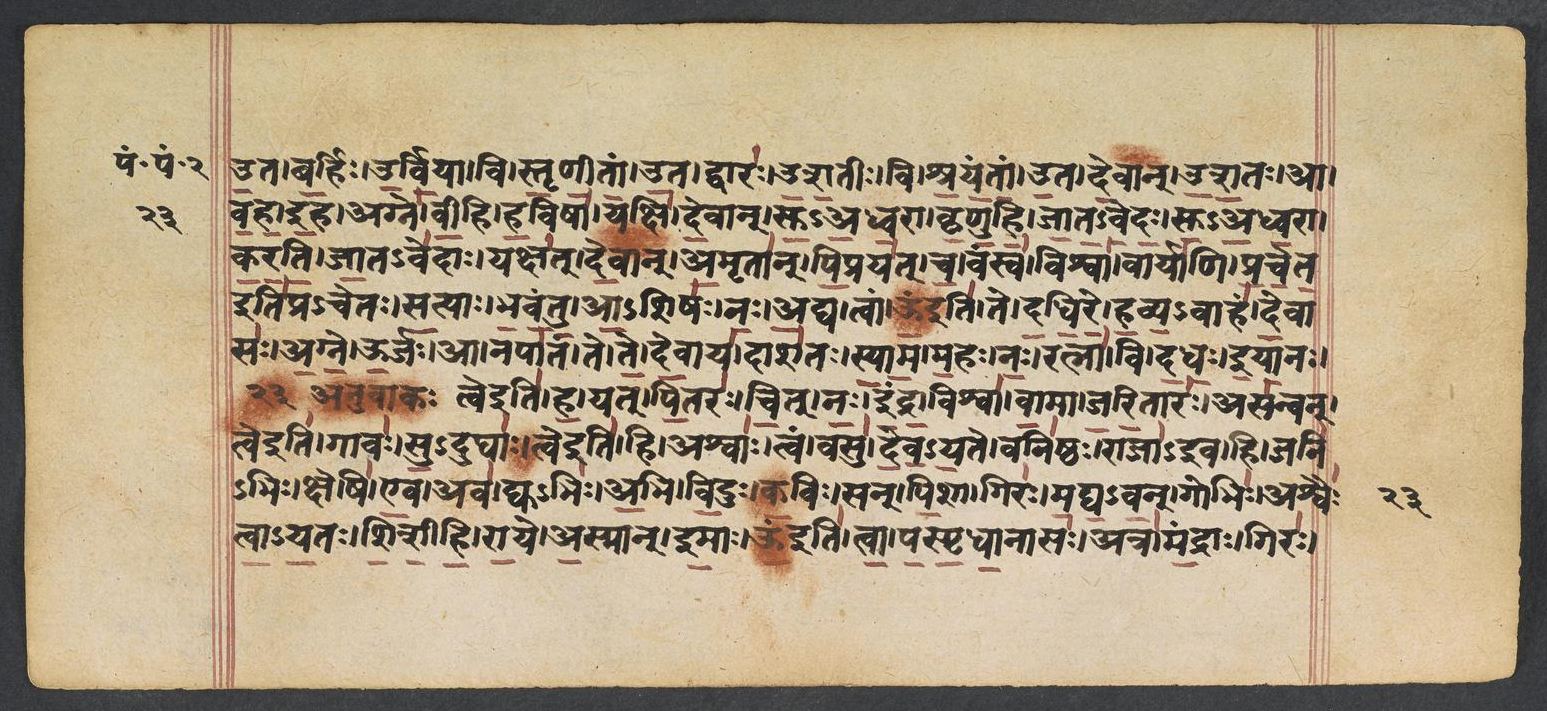
Where on the image
Penn Ms. Coll. 390 Item 41, fol. 502v (numbered 23v by the scribe) (OPenn image 503, upper leaf). Checked on the image: the Rigveda text on this page begins in RV 7.17.1 ‹uta barhiḥ urviyā vi›. The next page with Rigveda text, fol. 503r (numbered 24r by the scribe), begins in RV 7.18.3 ‹deva-yantīḥ upa sthuḥ arvācī›. Verses 7.17.1-7 end on this page; 7.17.1 begins on fol. 502r (numbered 23r by the scribe).
1agne̱ bhava̍ suṣa̱midhā̱ sami̍ddha u̱ta ba̱rhir u̍rvi̱yā vi stṛ̍ṇītām ||
2u̱ta dvāra̍ uśa̱tīr vi śra̍yantām u̱ta de̱vām̐ u̍śa̱ta ā va̍he̱ha ||
3agne̍ vī̱hi ha̱viṣā̱ yakṣi̍ de̱vān sva̍dhva̱rā kṛ̍ṇuhi jātavedaḥ ||
4sva̱dhva̱rā ka̍rati jā̱tave̍dā̱ yakṣa̍d de̱vām̐ a̱mṛtā̍n pi̱praya̍c ca ||
5vaṁsva̱ viśvā̱ vāryā̍ṇi pracetaḥ sa̱tyā bha̍vantv ā̱śiṣo̍ no a̱dya ||
6tvām u̱ te da̍dhire havya̱vāha̍ṁ de̱vāso̍ agna ū̱rja ā napā̍tam ||
7te te̍ de̱vāya̱ dāśa̍taḥ syāma ma̱ho no̱ ratnā̱ vi da̍dha iyā̱naḥ ||
Compare: Padapāṭha (word-by-word text written in the manuscript; Sansknet e-text via GRETIL)
1agne | bhava | su-samidhā | sam-iddhaḥ | uta | barhiḥ | urviyā | vi | stṛṇītām
2uta | dvāraḥ | uśatīḥ | vi | śrayantām | uta | devān | uśataḥ | ā | vaha | iha
3agne | vīhi | haviṣā | yakṣi | devān | su-adhvarā | kṛṇuhi | jāta-vedaḥ
4su-adhvarā | karati | jāta-vedāḥ | yakṣat | devān | amṛtān | piprayat | ca
5vaṃsva | viśvā | vāryāṇi | pracetaitipra-cetaḥ | satyāḥ | bhavantu | āśiṣaḥ | naḥ | adya
6tvām | oṃ iti | te | dadhire | havya-vāham | devāsaḥ | agne | ūrjaḥ | ā | napātam
7te | te | devāya | dāśataḥ | syāma | mahaḥ | naḥ | ratnā | vi | dadhaḥ | iyānaḥ
1AGNI, be kindled well with proper fuel, and let the grass be scattered wide about thee.
2Let the impatient Portals be thrown open bring thou the Gods impatient to come hither.
3Taste, Agni: serve the Gods with our oblation. Offer good sacrifices, Jâtavedas!
4Let Jâtavedas pay fair sacrifices, worship andgratify the Gods Immortal.
5Wise God, win for us things that are all-goodly, and let the prayers, we pray today be fruitful.
6Thee, even thee, the Son of Strength, O Agni, those Gods have made the bearer of oblations.
7To thee the God may we perform our worship: do thou, besought, grant us abundant riches.
Notes
- Sanskrit: Aufrecht's edition (1877) with the Vedic accents, as entered by van Nooten and Holland (GRETIL).
- English: Ralph T. H. Griffith, The Hymns of the Rigveda (1889-1892; 2nd ed. 1896-1897), from the VedaWeb digital text; OCR slips in that text were corrected against the printed 2nd edition (data/sources/rigveda/griffith_errata.json).
- Padapāṭha (edition text): Sansknet e-text via GRETIL (CC BY-NC-SA 4.0).
Cite
Sources
- Source: Penn Ms. Coll. 390 Item 41 (undated (catalogued with Penn's 18th-19th c. Vedic manuscripts)), OPenn, Public Domain Mark + Aufrecht's accented text (GRETIL) + Griffith's English (VedaWeb) (holding institution)
- Critical edition: Aufrecht (1877), accented e-text via GRETIL
← previous · → next · v cycle view · l back to library