Rigveda 7.22: To Indra
Introduction
Rigveda 7.22 is a hymn of 9 verses addressed to Indra. It stands in book (maṇḍala) 7, the family book of Vasiṣṭha. The Rigveda is the oldest collection of Sanskrit hymns, composed in the second half of the second millennium BCE and handed down orally for many centuries before it was written down.
The manuscript shown is Penn Ms. Coll. 390 Item 41 (University of Pennsylvania), an undated paper manuscript of the padapāṭha (the word-by-word recitation text, in which every word is written separately and compounds are split) of the whole Ṛgveda in Devanāgarī, 884 leaves in fascicles, 7-9 lines to the page, accents in red; this hymn stands on fol. 507v-508v. Each section below gives the verses that end on one page; the page boundaries were read on the images (the opening words of every page), not counted out. Where the manuscript is a padapāṭha (the word-by-word recitation text), the section shows Aufrecht's continuous (saṃhitā) text first and, as the edition text, the padapāṭha of the same verses, which is the form written on the page.
How was this verified? (Provenance)
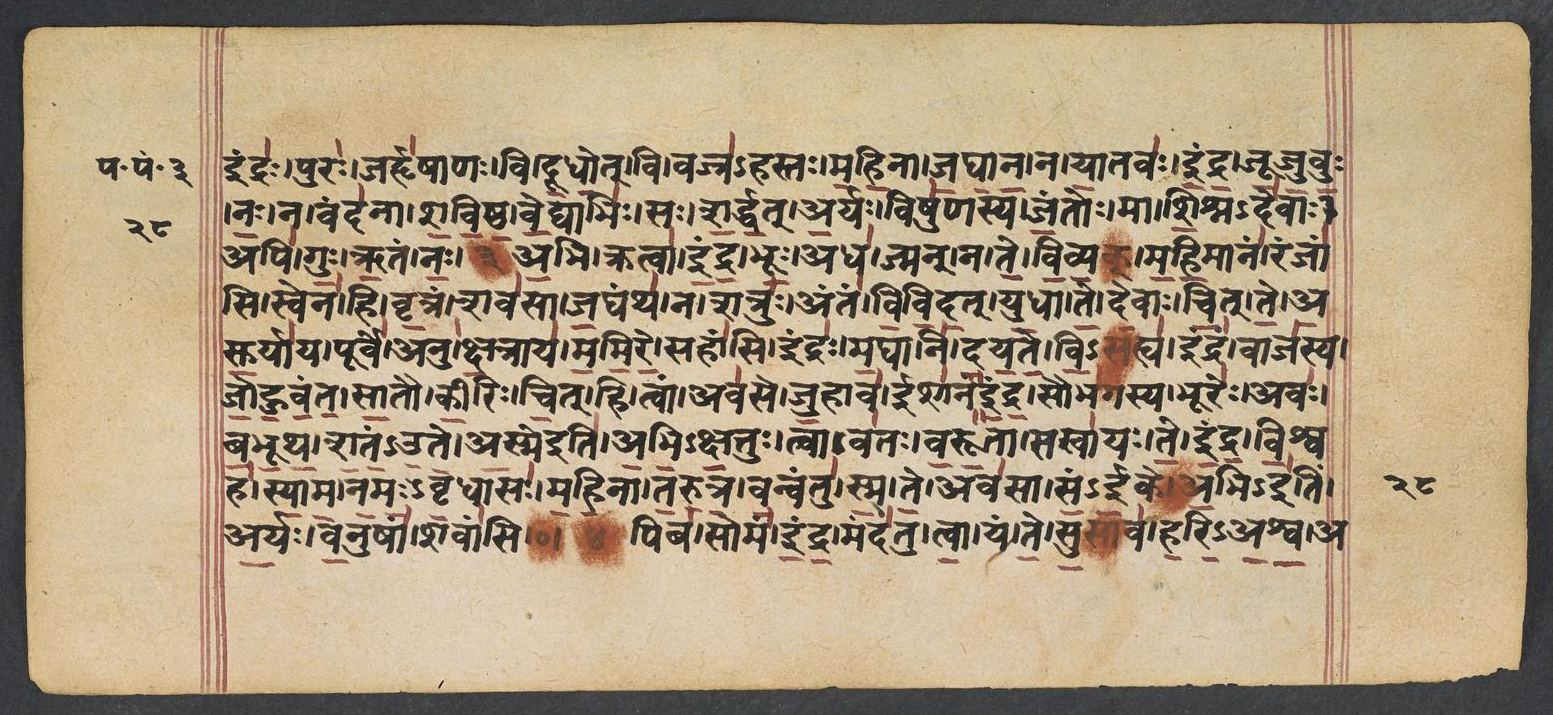
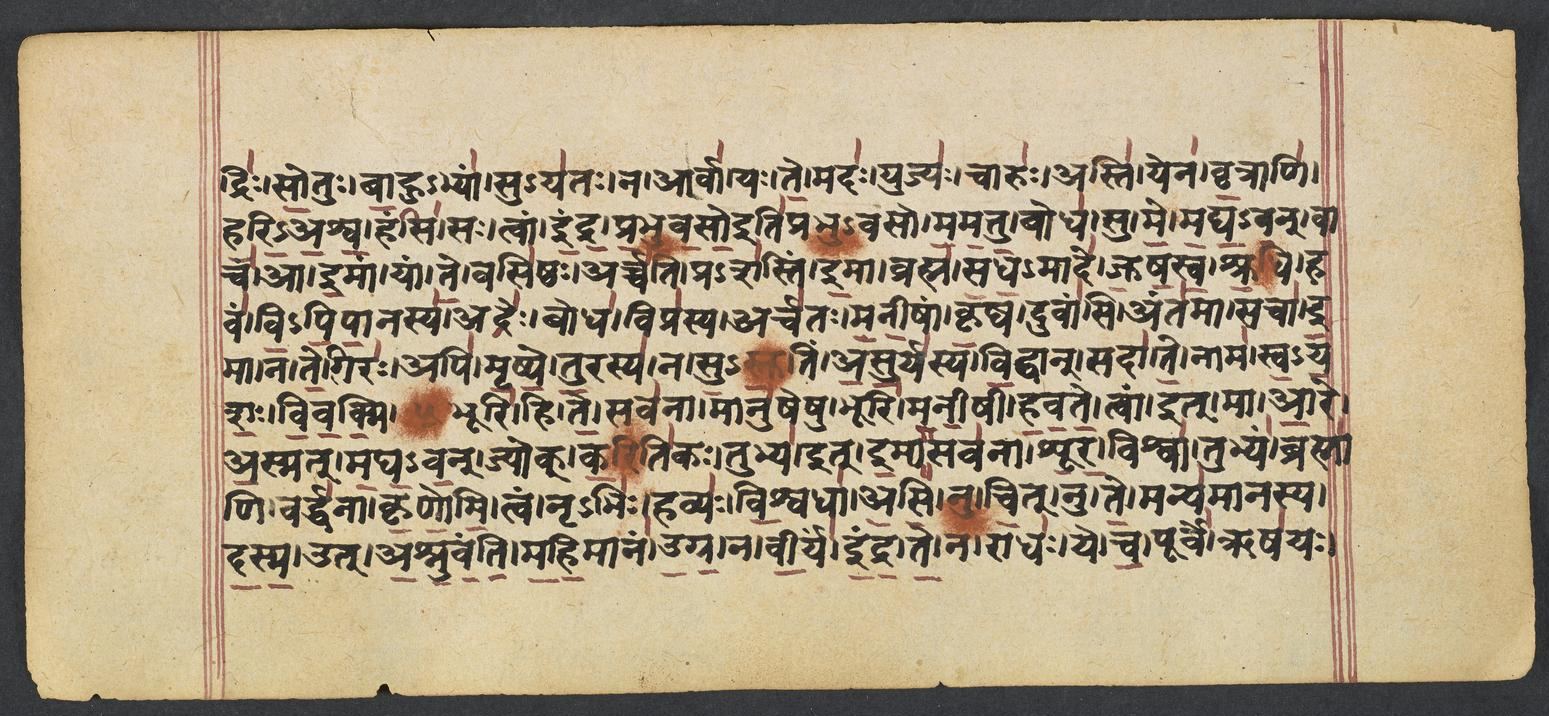
Where on the image
Penn Ms. Coll. 390 Item 41, fol. 508r (numbered 29r by the scribe) (OPenn image 508, lower leaf). Checked on the image: the Rigveda text on this page begins in RV 7.22.1 ‹-adriḥ sotuḥ bāhu-bhyām su-yataḥ›. The next page with Rigveda text, fol. 508v (numbered 29v by the scribe), begins in RV 7.22.9 ‹ye ca nūtnāḥ indra›. Verses 7.22.1-8 end on this page; 7.22.1 begins on fol. 507v (numbered 28v by the scribe).
1pibā̱ soma̍m indra̱ manda̍tu tvā̱ yaṁ te̍ su̱ṣāva̍ harya̱śvādri̍ḥ | so̱tur bā̱hubhyā̱ṁ suya̍to̱ nārvā̍ ||
2yas te̱ mado̱ yujya̱ś cāru̱r asti̱ yena̍ vṛ̱trāṇi̍ haryaśva̱ haṁsi̍ | sa tvām i̍ndra prabhūvaso mamattu ||
3bodhā̱ su me̍ maghava̱n vāca̱m emāṁ yāṁ te̱ vasi̍ṣṭho̱ arca̍ti̱ praśa̍stim | i̱mā brahma̍ sadha̱māde̍ juṣasva ||
4śru̱dhī hava̍ṁ vipipā̱nasyādre̱r bodhā̱ vipra̱syārca̍to manī̱ṣām | kṛ̱ṣvā duvā̱ṁsy anta̍mā̱ sace̱mā ||
5na te̱ giro̱ api̍ mṛṣye tu̱rasya̱ na su̍ṣṭu̱tim a̍su̱rya̍sya vi̱dvān | sadā̍ te̱ nāma̍ svayaśo vivakmi ||
6bhūri̱ hi te̱ sava̍nā̱ mānu̍ṣeṣu̱ bhūri̍ manī̱ṣī ha̍vate̱ tvām it | māre a̱sman ma̍ghava̱ñ jyok ka̍ḥ ||
7tubhyed i̱mā sava̍nā śūra̱ viśvā̱ tubhya̱m brahmā̍ṇi̱ vardha̍nā kṛṇomi | tvaṁ nṛbhi̱r havyo̍ vi̱śvadhā̍si ||
8nū ci̱n nu te̱ manya̍mānasya da̱smod a̍śnuvanti mahi̱māna̍m ugra | na vī̱rya̍m indra te̱ na rādha̍ḥ ||
Compare: Padapāṭha (word-by-word text written in the manuscript; Sansknet e-text via GRETIL)
1piba | somam | indra | mandatu | tvā | yam | te | susāva | hari-aśva | adriḥ | sotuḥ | bāhu-bhyām | su-yataḥ | na | arvā
2yaḥ | te | madaḥ | yujyaḥ | cāruḥ | asti | yena | vṛtrāṇi | hari-aśva | haṃsi | saḥ | tvām | indra | prabhuvaso itiprabhu-vaso | mamattu
3bodha | su | me | magha-van | vācam | ā | imām | yām | te | vasiṣṭhaḥ | arcati | pra-śastim | imā | brahma | sadha-māde | juṣasva
4śrudhi | havam | vi-pipānasya | adreḥ | bodha | viprasya | arcataḥ | manīṣām | kṛṣva | duvāṃsi | antamā | sacā | imā
5na | te | giraḥ | api | mṛṣye | turasya | na | su-stutim | asuryasya | vidvān | sadā | te | nāma | sva-yaśaḥ | vivakmi
6bhūri | hi | te | savanā | mānuṣeṣu | bhūri | manīṣī | havate | tvām | it | mā | āre | asmat | magha-van | jyok | karitikaḥ
7tubhya | it | imā | savanā | śūra | viśvā | tubhyam | brahmāṇi | vardhanā | kṛṇomi | tvam | nṛ-bhiḥ | havyaḥ | viśvadhā | asi
8nu | cit | nu | te | manyamānasya | dasma | ut | aśnuvanti | mahimānam | ugra | na | vīryam | indra | te | na | rādhaḥ
1DRINK Soma, Lord of Bays, and let it cheer thee: Indra, the stone, like a well guided courser, Directed by the presser's arms hath pressed it.
2So let the draught of joy, thy dear companion, by which, O Lord of Bays, thou slayest foemen, Delight thee, Indra, Lord of princely treasures.
3Mark closely, Maghavan, the words I utter, this eulogy recited by Vasishṭha: Accept the prayers I offer at thy banquet.
4Hear thou the call of the juice-drinking press-stone: hear thou the Brahman's hymn who sings and lauds thee. Take to thine inmost self these adorations.
5I know and ne'er forget the hymns and praises of thee, the Conqueror, and thy strength immortal. Thy name I ever utter. Self-Refulgent
6Among mankind many are thy libations, and many a time the pious sageinvokes thee. O Maghavan, be not long distant from us.
7All these libations are for thee, O Hero: to thee I offer these my prayers. that strengthen. Ever, in every place, must men invoke thee.
8Never do men attain, O Wonder-Worker, thy greatness, Mighty One, who must be lauded, Nor, Indra, thine heroic power and bounty.
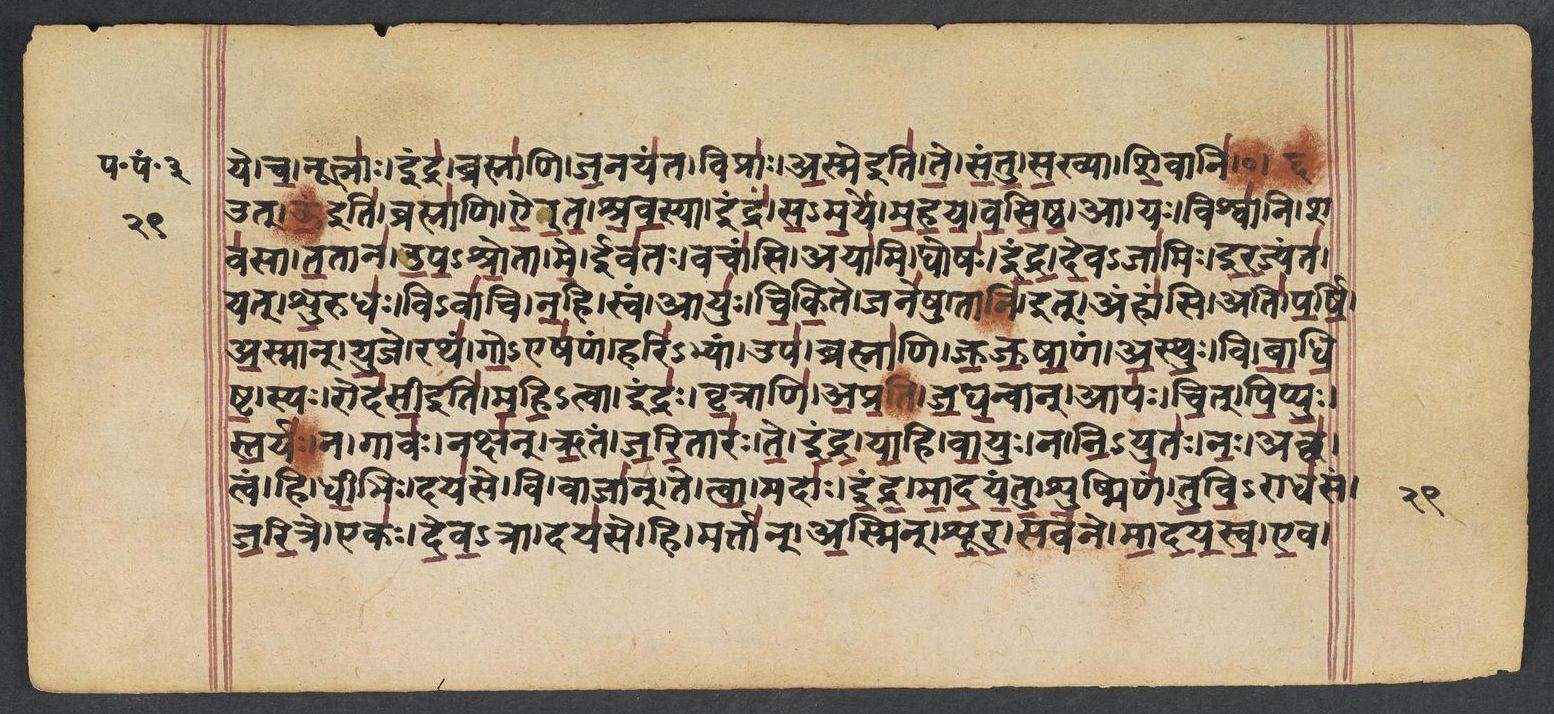
Where on the image
Penn Ms. Coll. 390 Item 41, fol. 508v (numbered 29v by the scribe) (OPenn image 509, upper leaf). Checked on the image: the Rigveda text on this page begins in RV 7.22.9 ‹ye ca nūtnāḥ indra›. The next page with Rigveda text, fol. 509r (numbered 30r by the scribe), begins in RV 7.23.6 ‹it indram vṛṣaṇam vajra-bāhum›. Verse 7.22.9 ends on this page; 7.22.9 begins on fol. 508r (numbered 29r by the scribe).
9ye ca̱ pūrva̱ ṛṣa̍yo̱ ye ca̱ nūtnā̱ indra̱ brahmā̍ṇi ja̱naya̍nta̱ viprā̍ḥ | a̱sme te̍ santu sa̱khyā śi̱vāni̍ yū̱yam pā̍ta sva̱stibhi̱ḥ sadā̍ naḥ ||
Compare: Padapāṭha (word-by-word text written in the manuscript; Sansknet e-text via GRETIL)
9ye | ca | pūrve | ṛṣayaḥ | ye | ca | nūtnāḥ | indra | brahmāṇi | janayanta | viprāḥ | asme iti | te | santu | sakhyā | śivāni | yūyam | pāta | svasti-bhiḥ | sadā | naḥ
9Among all R̥ishis, Indra, old and recent, who have engendered hymns as sacred singers, Even with us be thine auspicious friendships. Ye Gods, preserve us evermore with blessings.
Notes
- Sanskrit: Aufrecht's edition (1877) with the Vedic accents, as entered by van Nooten and Holland (GRETIL).
- English: Ralph T. H. Griffith, The Hymns of the Rigveda (1889-1892; 2nd ed. 1896-1897), from the VedaWeb digital text; OCR slips in that text were corrected against the printed 2nd edition (data/sources/rigveda/griffith_errata.json).
- Padapāṭha (edition text): Sansknet e-text via GRETIL (CC BY-NC-SA 4.0).
Cite
Sources
- Source: Penn Ms. Coll. 390 Item 41 (undated (catalogued with Penn's 18th-19th c. Vedic manuscripts)), OPenn, Public Domain Mark + Aufrecht's accented text (GRETIL) + Griffith's English (VedaWeb) (holding institution)
- Critical edition: Aufrecht (1877), accented e-text via GRETIL
← previous · → next · v cycle view · l back to library