Rigveda 7.25: To Indra
Introduction
Rigveda 7.25 is a hymn of 6 verses addressed to Indra. It stands in book (maṇḍala) 7, the family book of Vasiṣṭha. The Rigveda is the oldest collection of Sanskrit hymns, composed in the second half of the second millennium BCE and handed down orally for many centuries before it was written down.
The manuscript shown is Penn Ms. Coll. 390 Item 41 (University of Pennsylvania), an undated paper manuscript of the padapāṭha (the word-by-word recitation text, in which every word is written separately and compounds are split) of the whole Ṛgveda in Devanāgarī, 884 leaves in fascicles, 7-9 lines to the page, accents in red; this hymn stands on fol. 509v. Each section below gives the verses that end on one page; the page boundaries were read on the images (the opening words of every page), not counted out. Where the manuscript is a padapāṭha (the word-by-word recitation text), the section shows Aufrecht's continuous (saṃhitā) text first and, as the edition text, the padapāṭha of the same verses, which is the form written on the page.
How was this verified? (Provenance)
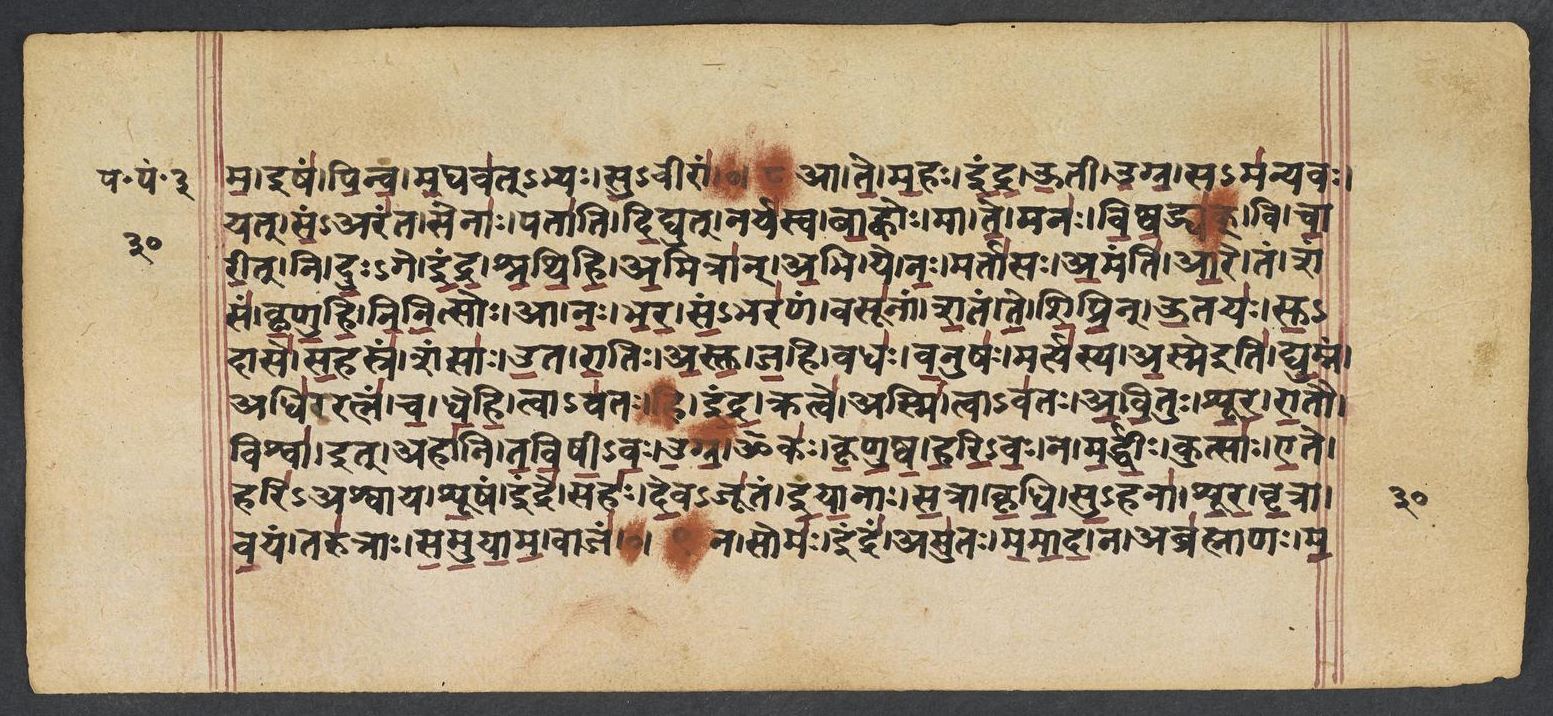
Where on the image
Penn Ms. Coll. 390 Item 41, fol. 509v (numbered 30v by the scribe) (OPenn image 510, upper leaf). Checked on the image: the Rigveda text on this page begins in RV 7.24.6 ‹-vevidāma iṣam pinva maghavat-bhyaḥ›. The next page with Rigveda text, fol. 510r (numbered 31r by the scribe), begins in RV 7.26.1 ‹-magha-vānam sutāsaḥ tasmai uktham›. Verses 7.25.1-6 end on this page.
1ā te̍ ma̱ha i̍ndro̱ty u̍gra̱ sama̍nyavo̱ yat sa̱mara̍nta̱ senā̍ḥ | patā̍ti di̱dyun narya̍sya bā̱hvor mā te̱ mano̍ viṣva̱drya1̱̍g vi cā̍rīt ||
2ni du̱rga i̍ndra śnathihy a̱mitrā̍m̐ a̱bhi ye no̱ martā̍so a̱manti̍ | ā̱re taṁ śaṁsa̍ṁ kṛṇuhi nini̱tsor ā no̍ bhara sa̱mbhara̍ṇa̱ṁ vasū̍nām ||
3śa̱taṁ te̍ śiprinn ū̱taya̍ḥ su̱dāse̍ sa̱hasra̱ṁ śaṁsā̍ u̱ta rā̱tir a̍stu | ja̱hi vadha̍r va̱nuṣo̱ martya̍syā̱sme dyu̱mnam adhi̱ ratna̍ṁ ca dhehi ||
4tvāva̍to̱ hī̍ndra̱ kratve̱ asmi̱ tvāva̍to 'vi̱tuḥ śū̍ra rā̱tau | viśved ahā̍ni taviṣīva ugra̱m̐ oka̍ḥ kṛṇuṣva harivo̱ na ma̍rdhīḥ ||
5kutsā̍ e̱te harya̍śvāya śū̱ṣam indre̱ saho̍ de̱vajū̍tam iyā̱nāḥ | sa̱trā kṛ̍dhi su̱hanā̍ śūra vṛ̱trā va̱yaṁ taru̍trāḥ sanuyāma̱ vāja̍m ||
6e̱vā na̍ indra̱ vārya̍sya pūrdhi̱ pra te̍ ma̱hīṁ su̍ma̱tiṁ ve̍vidāma | iṣa̍m pinva ma̱ghava̍dbhyaḥ su̱vīrā̍ṁ yū̱yam pā̍ta sva̱stibhi̱ḥ sadā̍ naḥ ||
Compare: Padapāṭha (word-by-word text written in the manuscript; Sansknet e-text via GRETIL)
1ā | te | mahaḥ | indra | ūtī | ugra | sa-manyavaḥ | yat | sam-aranta | senāḥ | patāti | didyut | naryasya | bāhvoḥ | mā | te | manaḥ | viṣvadryak | vi | cārīt
2ni | duḥ-ge | indra | śnathihi | amitrān | abhi | ye | naḥ | martāsaḥ | amanti | āre | tam | śaṃsam | kṛṇuhi | ninitsoḥ | ā | naḥ | bhara | sam-bharaṇam | vasūnām
3śatam | te | śiprin | ūtayaḥ | su-dāse | sahasram | śaṃsāḥ | uta | rātiḥ | astu | jahi | vadhaḥ | vanuṣaḥ | martyasys | asme iti | dyumnam | adhi | ratnam | ca | dhehi
4tvāvataḥ | hi | indra | kratve | asmi | tvāvataḥ | avituḥ | śūra | rātau | viśvā | it | ahāni | taviṣī-vaḥ | ugra | okaḥ | kṛṇuṣva | hari-vaḥ | na | mardhīḥ
5kutsā | ete | haryi-aśvāya | śūṣam | indre | sahaḥ | deva-jūtam | iyānāḥ | satrā | kṛdhi | su-hanā | śūra | vṛtrā | vayam | tarutrāḥ | sanuyāma | vājam
6eva | naḥ | indra | vāryasya | pūrdhi | pra | te | mahīm | su-matim | vevidāma | iṣam | pinva | maghavat-bhyaḥ | su-vīrām | yūyam | pāta | svasti-bhiḥ | sadā | naḥ
1WHEN with thy mighty help, O potent Indra, the armies rush together in their fury. When from the strong man's arm the lightning flieth, let not thy mind go forth to side with others.
2O Indra, where the ground is hard to traverse, smite down our foes, the mortals who assail us, Keep far from us the curse of the reviler: bring us accumulated store of treasures.
3God of the fair helm, give Sudâs a hundred succours, a thousand blessings, and thy bounty. Strike down the weapon of our mortal foeman: bestow upon us splendid fame and riches.
4I wait the power of one like thee, O Indra, gifts of a Helper such as thou art, Hero. Strong, Mighty God, dwell with me now and ever: Lord of Bay Horses, do not thou desert us.
5Here are the Kutsas supplicating Indra for might, the Lord of Bays for God-sent conquest. Make our foes ever easy to be vanquished: may we, victorious, win the spoil, O Hero.
6With precious things, O Indra, thus content us: may we attain to thine exalted favour. Send our chiefs plenteous food with hero children. Preserve us evermore, ye Gods, with blessings.
Notes
- Sanskrit: Aufrecht's edition (1877) with the Vedic accents, as entered by van Nooten and Holland (GRETIL).
- English: Ralph T. H. Griffith, The Hymns of the Rigveda (1889-1892; 2nd ed. 1896-1897), from the VedaWeb digital text; OCR slips in that text were corrected against the printed 2nd edition (data/sources/rigveda/griffith_errata.json).
- Padapāṭha (edition text): Sansknet e-text via GRETIL (CC BY-NC-SA 4.0).
Cite
Sources
- Source: Penn Ms. Coll. 390 Item 41 (undated (catalogued with Penn's 18th-19th c. Vedic manuscripts)), OPenn, Public Domain Mark + Aufrecht's accented text (GRETIL) + Griffith's English (VedaWeb) (holding institution)
- Critical edition: Aufrecht (1877), accented e-text via GRETIL
← previous · → next · v cycle view · l back to library