Rigveda 7.26: To Indra
Introduction
Rigveda 7.26 is a hymn of 5 verses addressed to Indra. It stands in book (maṇḍala) 7, the family book of Vasiṣṭha. The Rigveda is the oldest collection of Sanskrit hymns, composed in the second half of the second millennium BCE and handed down orally for many centuries before it was written down.
The manuscript shown is Penn Ms. Coll. 390 Item 41 (University of Pennsylvania), an undated paper manuscript of the padapāṭha (the word-by-word recitation text, in which every word is written separately and compounds are split) of the whole Ṛgveda in Devanāgarī, 884 leaves in fascicles, 7-9 lines to the page, accents in red; this hymn stands on fol. 509v-510r. Each section below gives the verses that end on one page; the page boundaries were read on the images (the opening words of every page), not counted out. Where the manuscript is a padapāṭha (the word-by-word recitation text), the section shows Aufrecht's continuous (saṃhitā) text first and, as the edition text, the padapāṭha of the same verses, which is the form written on the page.
How was this verified? (Provenance)
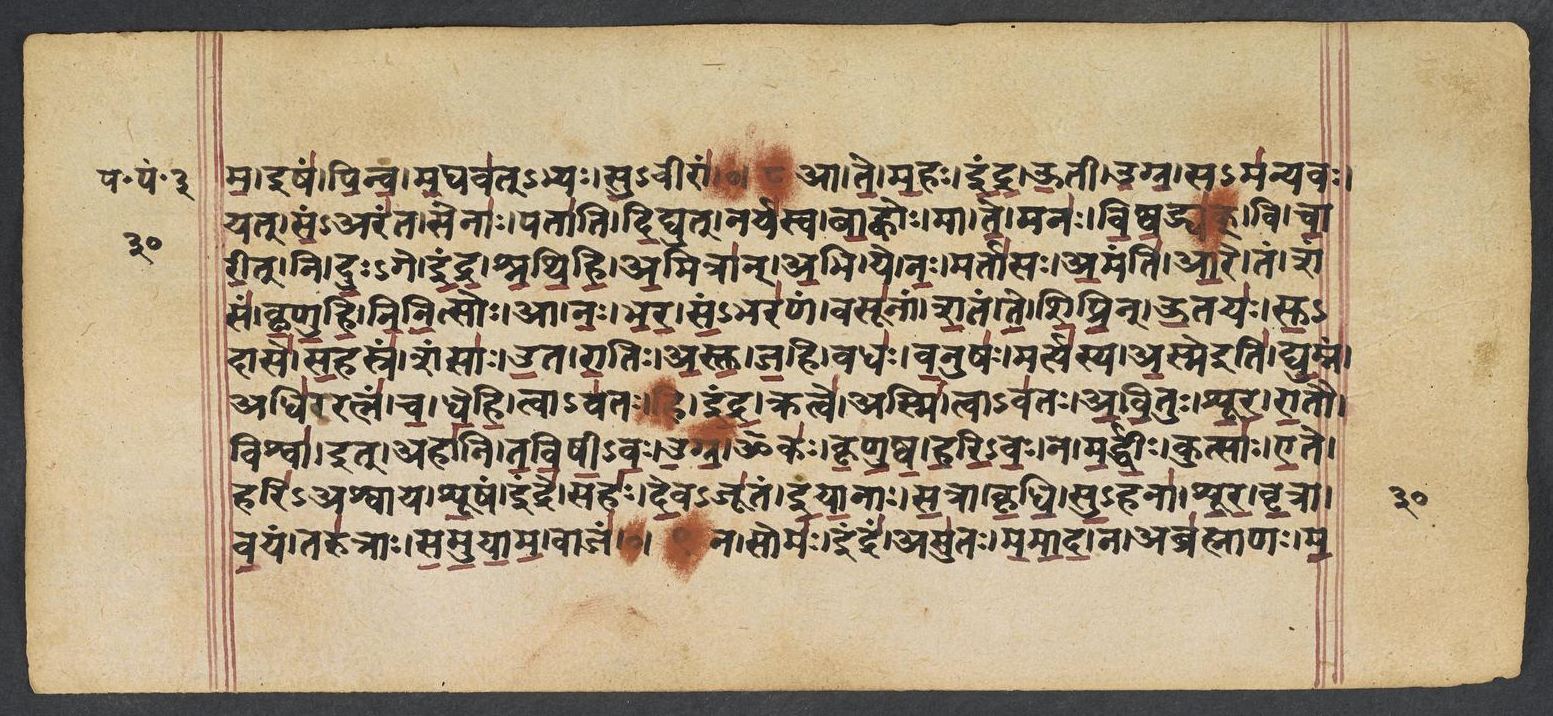
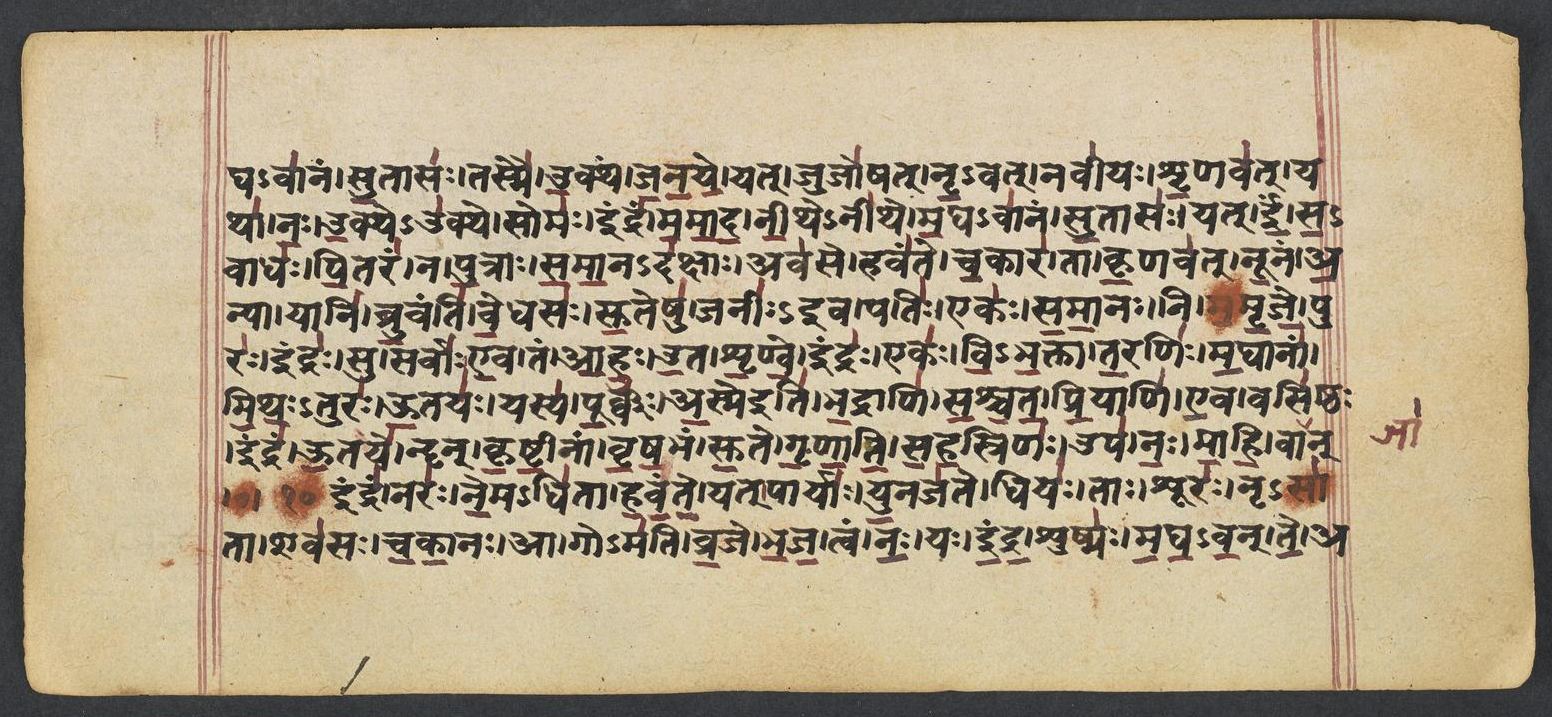
Where on the image
Penn Ms. Coll. 390 Item 41, fol. 510r (numbered 31r by the scribe) (OPenn image 510, lower leaf). Checked on the image: the Rigveda text on this page begins in RV 7.26.1 ‹-magha-vānam sutāsaḥ tasmai uktham›. The next page with Rigveda text, fol. 510v (numbered 31v by the scribe), begins in RV 7.27.2 ‹-asti śikṣa sakhi-bhyaḥ puru-hūta›. Verses 7.26.1-5 end on this page; 7.26.1 begins on fol. 509v (numbered 30v by the scribe).
1na soma̱ indra̱m asu̍to mamāda̱ nābra̍hmāṇo ma̱ghavā̍naṁ su̱tāsa̍ḥ | tasmā̍ u̱kthaṁ ja̍naye̱ yaj jujo̍ṣan nṛ̱van navī̍yaḥ śṛ̱ṇava̱d yathā̍ naḥ ||
2u̱ktha-u̍kthe̱ soma̱ indra̍m mamāda nī̱the-nī̍the ma̱ghavā̍naṁ su̱tāsa̍ḥ | yad ī̍ṁ sa̱bādha̍ḥ pi̱tara̱ṁ na pu̱trāḥ sa̍mā̱nada̍kṣā̱ ava̍se̱ hava̍nte ||
3ca̱kāra̱ tā kṛ̱ṇava̍n nū̱nam a̱nyā yāni̍ bru̱vanti̍ ve̱dhasa̍ḥ su̱teṣu̍ | janī̍r iva̱ pati̱r eka̍ḥ samā̱no ni mā̍mṛje̱ pura̱ indra̱ḥ su sarvā̍ḥ ||
4e̱vā tam ā̍hur u̱ta śṛ̍ṇva̱ indra̱ eko̍ vibha̱ktā ta̱raṇi̍r ma̱ghānā̍m | mi̱tha̱stura̍ ū̱tayo̱ yasya̍ pū̱rvīr a̱sme bha̱drāṇi̍ saścata pri̱yāṇi̍ ||
5e̱vā vasi̍ṣṭha̱ indra̍m ū̱taye̱ nṝn kṛ̍ṣṭī̱nāṁ vṛ̍ṣa̱bhaṁ su̱te gṛ̍ṇāti | sa̱ha̱sriṇa̱ upa̍ no māhi̱ vājā̍n yū̱yam pā̍ta sva̱stibhi̱ḥ sadā̍ naḥ ||
Compare: Padapāṭha (word-by-word text written in the manuscript; Sansknet e-text via GRETIL)
1na | somaḥ | indram | asutaḥ | mamāda | na | abrahmāṇaḥ | magha-vānam | sutāsaḥ | tasmai | uktham | janaye | yat | jujoṣat | nṛ-vat | navīyaḥ | śṛṇavat | yathā | naḥ
2ukthe--ukthe | somaḥ | indram | mamāda | nīthe--nīthe | magha-vānam | sutāsaḥ | yat | īm | sa-bādhaḥ | pitaram | na | putrāḥ | samāna-dakṣāḥ | avase | havante
3cakāra | tā | kṛṇavat | nūnam | anyā | yāni | bruvanti | vedhasaḥ | suteṣu | janīḥ-iva | patiḥ | ekaḥ | samānaḥ | ni | mamṛje | puraḥ | indraḥ | su | sarvāḥ
4eva | tam | āhuḥ | uta | śṛṇve | indraḥ | ekaḥ | vi-bhaktā | taraṇiḥ | maghānām | mithaḥ-turaḥ | ūtayaḥ | yasya | pūrvīḥ | asme iti | bhadrāṇi | saścata | priyāṇi
5eva | vasiṣṭhaḥ | indram | ūtaye | nṝn | kṛṣṭīnām | vṛṣabham | sute | gṛṇāti | sahasr iṇaḥ | upa | naḥ | māhi | vājān | yūyam | pāta | svasti-bhiḥ | sadā | naḥ
1SOMA unpressed ne'er gladdened liberal Indra, no juices pressed without a prayer have pleased him. I generate a laud that shall delight him, new and heroic, so that he may hear us.
2At every laud the Soma gladdens Indra: pressed juices please him as each psalm is chanted, What time the priests with one united effort call him to aid, as sons invoke their father.
3These deeds he did; let him achieve new exploits, such as the priests declare at their libations. Indra hath taken and possessed all castles, like as one common husband doth his spouses.
4Even thus have they declared him. Famed is Indra as Conqueror, sole distributer of treasures; Whose many succours come in close succession. May dear delightful benefits attend us.
5Thus, to bring help to men, Vasishṭha laudeth Indra, the peoples' Hero, at libation. Bestow upon us strength and wealth in thousands. Preserve us evermore, ye Gods, with blessings.
Notes
- Sanskrit: Aufrecht's edition (1877) with the Vedic accents, as entered by van Nooten and Holland (GRETIL).
- English: Ralph T. H. Griffith, The Hymns of the Rigveda (1889-1892; 2nd ed. 1896-1897), from the VedaWeb digital text; OCR slips in that text were corrected against the printed 2nd edition (data/sources/rigveda/griffith_errata.json).
- Padapāṭha (edition text): Sansknet e-text via GRETIL (CC BY-NC-SA 4.0).
Cite
Sources
- Source: Penn Ms. Coll. 390 Item 41 (undated (catalogued with Penn's 18th-19th c. Vedic manuscripts)), OPenn, Public Domain Mark + Aufrecht's accented text (GRETIL) + Griffith's English (VedaWeb) (holding institution)
- Critical edition: Aufrecht (1877), accented e-text via GRETIL
← previous · → next · v cycle view · l back to library