Rigveda 7.27: To Indra
Introduction
Rigveda 7.27 is a hymn of 5 verses addressed to Indra. It stands in book (maṇḍala) 7, the family book of Vasiṣṭha. The Rigveda is the oldest collection of Sanskrit hymns, composed in the second half of the second millennium BCE and handed down orally for many centuries before it was written down.
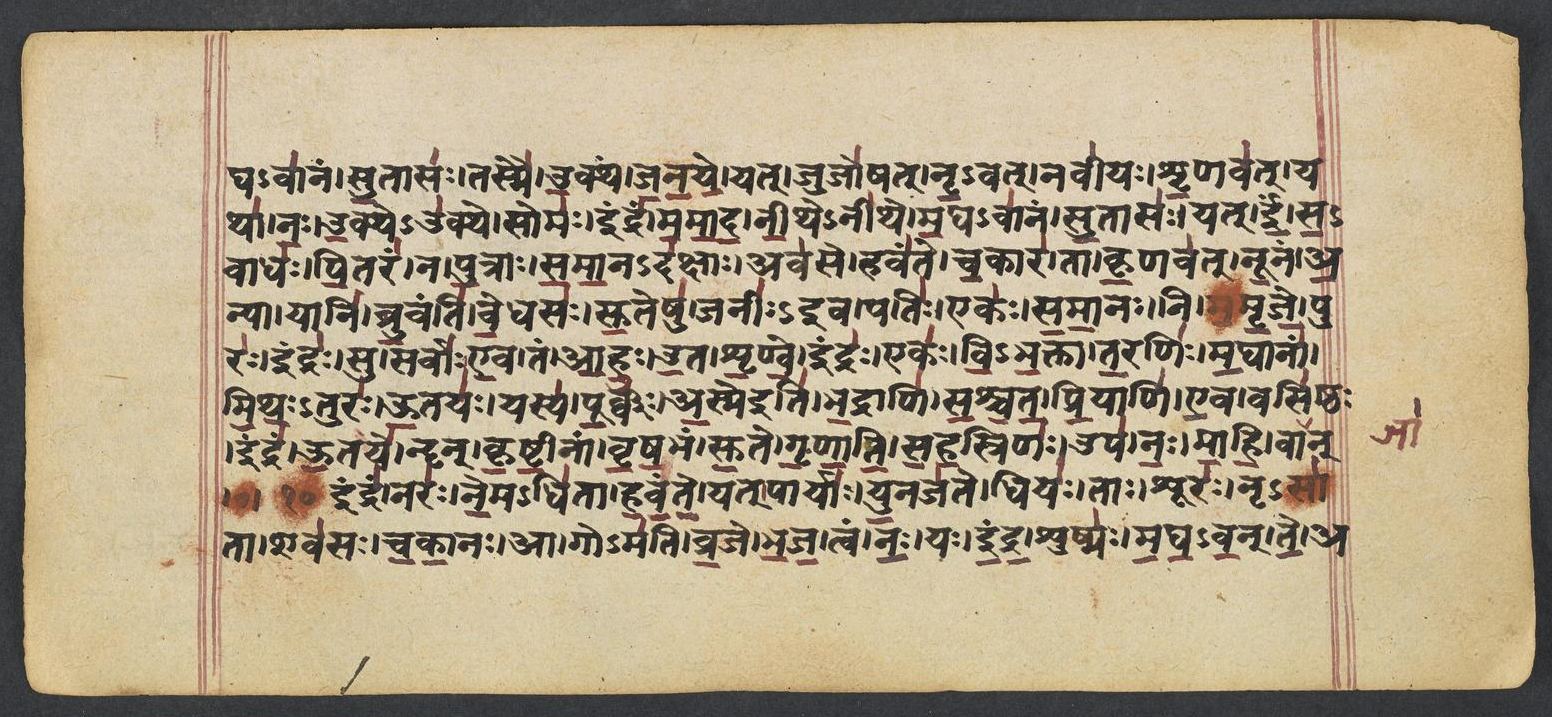
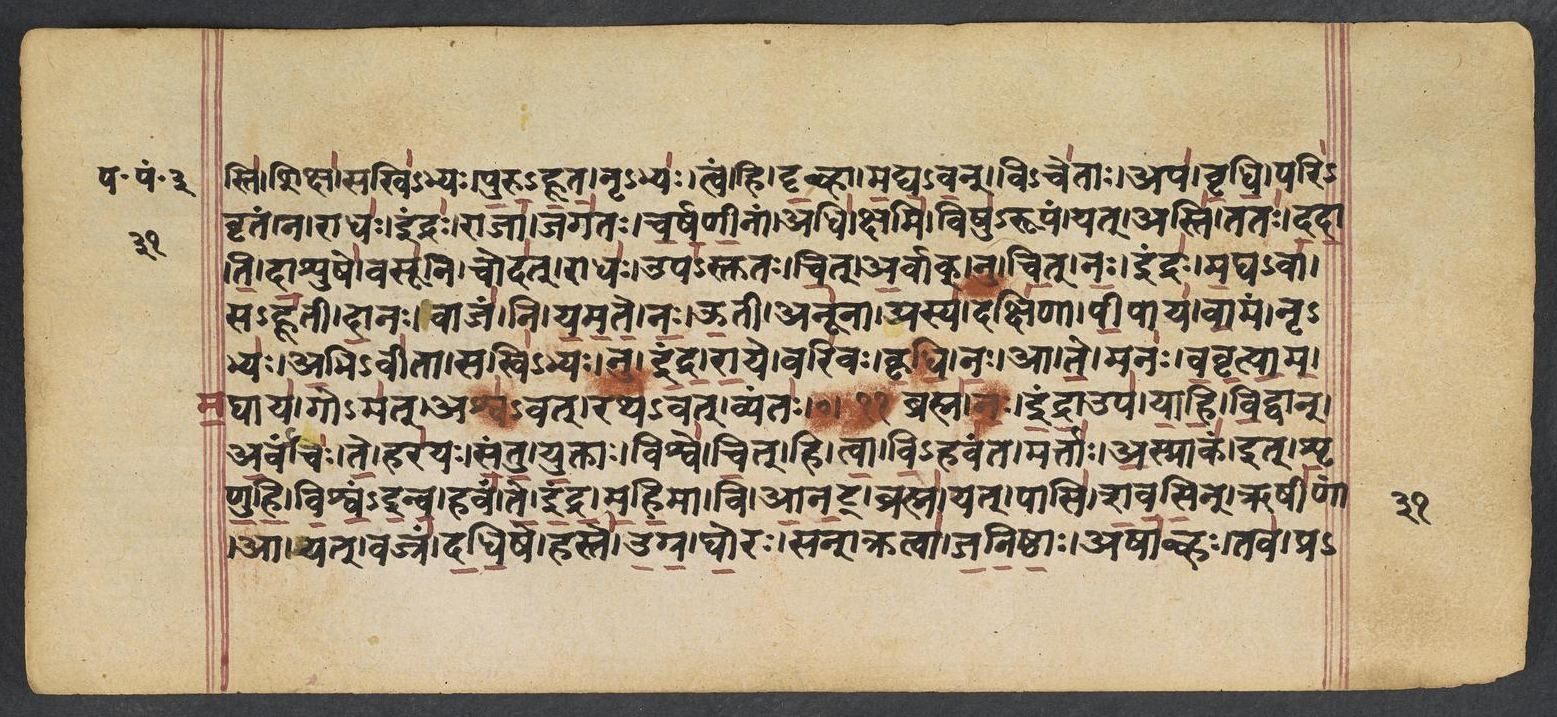
The manuscript shown is Penn Ms. Coll. 390 Item 41 (University of Pennsylvania), an undated paper manuscript of the padapāṭha (the word-by-word recitation text, in which every word is written separately and compounds are split) of the whole Ṛgveda in Devanāgarī, 884 leaves in fascicles, 7-9 lines to the page, accents in red; this hymn stands on fol. 510r-510v. Each section below gives the verses that end on one page; the page boundaries were read on the images (the opening words of every page), not counted out. Where the manuscript is a padapāṭha (the word-by-word recitation text), the section shows Aufrecht's continuous (saṃhitā) text first and, as the edition text, the padapāṭha of the same verses, which is the form written on the page.
How was this verified? (Provenance)
Where on the image
Penn Ms. Coll. 390 Item 41, fol. 510r (numbered 31r by the scribe) (OPenn image 510, lower leaf). Checked on the image: the Rigveda text on this page begins in RV 7.26.1 ‹-magha-vānam sutāsaḥ tasmai uktham›. The next page with Rigveda text, fol. 510v (numbered 31v by the scribe), begins in RV 7.27.2 ‹-asti śikṣa sakhi-bhyaḥ puru-hūta›. Verse 7.27.1 ends on this page.
1indra̱ṁ naro̍ ne̱madhi̍tā havante̱ yat pāryā̍ yu̱naja̍te̱ dhiya̱s tāḥ | śūro̱ nṛṣā̍tā̱ śava̍saś cakā̱na ā goma̍ti vra̱je bha̍jā̱ tvaṁ na̍ḥ ||
Compare: Padapāṭha (word-by-word text written in the manuscript; Sansknet e-text via GRETIL)
1indram | naraḥ | nema-dhitā | havante | yat | pāryāḥ | yunajate | dhiyaḥ | tāḥ | śūraḥ | nṛ-sātā | śavasaḥ | cakānaḥ | ā | gomati | vraje | bhaja | tvam | naḥ
1MEN call on Indra in the armed encounter that he may make the hymns they sing decisive. Hero, rejoicing in thy might, in combat give us a portion of the stall of cattle,
Where on the image
Penn Ms. Coll. 390 Item 41, fol. 510v (numbered 31v by the scribe) (OPenn image 511, upper leaf). Checked on the image: the Rigveda text on this page begins in RV 7.27.2 ‹-asti śikṣa sakhi-bhyaḥ puru-hūta›. The next page with Rigveda text, fol. 511r (numbered 32r by the scribe), begins in RV 7.28.3 ‹-pra-nītī indra johuvānān sam›. Verses 7.27.2-5 end on this page; 7.27.2 begins on fol. 510r (numbered 31r by the scribe).
2ya i̍ndra̱ śuṣmo̍ maghavan te̱ asti̱ śikṣā̱ sakhi̍bhyaḥ puruhūta̱ nṛbhya̍ḥ | tvaṁ hi dṛ̱ḻhā ma̍ghava̱n vice̍tā̱ apā̍ vṛdhi̱ pari̍vṛta̱ṁ na rādha̍ḥ ||
3indro̱ rājā̱ jaga̍taś carṣaṇī̱nām adhi̱ kṣami̱ viṣu̍rūpa̱ṁ yad asti̍ | tato̍ dadāti dā̱śuṣe̱ vasū̍ni̱ coda̱d rādha̱ upa̍stutaś cid a̱rvāk ||
4nū ci̍n na̱ indro̍ ma̱ghavā̱ sahū̍tī dā̱no vāja̱ṁ ni ya̍mate na ū̱tī | anū̍nā̱ yasya̱ dakṣi̍ṇā pī̱pāya̍ vā̱maṁ nṛbhyo̍ a̱bhivī̍tā̱ sakhi̍bhyaḥ ||
5nū i̍ndra rā̱ye vari̍vas kṛdhī na̱ ā te̱ mano̍ vavṛtyāma ma̱ghāya̍ | goma̱d aśvā̍va̱d ratha̍va̱d vyanto̍ yū̱yam pā̍ta sva̱stibhi̱ḥ sadā̍ naḥ ||
Compare: Padapāṭha (word-by-word text written in the manuscript; Sansknet e-text via GRETIL)
2yaḥ | indra | śuṣmaḥ | magha-van | te | asti | śikṣa | sakhi-bhyaḥ | puru-hūta | nṛ-bhyaḥ | tvam | hi | dṛḷhā | magha-van | vi-cetāḥ | apa | vṛdhi | pari-vṛtam | na | rādhaḥ
3indraḥ | rājā | jagataḥ | carṣaṇīnām | adhi | kṣami | viṣu-rūpam | yat | asti | tataḥ | dadāti | dāśuṣe | vasūni | codat | rādhaḥ | upa-stutaḥ | cit | arvāk
4nu | cit | naḥ | indraḥ | magha-vā | sa-hūtī | dānaḥ | vājam | ni | yamate | naḥ | ūtī | anūnā | yasya | dakṣiṇā | pīpāya | vāmam | nṛ-bhyaḥ | abhi-vītā | sakhi-bhyaḥ
5nu | indra | rāye | varivaḥ | kṛdhi | naḥ | ā | te | manaḥ | vavṛtyāma | maghāya | go--mat | aśva-vat | ratha-vat | vyantaḥ | yūyam | pāta | svasti-bhiḥ | sadā | naḥ
2Grant, Indra Maghavan, invoked of many, to these my friends the strength which thou possessest. Thou, Maghavan, hast rent strong places open: unclose for us, Wise God, thy hidden bounty.
3King of the living world, of men, is Indra, of all in varied form that earth containeth. Thence to the worshipper he giveth riches: may he enrich us also when we laud him.
4Maghavan Indra, when we all invoke him, bountiful ever sendeth strength to aid us: Whose perfect guerdon, never failing, bringeth wealth to the men, to friends the thing they covet.
5Quick, Indra, give us room and way to riches, and let us bring thy mind to grant us treasures, That we may win us cars and Steeds and cattle. Preserve us evermore, ye Gods, with blessings.
Notes
- Sanskrit: Aufrecht's edition (1877) with the Vedic accents, as entered by van Nooten and Holland (GRETIL).
- English: Ralph T. H. Griffith, The Hymns of the Rigveda (1889-1892; 2nd ed. 1896-1897), from the VedaWeb digital text; OCR slips in that text were corrected against the printed 2nd edition (data/sources/rigveda/griffith_errata.json).
- Padapāṭha (edition text): Sansknet e-text via GRETIL (CC BY-NC-SA 4.0).
Cite
Sources
- Source: Penn Ms. Coll. 390 Item 41 (undated (catalogued with Penn's 18th-19th c. Vedic manuscripts)), OPenn, Public Domain Mark + Aufrecht's accented text (GRETIL) + Griffith's English (VedaWeb) (holding institution)
- Critical edition: Aufrecht (1877), accented e-text via GRETIL
← previous · → next · v cycle view · l back to library