Rigveda 7.28: To Indra
Introduction
Rigveda 7.28 is a hymn of 5 verses addressed to Indra. It stands in book (maṇḍala) 7, the family book of Vasiṣṭha. The Rigveda is the oldest collection of Sanskrit hymns, composed in the second half of the second millennium BCE and handed down orally for many centuries before it was written down.
The manuscript shown is Penn Ms. Coll. 390 Item 41 (University of Pennsylvania), an undated paper manuscript of the padapāṭha (the word-by-word recitation text, in which every word is written separately and compounds are split) of the whole Ṛgveda in Devanāgarī, 884 leaves in fascicles, 7-9 lines to the page, accents in red; this hymn stands on fol. 510v-511r. Each section below gives the verses that end on one page; the page boundaries were read on the images (the opening words of every page), not counted out. Where the manuscript is a padapāṭha (the word-by-word recitation text), the section shows Aufrecht's continuous (saṃhitā) text first and, as the edition text, the padapāṭha of the same verses, which is the form written on the page.
How was this verified? (Provenance)
Where on the image
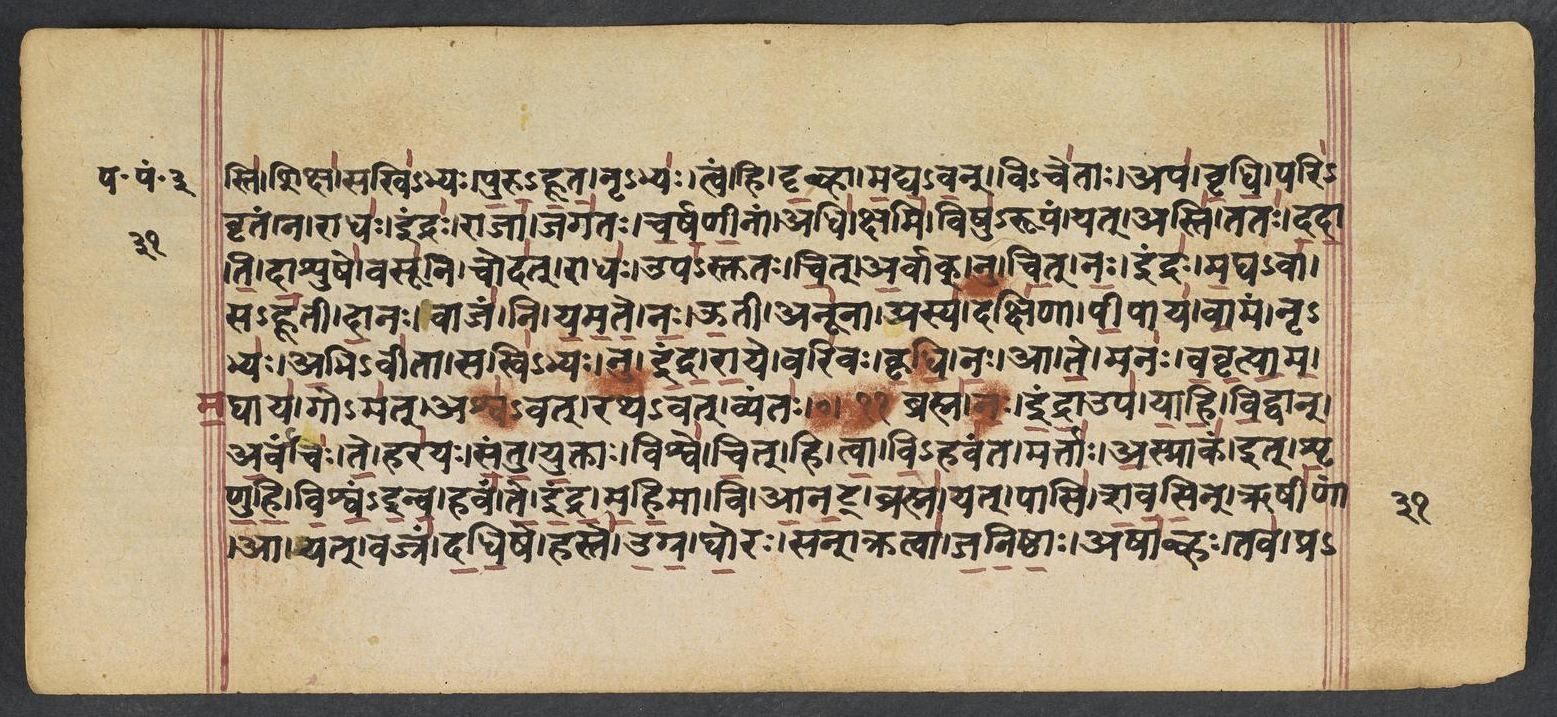
Penn Ms. Coll. 390 Item 41, fol. 510v (numbered 31v by the scribe) (OPenn image 511, upper leaf). Checked on the image: the Rigveda text on this page begins in RV 7.27.2 ‹-asti śikṣa sakhi-bhyaḥ puru-hūta›. The next page with Rigveda text, fol. 511r (numbered 32r by the scribe), begins in RV 7.28.3 ‹-pra-nītī indra johuvānān sam›. Verses 7.28.1-2 end on this page.
1brahmā̍ ṇa i̱ndropa̍ yāhi vi̱dvān a̱rvāñca̍s te̱ hara̍yaḥ santu yu̱ktāḥ | viśve̍ ci̱d dhi tvā̍ vi̱hava̍nta̱ martā̍ a̱smāka̱m ic chṛ̍ṇuhi viśvaminva ||
2hava̍ṁ ta indra mahi̱mā vy ā̍na̱ḍ brahma̱ yat pāsi̍ śavasi̱nn ṛṣī̍ṇām | ā yad vajra̍ṁ dadhi̱ṣe hasta̍ ugra gho̱raḥ san kratvā̍ janiṣṭhā̱ aṣā̍ḻhaḥ ||
Compare: Padapāṭha (word-by-word text written in the manuscript; Sansknet e-text via GRETIL)
1brahmā | naḥ | indra | upa | yāhi | vidvān | arvāñcaḥ | te | harayaḥ | santu | yuktāḥ | viśve | cit | hi | tvā | vi-havanta | martāḥ | asmākam | it | śṛṇuhi | viśvam-inva
2havam | te | indra | mahimā | vi | ānaṭ | brahma | yat | pāsi | śavasin | ṛṣīṇām | ā | yat | vajram | dadhiṣe | haste | ugra | ghoraḥ | san | kratvā | janiṣṭhāḥ | aṣāḷhaḥ
1COME to our prayers, O Indra, thou who knowest: let thy Bay Steeds be yoked and guided hither. Though mortal men on every side invoke thee, still give thine ear to us, O All-impeller.
2Thy greatness reacheth to our invocation, the sages' prayer which, Potent God, thou guardest. What time thy hand, O Mighty, holds the thunder, awful in strength thou hast become resistless.
Where on the image
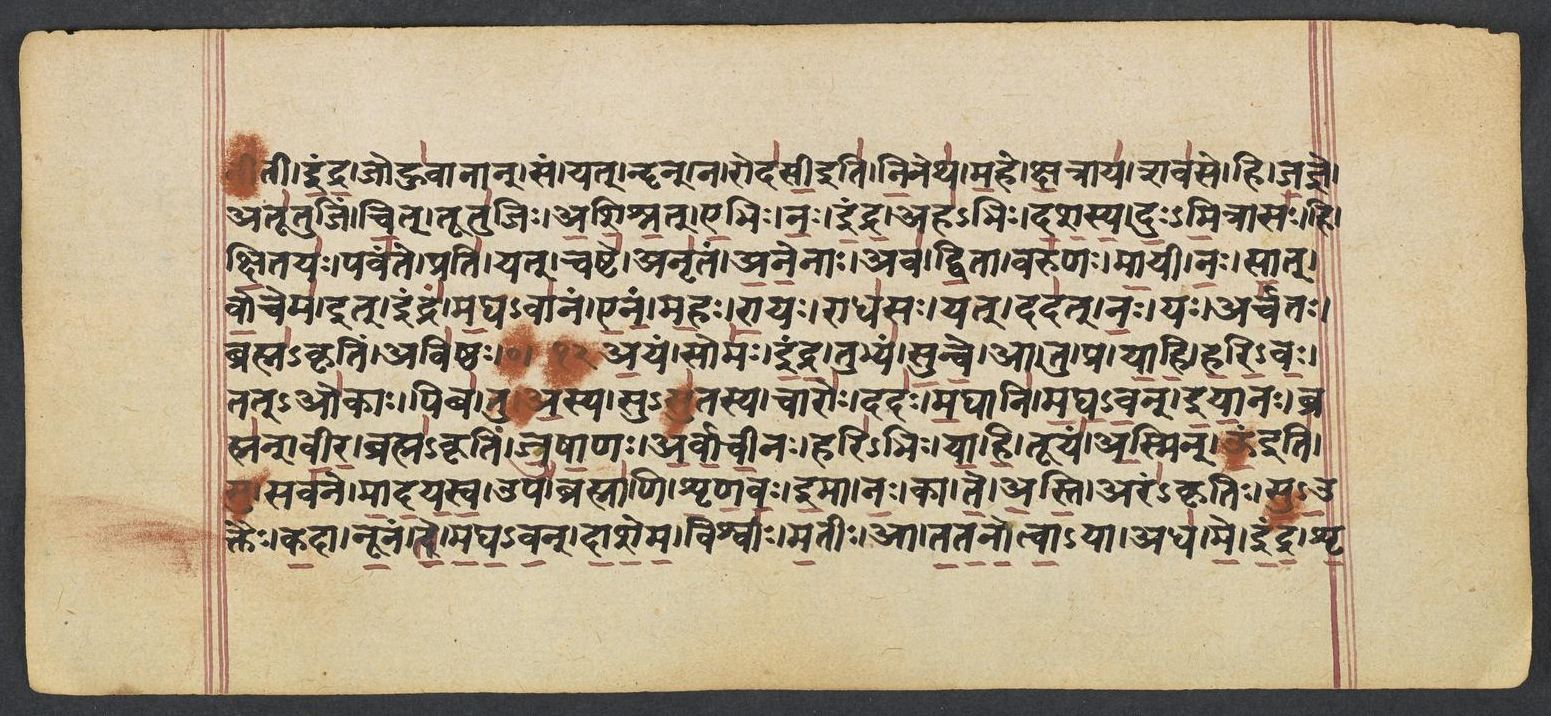
Penn Ms. Coll. 390 Item 41, fol. 511r (numbered 32r by the scribe) (OPenn image 511, lower leaf). Checked on the image: the Rigveda text on this page begins in RV 7.28.3 ‹-pra-nītī indra johuvānān sam›. The next page with Rigveda text, fol. 511v (numbered 32v by the scribe), begins in RV 7.29.3 ‹-śṛṇavaḥ havā imā›. Verses 7.28.3-5 end on this page; 7.28.3 begins on fol. 510v (numbered 31v by the scribe).
3tava̱ praṇī̍tīndra̱ johu̍vānā̱n saṁ yan nṝn na roda̍sī ni̱netha̍ | ma̱he kṣa̱trāya̱ śava̍se̱ hi ja̱jñe 'tū̍tujiṁ ci̱t tūtu̍jir aśiśnat ||
4e̱bhir na̍ i̱ndrāha̍bhir daśasya durmi̱trāso̱ hi kṣi̱taya̱ḥ pava̍nte | prati̱ yac caṣṭe̱ anṛ̍tam ane̱nā ava̍ dvi̱tā varu̍ṇo mā̱yī na̍ḥ sāt ||
5vo̱cemed indra̍m ma̱ghavā̍nam enam ma̱ho rā̱yo rādha̍so̱ yad dada̍n naḥ | yo arca̍to̱ brahma̍kṛti̱m avi̍ṣṭho yū̱yam pā̍ta sva̱stibhi̱ḥ sadā̍ naḥ ||
Compare: Padapāṭha (word-by-word text written in the manuscript; Sansknet e-text via GRETIL)
3tava | pra-nītī | indra | johuvānān | sam | yat | nṝn | na | rodasī iti | ninetha | mahe | kṣatrāya | śavase | hi | jajñe | atūtujim | cit | tūtujiḥ | aśiśnat
4ebhiḥ | naḥ | indra | aha-bhiḥ | daśasya | duḥ-mitrāsaḥ | hi | kṣitayaḥ | pavante | prati | yat | caṣṭe | anṛtam | anenāḥ | ava | dvitā | varuṇaḥ | māyī | naḥ | sāt
5vocema | it | indram | magha-vānam | enam | mahaḥ | rayaḥ | rādhasaḥ | yat | dadat | naḥ | yaḥ | arcataḥ | brahma-kṛtim | aviṣṭhaḥ | yūyam | pāta | svasti-bhiḥ | sadā | naḥ
3What time thou drewest both world-halves together, like heroes led by thee who call each other- For thou wast born for strength and high dominion-then e'en the active overthrew the sluggish.
4Honour us in these present days, O Indra, for hostile men are making expiation. Our sin that sinless Varuṇa discovered, the Wondrous-Wise hath long ago forgiven.
5We will address this liberal Lord, this Indra, that he may grant us gifts of ample riches, Best favourer of the singer's prayer and praises. Preserve us evermore, ye Gods, with blessings.
Notes
- Sanskrit: Aufrecht's edition (1877) with the Vedic accents, as entered by van Nooten and Holland (GRETIL).
- English: Ralph T. H. Griffith, The Hymns of the Rigveda (1889-1892; 2nd ed. 1896-1897), from the VedaWeb digital text; OCR slips in that text were corrected against the printed 2nd edition (data/sources/rigveda/griffith_errata.json).
- Padapāṭha (edition text): Sansknet e-text via GRETIL (CC BY-NC-SA 4.0).
Cite
Sources
- Source: Penn Ms. Coll. 390 Item 41 (undated (catalogued with Penn's 18th-19th c. Vedic manuscripts)), OPenn, Public Domain Mark + Aufrecht's accented text (GRETIL) + Griffith's English (VedaWeb) (holding institution)
- Critical edition: Aufrecht (1877), accented e-text via GRETIL
← previous · → next · v cycle view · l back to library