Rigveda 7.30: To Indra
Introduction
Rigveda 7.30 is a hymn of 5 verses addressed to Indra. It stands in book (maṇḍala) 7, the family book of Vasiṣṭha. The Rigveda is the oldest collection of Sanskrit hymns, composed in the second half of the second millennium BCE and handed down orally for many centuries before it was written down.
The manuscript shown is Penn Ms. Coll. 390 Item 41 (University of Pennsylvania), an undated paper manuscript of the padapāṭha (the word-by-word recitation text, in which every word is written separately and compounds are split) of the whole Ṛgveda in Devanāgarī, 884 leaves in fascicles, 7-9 lines to the page, accents in red; this hymn stands on fol. 511v. Each section below gives the verses that end on one page; the page boundaries were read on the images (the opening words of every page), not counted out. Where the manuscript is a padapāṭha (the word-by-word recitation text), the section shows Aufrecht's continuous (saṃhitā) text first and, as the edition text, the padapāṭha of the same verses, which is the form written on the page.
How was this verified? (Provenance)
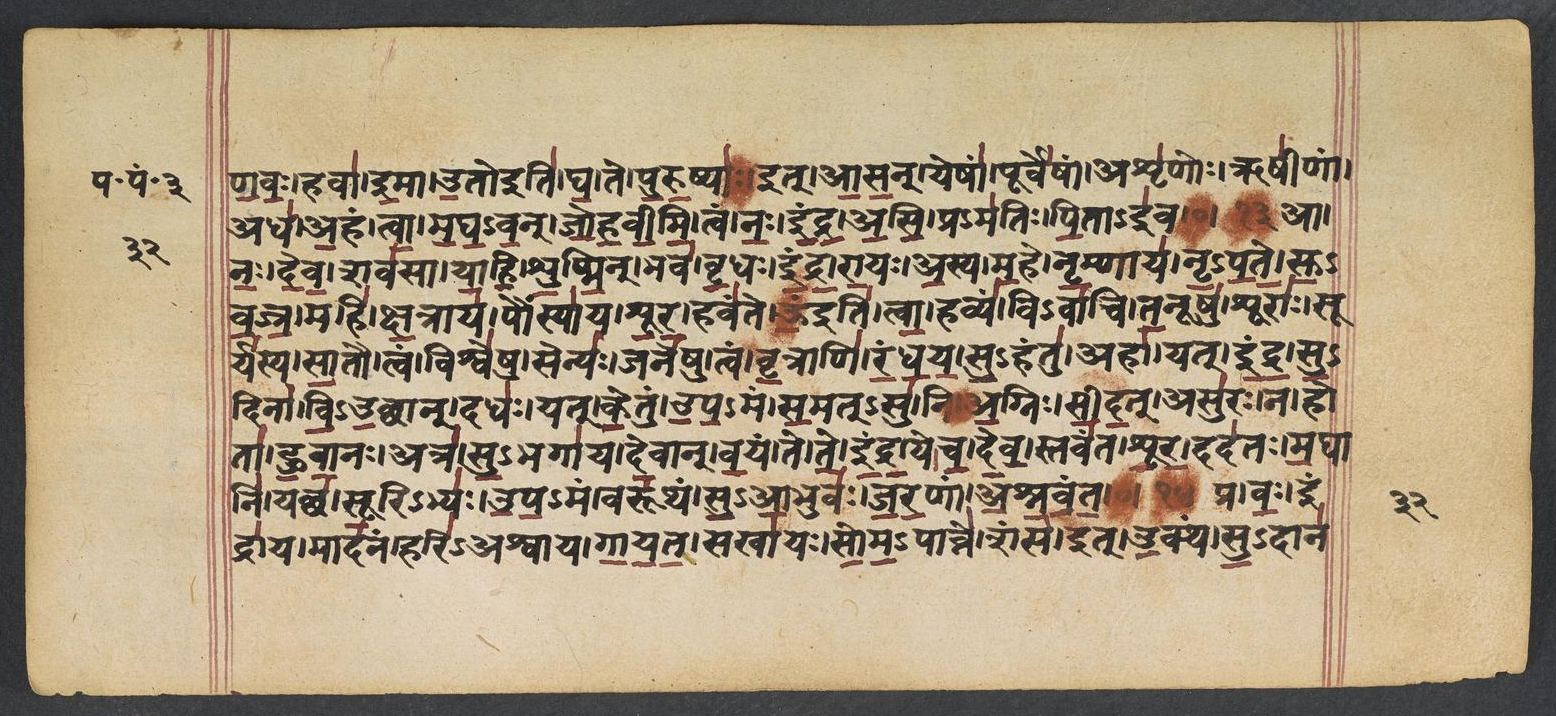
Where on the image
Penn Ms. Coll. 390 Item 41, fol. 511v (numbered 32v by the scribe) (OPenn image 512, upper leaf). Checked on the image: the Rigveda text on this page begins in RV 7.29.3 ‹-śṛṇavaḥ havā imā›. The next page with Rigveda text, fol. 512r (numbered 33r by the scribe), begins in RV 7.31.2 ‹-su-dānave uta dyukṣam yathā›. Verses 7.30.1-5 end on this page.
1ā no̍ deva̱ śava̍sā yāhi śuṣmi̱n bhavā̍ vṛ̱dha i̍ndra rā̱yo a̱sya | ma̱he nṛ̱mṇāya̍ nṛpate suvajra̱ mahi̍ kṣa̱trāya̱ pauṁsyā̍ya śūra ||
2hava̍nta u tvā̱ havya̱ṁ vivā̍ci ta̱nūṣu̱ śūrā̱ḥ sūrya̍sya sā̱tau | tvaṁ viśve̍ṣu̱ senyo̱ jane̍ṣu̱ tvaṁ vṛ̱trāṇi̍ randhayā su̱hantu̍ ||
3ahā̱ yad i̍ndra su̱dinā̍ vyu̱cchān dadho̱ yat ke̱tum u̍pa̱maṁ sa̱matsu̍ | ny a1̱̍gniḥ sī̍da̱d asu̍ro̱ na hotā̍ huvā̱no atra̍ su̱bhagā̍ya de̱vān ||
4va̱yaṁ te ta̍ indra̱ ye ca̍ deva̱ stava̍nta śūra̱ dada̍to ma̱ghāni̍ | yacchā̍ sū̱ribhya̍ upa̱maṁ varū̍thaṁ svā̱bhuvo̍ jara̱ṇām a̍śnavanta ||
5vo̱cemed indra̍m ma̱ghavā̍nam enam ma̱ho rā̱yo rādha̍so̱ yad dada̍n naḥ | yo arca̍to̱ brahma̍kṛti̱m avi̍ṣṭho yū̱yam pā̍ta sva̱stibhi̱ḥ sadā̍ naḥ ||
Compare: Padapāṭha (word-by-word text written in the manuscript; Sansknet e-text via GRETIL)
1ā | naḥ | deva | śavasā | yāhi | śuṣmin | bhava | vṛdhaḥ | indra | rāyaḥ | asya | mahe | nṛmṇāya | nṛ-pate | su-vajra | mahi | kṣatrāya | paiṃsyāya | śūra
2havante | oṃ iti | tvā | havyam | vi-vāci | tanūṣu | śūrāḥ | sūryasya | sātau | tvam | viśveṣu | senyaḥ | janeṣu | tvam | vṛtrāṇi | randhaya | su-hantu
3ahā | yat | indra | su-dinā | vi-ucchān | dadhaḥ | yat | ketum | upa-mam | samat-su | ni | agniḥ | sīdat | asuraḥ | na | hotā | huvānaḥ | atra | su-bhagāya | devān
4vayam | te | te | indra | ye | ca | deva | stavanta | śūra | dadataḥ | maghāni | yaccha | sūri-bhyaḥ | upa-mam | varūtham | su-ābhuvaḥ | jaraṇām | aśnavanta
5vocema | it | indram | magha-vānam | enam | mahaḥ | rayaḥ | rādhasaḥ | yat | dadat | naḥ | yaḥ | arcataḥ | brahma-kṛtim | aviṣṭhaḥ | yūyam | pāta | svasti-bhiḥ | sadā | naḥ
1WITH power and strength, O Mighty God, approach us: be the augmenter, Indra, of these riches; Strong Thunderer, Lord of men, for potent valour, for manly exploit and for high dominion.
2Thee, worth invoking, in the din of battle, heroes invoke in fray for life and sunlight. Among all people thou art foremost fighter: give up our enemies to easy slaughter.
3When fair bright days shall dawn on us, O Indra, and thou shalt bring thy banner near in battle, Agni the Asura shall sit as Herald, calling Gods hither for our great good fortune.
4Thine are we, Indra, thine, both these who praise thee, and those who give rich gifts, O God and Hero. Grant to our princes excellent protection, may they wax old and still be strong and happy.
5We will address this liberal Lord, this Indra that he may grant us gifts of ample riches: Best favourer of the singer's prayer and praises. Preserve us evermore, ye Gods, with blessings.
Notes
- Sanskrit: Aufrecht's edition (1877) with the Vedic accents, as entered by van Nooten and Holland (GRETIL).
- English: Ralph T. H. Griffith, The Hymns of the Rigveda (1889-1892; 2nd ed. 1896-1897), from the VedaWeb digital text; OCR slips in that text were corrected against the printed 2nd edition (data/sources/rigveda/griffith_errata.json).
- Padapāṭha (edition text): Sansknet e-text via GRETIL (CC BY-NC-SA 4.0).
Cite
Sources
- Source: Penn Ms. Coll. 390 Item 41 (undated (catalogued with Penn's 18th-19th c. Vedic manuscripts)), OPenn, Public Domain Mark + Aufrecht's accented text (GRETIL) + Griffith's English (VedaWeb) (holding institution)
- Critical edition: Aufrecht (1877), accented e-text via GRETIL
← previous · → next · v cycle view · l back to library